Tax Workflow Automation vs. Outsourced Tax Preparation: Finding the Right Balance



CPA firms do not have to choose between tax workflow automation and outsourced tax preparation as if one replaces the other. The strongest tax operations usually use automation to remove repetitive work, leverage tax preparation outsourcing services to add flexible preparation capacity, and rely on in-house professionals to protect quality, judgment, and client trust. The goal is not simply to move work faster, but to design a tax process that is easier to manage before, during, and after busy season.
Use automation for repetitive, rules-based workflow tasks; use outsourcing for clearly defined preparation work that requires human attention; and keep professional judgment, client communication, final review, and approval under the firm’s control.
“The strongest tax operations do not choose between automation and outsourcing. They use automation to remove repetitive work, outsourcing to add capacity, and in-house professionals to protect quality, judgment, and client trust.”
Cora Vollmar, Sr VP Growth, QX Accounting Services
- Tax Automation vs. Outsourcing at a Glance
- What Tax Tasks Should CPA Firms Automate, Outsource, or Keep In-House?
- Which Tax Preparation Tasks Should CPA Firms Automate?
- Which Tax Preparation Tasks Should CPA Firms Outsource?
- Why CPA Firms Combine Tax Automation and Outsourcing in 2026?
- How to Build an Effective Hybrid Tax Workflow
- Hybrid Tax Workflow Readiness Checklist for CPA Firms
- How CPA Firms Can Maintain Quality While Scaling Tax Operations
- Conclusion
- FAQs
Tax Automation vs. Outsourcing at a Glance
| Decision area | Automate | Outsource | Keep in-house |
| Best suited to | Repetitive, rules-based workflow tasks | Human preparation under documented standards | Judgment, advice, review, and approval |
| Examples | Reminders, routing, tracking, standard extraction | Workpaper organization, reconciliation, draft preparation | Exception resolution, client communication, final review |
| Primary value | Consistency and workflow visibility | Flexible preparation capacity | Control and professional judgment |
| Main control | Validate outputs and handle exceptions | Define scope, escalation, and review requirements | Document review and approval procedures |
What Tax Tasks Should CPA Firms Automate, Outsource, or Keep In-House?
CPA firms should automate high-volume, rule-based tasks, outsource preparation work that needs human handling but not necessarily partner-level attention, and keep final review, client advisory, quality control, and professional judgment in-house. This balance helps firms improve capacity without losing control of engagement. It also gives staff more time for exception handling, client communication, and higher-value tax planning.
A practical way to think about tax workflow automation vs outsourced tax preparation is to look at the nature of the task. If the work is repetitive, predictable, and driven by clear rules, it is often a strong candidate for automated tax workflows. If the work requires cleanup, interpretation, reconciliation, or organized preparation from imperfect client data, outsourced tax preparation may be a better support layer. If the work affects the firm’s professional opinion, client relationship, or final sign-off, it should stay with qualified in-house staff.
Which Tax Preparation Tasks Should CPA Firms Automate?
Tax workflow automation helps CPA firms reduce the manual friction that slows down engagements. It can support document intake, client reminders, data extraction, status tracking, task routing, e-signature coordination, and deadline visibility. These are not glamorous parts of tax preparation, but they consume enormous attention when handled manually.
For many firms, the value of tax automation for CPA firms is consistency. A standardized workflow can help every return move through the same intake, preparation, review, and delivery stages. That makes it easier to see where work is stuck, which clients are missing documents, and which team members are carrying the heaviest load.
AI-enabled tax tools may help recognize documents, extract data, categorize information, and flag items for attention. However, practitioners should not rely on automated results without appropriate professional judgment and review. The AICPA’s technology standard states that using a tool does not relieve a member of applicable professional obligations, and its definition of tools includes tax software, analytics, and artificial intelligence.
Also Read: Is Tax Automation Enough?
Good candidates for automation include:
- Client organizers and document request reminders
- Intake checklists and engagement status updates
- Routing work to preparers and reviewers
- Data extraction from standard tax documents
- Due date tracking and bottleneck reporting
- Reusable templates for common client communications
- Notifications when returns are ready for review, signature, or filing
Automation works best when the firm has already defined its process. If every partner, preparer, and admin uses a different system, software may simply speed up confusion. Tax process optimization should come before, or at least alongside, new technology.
Which Tax Preparation Tasks Should CPA Firms Outsource?
Outsourced tax preparation gives CPA firms access to additional preparation capacity without hiring a full internal team for every seasonal peak. It can be especially useful when a firm has more returns than staff can prepare comfortably, but still wants in-house professionals focused on review, advisory, and client relationships.
Tax preparation outsourcing for CPA firms is not only about reducing workload. It can also help smooth production when internal staff are overloaded with client questions, complex returns, or last-minute changes. A capable outsourcing partner can assist with workpaper assembly, source document organization, reconciliations, cleanup, draft preparation, and return preparation under the firm’s standards.
Outsourcing is most useful when expectations are clear. The firm should define what the outsourced team prepares, what documentation they need, how questions are escalated, and what review notes must be included. Without that structure, outsourcing can create rework instead of relief.
Strong candidates for outsourcing include:
- Preparation of lower-complexity individual or business returns
- Workpaper organization and source document cleanup
- Reconciliations that require human review
- Draft return preparation before in-house review
- Data entry when documents are inconsistent or incomplete
- Follow-up question lists for missing or unclear client information
The key is to remember that outsourced tax preparation does not remove responsibility from the CPA firm. The firm still owns quality, client communication, review procedures, data security expectations, and final filing decisions.
Firms evaluating an external preparation layer can explore QXAS’s tax preparation outsourcing services to understand how outsourced capacity may fit within an existing review and delivery process.
Why CPA Firms Combine Tax Automation and Outsourcing in 2026?
Choosing only automation or only outsourcing can leave gaps. Automation may move tasks quickly, but it can struggle when documents are messy, facts are unclear, or a judgment call is required. Outsourcing adds human capacity, but without automated tracking and standardized workflow, managers may still spend too much time chasing status updates.
A hybrid model connects the strengths of both. Automation keeps work visible, consistent, and moving. Outsourcing gives the firm a flexible preparation layer. In-house professionals focus on exceptions, review, planning, and relationship management.
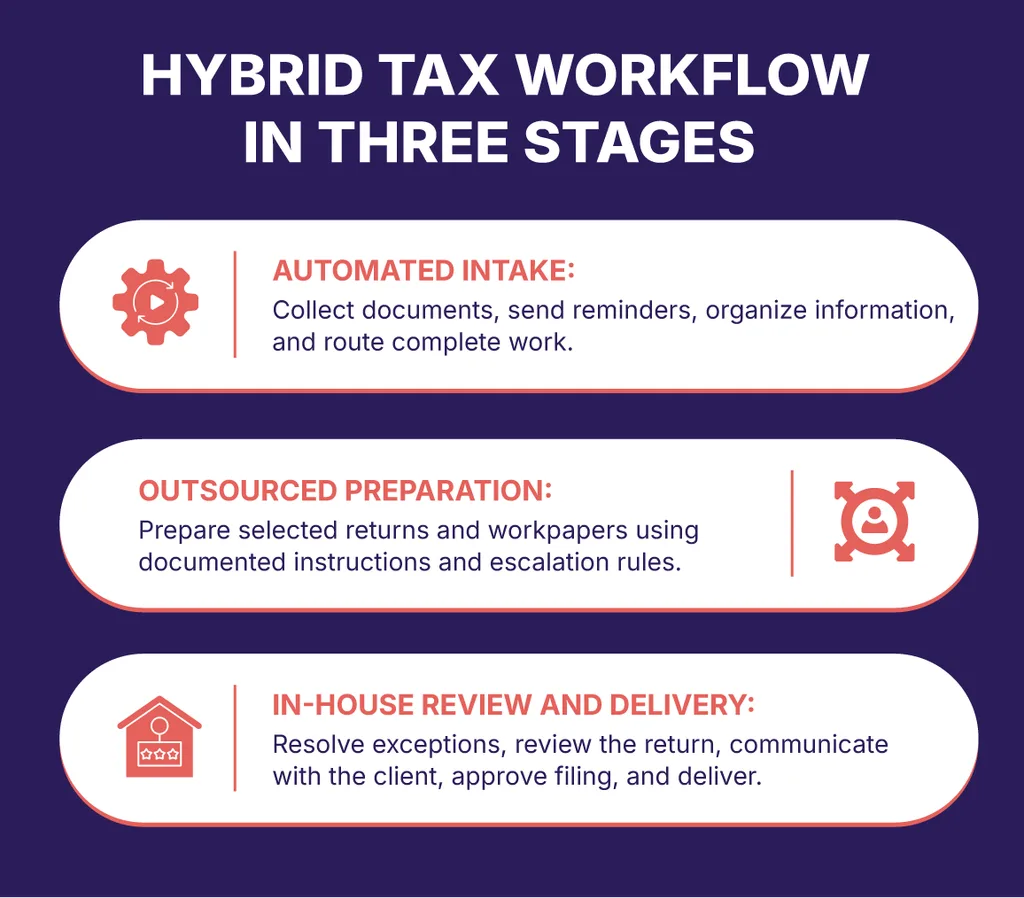
A simple hybrid workflow might look like this:
- Automate intake. Clients receive document requests, reminders, and upload instructions through a consistent process.
- Use automation to organize and route work. The system tracks what is complete, what is missing, and which return is ready for preparation.
- Outsource selected preparation tasks. Outsourced preparers work from standardized instructions, checklists, and source documents.
- Escalate exceptions early. Questions, missing documents, and unusual tax positions are flagged before the return reaches final review.
- Keep review in-house. CPA firm staff review the draft return, resolve open items, communicate with the client, and approve filing.
- Measure the workflow. Track bottlenecks, rework, turnaround time, and workload distribution so the process improves each season.
This approach turns tax workflow automation into the operating system for the process, while outsourcing becomes a controlled capacity resource inside that system.
Also read: Top Tax Preparation Outsourcing Companies
How to Build an Effective Hybrid Tax Workflow
Software can help, but it cannot fix an unclear process by itself. Before adopting new tools or expanding outsourced tax preparation, CPA firms should document how work actually moves through the firm. That includes who collects documents, who checks completeness, who prepares the return, who reviews it, and who communicates with the client.
Tax workflow automation is much more effective when roles are specific. A preparer should know when a return is ready to begin. A reviewer should know what notes to expect. An outsourced team should know how to handle missing information. A client service team member should know when to follow up and what message to send.
Firms should also build a feedback loop. If returns repeatedly stall at review, the problem may not be preparation capacity. It may be incomplete intake, unclear workpapers, inconsistent preparer notes, or too many returns assigned to one reviewer. Tax process optimization means identifying the real constraint before choosing the solution.
Hybrid Tax Workflow Readiness Checklist for CPA Firms
Before combining automation and outsourced support, confirm that the firm has:
- A documented intake-to-filing process
- Defined ownership for every workflow stage
- Standard preparation instructions and workpaper requirements
- A method for escalating incomplete information and exceptions
- Documented review and approval procedures
- Clear access and data-handling controls
- Visibility into status, rework, and workflow bottlenecks
- A training plan for internal and external team members
Case Study
Wine Industry CPA Firm Leverages QXAS ‘Hybrid Outsourcing to Boost Capacity and Drive Growth
Download Now
How CPA Firms Can Maintain Quality While Scaling Tax Operations
CPA firms can protect quality by combining standardized workflows, documented review procedures, secure data practices, and clear accountability for every stage of the return. Automation and outsourcing should make the process more visible, not more fragmented.
The firm should always know who touched the work, what changed, what questions remain, and who approved the final return.
For taxpayer-data safeguards, review IRS Publication 4557: Safeguarding Taxpayer Data. Quality control should be designed into the workflow from the beginning. That means using checklists, preparation standards, review notes, exception logs, and escalation rules.
It also means training staff on how to work with automation and outsourced preparers instead of assuming the process will manage itself.
A useful decision framework is to sort tasks by risk, volume, and complexity:
- Automate tasks that are high-volume, low-risk, and repeatable.
- Outsource tasks that need human preparation capacity but follow clear firm standards.
- Keep in-house tasks involving judgment, complex client facts, sensitive advisory issues, or final approval.
- Review closely any work affected by unusual transactions, incomplete data, new client circumstances, or aggressive tax positions.
Change management also matters. Staff may worry that automation or outsourcing will reduce their value. Firm leaders can address that by positioning these tools as ways to remove low-value manual work and create more time for review, advisory, mentoring, and client service.
Conclusion
Tax workflow automation and outsourced tax preparation solve different operational problems. Automation can reduce repetitive administration and improve workflow visibility. Outsourcing can add preparation capacity where human handling is still necessary. In-house professionals can then concentrate on exceptions, review, client communication, and decisions requiring professional judgment.
The right balance depends on where work is getting stuck. A firm facing intake delays may need better automation. A firm with a preparation backlog may need additional capacity. A firm experiencing review congestion may need to redesign the process before adding either technology or people.
If preparation capacity is part of the constraint, explore QX Accounting Services (QXAS) outsourced tax preparation support and assess how an outsourced delivery layer could fit within your workflow, controls, and review process.
Learn more about QX Accounting Services USA and its broader accounting outsourcing capabilities.
FAQs
Should CPA firms automate tax workflows or outsource tax preparation?
Most CPA firms should consider both. Automation improves consistency and reduces manual administrative work, while outsourcing adds preparation capacity when internal teams are stretched. The right mix depends on the firm’s client base, staff capacity, process maturity, and quality control needs.
Which tax preparation tasks should CPA firms automate versus outsource?
CPA firms should automate repeatable tasks such as reminders, intake tracking, document routing, status updates, and standard data extraction. They should outsource tasks such as draft preparation, workpaper assembly, reconciliations, and cleanup when those tasks require human attention but can be completed under clear firm guidelines.
What are the limitations of relying only on tax workflow automation?
Automation struggles when client information is incomplete, documents are inconsistent, or a tax issue requires judgment. It can also create false confidence if firms do not review outputs carefully. Automated tax workflows are powerful, but they still need human oversight and a sound process behind them.
How does outsourced tax preparation complement automated tax workflows?
Outsourced tax preparation works well inside an automated workflow because the software can organize documents, assign tasks, track progress, and highlight missing items. The outsourced team then handles preparation work within a controlled process, while in-house staff maintain visibility and review authority.
How can CPA firms maintain accuracy when combining automation and outsourcing?
Firms should use standardized checklists, secure document systems, defined review steps, and clear escalation rules. In-house professionals should review outsourced work, verify automated outputs, resolve exceptions, and approve the final return before filing.
What factors should CPA firms consider when deciding between automation and outsourcing?
Key factors include return volume, complexity, staff availability, turnaround expectations, client service standards, data security, review capacity, and process consistency. Firms should also consider whether their main bottleneck is administrative friction, preparation capacity, or final review.
Enquire now

Arjun Varshneya
Arjun Varshneya is an experienced Operations Leader with over 13 years of expertise in managing global delivery teams across Client Accounting Services, Tax, and U.S. operations. An auditor by background, he brings deep delivery knowledge and operational leadership to help CPA firms improve quality, strengthen working standards, optimize capacity, and drive review readiness across accounting and tax workflows. At QX Accounting Services, he focuses on building scalable operating models that support quality, risk management, execution excellence, and sustainable efficiency across complex, high-volume environments.
Unauthorized copying or plagiarism of our content is a violation of intellectual property rights. We take such matters seriously and will pursue legal action to protect our original work. Anyone found engaging in such activities will be held accountable under applicable laws.
Don't forget to share this post!
Our Latest Insights


Marketing Services
Outsourced Marketing Services vs In-House Team for CPA Firms...
23 September 2026

Marketing Services
How to Choose an Outsourced Marketing Partner for Your CPA F...
21 September 2026

Let’s Work Together
Explore outsourcing solutions, request a no-obligation trial or discuss your practice’s needs with our expert consultants.
 Book a Virtual Meeting
  Get Your ROI Estimate