How to Choose an Outsourced Marketing Partner for Your CPA Firm in the USA?



Choosing an outsourced marketing partner for CPA firms is not just a vendor decision; it is a growth decision. The right partner should help connect your accounting firm marketing strategy to qualified leads, stronger visibility, better client communication, and measurable business outcomes. For CPA firms in the USA, the best fit is usually a team that understands professional services, regulated messaging, local competition, and the long trust-building cycle behind accounting relationships.
If your firm is exploring outside support, review QXAS marketing services for CPA firms to see how positioning, visibility, pipeline development, and measurement can work as one connected growth system.
“The best outsourced marketing partner does more than run campaigns. It helps CPA firms turn visibility, trust, and follow-up into a measurable growth system.”
– Cora Vollmar, Sr VP Growth, QX Marketing Services
- Step 1: Define Strategic Fit for an Outsourced Marketing Partner
- Step 2: Set Growth Goals for CPA Firm Marketing Outsourcing
- Step 3: Prioritize CPA/Accounting Industry Marketing Experience
- Step 4: Connect Strategy, Execution, and Reporting (Outsourced Marketing ROI)
- How to Evaluate an Outsourced Marketing Partner: Process, Team, and Reporting ?
- How CPA Firms Should Compare Marketing Outsourcing Providers?
- Outsourced vs In-House Marketing and the Hybrid Model for CPA Firms
- How to Measure Outsourced Marketing ROI for CPA Firms?
- Compliance, Ethics, and Trust in Outsourced Marketing for CPA Firms
- Red Flags When Choosing Marketing Outsourcing Companies for CPA Firms
- A Simple 90-Day Plan to Choose the Right Marketing Partner
- Make Your Outsourced Marketing Partner Part of Your CPA Firm Growth System
- Conclusion
- FAQs
Step 1: Define Strategic Fit for an Outsourced Marketing Partner
A CPA firm should first look for strategic fit: whether the partner understands the firm’s ideal clients, service mix, growth goals, compliance expectations, and competitive market. Tactics matter, but tactics without strategy often produce scattered activity: a few posts, some ads, maybe a redesigned page, but no clear path from visibility to signed engagements. A strong outsourced marketing partner will ask about your niches, margins, referral sources, seasonal workload, sales process, and client retention before recommending campaigns.
For example, a mid-sized firm serving closely held businesses in a competitive metro market may need local SEO, niche service pages, lead nurturing, and authority-building content. A firm focused on high-net-worth tax planning may need a more credibility-driven approach, with careful messaging and educational assets. In both cases, outsourced digital marketing for CPA firms should feel tailored, not copied from a generic playbook.
Step 2: Set Growth Goals for CPA Firm Marketing Outsourcing
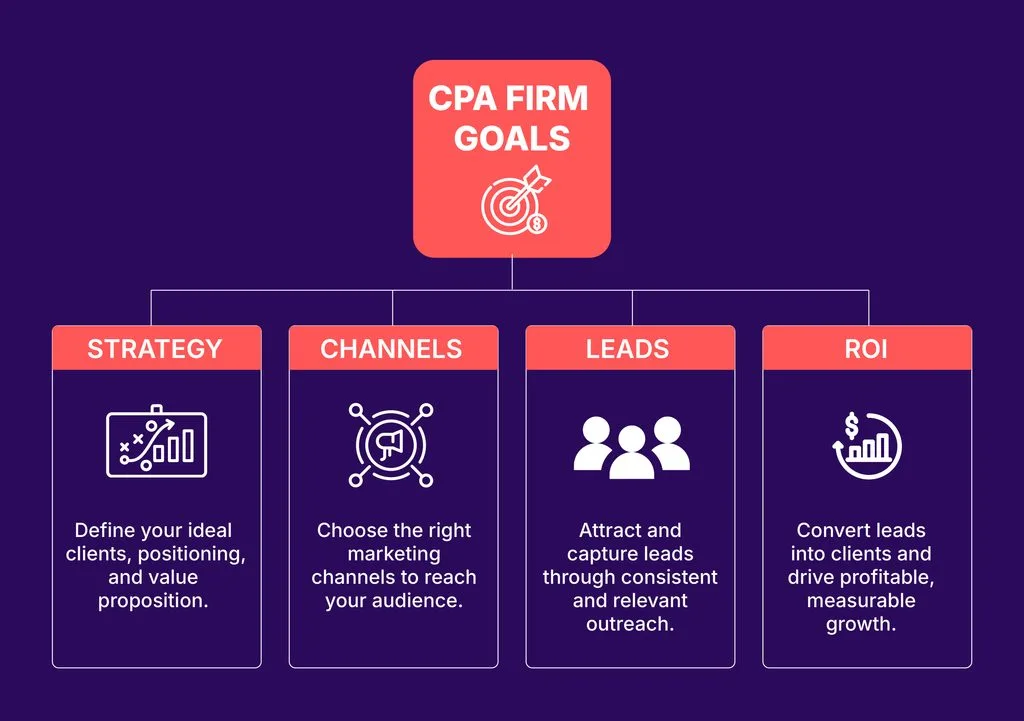
Before marketing partner evaluation begins, clarify what you want marketing to do. “We need more marketing” is too broad to guide budget, timelines, or accountability. Better goals are specific enough to shape the partner’s recommendations, even if you refine the numbers later.
Qualified consultations: Define which services matter most (advisory, tax, audit, outsourced accounting) and what a “good-fit” inquiry looks like for your firm.
Local visibility: If geography drives your pipeline, align on which cities or regions matter and what “showing up” should mean (map pack, service pages, reviews, directory presence). If your firm is competing locally, your partner should be fluent in how Google Business Profile works and how it supports discovery.
Niche authority: If you are building a vertical focus (construction, healthcare, nonprofit, real estate, professional services), decide what proof points and content will support trust.
Channel independence: If referrals are strong but unpredictable, set a goal to build owned channels; search visibility, email, and content, that you can control and grow.
Follow-up and nurturing: If prospects take time to decide, plan how your firm will stay visible through email, CRM workflows, and educational assets.
Credibility and brand alignment: If your website and messaging understate your expertise, prioritize improvements that make the firm look as credible online as it is in person.
This step protects you from buying services that sound impressive but do not match your business model. Some CPA firm marketing outsourcing engagements should be focused on demand generation. Others should focus first on positioning, messaging, website structure, or conversion paths. A good partner will help you prioritize instead of selling every service at once.
Step 3: Prioritize CPA/Accounting Industry Marketing Experience
Many marketing outsourcing companies for CPA firms offer similar surface-level services: website design, SEO, paid ads, social media, content, and email campaigns. The difference is whether they understand how accounting buyers make decisions. CPA clients are not usually choosing based on flashy slogans. They look for expertise, reliability, responsiveness, confidentiality, and a clear reason to trust your firm with sensitive financial matters.
Ask whether the partner has worked with accounting firms, tax professionals, outsourced CFO providers, or other regulated professional service firms. They do not need to know every nuance of your practice on day one, but they should understand that CPA marketing requires accuracy, restraint, and credibility. Overpromising results, using vague financial claims, or publishing casual tax advice without review can create risk and weaken trust.
Look for evidence that the partner can translate complex services into plain-English value. That means explaining advisory services without jargon, differentiating tax planning from tax preparation, and helping prospects understand when they need a CPA rather than basic software or a low-cost provider.
Step 4: Connect Strategy, Execution, and Reporting (Outsourced Marketing ROI)
Outsourced marketing services for CPA firms should not operate as disconnected tasks. Blog content should support SEO and sales conversations. Paid campaigns should lead to focused landing pages. Email nurturing should reflect the buyer’s stage and service interest. Reporting should show what is improving, what is stuck, and what decisions come next.
During evaluation, listen for how the partner explains the relationship between channels. If they recommend SEO, do they discuss technical health, local intent, service pages, content quality, and conversion points? If they recommend ads, do they explain audience targeting, landing-page relevance, budget control, and lead quality? If they recommend content, do they tie it to your niches, frequently asked client questions, and your firm’s point of view? A good baseline reference for how modern SEO works is Google’s own SEO Starter Guide, your partner’s recommendations should align with those fundamentals.
A strong accounting firm marketing strategy usually has several connected layers: positioning (who you serve and why you’re distinct), visibility (how prospects find you), conversion (how your site and follow-up turn interest into conversations), nurture (how you stay top of mind for longer decision cycles), and measurement (how you track results and choose next actions).
How to Evaluate an Outsourced Marketing Partner: Process, Team, and Reporting ?
Evaluate capabilities by asking for process, examples, roles, and reporting instead of accepting broad promises. A polished pitch is useful, but it should be backed by a clear explanation of who will do the work, how decisions are made, what tools are used, and how the partner learns your firm’s voice.
Discovery process: Look for a partner who asks about firm goals, niches, revenue priorities, capacity, and current lead sources before recommending tactics.
Relevant experience: Professional-services experience matters, ideally with accounting, tax, advisory, or similarly trust-based firms, and they should be able to share examples or references without compromising confidentiality.
Channel depth: Make sure they can cover the mix you actually need (SEO, content, paid media, email, CRM/automation, analytics, and website conversion), and can explain how those pieces work together.
Technology fit: Confirm they can work with your CMS, analytics setup, CRM, scheduling tools, and any marketing automation platform you use (or plan to implement).
Content review workflow: For technical topics, there should be a clear subject-matter review process before anything goes live.
Communication and reporting: Expect a defined meeting rhythm, written updates, clear owners, documented next steps, and reporting that explains business implications—not just traffic and impressions.
The goal is not to find a partner who says yes to everything. It is to find one that can explain trade-offs honestly. For example, if your website is weak, paid traffic may expose conversion problems rather than solve them. If your niche pages are thin, content may need to come before aggressive lead generation.
- Evidence that the provider can connect marketing activity to qualified opportunities
- Pricing structure, scope clarity, and engagement flexibility
- Communication cadence, account ownership, and escalation paths
- Content-review workflows for technical, tax, audit, and advisory topics
- Technology compatibility with your website, analytics, CRM, and automation tools
- Reporting transparency, KPI ownership, and next-step recommendations
- Lead-quality definitions and funnel measurement
- Strategy across SEO, content, paid media, email, CRM, and conversion
- Accounting and professional-services marketing experience
How CPA Firms Should Compare Marketing Outsourcing Providers?
When comparing marketing outsourcing companies for CPA firms, evaluate strategic alignment, industry experience, reporting quality, communication standards, technical capabilities, and the ability to connect marketing activity to business outcomes. Do not compare proposals only by channel count or monthly fee.
Use the following criteria to compare providers consistently:
A provider that understands accounting firm marketing strategy and the professional-services buying cycle is often more valuable than one that simply offers a longer list of services.
Outsourced vs In-House Marketing and the Hybrid Model for CPA Firms
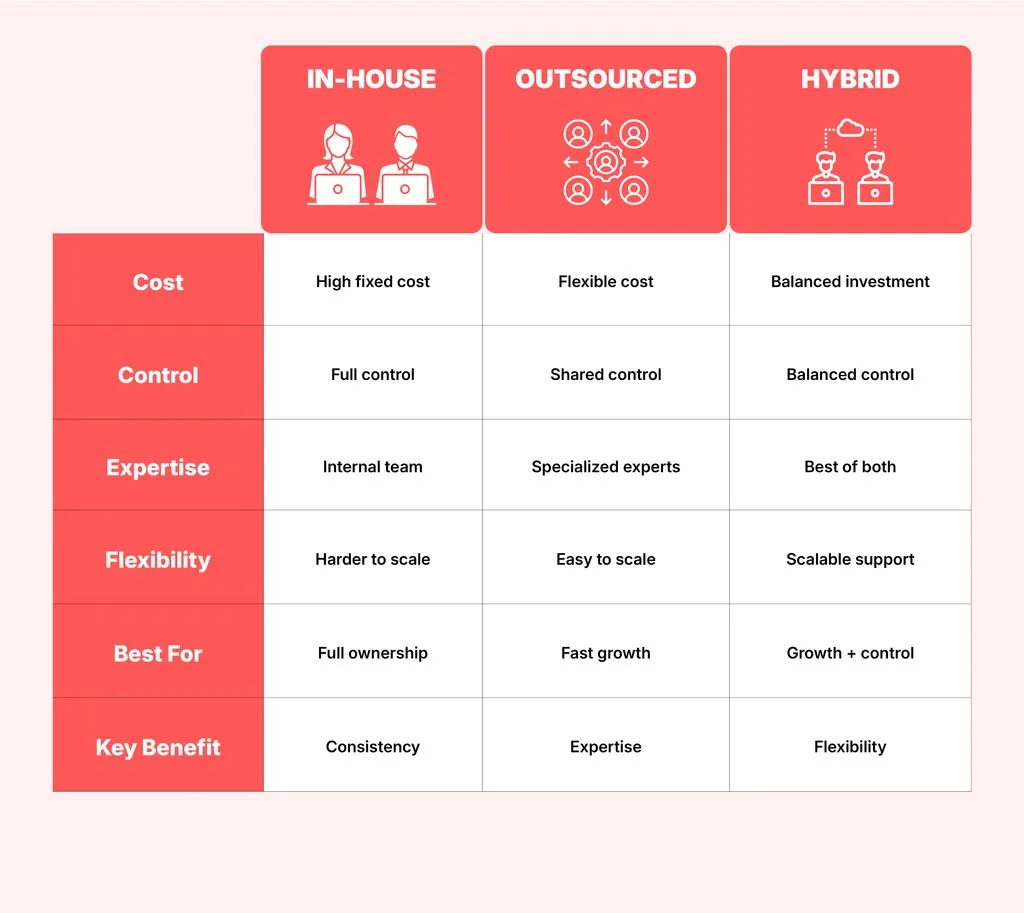
For many CPA firms, the choice is not simply “outsourced or internal.” It is about which model gives the firm the right mix of expertise, speed, control, and cost flexibility. An in-house marketer may know the firm deeply and be available day to day. However, one person may not have deep skills in SEO, copywriting, design, analytics, automation, paid media, and strategy.
An outsourced marketing partner can bring a broader team and established systems, often making it easier to scale campaigns up or down. The trade-off is that the firm must invest time in onboarding, approvals, and knowledge sharing. Outsourcing works best when the CPA firm assigns an internal owner who can answer questions, review technical content, and keep partners aligned with leadership priorities.
In-house support is often best when you need daily coordination, internal communications, event logistics, or close partner access.
Outsourced support is often best when you need specialized expertise, multi-channel execution, strategic planning, or scalable campaign capacity.
A hybrid model works well when an internal coordinator manages firm knowledge and approvals while an outside team handles strategy, creative, SEO, ads, and analytics.
For many growing firms, the hybrid model is especially practical. It keeps ownership inside the firm while giving access to specialists who work across marketing disciplines.
How to Measure Outsourced Marketing ROI for CPA Firms?
Outsourced marketing ROI should be discussed before work begins, not after several months of activity. That does not mean every result will be immediate or perfectly attributable. Accounting buyers may take weeks or months to decide, especially for high-value services. Still, the partner should help define what success looks like at each stage of the funnel.
A practical approach is to measure across the funnel. Start with visibility (priority rankings, local search presence, qualified organic traffic, and branded search growth), then track engagement (behavior on key pages, content downloads, webinar signups, email engagement, repeat visits), then track conversion (consultation requests, calls, booked meetings, and lead quality).
As marketing matures, connect these to sales outcomes (qualified opportunities, proposals, close rates, new-client value, acquisition cost) and, when relevant, retention/expansion signals (cross-service inquiries and engagement from existing clients).
Avoid judging a partner only on vanity metrics. More traffic is not useful if it attracts the wrong audience. More leads are not valuable if they are outside your service area, too small for your firm, or looking for services you do not provide.
The best reporting connects marketing activity to business decisions, such as which niches to emphasize, which campaigns to pause, and which service pages need stronger calls to action.
Compliance, Ethics, and Trust in Outsourced Marketing for CPA Firms
CPA firms in the USA operate in an environment where credibility matters deeply. Marketing should be persuasive, but it also needs to be careful. Any outsourced partner should understand that technical topics, tax-related content, financial claims, and professional-service promises require review before publication.
Create a review process that defines who approves what. General brand posts may need a lighter review. Tax planning, audit, advisory, or regulatory content may need review by a partner, manager, or designated subject-matter expert. If the firm references professional rules, tax-practice standards, or specific guidance such as IRS Circular 230 where relevant, the content should be checked by qualified internal professionals before it goes live.
If your firm aligns messaging to formal ethical expectations, it can also help to reference the AICPA Code of Professional Conduct as an internal benchmark for tone and claims.
Trust also includes tone. CPA firm marketing should sound confident without sounding exaggerated. Claims should be supportable. Case studies should protect confidentiality. Calls to action should invite a conversation rather than pressure readers with unrealistic promises.
If you’re unsure where marketing claims can cross the line, the FTC’s advertising and marketing guidance is a reliable place to start.
Red Flags When Choosing Marketing Outsourcing Companies for CPA Firms
Some warning signs appear early if you know what to watch for. A partner may still be talented, but these issues should prompt deeper questions before signing an agreement.
Unrealistic certainty: Be cautious of guaranteed rankings, guaranteed lead volume, or promises that sound too precise without context.
Lack of strategic curiosity: If they show little interest in your niche, geography, service mix, or sales process, their plan may default to a generic package.
Weak accountability: If reporting focuses only on tasks completed not outcomes, learning, and next steps, it will be hard to manage performance.
No technical review process: For tax and accounting topics, a missing review workflow is a serious risk.
Pressure and poor communication: High-pressure upsells early, or unclear communication during sales, often predicts the same problems after signing.
The best outsourced marketing partner for CPA firms will not make the process feel mysterious. They will explain what they recommend, why it matters, what it depends on, and how you will evaluate progress.
Also Check: Top Marketing Services Companies in the USA for CPA Firms: What Makes the Best Stand Out?
A Simple 90-Day Plan to Choose the Right Marketing Partner
Once you have narrowed the field, use a structured process instead of choosing based on personality or price alone. Start with a discovery call, then ask for a written recommendation that reflects your goals. Compare how each firm thinks, not just what each firm sells.
In practice, that means defining your top growth priorities and constraints, auditing your current website and tracking, interviewing two or three partners with relevant experience, and asking each one how they would sequence the first 90 days. From there, review sample reports and workflows, check references where possible, and choose the partner that offers the clearest strategic path not just the longest service list.
This approach makes marketing partner evaluation more objective. It also helps your leadership team align around what the partner is actually being hired to accomplish.
Make Your Outsourced Marketing Partner Part of Your CPA Firm Growth System
CPA firm marketing outsourcing works best when the relationship is collaborative. Your firm brings technical expertise, client insight, and business priorities. The outside partner brings marketing strategy, execution discipline, tools, and performance analysis. When both sides contribute consistently, marketing becomes less random and more repeatable.
The right partner will help your firm clarify its message, reach better-fit prospects, strengthen digital presence, and understand which activities are producing value. More importantly, they will help you make better decisions about where to focus next. For CPA firms in the USA competing for attention and trust, that combination of strategy, specialization, and measurable improvement is what turns outsourcing from an expense into a growth asset.
Conclusion
Choosing the right outsourced marketing partner for your CPA firm is ultimately about alignment: alignment with your ideal client profile, your service priorities, your capacity, and the standards of trust your brand must uphold. Look for a partner that can translate strategy into execution, connect channels into a cohesive system, and report progress in a way that supports real business decisions not just marketing activity.
If you want a simple next step, ask short-listed partners to map a realistic first-90-days plan that covers positioning, website and tracking fundamentals, a prioritized set of campaigns, and an approval workflow that protects compliance. The partner who can explain trade-offs clearly and build a repeatable growth process is usually the partner who will deliver the best long-term outsourced marketing ROI.
Explore QXAS outsourced marketing services for CPA firms to assess how a structured marketing function could support your firm’s visibility, qualified pipeline, and growth priorities.
FAQs
What Makes QX Accounting Services a Suitable Outsourced Marketing Partner for CPA Firms?
QXAS positions its marketing services around better-fit client acquisition, stronger pipeline development, reduced reliance on referrals, and measurement from first enquiry to signed client. The service is designed for CPA firms and can work alongside an existing team, agency, and technology stack. Firms should still evaluate fit against their own goals, resources, review needs, and budget.
How Can CPA Firms Compare the Cost and ROI of Different Marketing Partners?
Compare the total value of each engagement, including strategic support, channel coverage, content quality, internal management time, reporting depth, lead quality, and conversion performance. Outsourced marketing ROI becomes more useful when the firm connects activity to consultations, qualified opportunities, proposals, signed engagements, and client value.
How Can an Outsourced Marketing Partner Generate Qualified Leads for CPA Firms?
An outsourced marketing partner can improve qualified lead generation by clarifying the ideal client profile, strengthening niche and service positioning, improving local and organic search visibility, building focused landing pages, running targeted campaigns, and nurturing prospects through longer decision cycles. Success should be measured by lead fit and sales progress, not enquiry volume alone.
What Questions Should CPA Firms Ask Before Signing With a Marketing Outsourcing Provider?
Ask how the provider will learn the firm’s goals, ideal clients, service priorities, and sales process. Clarify who will do the work, how technical content is reviewed, which KPIs will be reported, how leads are qualified, what the firm must provide, and how scope or strategy will change when results are weak.
How Can CPA Firms Evaluate the Expertise of a Marketing Outsourcing Provider?
CPA firms should assess relevant industry experience, strategic thinking, channel depth, reporting practices, and evidence of results. Providers should understand accounting buyers, long decision cycles, niche positioning, local visibility, and the review requirements that apply to compliance-sensitive content.
Enquire now

Vishal Kurani
Unauthorized copying or plagiarism of our content is a violation of intellectual property rights. We take such matters seriously and will pursue legal action to protect our original work. Anyone found engaging in such activities will be held accountable under applicable laws.
Don't forget to share this post!
Our Latest Insights




Marketing Services
Outsourced Marketing Services vs In-House Team for CPA Firms...
23 September 2026
Let’s Work Together
Explore outsourcing solutions, request a no-obligation trial or discuss your practice’s needs with our expert consultants.
 Book a Virtual Meeting
  Get Your ROI Estimate