How CPA Firms Can Scale Marketing Without a Large In-House Team?



CPA firms can grow their marketing output without building a full in-house department by tightening workflows, outsourcing specialist tasks, and using automation where it supports consistency. The goal is not to “do more marketing” at random. It is to build a scalable system that turns strategy, content, campaigns, reporting, and follow-up into repeatable work. This guide walks through a practical approach to scaling CPA firm marketing while protecting quality, compliance, and partner visibility.
Outsource the execution, not the judgment. CPA firm leaders should retain control of positioning, technical accuracy, client fit, and growth priorities.
Cora Vollmar, SVP Growth, QX Accounting Services
- Why Outsourcing Works for CPA Firm Marketing?
- 1. Define Your Growth Goals Before Adding Capacity
- 2. Audit Your Current Marketing Workflow
- 3. Keep Strategy and Expertise Close to the Firm
- 4. Outsource Marketing Execution in the Right Order
- 5. Build a Repeatable Content Engine
- 6. Use Marketing Automation to Stay Consistent
- 7. Set Quality Controls Before Increasing Volume
- 8. Measure Marketing Capacity and Performance Together
- 9. Choose the Outsourcing Model That Fits Your Firm
- Turn Marketing Into a Scalable Operating System
- Conclusion
- FAQs
Why Outsourcing Works for CPA Firm Marketing?
Outsourcing can help CPA firms scale their marketing when it fills clear capacity gaps, follows a documented strategy, and works inside a defined approval process. Instead of expecting one internal marketer or partner to manage strategy, writing, SEO, design, email, social media, analytics, and website updates, firms can use CPA firm marketing outsourcing to add specialized execution without permanently expanding payroll.
The best results come when outsourcing is treated as an operating model, not a quick fix. Your firm still owns positioning, service priorities, client insight, and final approval. External specialists support the workflow so campaigns move faster and internal leaders spend more time on high-value decisions.
1. Define Your Growth Goals Before Adding Capacity
Start by deciding what marketing needs to support over the next 6 to 12 months. A CPA firm promoting CAS, tax planning, audit, outsourced accounting, or niche advisory services will need different messaging, content, and lead paths. Without a clear goal, extra marketing capacity often creates more activity but not more useful demand.
Write down the firm’s top growth priorities in plain language. For example, the priority may be to generate more qualified advisory consultations, improve visibility in a local market, support partner-led referral development, or nurture existing clients into higher-value services. This becomes the filter for every campaign and outsourced assignment.
A simple growth brief should cover the priority services or niches to promote, the ideal client profile and common pain points, geographic focus where relevant, current marketing channels and gaps, internal subject matter experts, the approval owner and expected turnaround time, and the key metrics that matter, such as consultations, form fills, email engagement, or proposal opportunities.
This brief keeps scalable marketing services for CPA firms focused on business outcomes rather than disconnected deliverables.
2. Audit Your Current Marketing Workflow
Marketing workflow optimization comes before scaling. If the current process is slow, unclear, or dependent on one overloaded person, adding more tasks will only expose the bottleneck faster. Map how an idea becomes a published campaign, from topic selection through drafting, review, design, publishing, promotion, and reporting.
Look for delays that repeat. Common CPA firm bottlenecks include partners reviewing content too late, no central campaign calendar, inconsistent access to service-line experts, or unclear handoffs between website, email, and social channels. These are process issues, not just staffing issues.
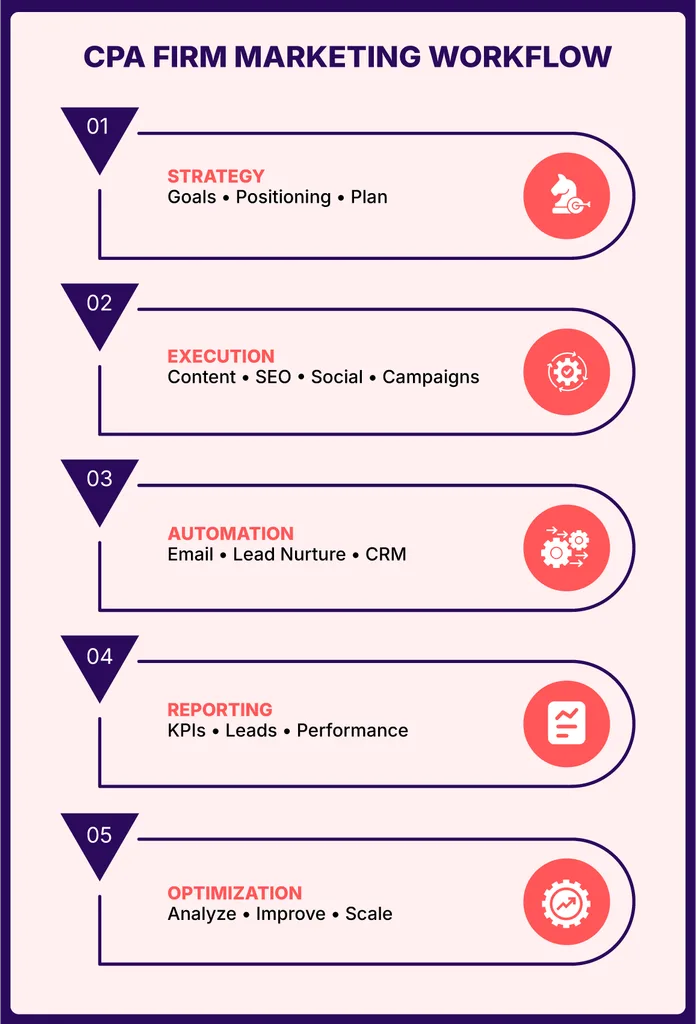
A simple workflow map follows this order: approve the topic or campaign idea, collect subject matter input, draft the copy, review technical accuracy, make brand and compliance edits, complete design or web formatting, publish and promote, and finally measure and discuss the results.
Once this path is visible, you can decide what stays in-house and what should be outsourced.
3. Keep Strategy and Expertise Close to the Firm
Even when using outsourced marketing for CPA firms, the firm should retain control of strategy, positioning, and technical judgment. Your internal team understands client relationships, regulatory sensitivity, service delivery capacity, and partner preferences. Those inputs are difficult for an external provider to guess accurately.
Keep these responsibilities with leadership or designated internal owners: selecting priority services and niches, defining the ideal client profile, providing technical guidance and review, approving claims, offers, and calls to action, deciding which leads are a good fit, and aligning marketing with firm capacity.
This does not mean partners need to write every article or manage every campaign. It means they should provide structured input early, then review only what truly requires their expertise. A short recorded interview, bullet-point outline, or monthly planning call can give an outsourced team enough material to create useful content while protecting accuracy.
4. Outsource Marketing Execution in the Right Order
The right outsourcing sequence depends on your firm’s current capacity. In most cases, the first tasks to outsource are repeatable, specialized, or time-consuming. This allows internal staff to focus on strategy, client experience, and business development.
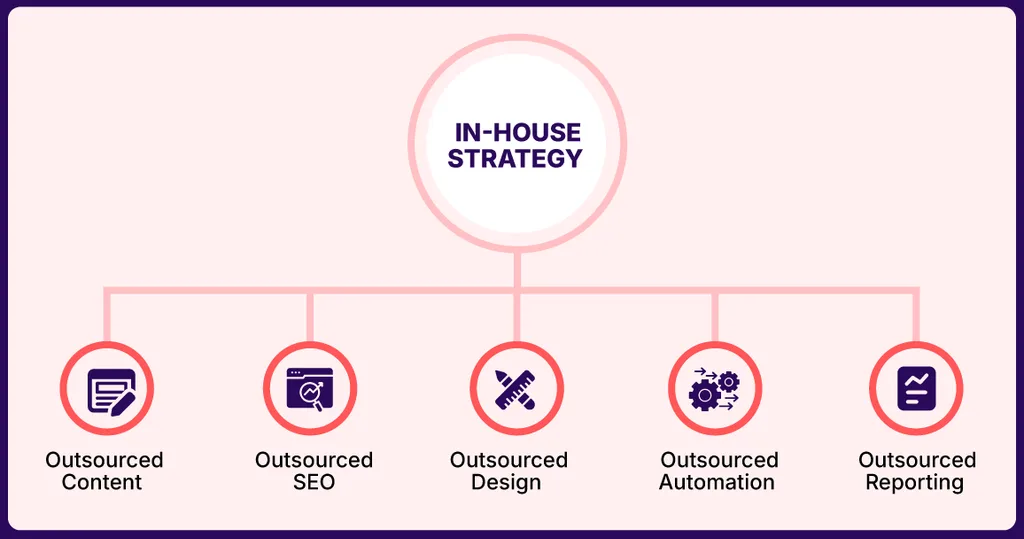
Start with the activities that slow the team down but do not require daily partner involvement. These often include blog writing, SEO support, website updates, email campaign setup, social post repurposing, design, analytics dashboards, and marketing automation setup.
A practical outsourcing order looks like this:
- Content production: Turn partner expertise into articles, service pages, emails, and guides.
- SEO and website optimization: Improve visibility for service and niche searches.
- Design and formatting: Create consistent visuals for campaigns and downloadable assets.
- Email and nurture campaigns: Stay visible to prospects, referral sources, and current clients.
- Reporting: Track what is working without manual spreadsheet work.
- Campaign coordination: Connect content, email, social, and landing pages into one plan.
5. Build a Repeatable Content Engine
Content is often the center of digital marketing scalability because one strong idea can support multiple channels. A partner’s insight from a client meeting can become a blog post, a LinkedIn post, an email, a short video script, and a sales enablement note for business development.
Create a monthly content rhythm instead of starting from scratch every week. Choose themes around client questions, tax deadlines, advisory triggers, industry changes, or service-line priorities. Then batch subject matter input so your outsourced team can produce several assets from one planning session.
A lean monthly content engine may include one planning call with internal stakeholders, two to four educational articles or service-focused pages, supporting social media posts, one email newsletter or nurture email, website updates for priority services, and a short performance review at month-end.
6. Use Marketing Automation to Stay Consistent
Automation should not replace professional judgment, but it can remove repetitive manual work. For CPA firms, marketing automation is most useful when it ensures timely follow-up, consistent nurturing, and cleaner reporting. It helps a small team act with more discipline without adding unnecessary complexity.
Marketing automation helps firms standardize lead capture, email follow-up, segmentation, reminders, and performance tracking, so prospects and clients receive relevant communication even when partners and staff are busy with client work.
Useful automation examples include website forms that route inquiries to the right person, confirmation emails after a guide download or event registration, segmented nurture sequences for CAS, tax planning, or outsourced accounting prospects, reminders for follow-up after consultations, and dashboards that pull campaign data into one place.
Keep automation simple at first. A small number of well-maintained workflows will usually outperform a complex system no one trusts.
7. Set Quality Controls Before Increasing Volume
Scaling content and campaigns without quality control can weaken trust. CPA firm marketing must be clear, accurate, professional, and aligned with the firm’s standards. The faster you publish, the more important your review process becomes.
CPA firms can maintain quality by documenting brand standards, using expert review for technical topics, creating approval workflows, and measuring whether content attracts the right audience. Quality should be built into the process before output increases.
Create a practical quality checklist:
- Does the content reflect the firm’s actual services and capacity?
- Are technical statements reviewed by the right internal expert?
- Are claims specific enough to be useful but not overstated?
- Is the call to action appropriate for the reader’s stage?
- Is the tone professional, clear, and client-centered?
- Are SEO keywords used naturally?
- Are links, forms, and tracking working before launch?
This checklist matters most when several marketing functions are outsourced at the same time.
8. Measure Marketing Capacity and Performance Together
Marketing performance is not only about leads. CPA firms also need to measure capacity: how much work the system can produce without overloading partners, staff, or the outsourced team. A campaign that generates interest but creates operational stress is not truly scalable.
Measure both output and outcomes. Track how many campaigns, articles, emails, and web updates are completed, then connect that activity to qualified inquiries, consultations, referral conversations, pipeline value, and client growth where possible.
Use a balanced scorecard:
- Capacity metrics: projects completed, review turnaround time, missed deadlines, workload by owner
- Visibility metrics: organic traffic, keyword movement, page engagement, social reach
- Conversion metrics: form fills, calls, consultation requests, event signups
- Quality metrics: lead fit, partner feedback, sales conversation quality
- Business metrics: opportunities created, proposals sent, new engagements, retained or expanded clients
Review these monthly. The goal is to spot whether your marketing system needs more strategy, better execution, cleaner automation, or stronger follow-up.
9. Choose the Outsourcing Model That Fits Your Firm
There is no single best model for every firm. Some CPA firms need project-based support for a website refresh or campaign launch. Others need ongoing outsourced marketing for CPA firms that functions like an extension of the internal team.
Common models include:
- Project support: Best for websites, brand refreshes, service pages, or one-time campaigns.
- Specialist support: Best when you need SEO, content, automation, design, or analytics help.
- Fractional marketing team: Best when the firm needs planning, coordination, and execution without hiring multiple employees.
- Hybrid model: Best when an internal marketer manages strategy while outsourced specialists handle production.
If your firm needs ongoing execution across content, campaigns, and digital channels, explore marketing services for CPA firms that are built around the accounting profession rather than generic small-business marketing.
Turn Marketing Into a Scalable Operating System
To scale marketing for CPA firms, do not start by hiring for every skill. Start by clarifying growth priorities, improving the workflow, outsourcing the right execution tasks, and adding automation where it protects consistency. Then measure both marketing performance and internal capacity so the system improves over time.
The firms that scale best are usually not the ones doing the most activity. They are the ones with a clear message, a repeatable process, reliable specialist support, and a practical way to turn firm expertise into market visibility.
Conclusion
Scaling CPA firm marketing does not require a large in-house team. It requires clear priorities, a documented workflow, the right outsourcing partner, and quality controls that protect the firm’s reputation. When firm leaders keep strategy and approvals while specialists handle execution, marketing becomes more consistent, more measurable, and easier to grow.
Ready to build marketing capacity without adding headcount? Visit the QX Accounting Services USA to see how we support CPA firms, or contact our team to discuss your firm’s marketing goals.
FAQs
Can outsourcing help CPA firms scale their marketing?
Yes. Outsourcing can help CPA firms scale their marketing when it fills clear capacity gaps, follows a documented strategy, and works inside a defined approval process. The firm should still own positioning, service priorities, client insight, and final approval, while specialists handle execution.
What marketing activities should CPA firms outsource first?
Start with repeatable, specialized, time-consuming tasks that do not require daily partner involvement, such as content production, SEO support, design, email setup, website updates, and reporting. This frees internal leaders to focus on strategy, client experience, and business development.
How can CPA firms maintain marketing quality while scaling?
Document brand standards, build a clear review and approval workflow, and ensure technical topics get expert review. Use a quality checklist so faster publishing does not compromise accuracy, compliance, or tone.
What role does marketing automation play in CPA firm growth?
Automation helps standardize lead capture, follow-up, segmentation, and reporting so prospects and clients receive consistent communication even during busy seasons. Start with a few simple, well-maintained workflows instead of building complex systems no one uses.
How should CPA firms measure marketing capacity and performance?
Track both output and outcomes. Measure capacity items like review turnaround time and projects completed, alongside performance items like traffic, conversions, lead quality, opportunities created, and client growth.
Enquire now

Vishal Kurani
Unauthorized copying or plagiarism of our content is a violation of intellectual property rights. We take such matters seriously and will pursue legal action to protect our original work. Anyone found engaging in such activities will be held accountable under applicable laws.
Don't forget to share this post!
Our Latest Insights




Let’s Work Together
Explore outsourcing solutions, request a no-obligation trial or discuss your practice’s needs with our expert consultants.
 Book a Virtual Meeting
 Get Your ROI Estimate