Tax Preparation Outsourcing Cost: Pricing, Savings and ROI for US CPA Firms



Tax preparation outsourcing cost is the provider’s fee plus the internal expense of onboarding, coordination, review, technology, and oversight. For US CPA firms, outsourcing is financially worthwhile when that combined cost is lower than a comparable in-house workflow, or when released capacity produces enough additional contribution to justify the investment. This guide explains published pricing examples, contract structures, cost comparisons, and a practical method for measuring savings and ROI. If you are planning for the 2027 busy season, it also shows where a managed option such as QX TaxReady for CPA firms fits into the comparison.
“The lowest quote is rarely the lowest cost. CPA firms should compare the delivered cost of each accepted return, including review, coordination and onboarding, before committing to any outsourcing model.”
Cora Vollmar, SVP Growth, QX Accounting Services
How much does tax preparation outsourcing cost?
There is no single price that applies across providers or return types. Published outsourced tax preparation pricing illustrates the variation: Hyoka lists a simple Form 1040 at $110, an itemized or multistate 1040 at $195, Form 1120-S or Form 1065 preparation at $295, and Form 1120 preparation at $425. These are one provider’s advertised production rates, not national averages or an assurance that your engagement will qualify.
Accounting Ally advertises starting prices of $299 for individual returns with schedules and $499 for business returns, and its published dedicated staffing model ranges from $2,200 to $3,800 monthly. Those examples show why a useful tax preparation outsourcing cost comparison needs more than a headline rate: obtain a written scope before treating two offers as equivalent.
Separate the provider fee from total delivered cost per return
Use three numbers in your budget: the quoted preparation fee, your retained delivery costs, and the resulting total cost per completed return. For planning, calculate that final number as total provider charges plus internal delivery costs, divided by completed, accepted returns. This avoids treating unfinished files or unused reserved capacity as successful output.
Ask providers to price the same sample workload rather than requesting their cheapest return. Include representative schedules, states, ownership structures, documentation quality, software requirements, and review expectations. Request separate prices for ordinary files and exceptions so the blended estimate reflects your actual practice.
Keep outsourcing fees separate from client-facing fees. The former purchases a defined production service; the latter must support your entire engagement, including responsibilities and services that remain with your firm. A low preparation quote alone does not establish a profitable client relationship.
Tax preparation outsourcing pricing models: per return, hourly, dedicated and hybrid
Evaluate pricing models against workload predictability and the responsibilities you want to retain. Published provider offerings include per-return and monthly dedicated-capacity arrangements. Use the following framework to decide what to request and which contract terms need closer examination. QX TaxReady takes a different route: one fixed price per return, with talent, automation, management and quality checks included. You can request QX TaxReady pricing based on your return mix and volumes.
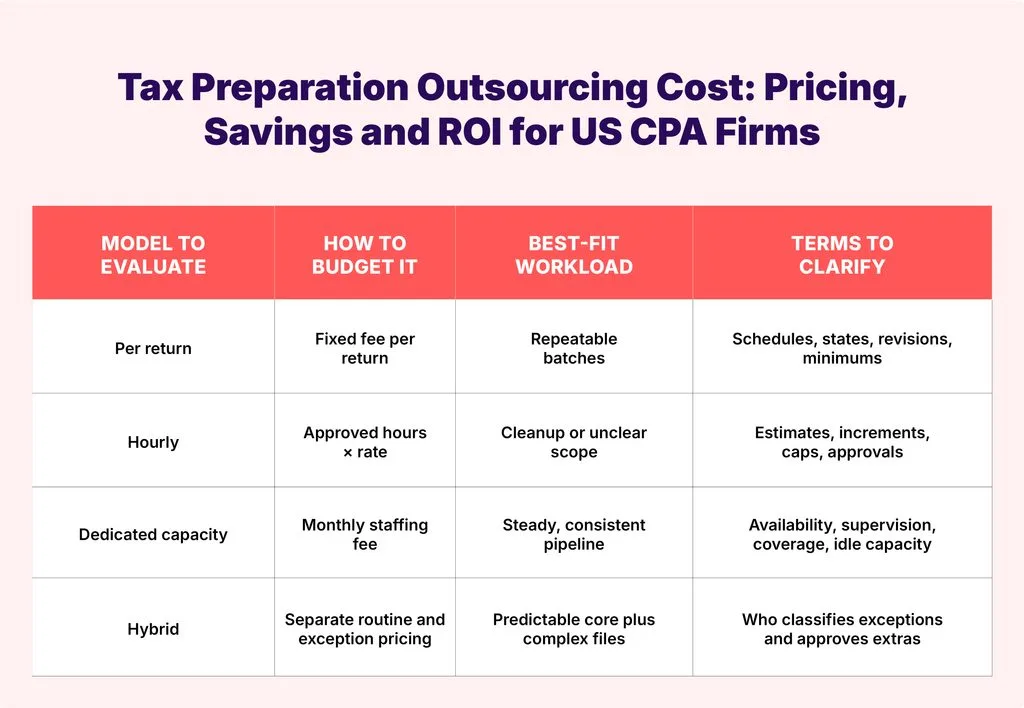
For a per-return proposal, ask what makes a return move into a higher tier. For hourly work, require notice before the estimate is exceeded. For dedicated staffing, define whether the commitment buys scheduled hours, exclusive availability, or an output target; do not leave those concepts interchangeable.
Choose pricing predictability over an attractive unit rate
Prepare a low-, expected-, and high-volume budget for each shortlisted arrangement. Include minimum payments even when your firm cannot supply enough ready-to-work files. A dedicated arrangement should be assessed on usable output, not the theoretical cost of a fully occupied preparer.
Also compare payment timing. A deposit, monthly commitment, or advance seasonal reservation affects cash planning differently from payment after accepted delivery. Ask whether unused balances expire, carry forward, or become refundable when capacity is unavailable.
How return type and workflow affect tax preparation outsourcing cost
Start your pricing request with the return families you actually handle. Form labels establish the filing category, but the provider still needs enough detail to estimate the work. Treat the following as scoping prompts, not automatic surcharges.
Outsourcing Form 1040 individual returns
Form 1040 is used by US taxpayers to file an annual income tax return. For outsourcing estimates, describe the supporting work rather than stopping at “individual return.” Flag business or rental schedules, investment records, pass-through documents, state filings, and any calculations your team expects the provider to prepare. Ask each provider how automation affects price and review load; QX’s TaxReady, for example, automates data capture and taxpayer-data retrieval for 1040 workflows.
Specify whether source documents arrive organized and whether prior-year information is available. Assign responsibility for missing-document follow-up and unresolved questions before production starts. Otherwise, two providers may quote different jobs while appearing to quote the same return.
Outsourcing Form 1065 and Form 1120-S pass-through returns
Form 1065 reports partnership activity, while Form 1120-S reports activity for an entity covered by an S corporation election. Your request should identify the number of owners, state footprint, relevant supporting schedules, and whether additional ownership-level calculations are included.
For a clean comparison, distinguish preparation from bookkeeping cleanup. Identify who reconciles the trial balance, resolves opening-balance differences, and supplies usable depreciation records. Ask the provider to list assumptions about those inputs in its proposal.
Outsourcing Form 1120 corporate returns
Domestic corporations use Form 1120 to report income and other tax items and calculate income tax liability. Describe the schedules and supporting calculations needed for your engagement rather than assuming every corporate return fits one production tier.
Identify unresolved accounting issues, state requirements, and any specialist work that needs separate approval. Then establish which workpapers must accompany the completed return. Review-ready documentation should be a defined deliverable, not an interpretation left until review begins.
In-house vs outsourced tax preparation: How to compare the costs
Compare equivalent work over the same period. Do not contrast an annual employee cost with a short seasonal outsourcing commitment unless the analysis also accounts for that employee’s other productive work. Similarly, do not compare outsourced preparation alone with an in-house engagement that includes client service and final review.
For your internal baseline, include wages, benefits, and employer payroll costs without double counting. BLS compensation reporting distinguishes wages and salaries from benefits, reinforcing why salary alone is an incomplete employment-cost measure. Use your firm’s actual costs rather than a general industry average.
Build the comparison in these categories:
- Preparation: Staff time or vendor charges for the same defined production tasks.
- Review: Reviewer and partner time, including clearing review notes.
- Coordination: Intake, assignment, questions, follow-up, and status tracking.
- Technology: Incremental licenses, secure access, equipment, and support.
- Transition: Training, workflow documentation, pilot work, and implementation.
- Exceptions: Approved cleanup, additional schedules, rush requests, and out-of-scope work.
Economic savings vs cash savings in tax outsourcing
Keep two versions of the business case. An economic comparison values all resources consumed, including salaried staff time. A cash comparison includes only spending that changes because of the decision, such as an avoided hire or reduced contractor expense.
Suppose outsourcing releases an employee’s preparation hours but the employee remains on payroll. That creates capacity, not an immediate payroll reduction. Record the released hours separately and identify their next use before claiming tax outsourcing cost savings.
For a seasonal decision, mark each baseline expense as avoidable, partially avoidable, or unchanged. Existing rent and software contracts may remain payable even if production moves outside the firm. Do not count an allocated expense as cash saved unless it actually disappears.
Security, consent and oversight costs in tax preparation outsourcing
Security and confidentiality belong in the cost model, not in a separate conversation after price negotiation. The FTC identifies tax preparation firms among businesses covered by its Safeguards Rule. Its guidance addresses information security programs and requires covered businesses to select appropriate service providers, establish contractual safeguards, and assess them periodically.
Before approving a provider, budget time to examine:
- Where personnel access, process, and store information.
- Named-user access, authentication, permissions, and activity records.
- Subcontractor involvement and approval procedures.
- Incident escalation, notification, and cooperation terms.
- Data retention, return, deletion, and access termination.
Outsourcing also requires a disclosure analysis. Section 7216 restricts unauthorized use or disclosure of tax return information; whether consent is required depends on the applicable rules and exceptions. Overseas preparation raises additional consent considerations, including specific conditions concerning Social Security number disclosures. Confirm the requirements for your arrangement before transferring taxpayer information.
Treat this section as a due-diligence starting point, not a complete compliance checklist. Have the appropriate firm personnel or advisers assess professional, contractual, federal, and state obligations for the proposed workflow. Include their implementation time in the business case. For reference, QX Accounting Services states that it is SOC 2 Type II compliant and holds ISO 27001 and ISO 27701 certifications; ask any provider, including QXAS, for current documentation.
How do you calculate tax preparation outsourcing ROI?
Calculate tax preparation outsourcing ROI by subtracting total outsourced delivery cost from the comparable in-house baseline, then dividing the difference by total outsourced delivery cost. State the formula and assumptions explicitly: a cost-reduction analysis is different from measuring additional revenue or the return on a one-time implementation expense.
For this guide, use:
Net economic benefit = comparable in-house cost − total outsourced delivery cost
Cost-based ROI = net economic benefit ÷ total outsourced delivery cost × 100
Cost reduction percentage = net economic benefit ÷ comparable in-house cost × 100
Tax preparation outsourcing ROI example (Hypothetical)
The figures below are hypothetical modeling assumptions, not market prices, a provider quote, or promised results. Assume a firm is evaluating 100 returns with equivalent scope and quality expectations. Its internal economic baseline is $60,000 for preparation, review, and coordination.
| Cost category | In-house baseline | Outsourced scenario |
| Preparation | $50,000 | $25,000 |
| Retained review | $8,000 | $8,000 |
| Coordination | $2,000 | $3,000 |
| Incremental technology and access | $0 | $2,000 |
| Onboarding allocated to this batch | $0 | $2,000 |
| Total economic cost | $60,000 | $40,000 |
Under these assumptions, the economic benefit is $20,000. Cost reduction is approximately 33%, while cost-based ROI is 50%. Delivered cost is $400 per return, despite the assumed preparation charge of $250 per return.
Those percentages answer different questions. The 33% figure measures the reduction against the original baseline; the 50% figure measures net benefit against outsourced delivery cost. Neither establishes $20,000 of cash savings unless the relevant baseline spending is actually avoided.
Stress-test your ROI under downside conditions
Recalculate the example with higher review time, fewer accepted returns, and additional coordination. If total outsourced delivery cost rises to $48,000, the economic benefit falls to $12,000, cost reduction becomes 20%, and cost-based ROI becomes 25%. These remain hypothetical results, but they show why retained work deserves close attention.
Calculate your maximum acceptable provider spend as well. Subtract retained delivery costs and your required benefit from the comparable baseline. That gives negotiators a budget ceiling grounded in firm economics rather than an arbitrary discount target.
Value released capacity without double counting
Track capacity benefits separately from direct cost reduction. If released hours support additional work, estimate incremental contribution after the costs of selling, delivering, reviewing, and collecting that work. Do not substitute gross billing potential for profit.
Avoid counting the same hours as both eliminated payroll and capacity available for another assignment. If the employee remains, the payroll is still payable. If a hire is avoided, those hypothetical employee hours are not also available for advisory work.
How to pilot tax preparation outsourcing before you scale?
A pilot should test the entire handoff, not simply whether a provider can populate tax software. Select a manageable batch representative of the workload you intend to outsource. Include ordinary complexity, document quality, and review expectations rather than choosing only unusually clean files.
Use a written scorecard:
- Define the starting point. Record the documents, workpapers, and information required before the turnaround clock begins.
- Assign responsibilities. Name the people handling questions, technical decisions, review, client contact, and filing.
- Measure retained time. Capture intake, coordination, review, and correction time separately.
- Assess accepted quality. Distinguish provider errors from missing inputs, preference changes, and new client information.
- Reconcile the invoice. Match charges to agreed scope, approved exceptions, and accepted deliverables.
- Rebuild the forecast. Use observed time and charges before increasing volume or reserving capacity.
Set acceptance criteria before the pilot starts. Specify workpaper organization, issue documentation, review-note response, and escalation expectations. A return that arrives quickly but cannot be reviewed efficiently should not count as a successful delivery.
Plan for peak tax season workload and exit terms
For the US tax season, request commitments by week and return type rather than relying only on annual volume. Define turnaround from a complete intake package, and specify what happens when files arrive incomplete. Reserve internal reviewer availability alongside outsourced production capacity.
Before signing, document notice periods, minimum commitments, reassignment rights, and unfinished-file handling. Establish how your firm retrieves workpapers and revokes access if the relationship ends. Include transition effort in the downside budget rather than assuming every engagement continues indefinitely.

Who Prepares Your Returns in the 2027 Busy Season?
Download NowConclusion
The strongest case for tax preparation outsourcing connects price, accepted quality, retained effort, and usable capacity. Start with comparable scope, calculate economic and cash outcomes separately, and validate both through a measured pilot. Expand only when observed savings and service performance justify the commitment, not because the lowest quoted fee looks compelling. To explore how a managed, fixed-price model could fit your firm, visit the QX Accounting Services USA or contact our team to discuss your 2027 busy-season capacity.
FAQs
What factors affect tax preparation outsourcing costs?
Return type, schedules, state filings, documentation quality, software environment, volume, deadlines, and required deliverables all influence price. Give providers a representative sample workload and ask them to identify which factors change their quote. Your total cost must also include retained review, coordination, onboarding, and oversight—not just the amount on the preparation invoice.
Is tax preparation outsourcing cheaper than hiring in-house staff?
It can be, but the answer depends on equivalent scope and actual utilization. Compare the outsourced workflow with the full cost and productive output of the proposed hire across the relevant period. If that employee would also perform valuable year-round work, include it rather than charging the entire annual position to seasonal preparation.
Does tax preparation outsourcing reduce tax season staffing costs?
It may reduce cash staffing costs when it replaces spending your firm would otherwise incur, such as an additional seasonal hire or contractor commitment. If existing employees remain on payroll, released hours are initially a capacity benefit. Track avoided spending and reassigned time separately so the staffing claim matches the financial result.
Are there hidden costs in tax preparation outsourcing?
Potentially overlooked budget items include onboarding, added access or licenses, internal coordination, review-note handling, and transition work. Treat these as questions for the proposal, not assumptions that every provider charges them. Require written inclusions, exclusions, correction terms, and approval rules so unexpected scope does not become an unexplained invoice. For comparison, QX TaxReady includes talent, automation, management, quality checks and infrastructure in its fixed price per return, with no separate software license.
Is tax preparation outsourcing cost-effective for small CPA firms?
It can be when the engagement matches a small firm’s workload and retained review capacity. Evaluate a limited batch or pilot against your own baseline before accepting a larger commitment. Low volume deserves particular scrutiny because fixed onboarding effort and minimum payments must be spread across fewer completed returns.
How much does it cost to outsource tax return preparation per return?
Published examples vary widely. Hyoka lists $110 for a simple Form 1040 and $425 for Form 1120, while Accounting Ally advertises starting prices of $299 for individual returns with schedules and $499 for business returns. These are individual providers’ advertised rates, not averages. Ask for a quote based on your own return mix, or request QX TaxReady pricing for one fixed price per return.
Can automation lower tax preparation outsourcing costs?
Automation can reduce repetitive data entry and shorten review preparation, but only if the provider’s workflow and your software environment support it. Ask how automation changes the price, turnaround, and review burden before you compare quotes.
Is outsourcing tax preparation secure and compliant?
It can be, if you complete due diligence first. Review the provider’s access controls, subcontractor practices, incident terms, and data retention and deletion policies, and confirm consent requirements under Section 7216 before sharing taxpayer information. Have qualified advisers assess the obligations for your specific workflow.
Enquire now

Arjun Varshneya
Arjun Varshneya is an experienced Operations Leader with over 13 years of expertise in managing global delivery teams across Client Accounting Services, Tax, and U.S. operations. An auditor by background, he brings deep delivery knowledge and operational leadership to help CPA firms improve quality, strengthen working standards, optimize capacity, and drive review readiness across accounting and tax workflows. At QX Accounting Services, he focuses on building scalable operating models that support quality, risk management, execution excellence, and sustainable efficiency across complex, high-volume environments.
Unauthorized copying or plagiarism of our content is a violation of intellectual property rights. We take such matters seriously and will pursue legal action to protect our original work. Anyone found engaging in such activities will be held accountable under applicable laws.
Don't forget to share this post!
Our Latest Insights




Let’s Work Together
Explore outsourcing solutions, request a no-obligation trial or discuss your practice’s needs with our expert consultants.
 Book a Virtual Meeting
 Get Your ROI Estimate