How to Choose the Right Marketing Partner for Your CPA Firm?



Choosing the right marketing partner can help a CPA firm turn reputation, referrals, and technical expertise into a consistent pipeline of qualified opportunities. For US firms, the best fit is not simply a vendor that runs campaigns; it is a partner that understands accounting buyers, seasonality, compliance-sensitive messaging, niche positioning, and the economics of firm growth. Firms considering outside support can first review marketing services for CPA firms to see how strategy, execution, and measurement can work as one connected growth system.
This guide explains what to expect, how to evaluate potential partners, and how to measure whether the relationship is creating value.
The best outsourced marketing partner does more than run campaigns. It helps CPA firms turn visibility, trust, and follow-up into a measurable growth system.
— Cora Vollmar, SVP Growth, QX Accounting Services
- What Should a CPA Firm Expect From a Marketing Partner?
- Choose a Partner Who Understands How CPA Firms Grow
- Core CPA Firm Marketing Services to Evaluate
- How to Evaluate a CPA Firm Marketing Partner?
- How to Measure CPA Firm Marketing Performance
- Build a Strong CPA Firm–Marketing Partner Collaboration
- Red Flags When Choosing a CPA Firm Marketing Partner
- A Practical CPA Firm Marketing Partner Selection Process
- Conclusion
- FAQs
- What marketing services should CPA firms expect from a partner?
What Should a CPA Firm Expect From a Marketing Partner?
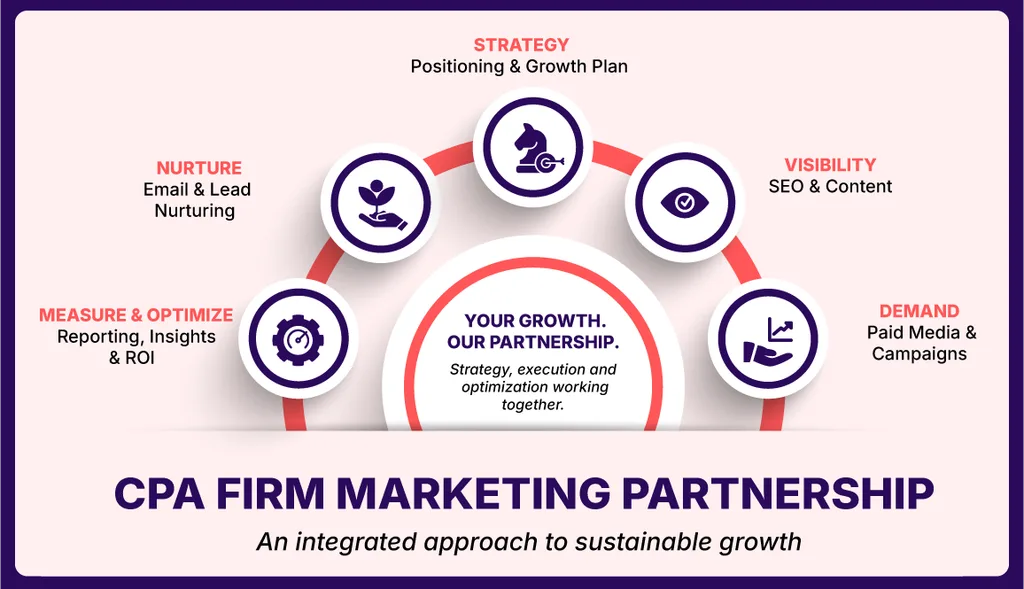
A CPA firm should expect a marketing partner to turn strategy into a measurable growth system. That means defining the right clients, sharpening service positioning, building visibility in priority markets, and creating a clear path from interest to consultation or proposal. Every activity like content, email, search, paid media, and reporting should support a defined firm goal, such as growing advisory services, entering a niche, improving lead quality, strengthening recruiting visibility, or acquiring new clients.
The best partner will also understand that CPA firms are relationship-driven businesses. Marketing should support trust before the first conversation, not replace the expertise of partners and client-facing teams. That means content, website messaging, search visibility, campaigns, and follow-up systems should all make it easier for the right prospects to understand what the firm does, who it serves, and why it is credible.
Choose a Partner Who Understands How CPA Firms Grow
A CPA firm marketing agency should understand how firms actually grow. Some firms want more tax clients, while others want fewer but better-fit clients. Some are building CAS, CFO advisory, audit, wealth-adjacent advisory, nonprofit, real estate, healthcare, construction, or high-net-worth niches. A generic lead generation plan can create noise if it does not reflect the firm’s services, capacity, margins, and desired client profile.
A capable outsourced marketing partner for CPA firms will ask questions before recommending tactics. Which services are strategic priorities? Which industries produce the strongest client relationships? What work should the firm avoid? How long is the sales cycle? Who follows up on leads?
What makes a lead sales-qualified rather than merely interested? These questions matter because CPA firm marketing ROI depends as much on fit and follow-through as on traffic or impressions.
Look for evidence that the partner can translate technical services into buyer-friendly language. Prospects may not search for the exact internal terms a firm uses, and they may not understand the full value of advisory, outsourced accounting, or tax planning services until the message is made practical. Good marketing bridges that gap without oversimplifying the profession.
Core CPA Firm Marketing Services to Evaluate
A marketing partner for CPA firms should bring a practical mix of strategy, digital execution, and measurement. Not every firm needs every channel at once, but the partner should know how the pieces fit together.
Key services to review include:
Start with positioning, messaging, and the website.
The partner should define ideal client profiles, service narratives, differentiators, and niche value propositions, then carry that strategy into service pages, landing pages, navigation, calls to action, and conversion paths.
Build visibility through connected channels.
SEO should improve relevant local, niche, and service-based search visibility, while content, email nurturing, paid media, and retargeting should reinforce the same priorities. Paid campaigns are most effective when the firm has a clear offer, focused landing page, realistic budget, and disciplined follow-up process.
Measure outcomes, not isolated activity.
Analytics and reporting should connect marketing work to enquiries, qualified consultations, opportunities, and revenue influence so the firm can see which messages and channels deserve further investment.
For firms comparing providers, resources such as this guide to marketing services companies for CPA firms can be helpful when mapping available service models against internal needs. Firms that want a more direct overview of specialized support can also explore Marketing services for CPA firms to understand how outsourced support can fit into a broader growth plan.
How to Evaluate a CPA Firm Marketing Partner?
Marketing partner evaluation should go beyond polished presentations. A strong proposal should show that the provider understands your goals, market, service mix, and decision-making process. It should also clarify what the partner will own, what your internal team must provide, and how success will be measured.
Use this checklist during evaluation:
- Industry understanding: Can the partner speak clearly about CPA firm buyer journeys, referral dynamics, seasonality, and niche positioning?
- Strategic discipline: Do they start with goals and audience definition before recommending channels?
- Service fit: Can they support the services you actually want to grow, not just generic accounting keywords?
- Content quality: Can they explain complex topics in clear, compliant, client-friendly language?
- Reporting clarity: Do they report on business outcomes, not only clicks, impressions, or rankings?
- Collaboration process: Do they have a practical workflow for approvals, interviews, deadlines, and feedback?
- Lead handling: Do they help define what happens after a form fill, call, or consultation request?
- Scalability: Can they adjust support as the firm grows, shifts niches, or changes priorities?
The right marketing partner for a US CPA firm should also be realistic about what sustainable growth requires. Promises of instant results, guaranteed rankings, or unexplained “exclusive” tactics are warning signs. Strong performance usually comes from clear positioning, useful content, consistent search visibility, targeted campaigns, and disciplined follow-up working together over time.
How to Measure CPA Firm Marketing Performance
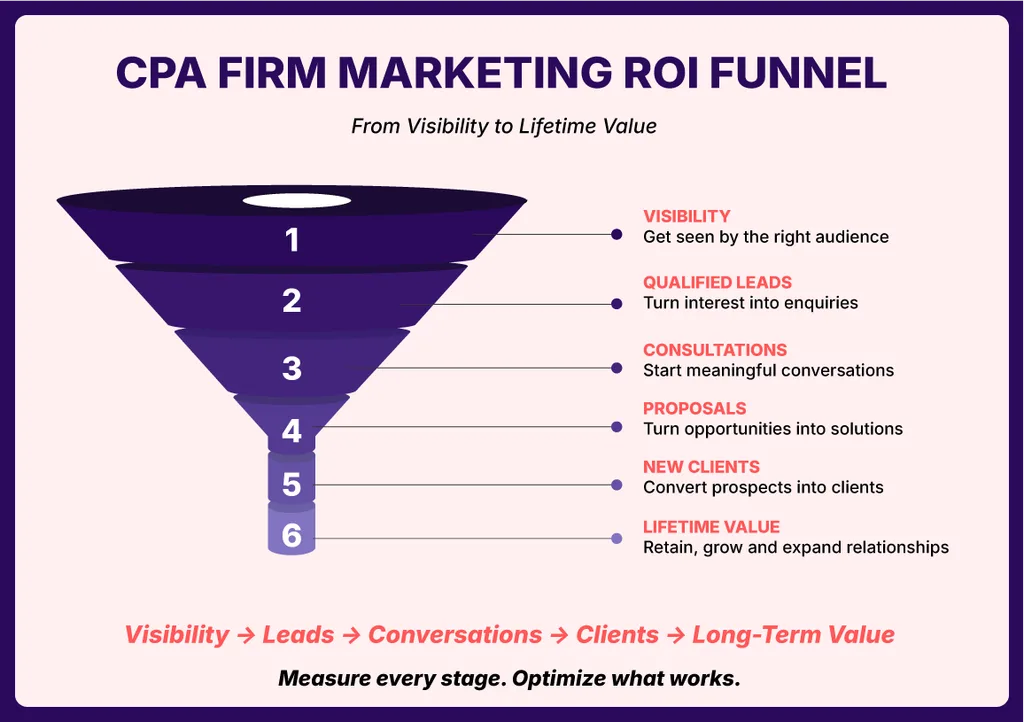
CPA firms should measure marketing performance by connecting activity to pipeline quality and business outcomes. Website visits and engagement metrics are useful, but they are only early indicators. The real question is whether marketing is helping the firm attract better-fit prospects, create more qualified conversations, and support profitable growth.
Practical KPIs include:
At the top of the funnel, track organic traffic and keyword visibility for priority service, niche, and location pages, along with conversion rates for forms, consultation requests, and landing pages. These indicators show whether the firm is reaching the right audience and making the next step clear.
Closer to revenue, monitor marketing-qualified and sales-qualified leads, lead source by service line, cost per qualified lead, consultation-to-proposal conversion, proposal-to-client conversion, client acquisition cost, payback period, and revenue influenced by marketing. Engagement from referral sources, existing clients, and nurture lists also helps reveal whether the firm is building durable demand.
This is where CPA firm marketing ROI becomes more nuanced. A high-volume campaign that generates poor-fit leads can drain partner time. A lower-volume strategy that attracts the right industry, service need, and fee potential may create stronger returns. Your partner should help define quality at the beginning so reports do not celebrate activity that fails to support the firm’s goals.
Build a Strong CPA Firm–Marketing Partner Collaboration
Even the best outsourced marketing expertise needs input from the firm. CPA partners, managers, and client service leaders hold the insight that makes marketing credible: common client questions, regulatory concerns, industry pain points, advisory opportunities, and examples of how the firm creates value. A good partner will extract that expertise efficiently through interviews, briefs, review cycles, and planning sessions.
Clear ownership prevents delays. The marketing partner may handle strategy, content, campaigns, SEO, reporting, and project management, while the firm approves positioning, provides subject matter input, confirms service priorities, and follows up on leads. When those responsibilities are vague, campaigns stall and performance becomes harder to diagnose.
Set a review rhythm early. Monthly reporting may cover performance and priorities, while quarterly strategy sessions can evaluate pipeline quality, service focus, budget allocation, and upcoming campaigns. This cadence keeps the relationship aligned with the firm’s business reality rather than locking both sides into a static plan.
Red Flags When Choosing a CPA Firm Marketing Partner
Not every marketing provider is a fit for accounting firms. Some may be skilled in general digital marketing but lack the context needed for professional services, professional standards and regulated topics, or long-trust sales cycles. Others may push tactics before understanding the firm’s goals.
Watch for these warning signs:
Be cautious when a provider recommends channels before asking about ideal clients, service lines, capacity, qualification, or follow-up. Reporting that focuses only on clicks, impressions, and ranking, without connecting activity to qualified opportunities is another warning sign.
Other concerns include generic content, unclear timelines and approval workflows, casual treatment of compliance-sensitive topics, and promises of quick wins without an explained strategy. A credible partner should discuss trade-offs, responsibilities, and a realistic roadmap based on the firm’s current marketing maturity.
A strong partner should be confident but not careless. They should be able to explain trade-offs, prioritize what matters first, and recommend a practical roadmap based on the firm’s current maturity.
A Practical CPA Firm Marketing Partner Selection Process
A structured selection process reduces the risk of choosing a partner based on personality, price, or one impressive tactic. Start by defining what marketing must achieve over the next 12 months. The priority may be more advisory leads, stronger niche visibility, better recruiting reach, higher website conversion, or more consistent referral nurturing. That outcome should become the benchmark for every provider, recommendation, and proposed channel.
Then compare partners against the same criteria. Ask each provider to explain their discovery process, recommended first priorities, expected collaboration model, reporting approach, and how they would define qualified leads. If possible, involve the partners or managers who will approve content and handle leads, because their participation will directly affect results.
A useful shortlisting process may look like this:
- Define growth goals and priority services.
- Identify internal marketing gaps and capacity limits.
- Shortlist providers with relevant professional services experience.
- Review strategy, not just deliverables.
- Ask how performance will be tracked from lead to opportunity.
- Clarify responsibilities, timelines, and communication cadence.
- Choose the partner that shows the strongest alignment with firm goals.
Conclusion
Choosing a CPA firm marketing partner is a growth decision, not simply a channel or vendor decision. The right partner brings structure to positioning, visibility, lead generation, collaboration, and reporting while respecting the expertise and trust that drive accounting relationships. Explore QX Accounting Services USA to learn how its broader support model helps CPA firms scale, or contact the QX team to discuss a marketing approach aligned with your firm’s services, capacity, and growth goals.
FAQs
What marketing services should CPA firms expect from a partner?
CPA firms should expect a mix of strategy, website support, SEO, content marketing, email nurturing, paid campaigns where appropriate, analytics, and campaign management. The exact mix depends on the firm’s goals, such as growing advisory services, improving local visibility, entering a niche, or increasing qualified consultations.
What KPIs should CPA firms use to measure a marketing partner?
Useful KPIs include qualified leads, consultation requests, conversion rates, organic traffic to priority pages, keyword visibility, cost per qualified lead, proposal opportunities, and revenue influenced by marketing. Firms should also track lead quality so the partner is measured on business relevance, not just activity.
How much does outsourced marketing cost for CPA firms?
Outsourced marketing costs vary by scope, channel mix, market competitiveness, content volume, advertising spend, and the level of strategic support required. A defined project will be priced differently from a fully outsourced marketing partnership. CPA firms should compare proposals against the work included, responsibilities on both sides, expected reporting, and the business goals the engagement is designed to support, not the monthly fee alone.
How can a marketing partner help CPA firms generate qualified leads?
A partner can improve lead quality by clarifying ideal client profiles, building stronger service pages, creating educational content, optimizing search visibility, running targeted campaigns, and designing conversion paths. They can also help define qualification criteria so the firm attracts prospects that match its services, fees, industries, and capacity.
How can CPA firms measure the ROI of a marketing partnership?
CPA firms can measure ROI by connecting marketing sources to qualified leads, consultations, proposals, new clients, and revenue. The most useful view combines acquisition cost, close rate, expected client value, and service-line profitability rather than relying only on traffic or lead volume.
Enquire now

Surbhi Shah
Unauthorized copying or plagiarism of our content is a violation of intellectual property rights. We take such matters seriously and will pursue legal action to protect our original work. Anyone found engaging in such activities will be held accountable under applicable laws.
Don't forget to share this post!
Our Latest Insights




Let’s Work Together
Explore outsourcing solutions, request a no-obligation trial or discuss your practice’s needs with our expert consultants.
 Book a Virtual Meeting
 Get Your ROI Estimate