How Much Can CPA Firms Save by Outsourcing Tax Preparation?



CPA firms can estimate outsourced tax preparation savings by comparing the avoidable cost of preparing returns internally with the complete cost of outsourced delivery, including internal review. There is no single savings percentage that fits every firm. This guide shows you how to build a comparison, test it with a pilot, and distinguish actual expense reductions from additional staff capacity.
“The real question is not what a provider charges per return. It is what your firm actually stops spending once review, coordination and rework are counted. Build the baseline from your own records, test it with a representative pilot, and let the results decide.”
Cora Vollmar, SVP, QX Accounting Services
How much could your CPA firm actually save?
Your potential savings equal the internal expenses you can avoid minus the outsourcing fees and internal costs needed to complete the same work. For example, replacing $60,000 of avoidable internal costs with $44,000 of total outsourced delivery costs would save $16,000, or approximately 26.7%. These figures are hypothetical calculations, not market averages or promised results. For personal tax returns, a managed service such as QX TaxReady prices each return at one fixed fee, so the cost side of your comparison is easier to model before busy season starts.
Explore the QX TaxReady page and request pricing for your mix return volumes →
Click Here
The distinction between avoidable costs and allocated costs matters. If salaried employees remain on payroll, transferring their preparation work does not automatically reduce payroll spending. It may free capacity, but that benefit belongs in a separate calculation until it produces additional revenue or prevents another expense.
Assess tax preparation outsourcing savings by return category rather than across an undifferentiated workload. Separate straightforward individual returns, complex individual returns, and business returns so differences in complexity do not distort your comparison.
5 Calculated Saving Steps
1. Establish a comparable internal baseline.
Select a defined group of returns and use completed work from your own records. Record preparation, review, corrections, and administrative time separately. Compare the same service scope on both sides, including responsibility for missing documents and client questions.
Build two views of your baseline:
- Fully loaded cost: Compensation, employer payroll costs, benefits, software, recruiting, training, and relevant overhead allocated to the work.
- Avoidable cost: Spending that would disappear or not occur if you outsourced, such as a planned seasonal hire, agency fees, or overtime.
Use the first view to understand delivery economics and the second to forecast cash savings. Do not count rent, existing annual licenses, or retained salaries as eliminated expenses unless your budget will actually change. Also avoid adding recruiting or training costs twice if your loaded hourly rate already includes them.
2. Request an all-in outsourcing quote.
When you evaluate providers that offer to outsource tax preparation services, supply representative return profiles rather than asking for one headline rate. Request written assumptions about complexity, schedules, state filings, turnaround, and document readiness. A quote is useful only when you understand what triggers an additional charge.
Ask each provider to identify:
- Preparation fees and minimum commitments.
- Setup, software access, and integration charges.
- Rush fees, complexity supplements, and amendment pricing.
- Responsibility for corrections and incomplete submissions.
- Included review work and expected deliverables.
Add your own coordination and final review costs. Separately investigate the provider’s data safeguards: the FTC Safeguards Rule requires covered firms to oversee service providers handling customer information, so outsourcing does not remove that responsibility.
Ask where staff will access client information, including subcontractors. Review applicable disclosure and consent requirements before transferring records; Section 7216 governs preparers’ disclosure and use of tax return information, with exceptions and consent rules that depend on the circumstances.
3. Calculate net savings and cost per completed return.
Use a spreadsheet that keeps vendor charges, retained work, and transition expenses visible. For a cash comparison, use this formula:
Net savings = avoidable internal cost − total outsourced delivery cost
Savings percentage = net savings ÷ avoidable internal cost × 100
Here is an illustrative model for 200 comparable returns. Every amount below is an assumption, not a provider quote or industry benchmark.
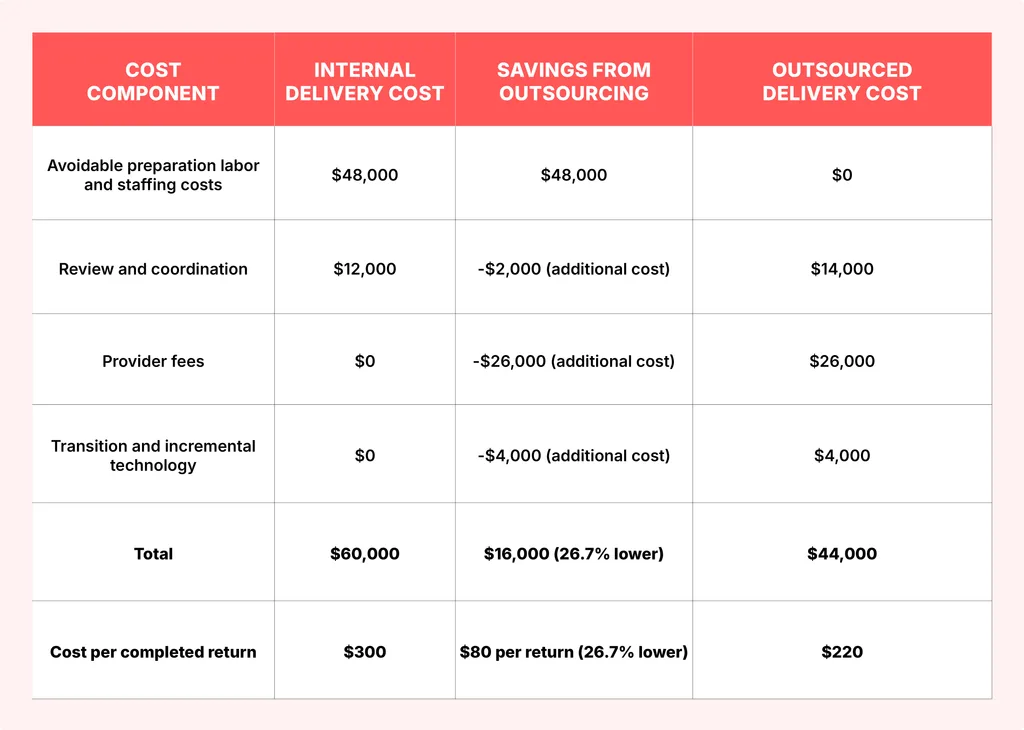
This example assumes the internal costs are avoidable and includes all review costs in both scenarios. The result is $80 saved per return and $16,000 overall. If part of the baseline remains payable, reduce the claimed cash savings accordingly.
Calculate first-season and ongoing results separately. Remove a transition expense from future projections only after confirming it will not recur; do not assume every setup charge is temporary.
4. Run a representative pilot and measure rework.
Choose returns that reflect the workload you actually intend to outsource, not only the easiest files. Agree on document standards, escalation procedures, review checklists, and completion criteria before work begins. Keep final acceptance within your firm’s process.
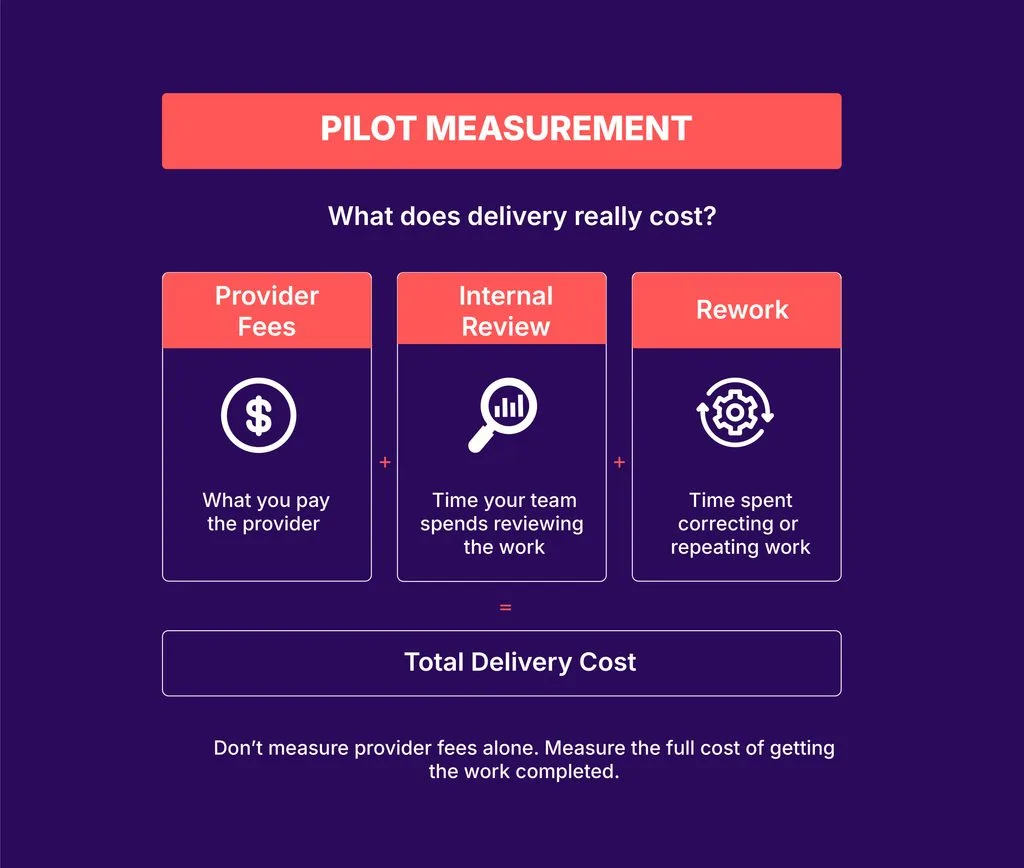
Track preparation fees, internal minutes, correction rounds, turnaround, and completed returns. Record why rework happens: missing source documents, unclear instructions, technical errors, or mismatched workpaper expectations. These observations help distinguish a fixable handoff problem from an unsuitable service arrangement.
Include compliance administration in the pilot budget. IRS guidance addresses taxpayer consent before tax information is sent outside the United States; obtain advice on the requirements applicable to your arrangement rather than treating a general engagement clause as sufficient.
Keep security work in the budget, too. The IRS states that professional tax preparers must create and maintain an information security plan for client data.
5. Separate expense reduction from capacity value.
Report tax season staffing savings separately from hours released for other work. Otherwise, the same employee time can appear twice: once as reduced expense and again as additional earning capacity.
Use three categories in your decision summary:
- Cash savings: Avoided hiring, overtime, or other spending, net of outsourced delivery costs.
- Capacity released: Internal hours available after coordination and review.
- Additional contribution: Revenue earned using those hours, less the incremental cost of delivering that work.
Treat scalable tax preparation support as a purchasing decision, not an automatic benefit. Check whether minimum volumes, cancellation terms, and peak-season commitments match your workload. Approve expansion only when the pilot supports both acceptable quality and the economics you need.
What should you do if the savings estimate falls short?
Identify which assumption failed before rejecting or expanding the arrangement. Higher review time, unplanned surcharges, or retained internal expenses require different responses. Recalculate tax outsourcing cost savings using observed results rather than the original quote.
If document cleanup consumes the difference, standardize intake before sending more work. If complex returns need extensive corrections, narrow the outsourced scope and retest it. If payroll remains unchanged, describe the result as capacity gained, not reduced tax preparation costs.
Set a maximum acceptable delivery cost before the next pilot. Include quality and completion requirements alongside that threshold; a lower invoice alone is not a successful outcome.
Conclusion
Outsourcing tax preparation saves money when avoidable internal costs exceed the total cost of outsourced delivery, including your own review. Build the baseline from completed work, request an all-in quote, test a representative pilot, and keep cash savings separate from released capacity. Those steps turn an estimate into a decision your partners can trust.
If you want help modeling your own numbers, visit the QX Accounting Services to explore tax, accounting and audit support for CPA firms, or learn how QX TaxReady handles personal returns at one fixed price per return.

Contact Us: Plan Your Tax Season Capacity →
Click HereFAQs
Is outsourcing tax preparation cheaper than hiring seasonal staff?
It can be, but compare both options at the same expected volume. Include recruiting, onboarding, supervision, and any minimum provider commitment. Test a lower-volume scenario as well: the cheaper option at full utilization may not remain cheaper when demand falls.
How can CPA firms calculate tax preparation outsourcing savings?
Create a worksheet by return category, enter avoidable internal expenses, and subtract complete outsourced delivery costs. Reconcile projected savings against actual invoices and internal time records after the pilot. This turns a proposal into a measurable business case.
What costs can CPA firms eliminate through tax outsourcing?
Potential candidates include an unfilled seasonal position, related recruiting expenses, or overtime that will no longer be needed. Existing commitments require separate scrutiny. Vendor oversight remains relevant: FTC guidance specifically includes service-provider monitoring within the security program.
Does outsourcing reduce the cost per tax return?
Only when total delivery cost divided by completed, accepted returns is lower than the comparable internal figure. Use accepted returns as the denominator, not files merely transferred to the provider. Keep complexity categories consistent between periods.
How does tax outsourcing affect CPA firm profit margins?
At unchanged revenue, genuine net expense reductions increase profit. Additional capacity improves profit only when it supports profitable work or avoids spending. Keep those effects separate when presenting CPA firm tax preparation cost savings to partners.
Does outsourcing remove a CPA firm’s data security responsibilities?
No. Your firm remains responsible for overseeing service providers that handle customer information. Ask where client data is stored, who can access it, and how subcontractors are controlled, and review the IRS guidance for tax professionals on protecting client data before you transfer records.
Can freed-up staff time be counted as savings?
Only when it changes spending. Hours released by outsourcing are capacity, and they become a financial benefit only when they produce additional revenue or avoid a cost such as overtime or a planned hire. Report the two separately so the same hours are not counted twice.
Enquire now

Arjun Varshneya
Arjun Varshneya is an experienced Operations Leader with over 13 years of expertise in managing global delivery teams across Client Accounting Services, Tax, and U.S. operations. An auditor by background, he brings deep delivery knowledge and operational leadership to help CPA firms improve quality, strengthen working standards, optimize capacity, and drive review readiness across accounting and tax workflows. At QX Accounting Services, he focuses on building scalable operating models that support quality, risk management, execution excellence, and sustainable efficiency across complex, high-volume environments.
Unauthorized copying or plagiarism of our content is a violation of intellectual property rights. We take such matters seriously and will pursue legal action to protect our original work. Anyone found engaging in such activities will be held accountable under applicable laws.
Don't forget to share this post!
Our Latest Insights




Let’s Work Together
Explore outsourcing solutions, request a no-obligation trial or discuss your practice’s needs with our expert consultants.
 Book a Virtual Meeting
 Get Your ROI Estimate