Tax Preparation Companies in the USA: Services, Pricing Models and How to Choose?



A tax preparation company can give an accounting firm flexible delivery capacity, access to trained preparers, and a more consistent workflow during peak season, but only when the provider fits the firm’s return mix, technology, review standards, and risk controls. This practical guide helps CPA firms and accounting practices define what they need, compare providers on an equivalent basis, test service quality, and move from a pilot to a controlled long-term engagement. It also explains the questions to ask about outsourced tax preparation services, pricing, security, responsibilities, and post-filing support. QX Accounting Services offers tax preparation support for accounting practices serving U.S. clients.
“The right tax preparation partner is the one that can show you its scope, review process, and safeguards in writing. Compare proposals against the same workload, test the arrangement with a pilot, and let observed results guide how far you expand.”
— Cora Vollmar, SVP-Growth, QX Accounting Services
A five-step approach to choosing the right provider
Let’s begin by defining the capacity, quality, or workflow problem your firm needs to solve. Translate that need into a written scope, compare providers against the same workload, verify their controls and delivery model, and test the preferred option through a controlled pilot. By the end, your firm should have the evidence needed to shortlist, select, contract with, and onboard the right tax preparation partner.
- Diagnose the need. Identify capacity gaps, bottlenecks, service risks, and seasonal pressure.
- Define the work. Specify return types, states, volumes, complexity, source-document condition, and deadlines.
- Compare consistently. Give shortlisted providers the same requirements and evaluation questions.
- Verify the claims. Request evidence, demonstrations, references, and contractual commitments.
- Test before scaling. Run representative work through a controlled pilot and review the results.
Define what your firm needs from a tax preparation partner
The right provider depends on why your firm needs support. A practice trying to absorb a predictable seasonal peak may need per-return capacity, while a firm seeking year-round workflow support may prefer a dedicated team or managed service. Document the business need before contacting vendors so that attractive demonstrations do not redefine your requirements.
Build a representative workload profile
Create a representative profile using recent, anonymized workload information. Separate straightforward returns from work involving multiple states, pass-through entities, incomplete records, foreign reporting, amended returns, or other specialist review. Include the tools your staff use, how source documents arrive, and the time available for questions and corrections.
- Volume: Expected weekly and seasonal return counts, including peak periods.
- Return mix: Individual, partnership, S corporation, C corporation, fiduciary, nonprofit, or other work.
- Complexity: Number of states, schedules, entities, adjustments, and recurring exceptions.
- Record readiness: Organized source files versus work requiring cleanup or follow-up.
- Delivery expectations: Standard turnaround, urgent work, review windows, and filing cutoffs.
- Internal capacity: Who will answer questions, review drafts, communicate with clients, and authorize filing.
Set measurable success criteria
Define success in operational terms that both parties can observe. Useful measures may include on-time delivery, completeness of workpapers, the number and type of review notes, question turnaround, rework, and the internal hours needed to coordinate and review the work. Avoid relying on a single measure: speed is not useful if it increases review effort, and a low unit price can be misleading if exclusions create frequent additional charges.
Outsourcing and internal hiring solve different capacity problems. Hiring may suit firms that need permanent, closely integrated capacity and can recruit, train, supervise, and retain the required talent. Outsourcing may suit firms that need flexible seasonal support, access to a broader delivery team, or a defined process without adding the same fixed headcount. Compare the options using total cost, speed to capacity, management effort, continuity, control, and the amount of work that must remain with your firm.
Choose the right capacity model, services, and responsibilities
A tax preparation company should provide a clearly defined service covering the returns, supporting work, and review responsibilities you need. Direct-to-taxpayer preparation and tax preparation support for CPA firms are different engagements: an outsourcing provider may prepare drafts and workpapers while the CPA firm manages client communication and final review.
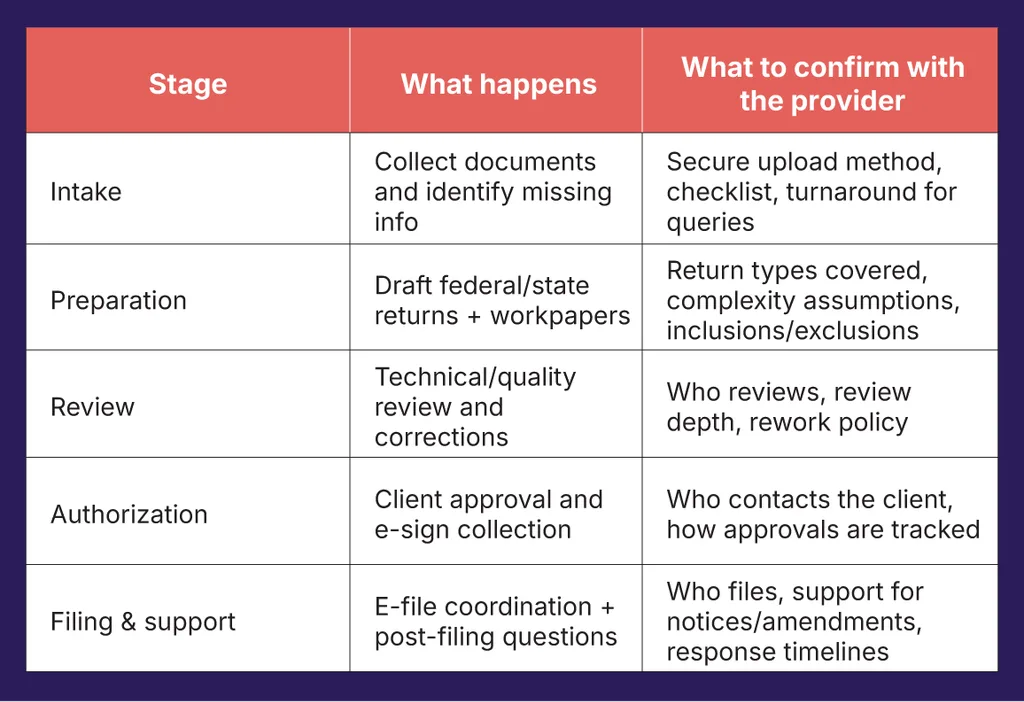
Before comparing proposals, separate essential deliverables from optional services. Ask each provider to mark the following as included, excluded, or separately priced:
- Document intake: Organizing source records and identifying missing information.
- Return preparation: Specifying federal and state returns, schedules, and supporting workpapers.
- Review: Naming who checks calculations, resolves questions, and approves completed work.
- Filing coordination: Clarifying who obtains authorizations, transmits returns, and handles rejected submissions.
- Post-filing assistance: Defining support for corrections, notices, and questions after delivery.
Do not assume that preparing a return includes representing a taxpayer before the IRS. Representation rights vary by professional qualification, and the IRS recommends choosing someone who remains available when questions arise. Get post-filing responsibilities in writing before the engagement starts.
Assign responsibility at every workflow stage
Two providers can describe the same service very differently. One may deliver a prepared return and supporting workpapers, while another may also manage intake, workflow status, review coordination, or e-file support. Build a responsibility matrix showing who performs, reviews, approves, and communicates at every stage.
| Activity | Your firm | Provider | Decision to document |
| Client communication | Usually retains relationship ownership | May provide questions through the firm | Whether direct client contact is permitted |
| Document intake | May collect and authorize access | May organize and flag gaps | Required formats, naming, and completeness checks |
| Preparation | Provides policies and prior-year context | Prepares agreed returns and workpapers | Included forms, states, schedules, and assumptions |
| Technical review | Retains final professional judgment | Performs agreed quality checks | Review depth, sign-off, and escalation route |
| Authorization and filing | Obtains approvals and controls release | Supports only if expressly included | Who transmits, monitors, and resolves rejections |
| Post-filing work | Manages client relationship and advice | May support corrections or notices | Response times, fees, and retention period |
Define exclusions as clearly as inclusions
A clear scope should state what the provider will not do. Common boundaries include bookkeeping cleanup, tax planning, tax positions requiring specialist advice, client calls, amended returns, notice responses, extensions, estimates, and e-filing. Exclusions are not necessarily weaknesses; hidden or inconsistent exclusions are the problem. Require a process for approving out-of-scope work before charges are incurred.
Specify what a completed deliverable includes
Describe what a completed assignment must contain: the return file, workpapers, open-item list, preparer notes, review responses, status update, and any documents returned to your system. Agree file-naming rules, version control, and where the authoritative copy will be stored. This reduces avoidable review time and makes performance easier to assess.
Compare tax preparation pricing models on equal terms
Compare pricing models by applying them to the same workload and service scope. A per-return proposal and a dedicated-resource proposal measure different things, so the headline prices alone cannot establish value. QXAS lists per-return, dedicated monthly, transaction-based, and managed outsourcing arrangements among its engagement options; availability and terms should be confirmed in each proposal.
Per-return pricing links cost to completed returns and can suit a defined seasonal batch, but firms should confirm how complexity, state filings, and revisions are classified. A dedicated monthly resource provides recurring capacity, so the comparison should consider supervision, utilisation, and cover during absences. Transaction-based pricing charges for an agreed unit of output and therefore requires a precise definition of completion and exceptions. Managed outsourcing prices a broader process or outcome, making service levels, governance, review ownership, and exclusions especially important.
Use this table as a proposal checklist, not a guarantee that every provider offers every model. Request a written explanation of what triggers additional charges. A useful quote should distinguish preparation from bookkeeping cleanup, planning, amendments, and post-filing work.
For example, ask two shortlisted providers to quote the same anonymized workload description: return types, state coverage, record condition, expected volume, and delivery requirements. Then add your internal review and coordination effort to the comparison. This creates a more useful decision than comparing an advertised starting price with a fully scoped engagement.
Avoid refund-linked pricing. The IRS advises taxpayers to avoid preparers whose fees depend on the size of the refund.
Calculate the total cost of the engagement
To compare offers fairly, include costs that sit outside the vendor invoice. Estimate internal time for onboarding, answering questions, reviewing work, correcting errors, maintaining software access, and managing the relationship. Also test how each model behaves when volume is lower or higher than expected.
- Base service fees: recurring charges or agreed unit rates.
- Complexity and exception fees: additional states, forms, cleanup, rush work, revisions, and amendments.
- Internal coordination: staff time required for handoffs, queries, monitoring, and escalation.
- Review and rework: time spent checking output and resolving recurring issues.
- Technology and access: licences, portals, integrations, secure environments, or implementation support.
- Transition costs: knowledge transfer, documentation, training, and exit assistance.
Test pricing against three workload scenarios
Ask each provider to price a low, expected, and peak-volume scenario using the same assumptions. This exposes minimum commitments, capacity limits, overtime or rush charges, and unused-capacity risk. Request a worked example showing how a return moves from the quoted base category to a higher-priced category.
Clarify these commercial terms
- What is included in the base fee, and what is always billed separately?
- How are complexity, incomplete records, additional states, and late changes classified?
- Are minimum volumes, deposits, onboarding fees, or annual commitments required?
- How are rejected work, corrections, and provider-caused rework handled?
- What happens to price and capacity during extensions and peak weeks?
- What are the renewal, termination, transition, and data-return terms?
Evaluate the factors that matter beyond price
The best tax preparation company is the one that can demonstrate a fit for your work, not the one making the broadest promises. Build your shortlist around evidence you can inspect: sample deliverables, documented procedures, named contacts, and clear contractual responsibilities. Use the following criteria to make provider discussions specific.
Confirm relevant expertise and review accountability
Ask a prospective tax preparation provider for CPA firms to describe experience with your actual return mix. Request a sample workpaper package or a walkthrough using synthetic information rather than identifiable client records. Establish who prepares, who reviews, and who resolves technical disagreements.
For paid federal return preparation, verify applicable PTIN requirements and the qualifications of the people responsible. A PTIN is not equivalent to a CPA license or enrolled agent credential. Taxpayers remain ultimately accountable for information reported on their returns, even when they hire a preparer.
Examine data protection and processing locations
Ask tax preparation outsourcing companies to explain their written information security program, access restrictions, encryption, multifactor authentication, and incident response arrangements. The FTC identifies tax preparation firms among businesses covered by its Safeguards Rule and requires covered businesses to oversee service providers handling customer information. Request evidence relevant to the proposed engagement rather than accepting a general “secure” label. (ftc.gov)
Identify where staff access information, whether subcontractors participate, and how access ends when someone leaves. Tax return information is subject to restrictions on use and disclosure under Section 7216. Determine which exceptions or consent requirements apply before sharing information, particularly when overseas processing is involved.
Assess software fit, communication, and continuity
Ask providers to demonstrate the proposed workflow in your software environment. Set expectations for status updates, missing-information requests, escalation contacts, and coverage during absences. Also agree how files, workpapers, and access permissions will be handled when the engagement ends.
When comparing outsourced tax preparation companies, request these commitments in writing. A polished demonstration is useful, but a documented operating process gives your team something concrete to manage against throughout the season.
| Category | Questions to ask | Evidence to request |
| Scope fit | Which return types/states are included? What’s excluded? | Written scope + sample deliverables/workpapers |
| Review ownership | Who prepares vs. who reviews? How are issues resolved? | RACI/role matrix + QA process description |
| Security | How is data protected in transit/at rest? Who has access? | Security controls summary + access/offboarding process |
| Compliance | How are Section 7216 consents handled (if applicable)? | Consent language/process + handling procedures |
| Operations | How are status updates, SLAs, and escalations managed? | Reporting cadence + sample tracker/dashboard |
| Pricing clarity | What triggers extra fees? How are revisions billed? | Rate card + assumptions/exceptions list |
Verify provider claims through due diligence
Treat due diligence as an evidence exercise, not a sales conversation. Give every finalist the same request, score responses against the same criteria, and distinguish current evidence from incomplete claims or material available only under a nondisclosure agreement. Bring in operations, tax leadership, information security, legal or compliance, and procurement where their expertise is relevant so that the final decision reflects delivery, risk, and commercial fit, not presentation quality alone.
Validate capability and quality controls
- Request examples of comparable work using synthetic or properly anonymized information.
- Ask how preparers are trained, assigned, supervised, and assessed for the return types in scope.
- Review the provider’s quality-control stages, error classification, root-cause process, and corrective actions.
- Confirm how technical questions are escalated and who has authority to resolve disagreements.
Review security and privacy safeguards
- Map where data will be stored, viewed, transferred, backed up, and deleted.
- Identify all organizations and locations involved, including subcontractors and remote personnel.
- Review access controls, multifactor authentication, encryption, logging, monitoring, incident response, and offboarding.
- Confirm breach-notification duties, cooperation obligations, audit rights, retention periods, and secure data return or destruction.
Assess operational resilience
- Ask how the provider handles staff absence, demand spikes, technology outages, and location disruption.
- Confirm named primary and backup contacts, escalation levels, and response targets.
- Review business-continuity testing, backup arrangements, and recovery priorities relevant to tax deadlines.
- Understand dependency on specific individuals, systems, subcontractors, or processing locations.
Check references and test the workflow
Use references to validate claims that matter to your engagement. Ask about return mix, seasonality, communication, review effort, response to mistakes, and performance under pressure. During demonstrations, follow a realistic assignment from intake through delivery rather than viewing only a prepared presentation.
Investigate these warning signs
- Vague answers about who performs or reviews the work.
- A price that cannot be tied to written assumptions and exclusions.
- Reluctance to identify processing locations, subprocessors, or security responsibilities.
- Quality claims supported only by broad percentages without definitions or sample evidence.
- No clear process for corrections, escalation, transition, or data return.
- Pressure to commit significant volume before completing a representative pilot.
Compare shortlisted providers with a weighted scorecard
Agree the evaluation method before final presentations. Weight the categories according to your firm’s risk and operating priorities, score each provider against the same evidence, and record important conditions or gaps beside the numeric score. A score supports judgment; it should not hide a critical failure in security, compliance, professional responsibility, or service continuity.
Test the engagement through a controlled pilot
Before committing a large workload, use a limited pilot to test the proposed arrangement. Agree its scope and evaluation criteria before work begins, including how lawful access to client information will be established. Treat the pilot as a test of both the provider and your own handoff process.
- Define representative work. Include the return types and record conditions the provider would actually receive.
- Document ownership. Assign responsibility for intake, technical questions, review, authorization, and filing.
- Track useful outcomes. Record delivery time, unresolved questions, correction requests, and internal review effort.
- Review the economics. Compare the quote with coordination, software, and review costs.
- Agree the next stage. Resolve recurring issues before increasing volume or extending the contract.
Set pilot acceptance criteria before work begins
Record the starting point, target, measurement method, owner, and review date for every pilot criterion. Use a balanced set of measures and classify issues by severity so that minor formatting points are not treated the same as technical errors or missed deadlines.
| Measure | How to assess it | Decision question |
| Timeliness | Compare agreed and actual delivery times by work type | Was delivery dependable under normal and peak conditions? |
| Completeness | Check required files, workpapers, notes, and status updates | Could reviewers begin without chasing missing items? |
| Technical quality | Classify review notes, corrections, and repeated issues | Did the output meet the agreed preparation standard? |
| Communication | Track question clarity, response times, and escalation | Were issues raised early and resolved by the right people? |
| Internal effort | Record coordination and review time by assignment | Did the model release capacity or move work elsewhere? |
| Commercial outcome | Compare invoice, exceptions, and internal effort with assumptions | Was the total cost predictable and proportionate? |
Scale the engagement in controlled stages
If the pilot meets the agreed standard, increase volume in controlled stages rather than moving the full workload immediately. Each stage should have a volume limit, work types, review intensity, monitoring period, and approval owner. Keep a rollback plan for recurring quality issues, capacity shortfalls, security events, or unacceptable review effort.
Finalize the contract and onboarding plan
Before production work begins, translate the agreed operating model into the contract, implementation plan, and day-to-day procedures. The legal agreement and the practical workflow should describe the same responsibilities.
- Scope: services, deliverables, return types, volumes, exclusions, assumptions, and change control.
- Service management: turnaround targets, working hours, status reporting, escalation, review, and correction procedures.
- People: named owners, backup contacts, staffing changes, training, and subcontractor controls.
- Security and privacy: permitted access, locations, safeguards, incidents, retention, deletion, and audit evidence.
- Commercial terms: rates, minimums, exceptions, invoicing, renewals, termination, and transition assistance.
- Technology: systems, licences, access approvals, testing, file standards, and support ownership.
- Governance: meeting cadence, performance reporting, issue log, improvement plan, and approval for scaling.
Prepare your internal team
Provider selection alone will not create a successful engagement. Train internal staff on the new handoff, explain which questions should be escalated, standardize source-document requirements, and protect reviewer time during the first production cycles. Assign one operational owner who can coordinate decisions across tax, technology, security, and commercial stakeholders.
Decide in advance what would justify expansion, further testing, or stopping the engagement. That keeps the decision tied to observed results rather than a deadline-driven impression.
Follow a structured provider-selection process
A disciplined selection does not need to be slow, but it should create comparable evidence and clear decision ownership. Use the following sequence as a working procurement plan.
- Confirm internal requirements. Approve workload, scope, constraints, mandatory controls, budget approach, and decision-makers.
- Create a longlist. Screen providers for relevant services, operating model, capacity, and basic risk requirements.
- Issue a consistent request. Provide the same anonymized workload profile, questions, pricing scenarios, and evidence list.
- Evaluate written responses. Score evidence, record gaps, and remove providers that fail mandatory requirements.
- Run structured demonstrations. Use realistic workflow scenarios and include operational, technical, and security stakeholders.
- Complete due diligence. Validate references, controls, contracts, processing arrangements, and continuity.
- Conduct a pilot. Test representative work against agreed measures and review the total internal effort.
- Negotiate and onboard. Align scope, responsibilities, service levels, security, pricing, governance, and exit provisions.
- Scale with checkpoints. Expand only when quality, capacity, communication, and economics remain acceptable.
Ask every shortlisted tax preparation company these questions
- Which parts of our proposed return mix are standard for your team, and which require specialist review?
- Who will prepare and review our work, and how will staffing changes be communicated?
- What does a complete deliverable include, and what work is excluded?
- How do you measure timeliness, quality, rework, and unresolved questions?
- How will our data be accessed, stored, transferred, retained, and deleted?
- Which locations and subcontractors will participate in the service?
- How will the workflow operate in our software and document-management environment?
- What capacity is reserved for peak weeks, and how is continuity maintained?
- What triggers additional fees, and how are exceptions approved?
- How will recurring issues be corrected, reported, and prevented?
- What happens if service levels are missed or the engagement ends?
- What evidence can you provide to support each answer?
Conclusion
The right tax preparation company is not simply the provider with the lowest price or the broadest service claim. It is the provider whose capabilities, controls, people, workflow, and commercial model match your actual workload, and whose claims can be tested. Define the scope in writing, compare equivalent proposals, verify review ownership and data safeguards, use a representative pilot, and scale only when results remain dependable. To explore support for your practice, visit the QX Accounting Services or contact us with your expected volume, return mix, software environment, timeline, and service requirements.
FAQs
What Are Tax Preparation Companies?
They are businesses that provide tax return preparation services. Some work directly with taxpayers; others support accounting firms through outsourced preparation. The practical distinction is who engages the taxpayer, communicates advice, reviews the work, and takes responsibility for each stage of delivery.
What is the difference between a tax preparation company and a tax planning company?
Preparation focuses on completing returns, while planning considers how prospective decisions may affect taxes. A tax preparation and planning company may offer both, but buyers should request separate deliverables: a completed return does not establish that ongoing advisory meetings or forward-looking analysis are included.
Are outsourced tax preparation services secure?
They can be supported by strong safeguards, but outsourcing does not eliminate risk. Assess the actual systems, people, service-provider controls, and disclosure arrangements involved. A security claim or confidentiality agreement should not replace review of the provider’s documented protections and your own compliance obligations.
What factors affect tax preparation service pricing?
Ask how the provider prices return complexity, state coverage, record cleanup, review, turnaround requirements, and additional support. Also confirm whether charges follow completed returns, assigned resources, or managed deliverables. QXAS’s engagement options illustrate why buyers should establish the pricing basis before comparing totals.
Can tax preparation companies handle business and corporate tax returns?
Yes, providers with appropriate capabilities can support business returns. Confirm experience with the entity’s federal tax classification and relevant filings; partnerships generally use Form 1065, while qualifying S corporations use Form 1120-S. An LLC label alone does not determine its federal income tax return.
Enquire now

Mangesh Singh
With nearly 20 years of experience in U.S. and Canadian tax, accounting, and operations, Mangesh is a PMP and CFP who drives service delivery, workflow efficiency, and team performance at QX Accounting Services. He supports CPA firms with scalable accounting and tax operations, helping improve accuracy, review quality, turnaround times, and client service. Known for his operational discipline and strategic insight, he turns complex delivery challenges into practical solutions that support consistency, accountability, and sustainable growth.
Unauthorized copying or plagiarism of our content is a violation of intellectual property rights. We take such matters seriously and will pursue legal action to protect our original work. Anyone found engaging in such activities will be held accountable under applicable laws.
Don't forget to share this post!
Our Latest Insights




Let’s Work Together
Explore outsourcing solutions, request a no-obligation trial or discuss your practice’s needs with our expert consultants.
 Book a Virtual Meeting
 Get Your ROI Estimate