What Marketing Services Should CPA Firms Outsource? A Guide for US Accounting Practices



For many US accounting practices, growth is limited less by technical expertise and more by visibility, consistency, and follow-up. Outsourced marketing for CPA firms can provide the strategy, website support, SEO, content, paid campaigns, email, reporting, and design capacity needed to keep marketing moving while firm leadership retains ownership of positioning, approvals, client relationships, and compliance standards.
This guide explains which marketing services CPA firms should outsource, which responsibilities should remain close to leadership, and how to build a balanced model that supports qualified growth without turning marketing into another demand on partners and client-service teams.
“Outsource the execution, not the judgment. CPA firm leaders should retain control of positioning, technical accuracy, client fit, and growth priorities.”
– Cora Vollmar, Sr VP Growth, QX Marketing Services
- Marketing Services CPA Firms Should Outsource First
- Why Outsourced Marketing Works for CPA Firms in the USA
- How CPA Firms Should Set Marketing Strategy Before Outsourcing?
- CPA Firm Website Optimization for Better Lead Conversion
- SEO for CPA Firms: Local Search and Organic Growth
- Content Marketing for Accounting Firms That Builds Trust
- PPC Marketing for CPA Firms: Paid Search and Lead Quality
- Email Marketing for CPA Firms: Lead Nurturing and Client Communication
- What CPA Firms Should Keep In-House vs. Outsource?
- CPA Firm Lead Generation: Build a Connected Multi-Channel System
- How to Choose an Outsourced Marketing Partner for Your CPA Firm?
- What CPA Firms Should Outsource at Each Growth Stage?
- Turn Outsourced Marketing Into a Predictable Growth Engine
- Conclusion
- FAQs
- When Should a CPA Firm Outsource Its Marketing?
- How Do Outsourced Marketing Services Help CPA Firms Generate Better Leads?
- Which CPA Firm Marketing Services Are Best to Outsource First?
- What Should CPA Firms Outsource at Each Stage of Growth?
- How Should CPA Firms Measure the ROI of Outsourced Marketing?
- Why Choose QX for Outsourced Marketing Services for CPA Firms?
Marketing Services CPA Firms Should Outsource First
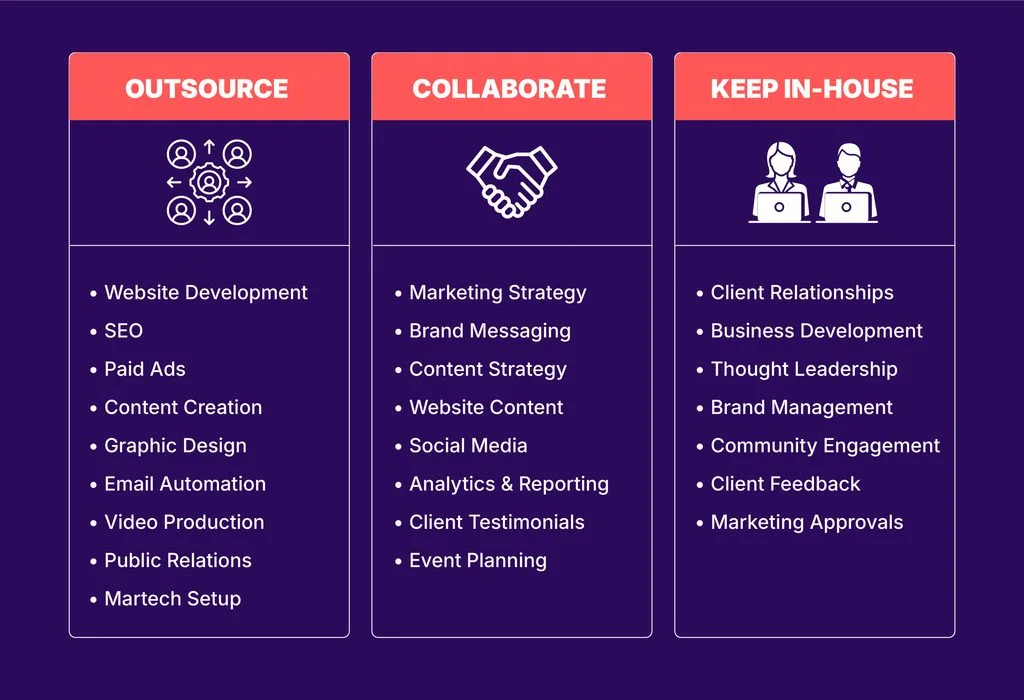
CPA firms usually gain the most value by outsourcing specialist, execution-heavy marketing work first: website optimization, SEO, content, PPC, email, analytics, reporting, and design. Firm leaders should stay closely involved in positioning, niche selection, service priorities, ideal-client decisions, technical accuracy, and final approvals. This balance gives the firm consistent marketing momentum without removing strategic control from leadership.
CPA firms should usually outsource the marketing services that require specialist execution, consistent production, or technical expertise the internal team cannot maintain reliably. That often includes website optimization, SEO for CPA firms, content marketing, PPC management, email automation, analytics, reporting, and design support.
Strategy can also be guided by an outsourced partner, but firm leaders should stay closely involved in positioning, niche selection, service priorities, ideal-client decisions, and final approval.
A practical starting point is to outsource the work that is both important and difficult to maintain during busy season. If blog publishing stops every spring, PPC campaigns run without review, website updates remain unfinished, or reports are produced without clear action, those are strong candidates for external support.
Accounting firm marketing outsourcing works best when it creates dependable momentum rather than occasional bursts of activity.
The objective is not to move every marketing task outside the firm. It is to place specialist and execution-heavy work with a team equipped to handle it, while using partner time for decisions that genuinely require leadership judgment.
That division gives the firm more consistent delivery without disconnecting marketing from business strategy.
Why Outsourced Marketing Works for CPA Firms in the USA
CPA firm growth depends on trust, timing, and visibility. Prospects often search when they have a specific need: a business is expanding, books are messy, tax planning has become more complex, or leadership wants stronger advisory support. If the firm is difficult to find, unclear online, or inconsistent in follow-up, those prospects may choose a competitor before a conversation begins.
Outsourcing solves three common constraints. It gives the firm access to specialist skills that are rarely found in one internal hire, including technical SEO, copywriting, paid search, conversion tracking, and marketing automation. It also adds capacity when attention is focused on client delivery and creates a repeatable operating rhythm, so marketing continues through busy season instead of depending on whichever partner has time that week.
That does not mean every responsibility should leave the firm. The strongest model gives the outsourced team ownership of planning, production, execution, optimization, and reporting, while firm leaders define business priorities, provide subject-matter expertise, approve technical messaging, and clarify which clients and services the firm wants to grow.
This approach makes outsourced marketing more than a collection of tasks. It becomes a managed growth function with clear ownership, specialist depth, and a cadence for reviewing progress. Firm leaders stay in control of the decisions that shape reputation and client fit without having to coordinate every campaign detail.
How CPA Firms Should Set Marketing Strategy Before Outsourcing?
Before outsourcing individual CPA firm digital marketing services, clarify what the firm wants marketing to accomplish. A general goal such as “more leads” is too broad. A stronger objective might be attracting more construction clients, increasing CAS inquiries, building visibility for high-net-worth tax planning, or supporting recruitment alongside business development.
An outsourced marketing partner can translate those goals into a working plan that defines target audiences, priority services, differentiators, geographic markets, content themes, lead sources, and measurement. Before execution begins, firm leaders should align on a structured CPA firm marketing plan. Without that foundation, marketing can look busy while failing to move the firm toward better-fit clients.
Positioning is especially important for firms that offer similar core services to local competitors. Tax preparation, audit, CAS, bookkeeping, advisory, and payroll pages can sound interchangeable when written without a distinct point of view. Outsourced strategists and writers can sharpen the message, but partners should contribute the nuance: who the firm serves best, which problems it solves repeatedly, and what makes the client experience different.
A strong strategy also connects demand creation to delivery capacity. If the firm wants more advisory work, marketing should promote the service, explain why it matters, and direct prospects toward a relevant next step. Leadership must also confirm that the firm has the people and process to respond when those opportunities arrive.
A simple way to decide what to outsource is to ask three questions: does this task require specialist knowledge, does it need consistent execution throughout the year, and does it directly affect lead quality or conversion? If the answer is yes, it is usually a strong outsourcing candidate. If the task involves firm positioning, technical advice, client promises, or relationship judgment, leadership should stay closely involved.
CPA Firm Website Optimization for Better Lead Conversion
A CPA firm’s website is often the first serious trust checkpoint for a prospect. It does not need to be flashy, but it must be clear, fast, easy to navigate, and built around the services and industries the firm wants to grow. If visitors cannot quickly understand who the firm helps and what to do next, traffic alone will not produce meaningful CPA firm lead generation.
Outsourcing website work is usually sensible because it combines design, copywriting, user experience, development, search optimization, and analytics. A strong provider can improve service pages, calls to action, navigation, and contact forms while ensuring the site supports both organic and paid traffic. QX’s marketing services for CPA firms connect these execution areas to positioning, lead generation, and performance reporting. Firms comparing external support with internal hiring can also review outsourced marketing vs. in-house teams for CPA firms.
For CPA firms, the most important website pages are usually service pages, industry pages, location pages, leadership or team pages, and contact pages. Each should answer real buyer questions: what the service includes, who it is for, when the prospect should seek help, and why the firm is a credible option. Good website outsourcing turns these pages from static brochures into business-development assets.
Conversion improvements should reduce friction once a visitor is ready to act. Contact forms should ask only for the information needed for the next conversation, calls to action should match the page context, and lead sources should be captured so the firm can distinguish general visibility from qualified opportunity generation.
SEO for CPA Firms: Local Search and Organic Growth
SEO for CPA firms is one of the strongest candidates for outsourcing because it requires ongoing technical, analytical, and editorial work. Search visibility depends on more than adding keywords to a page. It includes site structure, page quality, local signals such as an accurate Google Business Profile, internal linking, technical health, content relevance, and alignment with the way prospects search. Google Search Console can then help teams monitor queries, clicks, impressions, indexing, and page performance in Google Search.
A CPA firm may know its services deeply but still struggle to create search-friendly pages. For example, a partner may describe a service as outsourced accounting, while a business owner searches for monthly bookkeeping and tax planning for a small business. A skilled SEO team can bridge that language gap while keeping the content accurate and professional.
Typical outsourced SEO work includes keyword research, on-page optimization, local SEO, technical audits, competitor analysis, content planning, and performance reporting. The goal is not simply to rank for broad accounting terms. It is to attract business owners, executives, nonprofit leaders, and individuals actively seeking the type of help the firm provides. For a useful baseline, refer to Google’s SEO Starter Guide.
SEO reporting should separate broad visibility from business value. Rankings and organic traffic are useful indicators, but the stronger questions are whether priority service pages attract suitable visitors, whether those visitors take meaningful action, and whether the firm can connect search activity to consultations and opportunities. Tools such as Google Search Console can help teams review queries, clicks, impressions, indexing, and page performance in Google Search.
Content Marketing for Accounting Firms That Builds Trust
Content marketing for accounting firms is valuable because many prospects need education before they are ready to contact a CPA. They may not know whether they need tax planning, advisory services, bookkeeping cleanup, audit support, or a more strategic year-round relationship. Helpful content gives them language for the problem, shows them what good support looks like, and demonstrates that the firm understands their situation.
This work is often worth outsourcing because consistency matters. A content plan may include service-page updates, blog articles, industry guides, newsletters, lead magnets, partner ghostwriting, and social posts. The outsourced team can handle research, structure, drafting, editing, optimization, and publishing support, while the firm reviews technical accuracy and contributes practical insight.
The best accounting content is not generic tax trivia. It reflects the firm’s services, ideal clients, and recurring advisory conversations. A strong article might explain when a growing business should move beyond basic bookkeeping, how year-round tax planning differs from return preparation, or what nonprofit boards should understand about financial reporting. This content supports SEO, builds authority before the first conversation, and gives partners useful material for business development.
A disciplined outsourced content process also reduces the burden on partners. Subject-matter experts can provide focused input through interviews, notes, or review, while the external team turns that expertise into organized, accessible content. The firm retains accuracy and voice without requiring partners to draft every article themselves.
PPC Marketing for CPA Firms: Paid Search and Lead Quality
PPC marketing for CPA firms can generate visibility quickly, especially for competitive services or locations where organic rankings need time to develop. It can also waste budget quickly if campaigns launch without tight targeting, relevant landing pages, and ongoing review. Because paid search directly affects spend and lead quality, it is usually better assigned to specialists than handled casually as an administrative task.
A good PPC partner should choose the right campaign structure, target relevant searches, write and test ad copy, improve landing pages, monitor search terms, and report on lead quality. For CPA firms, lead fit matters more than raw volume. A campaign that generates many unsuitable inquiries can increase workload without creating meaningful opportunities.
Paid campaigns work best when connected to a clear offer or service line. Examples include tax-planning consultations, outsourced accounting inquiries, CAS discovery calls, audit support for defined organizations, or industry-focused advisory services. The firm should review inquiries and provide lead-quality feedback so the outsourced partner can improve targeting over time.
PPC results should not be assessed only through clicks or form fills. The firm and provider should agree on what qualifies as a relevant inquiry, how calls and forms are tracked, and how quickly internal teams follow up. This closes the gap between campaign activity and revenue opportunity. For paid campaigns, landing page relevance, navigation, and usefulness should also be reviewed against Google Ads landing page guidance.
Email Marketing for CPA Firms: Lead Nurturing and Client Communication
Not every prospect is ready to schedule a call the first time they visit the website. Some are researching options, comparing firms, or waiting for the right financial trigger. Email marketing helps CPA firms remain visible during that consideration period and maintain useful contact with existing clients.
Outsourced email support can include newsletter planning, list segmentation, copywriting, campaign design, automation setup, and performance tracking. This is especially useful for firms that want to communicate consistently but do not have time to draft and send messages every month. Email can support tax-season reminders, advisory topics, deadline awareness, service updates, and educational content.
The tone should be helpful rather than aggressive. CPA firm audiences respond better to clear, relevant, and timely guidance than to constant promotional messages. An outsourced team can create the cadence and process, while the firm approves sensitive topics and protects the standards clients expect from a trusted adviser. For compliance basics, refer to the FTC’s CAN-SPAM compliance guide. For performance context, email teams can benchmark open, click, and unsubscribe trends against Mailchimp’s email marketing benchmarks.
A useful email program should also connect with the broader marketing system. Content can support nurture sequences, service pages can provide deeper information, and CRM tracking can show whether subscribers progress toward consultations or additional services. This makes email part of pipeline development rather than a standalone newsletter exercise.
What CPA Firms Should Keep In-House vs. Outsource?
CPA firms should retain final control over business direction, technical accuracy, client promises, compliance-sensitive messaging, and relationship-based business development. An outsourced partner can lead marketing strategy and execution, but firm leadership should decide which services and clients to prioritize, what the firm is willing to promise, and how technical advice is framed.
The firm should also own its brand reputation and sales response. That includes how partners appear in thought leadership, how inquiries are qualified, and how quickly the team follows up. Even strong outsourced marketing cannot compensate for slow response times, unclear intake, or limited capacity to pursue suitable opportunities.
A simple division of responsibility can help clarify the working model:
- The outsourced team researches, drafts, builds, launches, optimizes, and reports.
- The firm provides goals, subject-matter insight, approvals, and feedback on lead quality.
- Both sides review performance, changing priorities, and the next growth opportunity on a regular cadence.
This division protects strategic control without turning partners into project managers. The outsourced team owns the marketing operating rhythm, while firm leaders use their time where it has the greatest value: market priorities, technical judgment, client fit, and sales conversations.
CPA Firm Lead Generation: Build a Connected Multi-Channel System
CPA firm lead generation works best when marketing channels support one another. SEO creates qualified visibility. Content builds trust. Website conversion captures demand. PPC accelerates reach and tests intent. Email nurtures prospects over time. Reporting shows which activities are producing meaningful conversations and where the next investment should go.
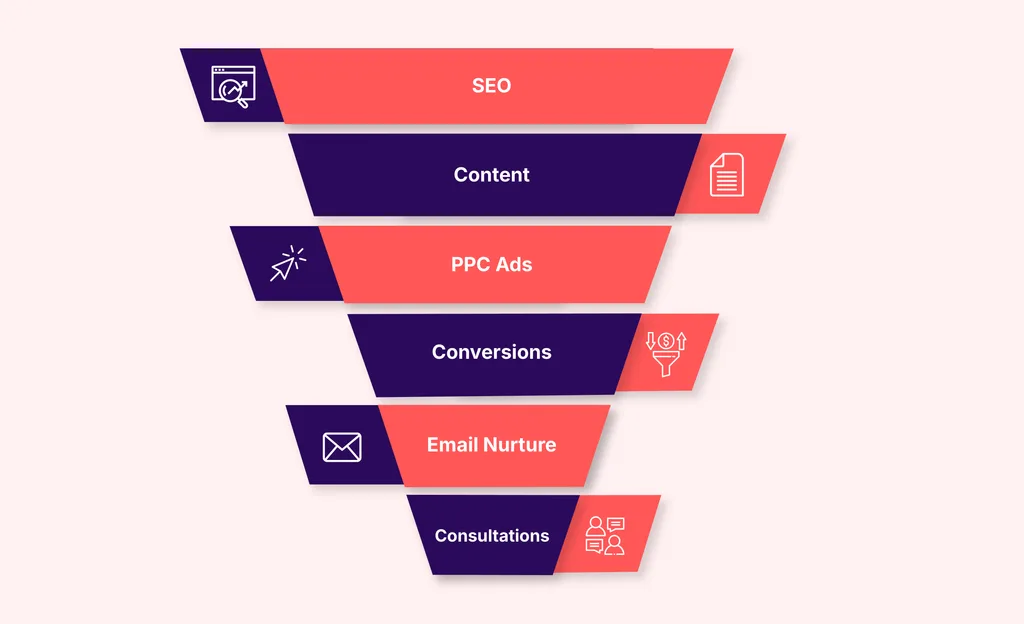
The mistake many firms make is treating each tactic separately. A blog post is published but not linked to a service page. A paid ad sends visitors to a generic homepage. A contact form collects inquiries, but no one tracks which campaign produced them. Outsourced marketing should connect these pieces into a system that supports measurable growth.
For firms evaluating marketing services for CPA firms, the priority is a partner that understands both digital execution and accounting-practice operations. Marketing should make the firm easier to find, understand, and contact without creating unnecessary complexity for partners and staff. Firms comparing internal, external, and hybrid structures can also review this guide to outsourced marketing vs. in-house teams for CPA firms.
At minimum, the firm should define what counts as a qualified inquiry, which service lines are priorities, which budget or business indicators matter, who responds to new inquiries, and how feedback is shared with the marketing partner. Without this feedback loop, campaigns may generate activity without showing which leads are worth pursuing.
A mature system also defines lead qualification and follow-up. Marketing and business development should agree on what a suitable opportunity looks like, which information should be captured, who responds, and how feedback returns to the marketing team. That feedback helps outsourced specialists refine audiences, messaging, and channel investment.
How to Choose an Outsourced Marketing Partner for Your CPA Firm?
Choose an outsourced marketing partner based on strategic fit, accounting-industry understanding, transparency, and the ability to execute consistently. The right partner should ask about the firm’s service mix, ideal clients, capacity, seasonality, approval process, intake workflow, and growth goals before recommending tactics. If the conversation jumps straight to ads, blogs, or rankings, the plan may be too generic.
Look for a partner that explains its process in plain language. You should understand what will be delivered each month, what the provider needs from the firm, how performance will be measured, and how often campaigns will be reviewed. Reporting should connect marketing activity to business outcomes such as qualified inquiries, consultation requests, service-line interest, and lead-source trends.
A sensible evaluation checklist includes:
- Experience with professional services or accounting-related marketing
- A clear method for SEO, content, PPC, website conversion, and reporting
- Respect for compliance, technical accuracy, and approval workflows
- The ability to write for business owners without oversimplifying technical topics
- Transparent communication about timelines, responsibilities, and results
The best partner will not promise instant dominance or effortless growth. A stronger provider will connect strategy, specialist execution, lead-quality feedback, and measurable reporting to build a durable marketing engine that improves over time. Firms comparing providers can review how to choose an outsourced marketing partner for CPA firms and this list of top marketing services companies for CPA firms.
What CPA Firms Should Outsource at Each Growth Stage?
CPA firms do not need to outsource everything at once. A phased approach is easier to govern and measure. Start with the assets that influence every channel, then add campaigns when the foundation can convert attention into qualified inquiries.
Phase one should focus on strategy, website clarity, analytics, and priority service pages, creating a stronger base for SEO, paid traffic, and referrals. Phase two can add content marketing, local SEO, and email nurturing so the firm becomes more visible and useful to prospects over time. Phase three can introduce PPC or more advanced campaigns for specific growth goals, such as expanding an advisory service line or entering a niche market.
This sequence prevents wasted spend. Driving traffic to a weak website or launching campaigns without clear positioning can create activity without results. Building the foundation first gives every outsourced service a stronger chance to perform and gives leadership a clearer view of where growth is coming from.
The roadmap should remain flexible. Some firms already have a strong website but lack content and reporting. Others have steady content but weak conversion tracking. A capable outsourced partner should diagnose the actual gap and prioritize work by likely business impact instead of forcing every firm through the same package.
Turn Outsourced Marketing Into a Predictable Growth Engine
The marketing services CPA firms should outsource are those that require consistency, technical skill, and focused execution: SEO, content, website optimization, PPC, email, analytics, and design. Firm leaders should keep close control of business priorities, technical judgment, reputation, client promises, and final decisions.
When that balance is right, accounting firm marketing outsourcing becomes more than a way to remove tasks from a partner’s calendar. It becomes a structured growth system that helps the firm communicate its value, attract better-fit prospects, and support business development throughout the year. For US accounting practices navigating competition, staffing pressure, and changing client expectations, the right partner brings specialist depth, operating discipline, and visibility into what is working.
The aim is not more activity for its own sake. It is a reliable process for choosing priorities, executing consistently, measuring lead quality, and making better decisions. This is where outsourced marketing delivers strategic value: the firm gains a marketing engine without having to build and manage every capability internally.
Conclusion
Outsourcing marketing does not mean giving up control. It means creating reliable execution around the work that is hardest to maintain consistently in-house. For most CPA firms, the strongest opportunities lie in outsourcing technical and production-heavy areas such as SEO, content, website optimization, PPC, design, email, analytics, and reporting, while leadership retains ownership of business priorities, client promises, technical standards, and final decisions.
Start with the channels that influence every other effort: a clear website, reliable tracking, and a steady stream of useful content. Add PPC and email nurturing once the message, conversion path, and intake process are ready for more inquiries.
Over time, the right outsourced partner becomes an extension of the firm’s growth engine, combining strategy, specialist execution, and reporting to help the firm stay visible, build trust, and attract better-fit clients. Explore QXAS’s marketing services for CPA firms to assess how this model could support your firm’s next stage of growth.
Educational note: This article provides general marketing information. CPA firms should evaluate professional, regulatory, privacy, advertising, and state-specific requirements with appropriate advisers before implementing campaigns.
FAQs
When Should a CPA Firm Outsource Its Marketing?
A CPA firm should outsource marketing when growth depends on consistent visibility, better lead generation, or specialist skills the internal team cannot maintain year-round. Common signs include stalled blog publishing, weak SEO performance, unmanaged PPC campaigns, unclear website conversion paths, inconsistent email nurturing, or reporting that does not show which channels generate qualified inquiries.
How Do Outsourced Marketing Services Help CPA Firms Generate Better Leads?
Outsourced marketing services help CPA firms generate better leads by connecting SEO, content, website optimization, PPC, email nurturing, and analytics into one coordinated system. Instead of producing disconnected activity, the firm gains consistent execution, clearer service positioning, stronger conversion paths, and regular lead-quality feedback so campaigns attract prospects that better match the firm’s target services and capacity.
Which CPA Firm Marketing Services Are Best to Outsource First?
The best marketing services for CPA firms to outsource first are usually the execution-heavy and specialist areas: SEO, content marketing, website optimization, PPC management, email marketing, analytics, reporting, and design. These services require ongoing technical knowledge, consistent production, and performance review, making them difficult to manage effectively as side-of-desk work during tax season or client delivery periods.
What Should CPA Firms Outsource at Each Stage of Growth?
Early-stage CPA firm marketing should prioritize positioning, website clarity, analytics setup, local SEO, and core service pages. Firms with a stronger foundation can then outsource blog content, email nurturing, and ongoing SEO to build authority and visibility. Firms ready to scale a niche, advisory service, or location can add PPC campaigns, landing-page optimization, and more advanced reporting to accelerate qualified demand.
How Should CPA Firms Measure the ROI of Outsourced Marketing?
CPA firms should measure outsourced marketing ROI by looking beyond traffic and impressions. Useful metrics include visibility for priority searches, qualified website traffic, conversion rate, cost per qualified lead, consultation requests, opportunities created, new engagements, and estimated client value. The strongest reporting also shows which services, pages, campaigns, and channels produce leads that the firm actually wants to pursue.
Why Choose QXAS for Outsourced Marketing Services for CPA Firms?
QXAS supports CPA firms with outsourced marketing services that combine strategy, SEO, content, website optimization, campaign execution, lead-generation support, and performance reporting. The goal is to help accounting practices improve visibility, clarify positioning, build stronger conversion paths, and attract better-fit prospects without placing every marketing task on partners or internal teams. Learn more about QXAS’s marketing services for CPA firms.
Enquire now

Vishal Kurani
Unauthorized copying or plagiarism of our content is a violation of intellectual property rights. We take such matters seriously and will pursue legal action to protect our original work. Anyone found engaging in such activities will be held accountable under applicable laws.
Don't forget to share this post!
Our Latest Insights




Marketing Services
Outsourced Marketing Services vs In-House Team for CPA Firms...
23 September 2026
Let’s Work Together
Explore outsourcing solutions, request a no-obligation trial or discuss your practice’s needs with our expert consultants.
 Book a Virtual Meeting
 Get Your ROI Estimate