Accounting Outsourcing for Mid-Sized CPA Firms



For mid-sized CPA firms, outsourcing is no longer just a cost-control tactic. It is a practical way to protect service quality, manage seasonal demand, improve accounting workflow optimization, and give senior professionals more room to focus on client relationships and advisory work. The right outsourced accounting team can help firms expand capacity without adding the full burden of recruiting, training, and managing every role in-house.
This is especially relevant for CPA firms in the USA that are navigating hiring pressure, heavier client expectations, and increasingly cloud-based delivery models. Done well, accounting outsourcing for mid-sized CPA firms supports growth while keeping oversight, compliance, and client trust firmly inside the firm.
Firms evaluating a scalable delivery model can explore QXAS’s accounting outsourcing services for CPA firms alongside the framework below.
- Why Mid-Sized CPA Firms Are Turning to Accounting Outsourcing?
- How Accounting Outsourcing Supports Growth Beyond Cost Savings?
- A Five-Step Accounting Outsourcing Roadmap for Mid-Sized CPA Firms
- Which Accounting Outsourcing Model Fits a Mid-Sized CPA Firm?
- How to Evaluate an Accounting Outsourcing Partner ?
- How to Design an Outsourced Accounting Workflow?
- How Mid-Sized CPA Firms Can Manage Outsourcing Risk
- How Technology Integration Supports Accounting Outsourcing
- Which Accounting Functions Should Mid-Sized CPA Firms Outsource First?
- How to Manage an Accounting Outsourcing Partnership
- Conclusion
- FAQs
Why Mid-Sized CPA Firms Are Turning to Accounting Outsourcing?
Mid-sized firms often sit in the most difficult operating position: large enough to manage complex client portfolios, but not always large enough to absorb constant hiring gaps, tax-season spikes, or technology transitions without strain. CPA firm accounting outsourcing helps relieve that pressure by moving repeatable, process-heavy work to trained external teams while internal staff retain review, strategy, and client-facing responsibilities.
The shift is also tied to accounting capacity management. When a firm cannot hire fast enough, every deadline feels fragile. Partners and managers may spend too much time chasing workpapers, reviewing basic reconciliations, or filling staffing gaps instead of developing stronger advisory services. Outsourcing gives the firm a flexible capacity layer that can expand during busy periods and stabilize delivery during normal months.
For many firms, the bigger opportunity is not simply “doing the same work cheaper.” It is building a delivery model that protects margins, reduces burnout, and supports better client service. That is where CPA firm growth and outsourcing become closely connected.
Also Read: Outsourced Bookkeeping for U.S. CPA Firms
How Accounting Outsourcing Supports Growth Beyond Cost Savings?
Cost matters, but it should not be the only reason to outsource. The most successful accounting outsourcing solutions for growing firms usually connect back to a broader operational goal: improving consistency, creating capacity, and freeing experienced professionals for higher-value work.
For example, a mid-sized firm may outsource bookkeeping, transaction coding, reconciliations, or workpaper preparation so internal teams can spend more time on tax planning, CFO advisory, client meetings, and complex reviews. This changes the role of outsourcing from “extra help” to a structured part of the firm’s service model.
Outsourced accounting solutions for mid-sized firms can also make growth less disruptive. When a firm wins new clients, expands into a niche, or absorbs a seasonal volume increase, it does not always have time to recruit and train new staff before the work arrives. Scalable accounting support gives leadership more room to accept growth opportunities without overloading the team.
Practical benefits often include:
- More predictable capacity: Firms can add support for routine accounting tasks without waiting through long hiring cycles.
- Better use of internal talent: Managers and seniors can focus on review, exception handling, advisory insights, and client communication.
- Improved turnaround discipline: Defined workflows, checklists, and service-level expectations can reduce last-minute bottlenecks.
- Reduced seasonal strain: Outsourcing can absorb volume surges during tax season, month-end close, or client onboarding waves.
- Stronger process visibility: A well-run outsourcing model forces firms to document responsibilities, handoffs, review points, and deadlines.
“The goal is not to outsource more work. It is to build a delivery model that adds capacity without weakening review, accountability, or client trust.”
– Cora Vollmar, Sr VP Growth, QX Accounting Services
A Five-Step Accounting Outsourcing Roadmap for Mid-Sized CPA Firms
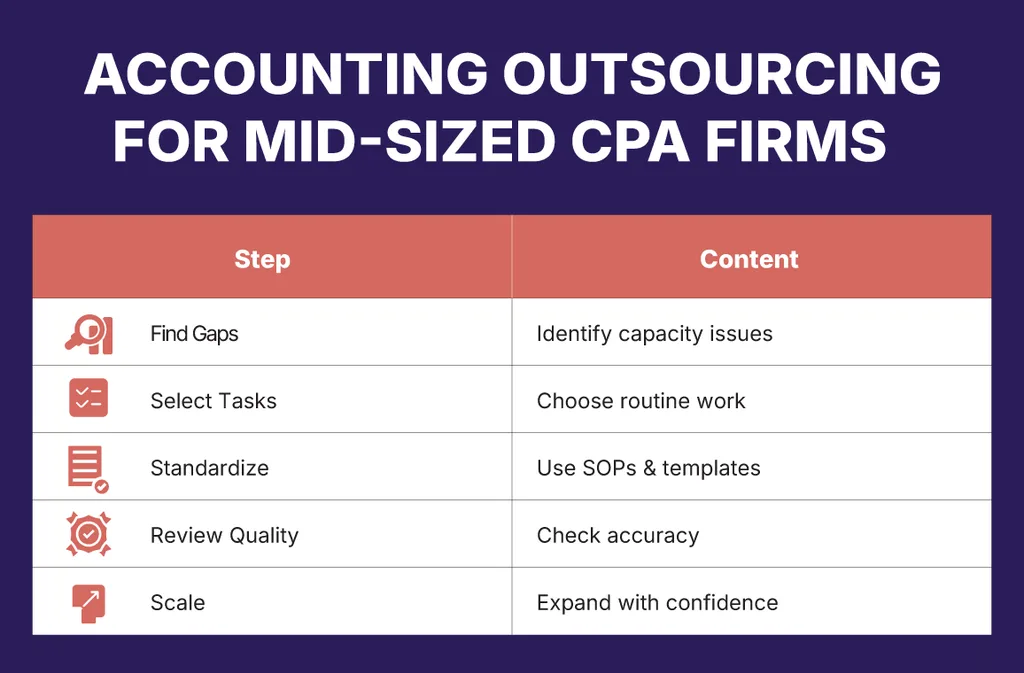
What to measure: On-time delivery • rework rate • review hours saved • seasonal coverage • client satisfaction
Which Accounting Outsourcing Model Fits a Mid-Sized CPA Firm?
Not every firm needs the same model. Some need a small task-based solution for overflow work, while others need a dedicated outsourced accounting team that operates like an extension of the firm. The right choice depends on volume, complexity, turnaround expectations, budget, and how much direct management the firm wants to retain.
A task-based model works well when the firm has defined assignments, such as catch-up bookkeeping, bank reconciliations, payroll support, accounts payable processing, or workpaper preparation. It is flexible and useful for firms testing outsourcing for the first time.
A dedicated staff or FTE-style model may be better when the workload is steady. In this structure, outsourced professionals become familiar with the firm’s clients, systems, templates, and review preferences. That familiarity can improve consistency, but it also requires stronger onboarding and management discipline.
Team-based outsourcing is typically suited for firms with larger recurring volumes or multiple service lines. This model can include preparers, reviewers, team leads, and account managers. It is often more scalable, but it should come with clear governance, communication routines, and quality control expectations.
A blended-shore model can be especially useful for mid-sized firms that want cost efficiency without losing coordination. In this approach, client management or project oversight may remain closer to the firm, while production work is handled by offshore or distributed teams. The goal is to balance accessibility, quality control, and cost-effective execution.
Compare engagement structures and cost considerations on QXAS’s accounting and bookkeeping outsourcing pricing page.
How to Evaluate an Accounting Outsourcing Partner ?
A CPA firm should look for a partner with accounting expertise, strong security practices, software compatibility, clear communication standards, and proven ability to scale with the firm’s workload. The best provider is not simply the lowest-cost option; it is the one that can fit into the firm’s workflow without creating hidden review burden or client-service risk.
Start with experience in US accounting practices. CPA firms in the USA need providers that understand US GAAP, tax-season rhythms, documentation expectations, and the importance of clean handoffs for review. Familiarity with professional standards and resources associated with the American Institute of CPAs (AICPA) is also helpful, especially when the firm expects outsourced work to support high-quality service delivery.
Technology fit is just as important. A provider should be comfortable with the firm’s existing software environment, whether that includes QuickBooks, Xero, Sage Intacct, tax platforms, document management tools, workflow systems, or cloud collaboration apps. A software-agnostic provider reduces disruption because the firm does not have to rebuild its tech stack around the vendor.
A practical companion is the 8-point checklist for choosing an accounting outsourcing partner, which focuses on service quality, scalability, trust, and hidden gaps.
Before choosing a provider, evaluate:
- Relevant CPA firm experience Ask whether the provider supports firms of similar size, service mix, and client complexity. Mid-sized firms need more than basic bookkeeping support; they need process maturity.
- Security and confidentiality controls Review data access, user permissions, encryption practices, confidentiality agreements, device controls, and any relevant security certifications or audit reports.
- Workflow integration Confirm how work is assigned, tracked, reviewed, corrected, and reported. A good provider should adapt to the firm’s workflow, not force a confusing parallel process.
- Communication rhythm Establish daily, weekly, and escalation communication standards. Time-zone differences can be manageable when expectations are clear.
- Quality review process Understand who reviews the work before it reaches your firm, how errors are tracked, and how process improvements are implemented.
- Scalability and continuity Ask how the provider handles staff turnover, backup coverage, busy-season volume, and urgent deadlines.
- Transparent pricing and scope Clarify what is included, what costs extra, and how changes in volume are handled.
How to Design an Outsourced Accounting Workflow?
Outsourcing exposes weak processes quickly. If a firm has inconsistent templates, unclear deadlines, undocumented client preferences, or scattered communication, an external team will struggle to deliver clean results. That is why accounting workflow optimization should happen before, during, and after the outsourcing transition.
Begin by mapping the work from intake to delivery. Identify who receives client documents, who checks completeness, who prepares the work, who reviews it, who handles questions, and who communicates final outputs to the client. The goal is to remove ambiguity before it becomes rework.
A practical outsourcing workflow should define:
- The tasks that will be outsourced and the tasks that will remain internal.
- Required source documents and naming conventions.
- Software access, permissions, and login protocols.
- Standard turnaround times by task type.
- Review checkpoints and approval responsibilities.
- Escalation rules for missing information or unusual transactions.
- Documentation standards for reviewer notes and client-specific instructions.
This structure protects quality. It also helps internal staff trust the process because they know where the work stands and what to expect at each stage.
Also Read: How Offshore Bookkeeping Works for CPA Firms.
How Mid-Sized CPA Firms Can Manage Outsourcing Risk
The biggest outsourcing risks are not mysterious. They usually involve unclear scope, poor communication, inconsistent quality, weak data controls, or insufficient internal review. These risks can be managed, but they should not be ignored.
A pilot program is often the safest starting point. Choose a defined group of clients or tasks, set measurable expectations, and review performance before expanding the scope. This gives the firm time to test turnaround, accuracy, responsiveness, and workflow fit without putting the entire client base through a new process at once.
Quality control should remain a firm responsibility. Even when preparation work is outsourced, partners and managers should maintain review standards, client communication ownership, and final accountability. Outsourcing works best when it extends the firm’s capacity, not when it replaces professional judgment.
For tax-related client data, IRS Publication 4557 describes safeguards for taxpayer information, while the FTC Safeguards Rule requires covered financial institutions to take steps to ensure service providers protect customer information in their care. Firms should evaluate applicability with qualified legal or compliance advisers.
Also read: Secure Accounting Outsourcing for CPA Firms.
Use these controls to reduce risk:
- Start with lower-complexity recurring work before moving into specialized tasks.
- Create written standard operating procedures for each outsourced function.
- Use role-based software access and avoid unnecessary data exposure.
- Track error patterns and review notes to improve training.
- Hold recurring check-ins with the outsourced team lead.
- Maintain backup coverage for critical deadlines.
- Reassess scope after the pilot period and again after busy season.
How Technology Integration Supports Accounting Outsourcing
Cloud accounting has made outsourcing easier, but software alone does not guarantee smooth delivery. The provider must understand how the firm uses each platform, how documents move through the system, and where approvals happen. Without that clarity, even a skilled team can create friction.
For an outsourced accounting service to work well, technology access should be secure, standardized, and easy to monitor. Firms should avoid sharing credentials casually, relying on email attachments for sensitive files, or managing work through disconnected spreadsheets when a workflow system is available.
Automation and AI-enabled tools can also improve productivity, but they still need human review. The practical goal is not to remove judgment from accounting work. It is to reduce manual effort in repetitive steps so professionals can spend more time on exceptions, analysis, and client guidance.
Guide For You
The Tech-Enabled CPA Firm of 2026: Automation, Outsourcing & Operating Models
Download Now
Which Accounting Functions Should Mid-Sized CPA Firms Outsource First?
Most mid-sized CPA firms should begin with repeatable, well-documented, lower-risk tasks. These functions are easier to standardize, easier to review, and more likely to produce quick capacity relief without disrupting client relationships.
Good starting points include:
- Bookkeeping and transaction categorization for recurring client accounts with clear rules.
- Bank and credit card reconciliations where source documents and expectations are consistent.
- Accounts payable and accounts receivable support for clients with defined approval workflows.
- Month-end close preparation including schedules, reconciliations, and supporting documentation.
- Payroll support tasks where responsibilities and compliance boundaries are clearly defined.
- Workpaper preparation for tax or assurance teams, with internal review retained by the firm.
- Catch-up or cleanup projects that are time-consuming but process-driven.
As confidence grows, the firm can expand into more complex support areas. The key is to build trust through repeatable success before outsourcing specialized or judgment-heavy work.
Explore QXAS’s bookkeeping outsourcing services for CPA firms for recurring bookkeeping, reconciliation, and reporting support.
How to Manage an Accounting Outsourcing Partnership
The firms that gain the most from outsourcing treat it as a managed operating model, not a quick fix. They invest time in onboarding, training, review routines, and relationship management. They also communicate internally so staff understand that outsourcing is meant to support them, not create uncertainty.
This matters because change can feel personal in a CPA firm. Team members may worry about quality, job security, or extra review work. Leaders should explain which tasks are moving, why the firm is making the change, and how internal roles will shift toward higher-value responsibilities.
A healthy partnership also includes regular performance conversations. Review turnaround times, error trends, client feedback, and capacity needs. If the provider is strong, these conversations should lead to process improvements rather than defensiveness.
Conclusion
Accounting outsourcing services for CPA firms can help mid-sized practices manage workload, protect margins, and create room for strategic growth. The key is to choose the right model, start with the right functions, and manage the relationship with the same discipline you would apply to an internal team.
If your firm is exploring accounting outsourcing, start with a workflow review, identify the most repeatable bottlenecks, and test the model through a focused pilot. Then explore QXAS’s accounting outsourcing services for CPA firms.
Also Check: Top Accounting Outsourcing Companies
FAQs
How Should CPA Firms Compare Accounting Outsourcing Pricing?
Compare total cost and operating fit, not hourly rate alone. Review scope, inclusions, management effort, revisions, software, minimums, volume changes, rush work, and offboarding. Compare providers using the same assumptions so the pricing models are genuinely comparable.
Which SLAs and KPIs Should Mid-Sized CPA Firms Track?
Define turnaround times, response expectations, review responsibilities, escalation paths, and staffing continuity in the SLA. Track on-time delivery, first-pass acceptance, rework, review notes, query resolution, close readiness, and recurring root causes.
How Can CPA Firms Protect Client Confidentiality When Outsourcing?
Use approved portals, role-based access, multi-factor authentication, clear data-handling rules, confidentiality terms, access monitoring, incident-response procedures, and timely offboarding. The firm should retain oversight and confirm that controls match the sensitivity of the work.
How Should Mid-Sized CPA Firms Evaluate an Outsourcing Provider?
Evaluate relevant CPA-firm experience, security controls, workflow integration, communication cadence, review procedures, continuity, scalability, and commercial clarity. Validate the provider through evidence, a process walkthrough, and a controlled pilot rather than relying on claims alone.
Which Accounting Outsourcing Model Works Best for a Growing CPA Firm?
The best model depends on workload stability, complexity, control needs, and review capacity. Task-based support can suit defined overflow work, a dedicated team can suit steady recurring work, and a managed team model can support broader volume or multiple service lines.
Is Accounting Outsourcing Only Useful During Tax Season?
No. It can support year-round bookkeeping, recurring close work, client onboarding, cleanup projects, payroll support, and workpaper preparation. The value is greater when outsourcing becomes a stable capacity layer rather than a last-minute seasonal fix.
What Accounting Functions Should Mid-Sized CPA Firms Outsource First?
Start with repeatable, documented work such as transaction coding, reconciliations, accounts payable and receivable support, month-end close preparation, workpaper preparation, and cleanup projects. Keep client ownership, complex judgment, final review, and approval inside the firm.
Enquire now

Mangesh Singh
With nearly 20 years of experience in U.S. and Canadian tax, accounting, and operations, Mangesh is a PMP and CFP who drives service delivery, workflow efficiency, and team performance at QX Accounting Services. He supports CPA firms with scalable accounting and tax operations, helping improve accuracy, review quality, turnaround times, and client service. Known for his operational discipline and strategic insight, he turns complex delivery challenges into practical solutions that support consistency, accountability, and sustainable growth.
Unauthorized copying or plagiarism of our content is a violation of intellectual property rights. We take such matters seriously and will pursue legal action to protect our original work. Anyone found engaging in such activities will be held accountable under applicable laws.
Don't forget to share this post!
Our Latest Insights




Let’s Work Together
Explore outsourcing solutions, request a no-obligation trial or discuss your practice’s needs with our expert consultants.
 Book a Virtual Meeting
 Get Your ROI Estimate