How Offshore Bookkeeping Works for CPA Firms?



Introduction: What Offshore Bookkeeping Looks Like
Offshore bookkeeping is often seen as a way to handle more work. In reality, it is a way to improve how work gets delivered.
For many CPA firms in the United States, the real challenge is not workload. It is how that workload is structured, reviewed, and completed at scale.
For firms that use offshore bookkeeping well, it becomes part of the delivery model. The offshore team handles defined execution tasks, while the CPA firm retains review, approvals, and client responsibility.
Many firms solve this through structured outsourcing bookkeeping services built around their existing workflows, review standards, and delivery expectations.
Bookkeeping is particularly well suited to offshore delivery because it is process-driven, recurring, and reviewable. That makes it easier to standardize, track, and validate than more judgment-heavy work.
When set up properly, it does not feel like traditional outsourcing. It functions as a consistent execution layer that helps work move smoothly without adding pressure to review teams.
“Offshore bookkeeping works when the output arrives structured, documented, and ready for review, not open for interpretation.”
Cora Vollmar, Sr VP Growth, QX Accounting Services
A quick question: If your firm added 20 to 30 percent more clients this quarter, would your bookkeeping process scale smoothly, or would month-end start to break down?
This blog explains how offshore bookkeeping works, what the workflow looks like in practice, and which controls keep it stable as volume grows.
Execution vs Accountability
Offshore bookkeeping means a team outside the United States performs defined bookkeeping tasks. It does not change accountability. CPA firms remain responsible for the quality of client deliverables even when work is outsourced.
The model works on a clear split:
- The offshore team handles execution and preparation
- The CPA firm retains review, approvals, and accountability
This split is critical. It allows CPA firms to scale execution without increasing risk.
The offshore team is responsible for completing tasks in line with defined processes, documentation standards, and timelines. The CPA firm remains responsible for reviewing outputs, approving adjustments, and maintaining compliance.
That distinction is what makes the model sustainable.
In practice, this means:
- Work is prepared offshore, then validated within the firm
- Exceptions are flagged early, then resolved under firm guidance
- Outputs are standardized, while judgment remains in-house
The offshore team supports how work gets completed. It does not replace firm ownership of quality, compliance, or final sign-off.
Well-run offshore bookkeeping teams operate as an extension of the firm’s delivery model, not as disconnected outside vendors.
If you are evaluating how to structure this model, you can also read our guide on Offshore Bookkeeping Outsourcing for CPA Firms, which explains when and why firms adopt offshore support as part of long-term delivery planning.
For CPA firms using third-party providers, supervision, confidentiality, and professional oversight remain essential. That aligns with broader outsourcing guidance discussed in AICPA-related professional liability and ethics commentary.
Step by Step: How Offshore Bookkeeping Works
A successful offshore bookkeeping setup follows a structured, repeatable system.
Step 1: Define Scope
Clarity at this stage prevents most downstream issues.
- Identify which tasks move offshore
- Clarify what remains within the CPA firm
- Set clear completion standards
- Establish escalation rules
Example:
A reconciliation is complete when the statement is matched, exceptions are documented, and support is attached.
When scope is clear at the start, most avoidable issues never show up later.
Step 2: Align Workflows
Standardization is what keeps output consistent.
- Chart of accounts rules
- Categorization guidelines
- Reconciliation checklists
- Month-end close checklist
- Documentation standards
Without defined workflows, output may be fast, but it will not be consistent.
These standards should be applied the same way across all clients to avoid variation in output quality.
Step 3: Set Secure Access
Security has to be built into the model from the beginning.
- Role-based access
- Controlled permissions
- Audit logs and monitoring
- Access provisioning and removal processes
A secure model depends on defined controls, not assumptions.
Step 4: Execute and Prepare Work for Review
This is where execution quality becomes visible. The offshore team should:
- Follow defined processes
- Add clear notes where needed
- Attach supporting documentation
- Flag exceptions early
- Package outputs consistently
Good execution is not just about getting work done. It is about making review fast, clear, and predictable.
Step 5: Review and Sign Off
The CPA firm remains in control.
- Review outputs
- Approve adjustments
- Maintain audit trails
- Finalize deliverables
Offshore teams prepare. Your firm reviews and validates.
Step 6: Improve and Stabilize
Stability is what creates scale.
- Track key performance indicators
- Improve processes when patterns appear
- Reduce repeat errors
- Expand scope only after stability is proven
Offshore bookkeeping scales when processes are stable, not when teams are simply expanded.
How the Model Runs in Practice
In practice, offshore bookkeeping runs through a predictable rhythm across daily, weekly, and month-end activities.
Daily: Transaction Processing
- Transactions coded using defined rules
- Notes added for clarity
- Issues flagged early
This stage often determines whether the rest of the workflow stays smooth or becomes correction-heavy.
Weekly: Reconciliation Preparation
- Bank reconciliations
- Credit card reconciliations
- Supporting schedules
Review teams should not spend time chasing missing information.
Ongoing: AP and AR Support
- Bill entry and transaction categorization
- Aging reports
- Invoice tracking
- Follow-up lists prepared for client-facing teams
Remote bookkeeping teams support execution while control stays with the CPA firm.
Month-End: Close Preparation
Month-end is where offshore bookkeeping often delivers the clearest value.
- Reconciliations finalized
- Supporting schedules prepared
- Variances documented
- Draft financials created
When structured correctly, offshore bookkeeping improves close cycles, not just workload distribution.
Case Study
How JBA CPA LLC Handled 30+ Projects Without Expanding Internal Overhead
View Success Story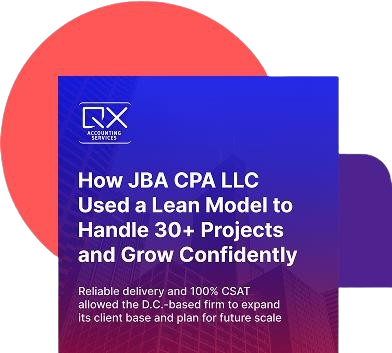
What Keeps Offshore Bookkeeping Consistent
Offshore bookkeeping should not reduce control. It should improve it.
Think of this as the control layer that governs execution. Without it, the model does not fail immediately. It becomes inconsistent over time.
Review Ownership
CPA firms retain:
- Review authority
- Approval rights
- Exception handling
- Compliance responsibility
Outsourcing bookkeeping does not shift accountability. Professional responsibility remains with the firm.
Security and Data Protection
A strong security model includes:
- Role-based access
- Encryption
- Monitoring and audit logs
- Incident response protocols
Many firms use SOC-based frameworks as a baseline, but those controls should still be validated during onboarding rather than assumed. The AICPA’s SOC framework is commonly used to evaluate controls relevant to security, availability, and related risk areas in outsourced environments.
Firms handling taxpayer information should also align their controls with IRS taxpayer data security guidelines, which emphasize written safeguards, monitoring, and incident response.
And where client tax data is involved, CPA firms should understand how IRS Section 7216 confidentiality rules affect the disclosure and use of taxpayer information when third parties are involved.
KPIs That Show Whether the Model Is Working
These KPIs are not just reporting metrics. They help CPA firms see whether an offshore bookkeeping model is becoming more stable or creating more friction. When tracked consistently, they show where the workflow is holding up, where reviewers are losing time, and where small issues may turn into recurring delivery problems.
- Turnaround time shows how quickly recurring bookkeeping work moves from assignment to review-ready completion. If turnaround begins to slow, it usually signals workflow bottlenecks, unclear ownership, or capacity issues.
- Rework rate measures how often completed work comes back for correction. A rising rework rate usually points to inconsistent process execution, weak documentation, or completion standards that are not clearly understood.
- Error rate tracks the volume of mistakes that make it into review. This helps firms distinguish between minor corrections and deeper process problems that affect quality across multiple accounts or clients.
- Month-end readiness shows whether reconciliations, schedules, and support are prepared on time for close. This is one of the clearest indicators of whether the offshore team is reducing pressure or adding last-minute review work.
- Exception resolution time measures how quickly unusual items are identified, escalated, and cleared. When exception handling is slow, delays spread into review cycles and make the overall model feel less predictable.
If these metrics remain stable, the model is working as intended. If they start to fluctuate, the issue is usually not effort alone. It is more often a sign that processes, handoffs, or review standards need attention before quality starts to slip.
Used well, these KPIs give firms an early view of whether offshore bookkeeping is improving consistency, reducing review pressure, and helping month-end run in a more controlled way.
Where Offshore Bookkeeping Models Break
Offshore bookkeeping models rarely fail because of location. They usually break because the process is not clear enough to support consistent execution.
Reviewers Redo the Work
When scope is unclear, reviewers stop reviewing and start redoing the work. Weak SOPs and late issue escalation make the process correction-heavy, so the fix is to define clear completion standards upfront and flag exceptions early.
Work Status Is Unclear
When work status is unclear, teams lose visibility into what is done, what is pending, and where delays are building. The fix is to use simple task trackers, standardize status labels, and hold regular check-ins so progress stays visible and bottlenecks are addressed early.
Month-End Becomes Reactive
When issues surface late, month-end stops being a controlled process and turns into a last-minute scramble. The fix is to standardize documentation, flag exceptions early, and follow a consistent close workflow so delays do not build at the final stage.
Security Feels Assumed
When security is treated as assumed rather than enforced, control gaps stay hidden until they create risk. The fix is to define access clearly, validate security protocols in practice, and monitor activity consistently so protection is real, not just documented.
When Offshore Bookkeeping Works Best
It works best for firms that:
- Have defined workflows
- Face review bottlenecks
- Are scaling client volume
- Want consistent execution without stretching internal teams
It struggles when:
- Processes are undefined
- Reviews are inconsistent
- Data inputs vary widely
- Expectations are not clearly documented
Conclusion
Offshore bookkeeping works when it is built as a structured operating model with clear scope, standardized workflows, retained review ownership, strong controls, and consistent communication.
When these fundamentals are in place, the model becomes stable, predictable, and scalable without adding review pressure. If month-end still feels unpredictable, the issue is usually not effort. It is structure.
Build a Bookkeeping Model That Scales Without Adding Review Pressure See how QX Accounting Services helps CPA firms build offshore bookkeeping models that reduce review pressure instead of adding to it.

Explore a bookkeeping model that increases capacity without losing control.
Click Here!FAQs
What is the process of outsourcing bookkeeping offshore for CPA firms?
- Define scope and task ownership
- Standardize workflows and documentation
- Set secure access and controls
- Execute bookkeeping tasks offshore
- Review outputs and approve adjustments
- Improve the model based on performance
What tasks are handled in offshore bookkeeping services?
- Transaction coding and categorization
- Bank and credit card reconciliations
- Accounts payable and accounts receivable support
- Supporting schedules and documentation
- Month-end close preparation
How is data security maintained in offshore bookkeeping for CPA firms?
- Role-based access to systems and data
- Encryption for sensitive information
- Monitoring and audit logs
- Documented security controls
- Structured control frameworks for oversight
How do offshore bookkeeping providers ensure compliance with U.S. regulations?
- Align workflows with CPA firm review processes
- Maintain audit trails and supporting documentation
- Follow documented standards and controls
- Escalate exceptions under firm guidance
What should CPA firms consider before outsourcing bookkeeping offshore?
- Scope clarity and task ownership
- Process maturity and workflow consistency
- Control environment and review structure
- Security readiness and data protection
- Ability to scale without increasing errors
Enquire now

Bhagyashree Patankar
With over 14 years of global experience in finance and accounting, Bhagyashree is a Chartered Accountant and US CPA with a master’s in Accounting and Finance. She leads an 80+ member team across accounting, audit, and tax, driving operational excellence, talent development, and high-quality delivery. Known for her precision and strategic insight, she transforms financial data into actionable business strategies that enhance decision-making, efficiency, and sustainable growth.
Unauthorized copying or plagiarism of our content is a violation of intellectual property rights. We take such matters seriously and will pursue legal action to protect our original work. Anyone found engaging in such activities will be held accountable under applicable laws.
Don't forget to share this post!
Our Latest Insights




Let’s Work Together
Explore outsourcing solutions, request a no-obligation trial or discuss your practice’s needs with our expert consultants.
 Book a Virtual Meeting
  Get Your ROI Estimate