A Practical, Compliance Aware Guide to Scaling Without Losing Control
For US CPA firms, talent shortages, rising costs, and higher client expectations are putting traditional delivery models under strain. Firms must still meet strict standards for accuracy, compliance, and turnaround time, especially during tax season and year‑end close.
Bookkeeping sits at the center of this pressure.
It is essential to every engagement, yet highly process‑driven and increasingly difficult to staff onshore. As firms grow, bookkeeping workloads scale quickly, stretching internal teams.
As a result, many CPA firms are asking a critical question:
“Is our bookkeeping model scalable without increasing risk or burnout?“
This is where outsourced bookkeeping, often delivered through offshore models, has become a strategic delivery decision. When structured correctly, it helps firms expand capacity, stabilize operations, and protect margins while maintaining control over quality and compliance.
“Scalability in bookkeeping isn’t about doing more with less; it’s about building a delivery model that holds up as firms grow.”
Sagar Ahuja, CEO, QX Accounting Services
This guide explains what outsourced bookkeeping means for US CPA firms and how to implement it responsibly in 2026.
What Outsourced Bookkeeping Covers and What CPA Firms Continue to Control?
Outsourced bookkeeping allows CPA firms to delegate defined, execution‑heavy bookkeeping tasks to a qualified external accounting team, while retaining full ownership of the client relationship, review responsibility, and regulatory accountability.
In many cases, firms use offshore execution teams based outside the United States, most commonly in countries like India. Regardless of delivery location, professional responsibility always remains with the CPA firm.
In practice, outsourced bookkeeping covers high‑volume, rules‑based activities that support day‑to‑day delivery and do not require ongoing client interaction or senior‑level judgment, such as:
Transaction recording and categorization
Bank and credit card reconciliations
Accounts payable and accounts receivable processing
Month‑end close support
Draft financial statement preparation
Cleanup and catch‑up bookkeeping
Payroll processing support
At the same time, CPA firms continue to control the most critical elements of service delivery. This includes client communication and advisory, review and approval authority, compliance and regulatory responsibility, final sign‑off, and audit and assurance oversight.
When structured correctly, outsourced bookkeeping strengthens control by introducing standardized processes, clearer documentation, and defined review layers that stretched in‑house teams often struggle to sustain.
Why US CPA Firms Are Turning to Offshore Bookkeeping
1. A Structural Talent Shortage
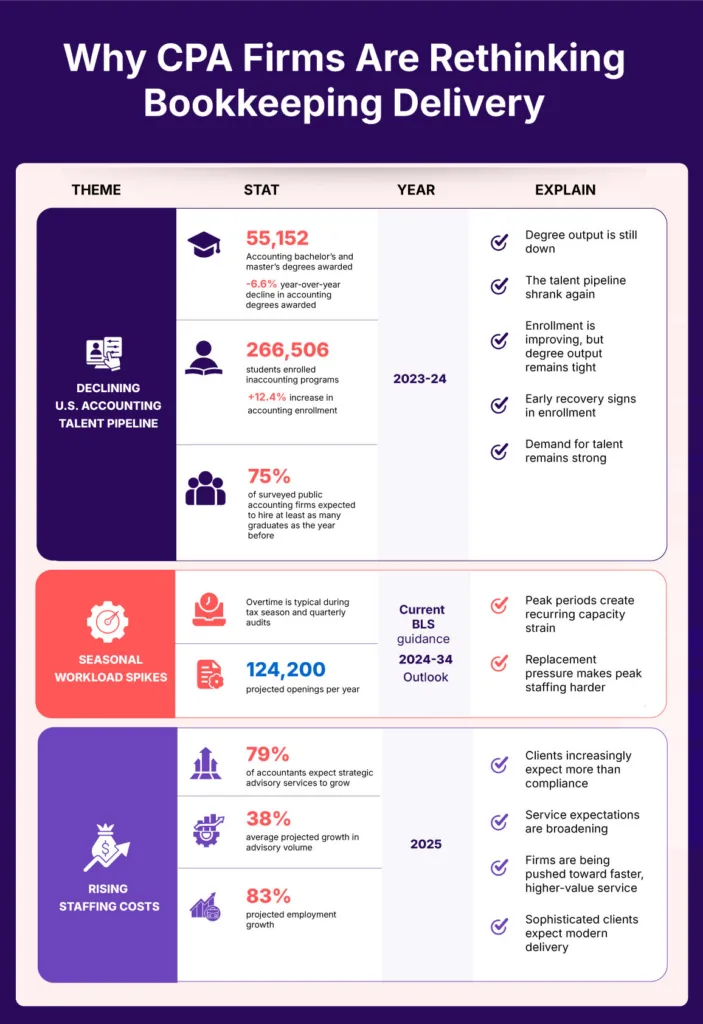
The accounting profession in the US is facing a long‑term talent pipeline challenge, e, driven by a declining accounting talent pipeline, rising retirements, and ongoing attrition. Enrollment in accounting programs has declined, while retirements and attrition continue to rise. To address these structural constraints, many firms are turning to outsource bookkeeping services through a trusted bookkeeping outsourcing company like QX Accounting Services (QXAS), enabling them to access skilled professionals without increasing internal hiring pressure or operational risk.
2. Rising Cost Pressure on Compliance Work
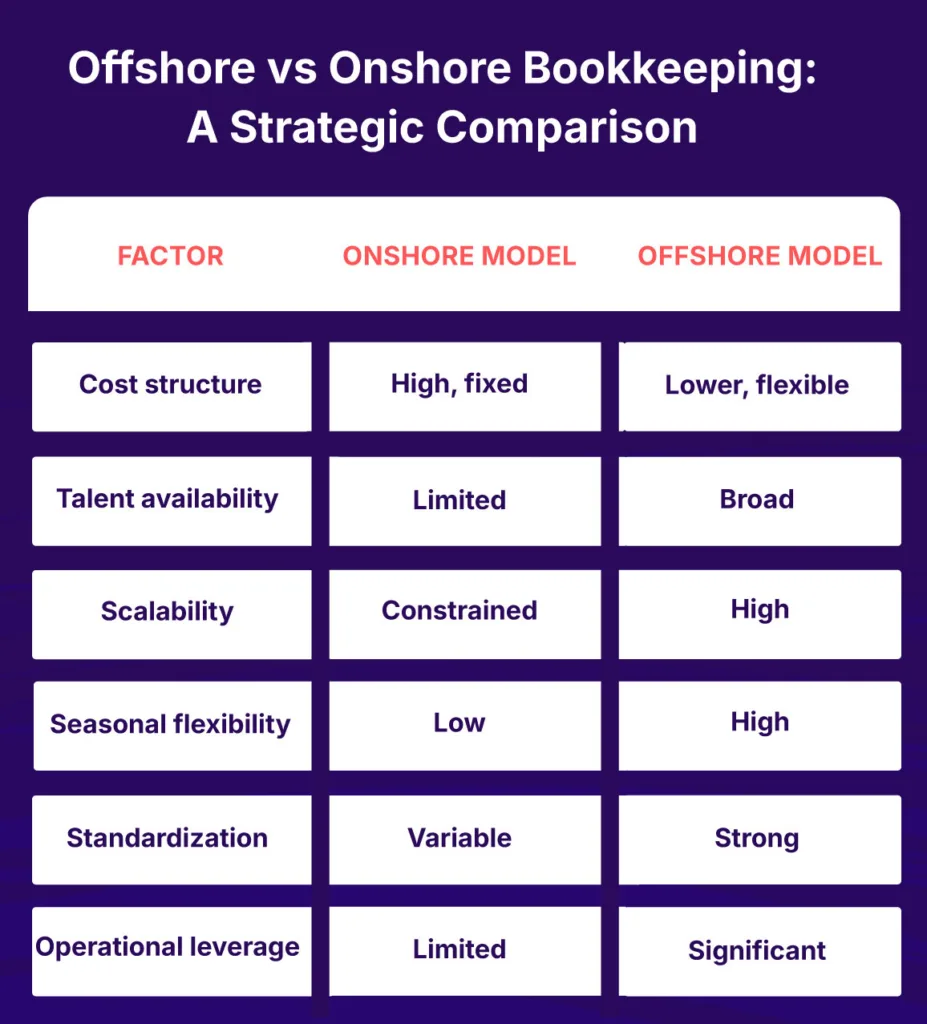
Bookkeeping margins are under pressure. Onshore costs include salaries, benefits, recruitment, training, and turnover. A structured bookkeeping outsourcing company model allows firms to convert fixed staffing costs into variable, scalable capacity, improving margin stability while maintaining service levels.
3. Higher Client Expectations
Today’s clients expect faster closes, real-time or near-real-time financial visibility, and year-round responsiveness. Meeting these expectations through traditional models often leads firms to consider outsourced bookkeeping services to maintain service quality without overburdening internal teams.
4. Seasonal Workload Volatility
Tax season, audits, and year-end reporting create sharp capacity spikes. Using outsourcing bookkeeping services, firms can scale capacity during peak periods without permanently increasing headcount, one of the most practical advantages of modern outsourced bookkeeping solutions.
Why Bookkeeping Is the First Function to Be Outsourced ?
Bookkeeping lends itself well to offshore delivery because it relies on high‑volume, rules‑based work.
Process‑driven
Rule‑based (US GAAP aligned)
High‑volume and repeatable
Easily reviewable and auditable
Unlike advisory or complex tax planning, bookkeeping execution does not require continuous client interaction. This allows CPA firms to clearly separate execution from oversight, making it ideal for outsourcing bookkeeping models.
The key difference is often not quality, but operating leverage, the ability to scale output without increasing headcount at the same rate which is why many firms adopt bookkeeping outsourcing services.
Dedicated offshore professionals are trained firm‑specific workflows, accounting platforms, and documentation standards before execution begins. In a structured delivery model, providers like QX Accounting Servicesalign offshore teams closely with the CPA firm’s processes, ensuring consistency, clarity, and seamless integration into day‑to‑day bookkeeping operations.
Scope Definition
The CPA firm clearly defines:
Tasks to be outsourced
Service‑level expectations
Review and escalation responsibilities
This is a critical step when engaging any bookkeeping outsourcing company, as clarity at this stage determines long-term success.
These controls are standard in high-quality outsourced bookkeeping companies.
Execution & Review
Offshore teams execute defined tasks
CPA firm reviews, finalizes, and communicates with clients
This ensures accountability remains with the firm while leveraging external execution through outsource bookkeeping services.
Continuous Optimization
Performance monitoring
Process improvements
Capacity adjustments
Over time, this creates efficiency gains and strengthens the overall outsourced bookkeeping solutions framework.
Common Challenges in Offshore Bookkeeping (and How Firms Address Them)
Like any delivery model change, offshore bookkeeping introduces new operational considerations. The challenges themselves are not unique or unexpected, but how firms plan for and manage them determines whether outsourcing improves outcomes or creates friction.
Experienced CPA firms approach offshore bookkeeping with the understanding that success depends on structure, visibility, and governance, not just execution.
1. Quality Consistency
One of the most common concerns is whether work quality will remain consistent across engagements. Without standardized processes, results can vary from one team or client to another.
Firms address this by implementing documented workflows, standardized templates, and layered review structures. Clear SOPs and defined review checkpoints ensure that offshore work meets the same quality standards as onshore execution.
2. Limited Visibility into Work Performed
When work is performed outside the firm, lack of visibility can quickly become a risk. Partners and managers need confidence not only in the output, but also in how that output was produced.
This is mitigated through dashboards, regular reporting, and audit trails that provide transparency into task status, turnaround times, and review history. Visibility restores control and makes outsourced work easier to manage at scale.
3. Data Security and Confidentiality Concerns
CPA firms handle highly sensitive financial and taxpayer data, making security a non‑negotiable requirement. Any perceived weakness in data protection can undermine client trust.
This risk is addressed by working within SOC 2‑aligned control environments, supported by role‑based access controls, encrypted data handling, continuous monitoring, and incident response procedures. Strong security frameworks ensure outsourced bookkeeping meets the same confidentiality standards as in‑house work.
When these challenges are addressed proactively, offshore bookkeeping becomes predictable, auditable, and scalable. In practice, firms that work within a structured outsourced bookkeeping model find that these risks are not only manageable but often easier to control than in fragmented, overextended in‑house teams.
Why India Has Become a Leading Hub for Offshore Bookkeeping Delivery?
Many outsourced bookkeeping models are delivered offshore because they provide access to ready‑to‑deploy accounting talent at scale. Over time, offshore delivery has evolved beyond simple cost savings into a model focused on capability, consistency, and scalability.
India has emerged as a leading hub for outsourced bookkeeping due to its large and growing pool of accounting professionals, strong familiarity with US GAAP and CPA firm workflows, and deep experience supporting US firms across bookkeeping, tax, and accounting services.
Supported by a mature outsourcing ecosystem and established governance frameworks, offshore delivery from India enables CPA firms to scale bookkeeping capacity reliably while maintaining quality, control, and compliance.
How to Evaluate a Bookkeeping Outsourcing Company
Not all accounting outsourcing experiences are the same. CPA firms should prioritize providers with direct experience supporting US CPA firms, as this ensures familiarity with firm workflows, review expectations, and client service standards.
Experience in CPA environments reduces onboarding friction and minimizes the risk of rework or misalignment.
1. Trained, Ready‑to‑Deploy Accounting Talent
One of the most significant advantages of mature outsourcing models is access to trained talent that is ready to deploy, rather than resources that require months of ramp‑up.
Firms should assess:
How talent is recruited and trained
Familiarity with US GAAP and CPA firm documentation standards
Ability to scale teams quickly during peak periods
This is a core pillar of Outsourcing 3.0 capacity that is immediately usable, not theoretically available.
2. Strong US GAAP and Compliance Knowledge
Outsourced bookkeeping must operate within the same regulatory and professional frameworks as onshore teams. Providers should demonstrate clear understanding of:
US GAAP
IRS expectations
Due diligence and documentation requirements
Compliance knowledge should be embedded into workflows, not handled as an afterthought.
3. Technology Enablement (Beyond Just Software)
While familiarity with platforms such as QuickBooks, Xero, and Sage Intacct is essential, technology capability should go beyond software proficiency.
CPA firms should look for an automation and workflow layer that supports:
Standardized task execution
Review and approval workflows
Audit trails and version control
Performance tracking and reporting
This technology layer is what allows outsourced bookkeeping to scale without increasing risk.
4. Security and Control Environment
Data security is non‑negotiable. A credible bookkeeping outsourcing company should operate within a mature control environment supported by:
SOC 2 and relevant ISO certifications
Role‑based access controls
Encrypted data handling
Continuous monitoring and incident response procedures
Security standards should be independently validated and consistently enforced.
Communication, Governance, and Reporting Structure
Finally, CPA firms should assess how they manage and monitor work over time. Clear governance structures are essential to maintaining visibility and accountability.
This includes:
Defined points of contact
Regular reporting and dashboards
Escalation paths and review protocols
Clearly documented SLAs and KPIs
Strong governance is what transforms outsourcing from a transactional arrangement into a dependable operating model.
Choosing the right bookkeeping outsourcing company is not just an operational decision. It directly impacts quality, compliance risk, team capacity, and the firm’s ability to scale sustainably. Firms that evaluate providers through an Outsourcing 3.0 lens position themselves far better for long‑term success.
Managing Compliance, Risk, and Control in Offshore Bookkeeping
Outsourcing bookkeeping does not reduce a CPA firm’s compliance obligations. In fact, it increases the need for structure, documentation, and oversight. While outsourcing changes how firms perform the work, CPA firms always retain responsibility for it.
For CPA firms, this makes offshore bookkeeping a control decision, not just an operational one.
1. Regulatory Responsibility Remains with the CPA Firm
The IRS allows CPA firms to outsource bookkeeping and accounting work. Regardless of delivery location, CPA firms retain full responsibility for accuracy, documentation, and regulatory compliance. Frameworks such as IRS Circular 230, due‑diligence requirements, and record‑keeping standards continue to apply, which is why firms must retain full ownership of review and audit readiness.
2. Data Security and Confidentiality
CPA firms handle highly sensitive financial and taxpayer data, which makes security non‑negotiable. When firms outsource bookkeeping, they must apply data protection standards that match or exceed internal controls. These typically include encrypted data handling, role‑based access controls, continuous monitoring, and clearly defined incident‑response procedures. As a result, SOC 2 compliance has become a baseline expectation because it confirms that independent auditors regularly assess and enforce security controls.
3. Governance and Quality Assurance
Effective offshore bookkeeping relies on governance, not supervision. Documented SOPs, multi‑layer review structures, clearly defined SLAs and KPIs, and regular performance reporting ensure that outsourced work remains consistent, auditable, and defensible. Strong governance allows firms to scale confidently without increasing operational or compliance risk.
Conclusion
Outsourced bookkeeping has become a strategic way for CPA firms to manage capacity, control risk, and scale sustainably in a challenging operating environment. When structured with the right governance, review controls, and compliance frameworks, it allows firms to grow without sacrificing quality or oversight. This is where experienced partners like QX Accounting Services play a role, by supporting CPA firms with mature delivery models aligned to US regulatory and operational expectations.
If bookkeeping capacity or hiring constraints slow your firm down, it may be time to reassess whether your current delivery model can scale. This guide helps CPA firms evaluate outsourced bookkeeping objectively and understand what a well‑structured approach looks like.
If you are outsourcing or planning to, ask one essential question: Is your model secure, or simply efficient?
Ready to Evaluate Your Current Setup?
Start with a structured review. Let us have a conversation.
Is outsourced bookkeeping allowed for US CPA firms?
Yes. CPA firms can outsource bookkeeping under US regulations, but they always retain responsibility for accuracy, documentation, and compliance, regardless of delivery location.
Will outsourcing bookkeeping reduce our control over quality?
When firms structure outsourced bookkeeping correctly, they improve control through standardized workflows, documented procedures, and layered reviews that overstretched in‑house teams often struggle to maintain.
Does outsourced or offshore bookkeeping increase compliance risk?
Outsourcing itself does not increase risk. Risk typically arises from weak processes, limited visibility, or poor governance. Firms that embed compliance, documentation, and review controls into their outsourcing model often find it easier to remain audit‑ready.
Do clients object to outsource bookkeeping?
Most clients evaluate firms based on outcomes such as accuracy, turnaround time, and data security, rather than delivery location. Clear communication and consistent service quality matter far more than delivery location.
What types of CPA firms benefit most from outsourced bookkeeping?
Outsourced bookkeeping is especially effective for firms serving SMB and mid‑market clients, firms facing seasonal workload spikes, and firms looking to free senior staff for advisory and higher‑value work.
Is outsourced bookkeeping only about reducing costs?
No. Although cost savings matter, CPA firms primarily adopt outsourced bookkeeping to improve scalability, stabilize operations, and reduce dependence on hard‑to‑hire talent during peak periods.
Enquire now
Bhagyashree Patankar
With over 14 years of global experience in finance and accounting, Bhagyashree is a Chartered Accountant and US CPA with a master’s in Accounting and Finance. She leads an 80+ member team across accounting, audit, and tax, driving operational excellence, talent development, and high-quality delivery. Known for her precision and strategic insight, she transforms financial data into actionable business strategies that enhance decision-making, efficiency, and sustainable growth.
Unauthorized copying or plagiarism of our content is a violation of intellectual property rights. We take such matters seriously and will pursue legal action to protect our original work. Anyone found engaging in such activities will be held accountable under applicable laws.
Don't forget to share this post!
Our Latest Insights
Explore all insights on topics that matter to you and your accounting firm.









 Book a Virtual Meeting
  Get Your ROI Estimate