IRS Compliance in U.S. Accounting Outsourcing: 2026 Guide



Outsourcing is rapidly becoming a standard operating model for CPA firms across the US. However, as firms scale delivery, IRS compliance in accounting outsourcing services has become a critical concern.
From the Internal Revenue Service’s (IRS) perspective, responsibility for accuracy, documentation, and regulatory compliance always remains with the CPA firm, regardless of who performs the work.
This makes outsourcing more than just an operational decision. Outsourcing is now a critical control decision that directly affects risk, client trust, and long-term scalability.
Why Compliance Needs More Attention in Outsourced Models
Earlier, most firms adopted outsourcing to address capacity and efficiency challenges. But this is slowly shifting toward a scenario in which outsourcing is viewed as a long-term strategy. Deliverability, technology, quality, everything is minutely reviewed. But what about compliance?
Nobody can deny that outsourcing introduces an additional layer of risk, especially when sensitive taxpayer data and regulatory requirements are involved.
In line with the above, the IRS continues to increase enforcement. In FY 2024, it closed over 505,000 audits, resulting in approximately $29 billion in additional recommended tax assessments. This level of scrutiny makes even minor compliance gaps significant.
At the same time, CPA firms remain prime targets for cyber threats due to the volume of confidential financial data they handle. This makes secure tax data handling outsourcing just as important as technical accuracy.
All of this leads to one clear point: compliance demands constant attention. There is no room for compromise. Experienced outsourcing providers and CPA firms already operate with this mindset.
IRS Compliance in Accounting Outsourcing: Key Requirements for CPA Firms
For CPA firms, compliance extends to how work is performed, reviewed, and documented across the outsourcing lifecycle. It is not limited to just one activity, say tax filings. CPA firms want compliance embedded into the workflow. That’s the only way to maintain it consistently and review it effectively.
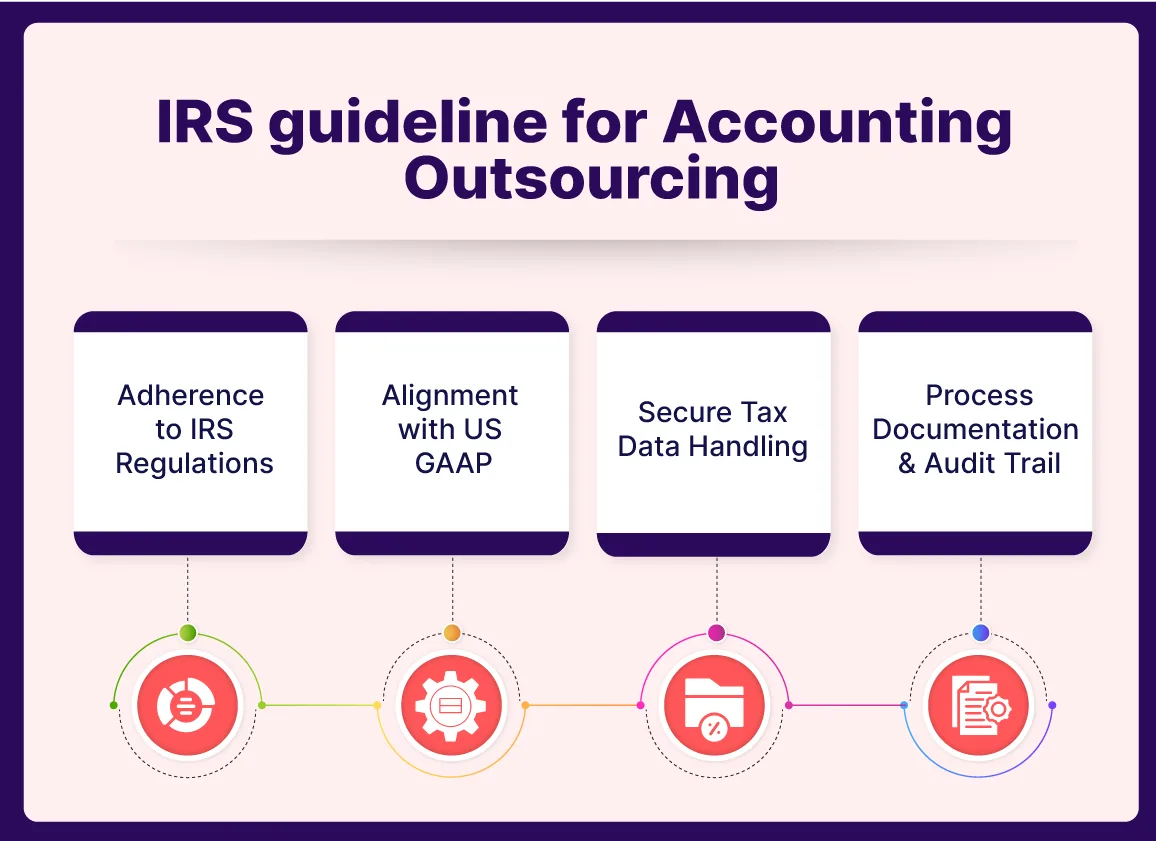
Under IRS guidelines for outsourced accounting, firms should focus on the following:
1. Adherence to IRS Regulations
Outsourcing partners must operate within IRS requirements, including Circular 230. This ensures proper due diligence, documentation, and accuracy in reporting.
2. Alignment with US GAAP
All financial outputs must remain consistent with US accounting standards, regardless of where the work is performed.
3. Secure Tax Data Handling
Effective secure tax data handling outsourcing requires:
- Encrypted systems and data transfers
- Role-based access controls
- Continuous monitoring and activity logs
- Defined data governance protocols
4. Process Documentation and Audit Trail
Every step in the workflow should be traceable and documented. This is essential for audit readiness and regulatory defense.
Everything you need to know about secure outsourcing is right here.
Head to this blog- Secure Accounting Outsourcing for CPA Firms in 2026: An Expert Guide
The Role of SOC 2 in Accounting Outsourcing Compliance Standards
Any claims about security and compliance must be backed by controls that can be verified.
SOC 2 compliance is now a basic requirement for outsourcing providers who handle financial and taxpayer data. It checks controls in areas such as:
- Security
- Availability
- Processing integrity
- Confidentiality
For CPA firms, this directly affects how well they meet compliance standards for outsourcing and lowers their risk under IRS rules. Besides SOC 2, firms should also look for:
- Multi-factor authentication (MFA)
- Periodic third-party audits
- Defined incident response mechanisms
20 Years | Zero Data Security Breaches
QX Accounting Services is a fully SOC 2–compliant outsourcing partner, with ISO 27001 and ISO 27701 certifications. 350+ accounting firms in the U.S. trust us to handle sensitive financial data, securely, consistently, and without compromise.
Common Risks in Tax Compliance in Accounting Outsourcing
Tax outsourcing does not inherently increase compliance risk. Providers with a casual approach, weak infrastructure, non-adherence to SOPs, and inadequate security maturity often welcome security challenges.
Common compliance issues include:
- Limited visibility into outsourced workflows
- Gaps in understanding of US tax regulations
- Weak or inconsistent data security practices
- Poorly documented or non-standardized processes
These challenges directly impact tax compliance in accounting outsourcing, particularly when firms are unable to demonstrate how work was performed during an audit.
How CPA Firms Can Strengthen IRS-Compliant Accounting Outsourcing
Evaluate Partners Beyond Cost: Focus on certifications, IRS expertise, and control frameworks.
Standardize and Document Workflows: Ensure all processes align with IRS expectations and are consistently followed.
Establish Oversight and Governance: Implement review layers, audit logs, and reporting structures.
Prioritize US Tax Expertise: Outsourced teams must understand IRS requirements, not just accounting execution.
When implemented correctly, accounting outsourcing for USA CPA firms can improve operational efficiency and enhance compliance controls.
Compliance: A Competitive Advantage
Compliance is no longer just about avoiding penalties. It is becoming a business differentiator.
According to PwC, 71% of executives expect compliance to play a key role in business transformation initiatives. This shift is visible across the accounting industry, where clients are placing greater emphasis on data security, transparency, and regulatory alignment.
For CPA firms, this is changing how services are evaluated.
Clients are no longer assessing partners only on technical capability, industry expertise, or turnaround time. They are also evaluating more critical factors such as data protection measures, audit-readiness, and SOPs in accordance with IRS expectations. This is especially relevant for firms serving mid-market and enterprise clients, where due diligence standards are significantly higher.
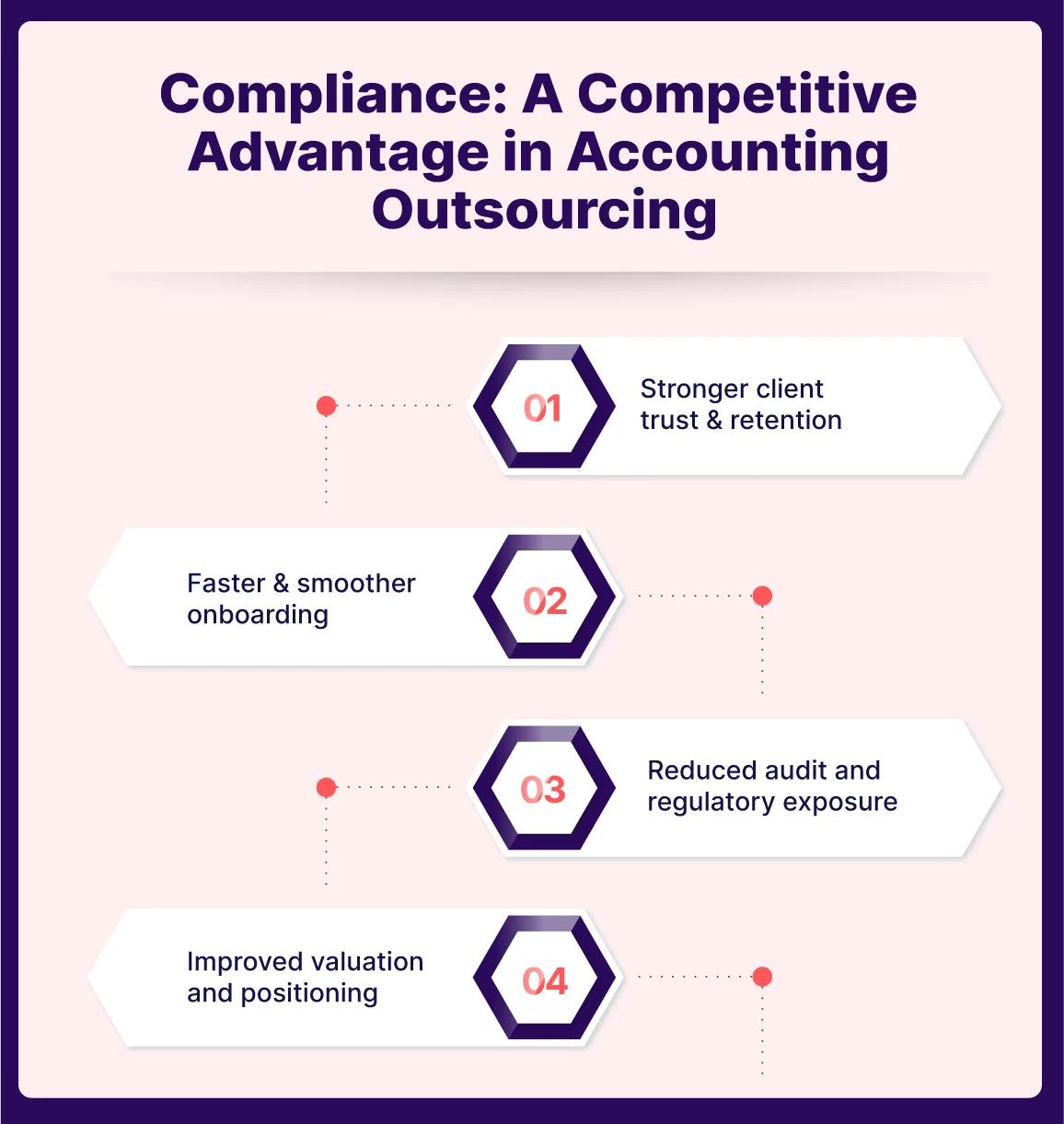
A strong compliance framework directly contributes to:
- Stronger client trust and retention
Clients are more likely to stay with firms that demonstrate consistent control over data and processes.
- Faster and smoother onboarding
Well-documented workflows and security controls reduce friction during client due diligence.
- Reduced audit and regulatory exposure
Clear audit trails and standardized processes make it easier to respond to IRS inquiries.
- Improved valuation and positioning
Firms with mature compliance frameworks are often better positioned for growth, partnerships, or acquisitions.
Firms that recognize this shift early are not just managing risk; they are using compliance as a lever for long-term growth.
Conclusion
IRS compliance in accounting outsourcing has taken the form of a systematic control framework that defines how safely a firm can scale.
Firms that treat outsourcing as a cost decision often overlook the compliance layer. In contrast, firms that approach it as an extension of their control environment are better positioned to grow without increasing risk.
This is where the right partner becomes critical. A provider like QX Accounting Services is structured around these requirements, with delivery models aligned to IRS expectations, adherence to US GAAP, and a strong focus on audit-ready processes.
From a security standpoint, QXAS operates in environments that support SOC 2 compliance frameworks. This includes:
- Role-based access controls
- Encrypted data handling and secure transfer protocols
- Continuous monitoring and audit trails
- Defined data governance and incident response processes
Workflows are standardized, documented, and fully traceable. Thus, ensuring that firms are not just compliant with output, but defensible in their processes.
For CPA firms, this enables a shift from basic outsourcing to IRS-compliant accounting outsourcing that supports both scale and control.
QX Accounting Service works with US CPA firms to build structured, IRS-compliant accounting outsourcing models—with clear controls, secure data environments, and audit-ready processes from day one.
If you are evaluating your current outsourcing setup or planning to scale, it is worth asking a simple question:
Is your outsourcing partner reducing risk or introducing it?
Speak to our team to assess your current model and identify compliance gaps before they become issues.
FAQs
1. What IRS rules apply when CPA firms outsource accounting services?
Even when CPA firms outsource, there is no transfer of liability. Thsi means they are still fully responsible for compliance with the Internal Revenue Service (IRS).
Key IRS guidelines for outsourced accounting include adherence to Circular 230, due diligence, accurate reporting, timely review and maintaining complete documentation. One of the topmost priorities is protecting taxpayer data is protected.
For CPA firms to ensure they are adhering to the IRS rules, it is important that the Outsourcing partners understand and operate within the same regulatory framework as the firm itself. This is a core part of maintaining IRS compliance in accounting outsourcing.
2. How do outsourced accounting providers ensure IRS compliance for U.S. firms?
Reputable providers build compliance into their delivery model. Deeply rooted in their core processes and workflows, compliance acts a strong pillar for the entire internal structure.
To support IRS compliant accounting outsourcing, providers typically focus on:
- Structured workflows aligned with IRS requirements
- Teams trained in US tax regulations and reporting standards
- Strong documentation and audit trails
- Review mechanisms to ensure accuracy and completeness
They also align financial outputs with US GAAP and maintain strict controls around data handling.
The goal is to ensure that outsourced work is not just accurate, but fully audit-ready and defensible under IRS review.
3. Is accounting outsourcing allowed under IRS regulations for CPA firms?
Yes, outsourcing is allowed. The IRS does not prohibit CPA firms from outsourcing accounting or tax work.
However, under IRS regulations for outsourced accounting, the CPA firm retains full responsibility for compliance, accuracy, and confidentiality. This includes ensuring that any third-party provider follows IRS rules and maintains appropriate safeguards for taxpayer data.
4. What compliance risks should CPA firms consider when outsourcing accounting?
Outsourcing introduces operational benefits, but it also creates specific compliance risks if not managed properly.
Common risks in tax compliance in accounting outsourcing include:
- Limited visibility into how work is performed
- Inadequate understanding of US tax regulations by offshore teams
- Weak data security controls
- Poor documentation or lack of audit trails
These risks can lead to errors, data breaches, or challenges during IRS audits. A structured and controlled outsourcing model is essential to mitigate them.
5. How can CPA firms verify IRS compliance of an accounting outsourcing partner?
Verifying an outsourcing partner for their policies and processes in line to IRS compliance requires more than basic due diligence.
For a thorough validation, CPA firms should:
- Review the provider’s understanding of IRS regulations and Circular 230
- Evaluate process documentation and audit trail capabilities
- Check alignment with US GAAP
- Assess governance, review structures, and escalation mechanisms
It is also important to validate certifications such as SOC 2 compliance, which indicate mature control environments.
6. What data security standards support IRS-compliant accounting outsourcing?
To support compliance, outsourcing providers should follow established compliance standards.
These include:
- SOC 2 compliant systems and controls
- Encryption of data at rest and in transit
- Role-based access controls
- Multi-factor authentication (MFA)
- Continuous monitoring and audit logging
These measures ensure that sensitive taxpayer information is protected and that firms can meet IRS expectations around data confidentiality and security.
Enquire now

Vishal Shah
With 13 years of experience in accounting and bookkeeping, Vishal Shah leads QX’s accounting operations, managing a 65+ member team. He specializes in process efficiency, quality control, and client delivery across industries, including SaaS, real estate, and workforce management. Vishal’s leadership drives scale, speed, and client satisfaction for CPA firms.
Unauthorized copying or plagiarism of our content is a violation of intellectual property rights. We take such matters seriously and will pursue legal action to protect our original work. Anyone found engaging in such activities will be held accountable under applicable laws.
Don't forget to share this post!
Our Latest Insights




Let’s Work Together
Explore outsourcing solutions, request a no-obligation trial or discuss your practice’s needs with our expert consultants.
 Book a Virtual Meeting
  Get Your ROI Estimate