How CPA Firms Can Hire a Dedicated Bookkeeping Team in India Without Losing Control?



Introduction: The Real Constraint Isn’t Growth. It’s Execution.
If you run a CPA firm, you know the pattern: bookkeeping volume grows; deadlines compress, and reviewers get stretched. At the same time, hiring takes longer, retention is harder, and month-end close does not wait.
This is not a demand issue. It’s how capacity is structured and managed.
That is why many US CPA firms are choosing to hire a dedicated bookkeeping team in India through a structured offshore delivery model. The goal is not to hand off responsibility, but to add quality execution without weakening review control.
“The goal of outsourcing is not to reduce effort. It is to build a delivery model that scales without increasing rework, delays, or loss of oversight.”
Cola Vollmar, Sr VP Growth
- Why US CPA Firms Are Building Bookkeeping Teams in India?
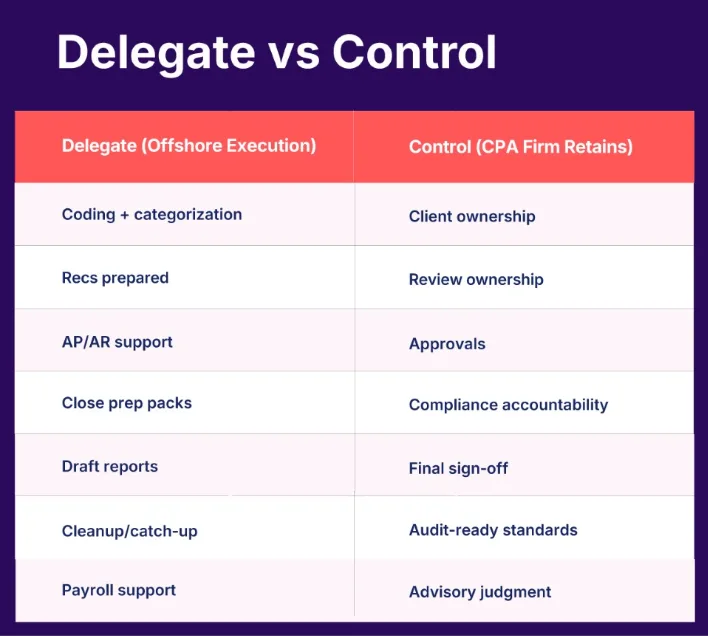
- What to Delegate vs What Your Firm Must Retain?
- How to Hire and Run a Dedicated Bookkeeping Team in India?
- Beyond Staffing: How CPA Firms Should Evaluate an Offshore Partner
- What Affects the Cost of Hiring a Bookkeeping Team in India?
- Why CPA Firms Choose QXAS for Dedicated Offshore Bookkeeping Teams?
- Is Your Firm Ready for an Offshore Bookkeeping Team?
- Conclusion
- FAQs
This blog will help you understand how to hire and manage a dedicated bookkeeping team in India while maintaining oversight, improve turnaround time, and scale without adding operational risk.
Why US CPA Firms Are Building Bookkeeping Teams in India?
The challenge isn’t a lack of work. It is a delivery challenge, intensified by the accounting talent shortage in the US, with fewer professionals entering the field and increasing pressure on existing teams.
- Demand outpaces delivery capacity
- Hiring pipelines are tight, and retention is increasingly difficult
- Review teams are overloaded with corrections instead of oversight
With ongoing talent shortages and increasing pressure during month‑end and tax cycles, offshore bookkeeping has evolved into a structured operating decision. Many firms now treat it as part of a broader finance and accounting outsourcing strategy to improve efficiency, consistency, and scalability.
At the same time, accounting outsourcing to India is growing rapidly as firms respond to talent constraints and rising operational pressure.
Hiring a dedicated offshore bookkeeping team enables firms to:
- Reduce backlog and prevent spillover
- Improve turnaround for recurring work
- Free up reviewers for higher‑value tasks
- Scale delivery without constant hiring disruption .
India offers access to trained accounting talent, mature outsourcing infrastructure, and teams experienced in supporting US workflows. The advantage is not just cost. It is the ability to redesign how work gets delivered in a way that remains consistent under pressure. ng infrastructure, and teams experienced in supporting US accounting workflows. The advantage is not just cost. It is about redesigning how work gets delivered in a way that scales without breaking under pressure.
Three Offshore Bookkeeping Models CPA Firms Use
1. Dedicated Team Model: Best for Recurring Volume
This is the closest model to building an extension of your in-house bookkeeping department.
- Dedicated team aligned to your firm
- Follows your SOPs, workflows, and monthly checklists
- Adapts to your review preferences over time
Best when: You have consistent monthly volume and want predictable, reliable execution.
2. Hybrid Model: Best for Flexibility
Onshore teams retain control and client-facing work, while offshore teams support execution.
- Handles reconciliations, coding, AP/AR, and close preparation
- Scales during peak cycles
Best when: You need flexible support during peak periods before committing to a long-term model.
3. Project Model: Best for Cleanup & Catch-Up
Used for short-term, defined needs:
- Backlog cleanup
- Catch-up bookkeeping
- Transition work
Best when: You want quick results or to test offshore capability.
Case Study
How JBA CPA LLC Managed 30+ Projects Efficiently with a Lean Delivery Model.
View Success Story
What to Delegate vs What Your Firm Must Retain?
A successful offshore model depends on clear separation between execution and control.
As the offshore team handles repeatable execution, your firm retains client ownership, review judgment, approval authority, and compliance responsibility.
How to Hire and Run a Dedicated Bookkeeping Team in India?
A scalable offshore model is built on structure, not headcount. Adding people only works when scope, workflows, review layers, and communication rhythms are defined upfront.
Here is a step-by-step guide for you:
Step 1: Define Scope
What will be executed offshore? What stays in-house?
- Task list
- Ownership boundaries
- Turnaround expectations
Step 2: Standardize Workflows (SOPs)
Without SOPs, output will vary.
- Templates
- Month-end checklists
- Documentation standards
Step 3: Build Review Layers
Review should validate, not redo.
- Add checkpoints before final review
- Define exception handling
- Set clear “done” criteria
Step 4: Design Communication Rhythm
Time zones only work when structured.
- Overlap hours
- Daily handoff updates
- Weekly governance check-ins
Step 5: Track Performance with KPIs
Measure what matters and make your expectations clear from the start:
- Turnaround time
- Error rate
- Rework percentage
- Month-end readiness
Without this structure, offshore teams can increase rework and reviewer burden. With it, they become a reliable execution layer that improves capacity without weakening control.
Also Read: Top Bookkeeping Outsourcing Companies in USA
Beyond Staffing: How CPA Firms Should Evaluate an Offshore Partner
The question is no longer: “Can they do the work?” The question is: “Can they deliver the work the way your firm needs it done?”
CPA Firm Experience
Look for partners who understand how US CPA firms actually operate. This includes familiarity with month-end timelines, review workflows, documentation standards, and client service expectations. A team that understands bookkeeping but not the CPA firm review environment can create delays, rework, and inconsistency.
Onboarding Structure
A strong partner should provide a structured onboarding framework. This includes clear transition plans, SOP alignment, defined ownership, and phased ramp-up timelines. The goal is to integrate the offshore team without disrupting existing workflows or delivery schedules.
Workflow Visibility
You should have full visibility into how work moves. This means clear task tracking, real-time status updates, and audit trails that show what has been completed, what is pending, and where bottlenecks exist. Visibility is critical for maintaining control as volumes grow.
Security & Control Environment
The partner should operate within a well-defined security framework. This includes role-based access controls, encryption, activity monitoring, and documented incident response protocols. Look for providers that follow SOC 2–aligned control environments to ensure data security, confidentiality, and audit-ready processes.
Governance Model
Consistent delivery depends on strong governance. A mature partner will define service-level agreements (SLAs), reporting cadence (daily/weekly/monthly), and escalation paths for issue resolution. Governance ensures that performance is tracked, reviewed, and continuously improved.
Scalability
The real test of a partner is their ability to scale without compromising quality. They should be able to add resources, cross-train teams, and maintain consistency during peak periods without increasing error rates or disrupting workflows. Scalability should be structured, not reactive.
A strong partner should clearly demonstrate how work is assigned, reviewed, escalated, measured, and improved over time. Firms must comply with IRS taxpayer data security guidelines, including encryption, access controls, and monitoring protocols.
What Affects the Cost of Hiring a Bookkeeping Team in India?
Hourly rates are often the starting point, but they don’t capture the full economics of the model.
In reality, cost depends on things like:
- The experience level of the team
- How complex the work is
- The tools and software involved
- The level of review and quality checks needed
- How much reporting and oversight you want
But here’s what actually matters more than the rate you pay:
- Is your backlog reducing?
- Are reviewers spending less time fixing errors?
- Is month-end moving faster and more smoothly?
- Can you rely on consistent delivery every cycle?
That’s where the real value comes in. A well-structured offshore model makes your entire bookkeeping process more predictable and easier to manage. And over time, that’s what truly brings down your total operating cost.
Why CPA Firms Choose QXAS for Dedicated Offshore Bookkeeping Teams?
CPA firms need more than offshore capacity. They need a delivery partner that understands how CPA firms manage deadlines, review workflows, client expectations, and compliance responsibility.
QX Accounting Services supports CPA firms with structured offshore bookkeeping teams that integrate into existing workflows, improve delivery consistency, and reduce reviewer workload.
- Dedicated offshore bookkeeping teams
- Experience with US CPA firm workflows
- SOP-led onboarding and transition
- Review-ready documentation standards
- Workflow visibility and reporting
- Security-focused delivery environments
- Scalable support during peak periods.
With experience supporting CPA firms across the US, QXAS brings trained teams, structured processes, and governance-led delivery to firms looking for long-term scalability.
Is Your Firm Ready for an Offshore Bookkeeping Team?
You are ready if:
- You have recurring bookkeeping work
- Month-end consistently runs late
- Reviewers spend time fixing work
- Hiring locally is slow
- You are ready to standardize workflows
Conclusion
Hiring a dedicated outsourcing bookkeeping team in India is not about outsourcing tasks. It is about building an execution layer that expands delivery stability while protecting quality, visibility, and accountability.
CPA firms that succeed with this model are not the ones that outsource the fastest. They are the ones that define the model clearly from the start; with the right scope, workflows, review layers, controls, and partner support.
With a structured approach and the right partner such as QX Accounting Services, firms can scale bookkeeping operations confidently while maintaining full control over delivery, compliance, and client outcomes.

Build Bookkeeping Operations Without Adding Review Chaos
Click Here!FAQs
Does hiring bookkeepers in India mean direct hiring or outsourcing?
In most cases, it involves working with an outsourcing partner to build a dedicated offshore team, rather than directly hiring employees in India. The team operates as an extension of your firm, aligned with your workflows and review standards.
What work should be outsourced vs retained?
CPA firms typically outsource repeatable execution tasks such as transaction coding and categorization, reconciliations, AP/AR processing, reporting preparation, and historical cleanup work, while retaining responsibility for client communication, review, compliance, advisory decisions, and final approvals.
How do offshore bookkeeping teams maintain consistent quality?
Quality improves when SOPs, templates, checkpoints, and clear “done” criteria are defined upfront. Track KPIs such as turnaround time, error rate, and rework to measure and continuously improve performance
Are CPA firms still responsible for compliance while outsourcing work?
Yes. Outsourcing does not shift responsibility. Your firm remains fully accountable for the accuracy of financial data, proper documentation, and compliance with regulatory and professional standards. The offshore team supports execution, but final review, approvals, and accountability always stay with the CPA firm.
What security controls should be in place?
At minimum, a secure offshore bookkeeping setup should include role-based access controls, encryption, activity monitoring, audit logs, defined approval workflows, and clear incident response protocols. These controls ensure that access is restricted, activity is traceable, and data remains protected at every stage.
Enquire now
Bhagyashree Patankar
With over 14 years of global experience in finance and accounting, Bhagyashree is a Chartered Accountant and US CPA with a master’s in Accounting and Finance. She leads an 80+ member team across accounting, audit, and tax, driving operational excellence, talent development, and high-quality delivery. Known for her precision and strategic insight, she transforms financial data into actionable business strategies that enhance decision-making, efficiency, and sustainable growth.
Unauthorized copying or plagiarism of our content is a violation of intellectual property rights. We take such matters seriously and will pursue legal action to protect our original work. Anyone found engaging in such activities will be held accountable under applicable laws.
Don't forget to share this post!
Our Latest Insights


Marketing Services
Outsourced Marketing Services vs In-House Team for CPA Firms...
23 September 2026

Marketing Services
How to Choose an Outsourced Marketing Partner for Your CPA F...
21 September 2026

Let’s Work Together
Explore outsourcing solutions, request a no-obligation trial or discuss your practice’s needs with our expert consultants.
 Book a Virtual Meeting
  Get Your ROI Estimate