Is Tax Automation Enough?



Every tax season brings a familiar set of challenges. Yet for the past few years, it has also arrived with a new promise. This year, it’s AI-powered tax preparation. Last year, it was intelligent document processing. Before that, it was workflow automation.
The message is clear: technology will eliminate inefficiencies, accelerate turnaround times, and reduce the burden on already stretched tax teams. And to an extent, it has.
Today’s automation tools can extract data from source documents, categorize transactions, identify anomalies, perform preliminary tax research, and even draft client communications. Much of the manual work that once consumed hours can now be completed in minutes.
The profession is undoubtedly becoming faster. But does faster mean better? Not necessarily. Speed alone does not guarantee better outcomes.
The firms creating the most value today are discovering something important: automation improves execution, but human judgment remains indispensable. It is human judgment that continues to carry the responsibility and accountability for delivering quality outcomes.
The future of tax isn’t human versus machine. It’s human expertise amplified by technology.
The Problem Technology Still Can’t Solve
Most tax work appears procedural from the outside. Forms need to be completed. Data must be validated. Regulations must be applied correctly. Deadlines need to be met. And these are precisely the areas where automation excels.
Tax: Artificial intelligence can simplify routine tax and accounting tasks, accelerate research, improve workflow efficiency, and help teams process large volumes of information more quickly. It is important to note that human review remains critical for confirming accuracy and providing the nuance required in a complex field like taxation.
Bloomberg
The technology can surface information. It cannot assume responsibility for interpreting it.
Tax regulations rarely exist in neat, predictable environments. They operate within the context of business realities, client objectives, evolving legislation, judicial interpretations, and industry-specific considerations.
For instance, two companies can have similar facts on paper and require entirely different recommendations. This is because the variable environment (business context, risk exposure, strategic priorities, operating environments, etc.) could be entirely different for both of these companies.
An automation tool can identify applicable rules. An experienced tax professional understands which rules matter most, where risks exist, how authorities may interpret a position, and what outcome best aligns with a client’s broader business goals.
The difference is huge. The difference is “Human”. And this remains irreplaceable.
Why More Automation Actually Increases the Value of Human Expertise?
One of the biggest misconceptions surrounding AI is that greater automation reduces the need for professionals. The truth is often the opposite. As routine work becomes commoditized, the value of interpretation rises.
“As automation increases, so does the value of trust, relationships, and judgment. The firm argues that human contribution becomes more, not less, important as technology takes over repeatable processes.” KPMG
This evolution is already visible across the profession. Clients rarely seek advisors because they can prepare a return. They seek advisors because they need
- clarity in uncertain situations
- Help in evaluating options
- guidance when regulations change
- Somebody who understands consequences beyond the numbers on a form.
Technology can produce information at scale. But the main ingredient in the recipe: Trust and confidence, still come from people. The real competitive advantage for firms is no longer how quickly they can move data from one system to another. Increasingly, it is how effectively they cantransform information into decisions.
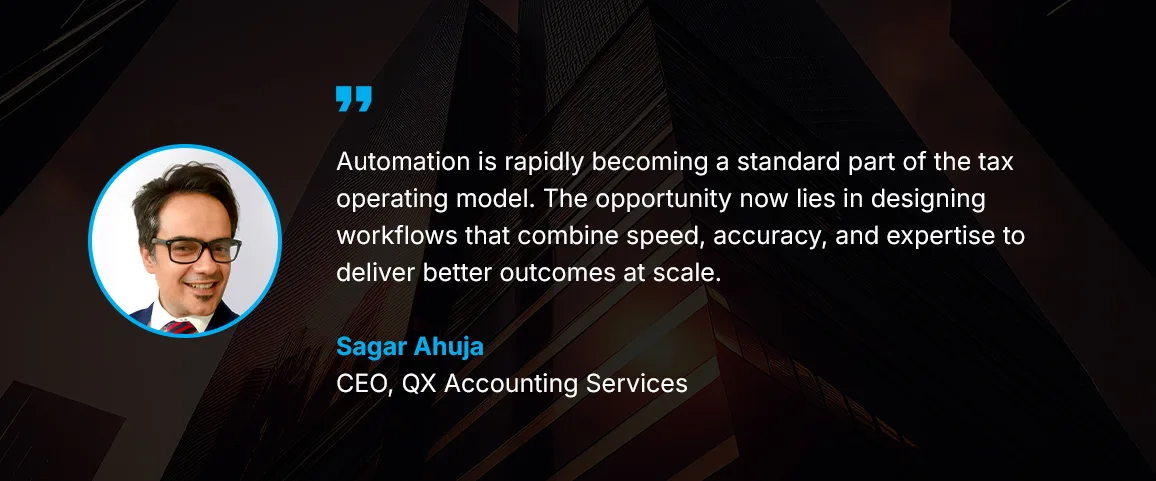
Tax Is Becoming More Complex
Automation is advancing rapidly. At the same time, tax environments continue to grow more complicated. Global operations, evolving reporting requirements, changing state and federal regulations, digital assets, international compliance obligations, and increased scrutiny from authorities have created a landscape where context matters more than ever.
Technology can help professionals manage complexity, but it does not magically eliminate complexity.
In a 2025 analysis of AI’s role in tax operations, KPMG described a future where AI systems handle data extraction, rule selection, document drafting, and large portions of workflow management. Yet the firm emphasized that professionals will increasingly focus on complex legal issues, reviewing outputs and applying human judgment to situations where nuance and interpretation matter most.
In simpler words: Automation doesn’t eliminate the need for professional expertise. In fact, it does the opposite; it changes where professionals spend their time to increase their productivity and overall performance of the business.
Also Read: Top Tax Outsourcing Companies in the USA
That’s an important distinction for firms planning their future operating model.

The Hidden Risk: Losing the Path to Judgment
There is another challenge the profession isn’t discussing enough. Judgment is not innate. It needs to be developed, with time, experience, mistakes, and successes.
Historically, tax professionals built expertise through years of exposure to client situations, compliance work, exception handling, and regulatory interpretation. Many of those foundational tasks are now being automated.
What happens to the junior professionals? Well, multiple reports have publicly acknowledged this challenge, noting that upcoming professionals may no longer gain experience that traditionally helped them build judgment. The firm’s response has been to invest in simulation-based learning that replicates real-world scenarios and accelerates professional development.
That investment highlights an important reality: The profession doesn’t just need experienced professionals with judgment. It must also find new ways to develop the next generation of advisors.
Automation cannot become a substitute for expertise. it must become a tool that helps professionals reach expertise faster.
The Firms That Win Will Balance Technology and Judgment
The conversation about AI often focuses on efficiency metrics.
Hours saved, processes automated, returns completed, and so on. Of course, these measurements matter. But they aren’t what clients ultimately remember.
Clients remember the advisor who identified a risk before it became a problem. The advisor who provided clarity during uncertainty. The advisor who helped them make a better business decision. Those outcomes rarely come from automation alone.
According to Thomson Reuters‘ report, an estimated $143 billion in U.S. client revenue is at risk for organizations that fail to adapt to AI-driven transformation. However, the report also emphasizes that technology adoption alone is not enough; competitive advantage increasingly depends on how effectively professionals apply expertise, judgment, and client insight alongside AI.
This is likely where the future of tax is heading: toward a model where machines handle processing and humans provide direction.
The Future Belongs to Augmented Firms
Tax automation is not the future. Tax automation combined with human judgment is.
The firms that thrive over the next decade won’t simply adopt more technology. They’ll be the ones that use technology to remove administrative burden while strengthening the expertise, critical thinking, and advisory capabilities that clients ultimately value.
At QX Accounting Services, that’s exactly how we view automation. Rather than treating it as a replacement for professional expertise, we’re embedding automation into tax workflows to eliminate repetitive tasks, accelerate turnaround times, and create greater operational efficiency. The objective isn’t to reduce human involvement; it’s to ensure that experienced tax professionals can spend more time reviewing complex scenarios, exercising judgment, and delivering higher-value outcomes for clients.
Automation makes firms faster. Human judgment makes firms valuable.
And the firms that successfully combine both will be best positioned to navigate the future of tax.
If you’d be interested in exploring more, connect with us.
FAQs
1. If automation can handle most routine tax work, where is human judgment still needed?
Human judgment remains critical in areas that require interpretation, risk assessment, and decision-making. While automation can apply rules and process information at scale, tax professionals are still needed to evaluate complex scenarios, assess uncertain positions, understand business context, and provide recommendations aligned with a client’s broader objectives.
2. Will AI eventually replace tax professionals?
AI is expected to automate many repetitive and process-driven tasks, but it is unlikely to replace tax professionals entirely. Tax advice often requires contextual understanding, professional skepticism, ethical considerations, and client-specific interpretation- areas where human expertise remains essential. The future is more likely to be characterized by collaboration between technology and professionals rather than replacement.
3. How can firms automate tax workflows without compromising quality?
The most effective approach is to automate high-volume, rule-based activities while maintaining human oversight at critical review and decision points. Firms that successfully balance automation with professional review can improve efficiency while preserving accuracy, compliance, and client confidence.
4. What skills will become more valuable as tax automation advances?
As routine work becomes increasingly automated, skills such as critical thinking, tax research, risk evaluation, advisory capabilities, client communication, and strategic problem-solving will become even more important. Firms will differentiate themselves through the quality of their judgment rather than the speed of processing.
Enquire now

Cora Vollmar
With over 20 years of experience in accounting, talent strategy, operations, and business development, Cora Vollmar helps CPA firms solve capacity challenges and build scalable growth strategies. She is an expert in senior-level accounting and CPA recruiting, with a proven track record of helping firms develop talent pipelines, recruit leadership professionals, and address the ongoing accounting talent shortage.
Through strong relationships with State CPA Societies, accounting alliances, and industry organizations, Cora brings valuable insight into firm growth, talent trends, and the future of the profession. At QX Accounting Services, she helps firms leverage global talent, managed services, and workforce strategies to build sustainable capacity and support long-term growth.
Unauthorized copying or plagiarism of our content is a violation of intellectual property rights. We take such matters seriously and will pursue legal action to protect our original work. Anyone found engaging in such activities will be held accountable under applicable laws.
Don't forget to share this post!
Our Latest Insights




Let’s Work Together
Explore outsourcing solutions, request a no-obligation trial or discuss your practice’s needs with our expert consultants.
 Book a Virtual Meeting
  Get Your ROI Estimate