How CPA Firms Are Using Hybrid Outsourcing to Survive the 2026 Tax Season?



Tax season has always been demanding. True!
But there’s something that’s changing in 2026- the margin for error.
Let me explain this to you in a bit of detail. CPA firms in today’s dynamic market are dealing with heavier workloads, more complex compliance, and a talent pipeline that isn’t keeping up. The usual response mechanism that includes hiring ahead of peak season, stretching teams, and relying on seasonal staff is no longer enough. These create cost strain in the off-season and fatigue during the months that matter most. Instead, a growing number of progressive firms are quietly restructuring how work gets done.
No, this is not happening just because of “Outsourcing”. There’s more to it- a hybrid operating model.
A Different Way to Scale Through Peak Season
At its core, the hybrid model is straightforward. Firms retain ownership of client relationships, review, and final sign-off, while shifting the preparatory layer—data-heavy, process-driven work to an offshore team.
At a higher level, this may look like reducing involvement. But it’s more about placing effort where it has the highest value.
For example: when a partner is reviewing a complex position or advising a client, that time compounds. When the same partner is buried in data entry or repetitive workpapers, it doesn’t.
The hybrid structure corrects that imbalance.
What Actually Moves Offshore and What Doesn’t
There’s a clear distinction between what stays in-house and what moves offshore. This is completely based on the natural structure of tax workflows.
The work that moves offshore can be defined clearly and executed consistently: organizer data entry, initial 1040 preparation, trial balance mapping, first-pass 1120 workpapers, diagnostics cleanup. Work that has a known input and a verifiable output.
What stays in-house then? Well, everything tied to judgment, human behaviour, and decision-making. This includes review decisions, tax positions, client conversations, and accountability.
Firms that get this separation right don’t feel like they’ve outsourced work.
Rather, they feel like they’ve created a more efficient version of their own internal model; just with an extended execution layer.
Why Hybrid Model Is Gaining Ground Now
This shift majorly comes as a response to structural constraints.
The talent shortage is one of them, but not in the way it’s often described. It’s not just that firms can’t hire fast enough; it’s that hiring is no longer a viable way to manage a seasonal spike. Building a team for peak capacity means carrying that cost year-round, which doesn’t hold up economically.
At the same time, the nature of tax work is expanding. Regulatory changes, updated reporting requirements, and higher client expectations mean there is simply more work to process before a return is ready for review. Even with better software, the volume of preparation hasn’t meaningfully reduced.
The result is pressure at exactly the wrong layer of the firm. Managers and partners get pulled deeper into production just to keep things moving. And more often than not, the part that differentiates the firm gets pushed aside.
Hybrid outsourcing addresses this by removing the dependency between volume and senior time.
See how CPA firms are scaling tax season capacity without increasing permanent headcount.
Talk to a Tax Capacity Specialist
The Real Advantage Isn’t Cost—It’s Control Over Capacity
Cost savings are often the headline, but they’re not the reason firms are sticking with the model. What matters more is control.
A hybrid setup allows firms to expand throughput during peak months without overextending their internal team. Work continues to move, turnaround times improve, and review isn’t rushed at the last minute.
There’s also a quieter but important shift in how time flows. With an offshore team aligned to the firm’s process, work prepared at the end of the day can be ready for review the next morning. That continuity changes how deadlines feel, as part of a steady cycle.
Over the course of a busy season, that difference compounds.
Also Check Expert Tax Preparation Outsourcing Services For CPAS in USA
Where the Operating Model Breaks Down?
Not every firm sees the same results with outsourcing. The success of offshoring as a strategy is mostly dependent on how the model is implemented.
Problems start when outsourcing is treated as a transaction, instead of an integration. If the offshore team operates outside the firm’s workflows, the result is predictable—more rework, slower reviews, and inconsistent output.
The firms that succeed invest upfront in defining how work should move. They standardize inputs, clarify what “review-ready” means, and maintain visibility into progress. In other words, they design the model before scaling it.
Without that structure, outsourcing adds volume.
With it, it adds stability.
What This Signals for the Profession?
Hybrid outsourcing is no longer a workaround for the busy season. It is becoming part of how firms are structurally designed. There is a clear shift underway: firms are moving from headcount-driven capacity to model-driven capacity. They are recognizing that not all work needs to sit inside the firm to remain under their control.
And there is publically available data to reflect this shift. According to the AICPA’s MAP survey, 25% of CPA firms already use offshore outsourcing, with more planning to adopt it; a clear indication that hybrid delivery is becoming embedded, not experimental.
Also Read: Tax Outsourcing Companies for CPA Firms in the USA
From Capacity Constraint to Operating Choice
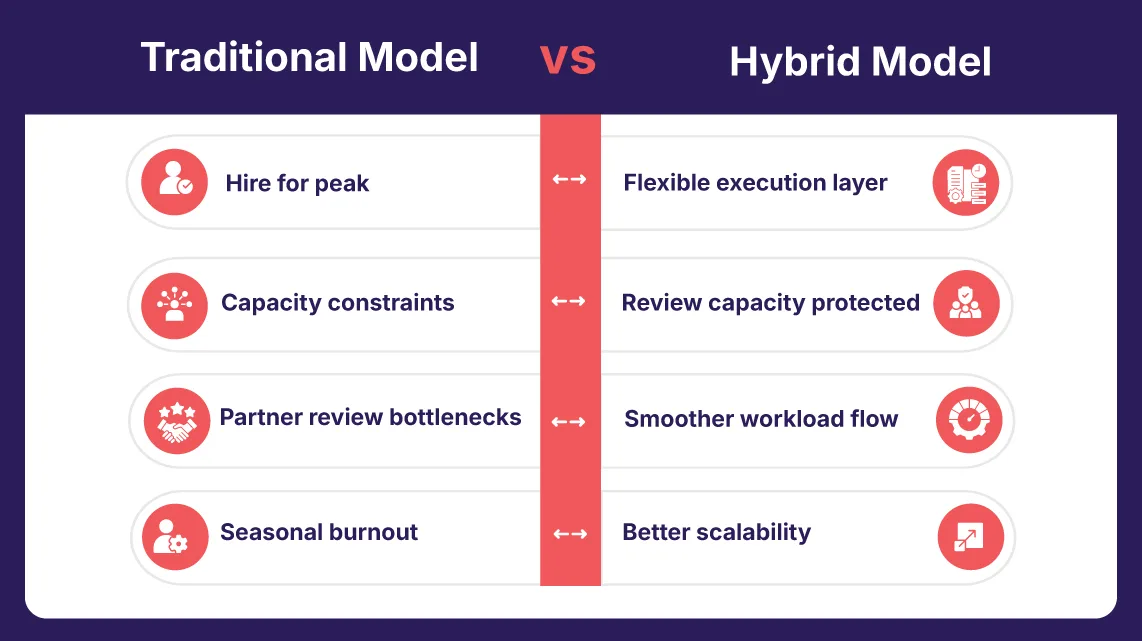
The real impact of hybrid outsourcing shows up in how the firm functions under pressure.
Firms that adopt this model effectively are not just managing tax season better; they are changing the economics and experience of it.
Peak months stop feeling like a survival exercise. Work moves in a steady rhythm instead of last-minute surges. Senior time is protected, not consumed.
Of course, the tax season chaos won’t start looking like a romantic date night, straight out of a 70’s Hollywood movie, but it does become far more predictable and controlled. Firms gain a level of consistency that traditional staffing models rarely provide.
This is what defines the shift.
Hybrid outsourcing turns capacity from a constraint into a design decision.
It allows firms to decide how they want work to flow, rather than reacting to volume as it arrives. And as tax complexity continues to rise and talent constraints persist, this distinction becomes critical.
Because the firms that will scale through future tax seasons won’t be the ones that simply hire more. They will be the ones that build operating models capable of absorbing change, without losing control over quality, timelines, or client experience.
FAQs
1. What is a hybrid outsourcing model in CPA firms?
A hybrid outsourcing model combines an in-house team with an offshore execution layer. The internal team retains ownership of client relationships, review, and final sign-off, while offshore teams handle structured, high-volume tasks such as data entry, workpaper preparation, and first-pass tax returns.
2. Which tax workflows are best suited for offshore execution?
Work that is repeatable, rules-driven, and clearly defined tends to transition well. This typically includes 1040 data entry, trial balance mapping, initial 1120/1120-S workpapers, and diagnostics cleanup. Judgment-heavy areas—tax positions, review decisions, and client advisory—remain in-house.
3. How does hybrid outsourcing improve capacity during peak tax season?
Instead of scaling internal headcount for a short-term surge, firms use offshore teams to absorb preparatory workload. This allows them to handle 2–3x volume spikes without overburdening internal teams or carrying excess capacity post-season.
4. Does outsourcing impact quality or client experience?
When structured correctly, it shouldn’t. In a hybrid model, offshore teams prepare work to a review-ready stage, while the CPA firm retains control over quality, compliance, and client interaction. The client experience remains consistent because accountability does not shift.
5. What are the key risks firms should address before adopting a hybrid model?
The primary risks typically come from poor process design, such as unclear workflows, inconsistent inputs, and lack of visibility. Firms need defined SOPs, strong review layers, and real-time tracking to ensure the offshore team integrates seamlessly into their delivery model.
Enquire now

Cora Vollmar
With over 20 years of experience in accounting, talent strategy, operations, and business development, Cora Vollmar helps CPA firms solve capacity challenges and build scalable growth strategies. She is an expert in senior-level accounting and CPA recruiting, with a proven track record of helping firms develop talent pipelines, recruit leadership professionals, and address the ongoing accounting talent shortage.
Through strong relationships with State CPA Societies, accounting alliances, and industry organizations, Cora brings valuable insight into firm growth, talent trends, and the future of the profession. At QX Accounting Services, she helps firms leverage global talent, managed services, and workforce strategies to build sustainable capacity and support long-term growth.
Unauthorized copying or plagiarism of our content is a violation of intellectual property rights. We take such matters seriously and will pursue legal action to protect our original work. Anyone found engaging in such activities will be held accountable under applicable laws.
Don't forget to share this post!
Our Latest Insights




Let’s Work Together
Explore outsourcing solutions, request a no-obligation trial or discuss your practice’s needs with our expert consultants.
 Book a Virtual Meeting
  Get Your ROI Estimate