KPIs to Measure Outsourced Bookkeeping Performance for CPA Firms



For CPA firms in the United States, outsourcing bookkeeping can expand capacity, reduce seasonal pressure, and improve client responsiveness. But the arrangement only works when performance is measured clearly. The right outsourced bookkeeping KPIs help firms move beyond “Is the work getting done?” and answer better questions: Is it accurate? Is it timely? Is it scalable? Is it protecting client relationships?
Use the following KPIs to measure outsourced bookkeeping performance and build a practical scorecard for your firm, your clients, and your outsourcing partner. If you’re starting from scratch, this outsourced bookkeeping for US CPA firms guide is a solid companion piece.
“Outsourced bookkeeping only works when performance is measured, not assumed.”
– Cora Vollmar, SVP Growth, QX Accounting Services
Why CPA firms need to measure outsourced bookkeeping performance?
For CPA firms, Outsourced Bookkeeping Services is not just about moving tasks off the internal team’s plate. It affects review time, client confidence, advisory readiness, tax-season pressure, and the firm’s ability to scale without losing control. Measuring performance gives partners and managers a clear view of whether the outsourcing arrangement is improving capacity, quality, turnaround, and profitability or simply shifting work elsewhere.
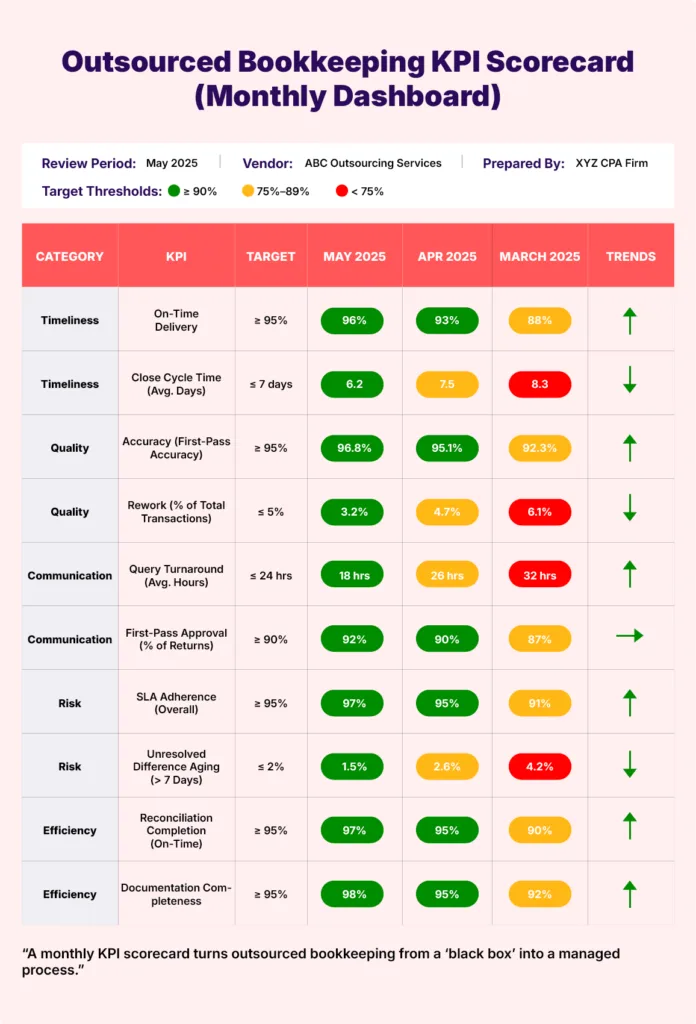
The KPIs below help firms turn outsourced bookkeeping into a managed process with clear expectations, early warning signs, and practical improvement points.
How to use the scorecard: baseline, benchmark, and review cadence?
- Baseline first: For new transitions, track KPIs weekly for the first 4–8 weeks and treat the results as “baseline,” not failure.
- Benchmark fairly: Segment scorecards by client tier (simple/standard/complex), transaction volume, and systems (QBO, Xero, bill pay tools, payroll tools). Apples-to-apples comparisons prevent bad decisions.
- Assign owners: Each KPI should have (1) a provider owner who fixes root causes, and (2) a CPA firm owner who sets standards and signs off on changes.
- Cadence that works for CPA firms: Weekly for high-volume clients and during transition; monthly for steady-state production; quarterly for trend review, pricing/staffing decisions, and SLA resets.
Don’t forget the “why”: Tie at least one KPI to business outcomes (review hours saved, close speed, margin per engagement).
Also Read: ROI of Outsourced Bookkeeping for CPA Firms
Bookkeeping KPI scorecard: metrics, formulas, and starter benchmarks
Targets vary by client complexity, transaction volume, and how clean the source documents are. Use these as starter bands, then adjust after you baseline performance for 30–60 days.
| KPI | What it tells you | Simple formula | Starter target (typical) |
| On-time delivery rate | Whether deliverables hit agreed deadlines | (On-time deliverables ÷ total deliverables) × 100 | ≥ 95% for steady-state clients |
| Month-end close cycle time | How fast you can review and advise | Business days from month-end to “close package delivered” | 5–10 days for simple clients; 10–15 days for complex clients |
| Accuracy rate | Quality of coding, postings, and reconciliations | 100 − [(Errors found ÷ items sampled) × 100] | ≥ 98% on sampled work |
| Rework rate | Hidden cost of quality gaps | (Reworked tasks ÷ total reviewed tasks) × 100 | ≤ 5%; aim lower as SOPs mature |
| Reconciliation completion | Whether the books are audit-ready each period | (Accounts reconciled by deadline ÷ accounts due) × 100 | 100% for required accounts |
| Query turnaround | How fast blockers are raised and cleared | Average hours from vendor question to firm/client resolution, excluding client delay if needed | Same day or next business day |
| First-pass review approval | Whether work meets your firm’s standards | (Items approved on first pass ÷ items reviewed) × 100 | ≥ 90%, then raise the bar |
Once your firm has a baseline scorecard, the next step is to look at each KPI in more detail. The following sections explain what each metric means, why it matters, and how CPA firms can track it in day-to-day outsourced bookkeeping workflows.
1. On-Time Delivery Rate
On-time delivery is one of the most important bookkeeping outsourcing performance metrics because delays affect financial reporting, tax planning, advisory work, and client confidence.
Track the percentage of deliverables completed by the agreed deadline, such as weekly bank reconciliations, monthly financial statements, payroll-related entries, or close packages.
A strong on-time delivery KPI should define:
- What counts as “complete”
- The due date for each task
- Whether client-side delays are excluded
- How exceptions are documented
Tip: If you want to formalize deadlines and response times, document them in a simple service-level agreement (SLA).
2. Month-End Close Cycle Time
Month-end close cycle time measures how long it takes to complete the bookkeeping close after the end of the month. For CPA firms, this KPI connects directly to client service quality.
A shorter close cycle helps your team review financials faster, identify issues earlier, and deliver timely insights. A longer or inconsistent cycle may signal unclear processes, missing documents, capacity issues, or weak communication. For many firms, the time zone advantage in offshore bookkeeping is one practical lever for improving turnaround.
To track it, measure the number of business days from month-end to final close package delivery. Segment results by client complexity so performance benchmarking is fair.
3. Bookkeeping Accuracy Rate
Accuracy is the foundation of outsourced bookkeeping performance measurement. This KPI tracks how often the work is completed correctly the first time.
Examples of accuracy issues include:
- Misclassified transactions
- Duplicate entries
- Incorrect reconciliations
- Missing accruals or adjustments
- Inconsistent use of client-specific rules
CPA firms can calculate an accuracy rate by reviewing sampled transactions or completed workpapers and tracking errors as a percentage of total items reviewed. As one of the most important bookkeeping quality metrics, accuracy should be monitored consistently, not only when problems arise.
If accuracy dips, it’s often less about “effort” and more about team structure and oversight.
4. Rework Rate
Rework rate measures how much bookkeeping work must be corrected after review. While accuracy rate focuses on defects, rework rate highlights the operational cost of those defects.
High rework can quietly reduce the ROI of outsourced bookkeeping because your internal team spends more time reviewing, correcting, and explaining issues.
Track rework by client, task type, and team member when possible. If rework is concentrated in one area, such as accounts payable coding or payroll journal entries, targeted training may solve the issue quickly. If you want a clearer picture of roles and handoffs, use this breakdown of how offshore bookkeeping works as a workflow reference.
5. Reconciliation Completion Rate
Reconciliation completion rate shows whether bank, credit card, loan, and balance sheet accounts are reconciled within the required period. This is one of the most practical bookkeeping service level metrics because reconciliations are central to reliable financial reporting.
Measure both completion percentage and timeliness. A reconciliation completed late may still create downstream problems for tax teams, advisory teams, and client decision-making.
6. Unresolved Difference Aging
Not all reconciliation issues can be solved immediately. However, unresolved differences should not remain open indefinitely.
This KPI tracks the age and value of unreconciled items, suspense balances, unknown transactions, and open questions. It helps identify risks before they impact bookkeeping accuracy or compliance.
Useful aging categories include:
- Less than 7 days
- 8 to 15 days
- 16 to 30 days
- More than 30 days
Older unresolved items should trigger escalation, especially for clients with tight reporting deadlines or higher compliance sensitivity.
7. Client Query Turnaround Time
Outsourced bookkeeping often depends on answers from clients. Query turnaround time measures how quickly questions are raised, answered, and resolved.
This KPI should separate vendor response time from client response time. If the outsourcing team waits too long to ask questions, delays are vendor-driven. If the client does not respond, the firm may need a better client communication process.
For CPA firms, this KPI improves visibility. It shows whether bottlenecks come from the outsourced team, internal reviewers, or clients.
8. First-Pass Review Approval Rate
First-pass review approval rate measures the percentage of work accepted by the CPA firm reviewer without significant correction.
This is one of the strongest bookkeeping outsourcing KPIs for CPA firms because it reflects both quality and preparedness. A high first-pass rate means the outsourcing partner understands your standards, client preferences, chart of accounts, and documentation expectations.
If this KPI is low, look for root causes such as unclear SOPs, poor onboarding, inconsistent review notes, or lack of industry-specific knowledge.
9. SLA Adherence Rate
Service level agreements define what the outsourcing provider is expected to deliver. SLA adherence rate measures whether those commitments are being met.
Common bookkeeping service level metrics include:
- Turnaround time for transaction coding
- Monthly close deadlines
- Response time for urgent questions
- Reconciliation deadlines
- Review note correction timelines
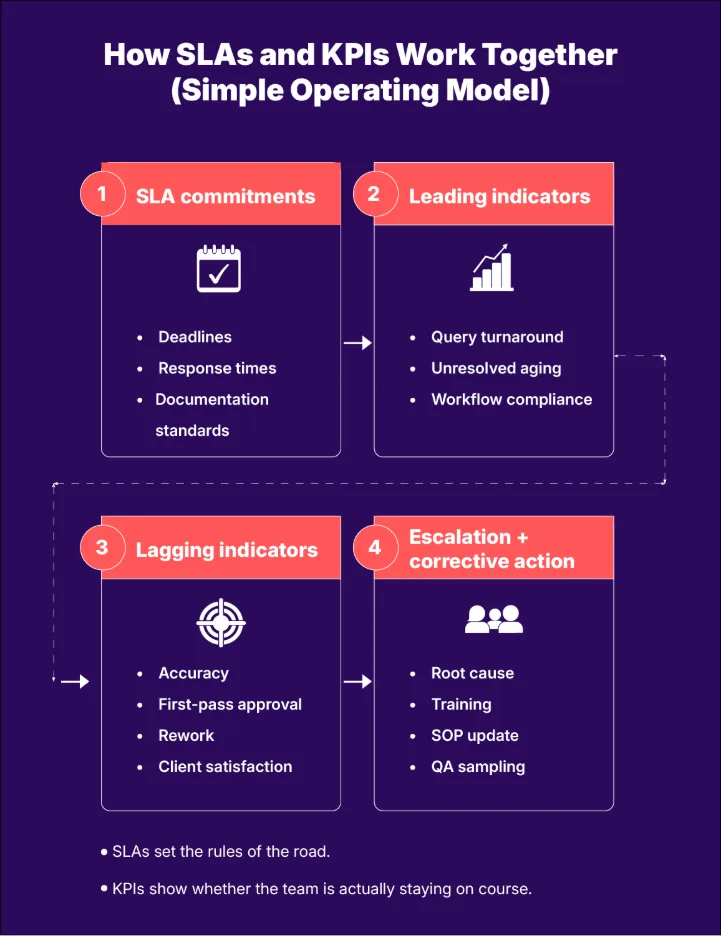
SLAs and KPIs work best together: the SLA sets the expectation, while the KPI shows actual performance. If you’re standardizing deliverables across clients, this bookkeeping outsourcing guide can help you tighten definitions (so you’re measuring the same thing every month).
10. Productivity per Bookkeeper
Bookkeeping outsourcing productivity measures how much work is completed within a defined period without sacrificing quality.
Possible productivity measures include:
- Transactions processed per hour
- Clients supported per bookkeeper
- Reconciliations completed per week
- Close packages completed per month
Productivity should always be viewed alongside accuracy, rework, and complexity. A provider that processes more transactions but creates more errors may not be more efficient.
To tie productivity to economics, pair it with profitability metrics like cost per engagement and review time. Here’s a practical framework for the ROI of outsourced bookkeeping and what to measure to prove (or improve) it.
11. Documentation Completeness
Documentation completeness measures whether the outsourced team attaches support, leaves clear notes, follows workpaper standards, and maintains audit-ready records.
This KPI is especially important for CPA firms because bookkeeping work often feeds tax preparation, advisory services, financial statement preparation, or compliance support. If your goal is tax-season lift, connect documentation KPIs to your tax preparation outsourcing workflow so handoffs stay clean.
Strong documentation reduces review time and helps protect continuity if staff changes occur. Weak documentation may create hidden risk even when the numbers appear correct.
12. Escalation Rate
Escalation rate tracks how often issues must be elevated to managers, partners, or senior reviewers. Some escalation is healthy, especially for unusual transactions. Too much escalation may indicate inadequate training, poor SOPs, or unclear ownership.
Track escalations by reason:
- Missing documents
- Unclear transaction treatment
- Software access issues
- Client communication delays
- Quality concerns
This KPI helps firms identify risks early and improve both process design and outsourcing ROI.
13. Software and Workflow Compliance
Many CPA firms rely on standardized accounting platforms, document management systems, workflow tools, and approval processes. This KPI measures whether the outsourced team follows those systems correctly.
Examples include proper task status updates, naming conventions, document uploads, checklist completion, and review note responses.
Workflow compliance may seem administrative, but it directly affects visibility, accountability, and scalability.
14. Client Satisfaction and Internal Team Satisfaction
Numbers matter, but stakeholder experience matters too. CPA firms should track feedback from both clients and internal team members.
Client satisfaction can reveal whether outsourced work supports timely communication and confidence in financial reports. Internal satisfaction shows whether managers feel supported or burdened by the outsourcing relationship.
15. Security & Compliance Control KPIs
For CPA firms, “performance” also includes protecting client data and reducing compliance risk. If you’re formalizing controls, align KPI expectations with your governance approach and security and quality controls.
- Access exceptions: Number of unauthorized access attempts or access-policy violations (target: 0).
- Provisioning/deprovisioning timeliness: Time to remove access for offboarded users (target: same day).
- MFA and least-privilege adherence: % of users and tools compliant with MFA and role-based access (target: 100%).
- Security incident count + time to contain: Incidents per quarter and time-to-containment (target: decreasing trend; tight response SLAs).
- Vendor assurance status: Current SOC reports / control attestations on file (target: up to date for in-scope services).
These KPIs complement operational metrics like accuracy and documentation, and they’re especially relevant for US firms working under data protection requirements.
How to Build a Practical KPI Scorecard?
A strong scorecard does not need dozens of metrics. Start with a focused set of outsourced bookkeeping KPIs that cover timeliness, quality, productivity, communication, and risk.
A practical scorecard might include:
- On-time delivery rate
- Month-end close cycle time
- Accuracy rate
- Rework rate
- Reconciliation completion rate
- SLA adherence rate
- Query turnaround time
- First-pass review approval rate
- Documentation completeness
- Escalation rate.
Review these metrics by client, service line, and complexity level. This makes bookkeeping performance benchmarking more meaningful and prevents unfair comparisons between simple and complex engagements.
When you’re pressure-testing costs, it also helps to understand common pricing models of bookkeeping outsourcing companies so your KPI targets line up with your commercial model.
Conclusion
Outsourced bookkeeping can give CPA firms the capacity to serve more clients, move faster during peak periods, and reduce internal pressure. But capacity alone is not enough. The real value comes when firms measure what matters: accuracy, turnaround time, review quality, communication, documentation, and risk control.
A focused KPI scorecard helps turn outsourcing from a task handoff into a managed performance model. It gives your firm clearer expectations, better vendor accountability, and stronger visibility into where processes need to improve. Start with a small set of practical KPIs, review them consistently, and refine targets as your outsourced bookkeeping workflow matures.
Looking to make outsourced bookkeeping more measurable and reliable? Explore QX Accounting Services or contact us to discuss how we can support your CPA firm.
FAQ
How can CPA firms evaluate the success of outsourced bookkeeping using performance metrics?
CPA firms can evaluate success by tracking whether outsourced work is accurate, timely, well-documented, and efficient. The best KPIs to measure outsourced bookkeeping performance include on-time delivery, close cycle time, accuracy rate, rework rate, reconciliation completion, SLA adherence, and client satisfaction. Together, these metrics show whether outsourcing is improving capacity, quality, and profitability.
Which operational KPIs best reflect the quality of outsourced bookkeeping services?
The strongest bookkeeping quality metrics include accuracy rate, first-pass review approval rate, rework rate, documentation completeness, reconciliation completion rate, and unresolved difference aging. These KPIs show whether the provider is producing reliable work that your CPA firm can confidently review, use, and deliver to clients.
How do SLAs and KPIs work together to improve bookkeeping outsourcing outcomes?
SLAs define the service expectations, such as deadlines, response times, and deliverable standards. KPIs measure whether those expectations are being met. When used together, SLAs and KPIs create accountability, reduce ambiguity, and give both the CPA firm and outsourcing provider a shared framework for improvement.
How can firms benchmark outsourced bookkeeping performance against in-house teams?
CPA firms can benchmark outsourced bookkeeping performance against in-house teams by using the same definitions for speed, accuracy, review time, rework, and cost per deliverable. For a fair comparison, segment clients by complexity, transaction volume, software stack, and reporting requirements.
What reporting cadence is ideal for tracking outsourced bookkeeping KPIs?
A monthly KPI review is ideal for most firms because bookkeeping cycles usually follow monthly reporting. However, high-volume or newly outsourced engagements may need weekly monitoring at first. Quarterly reviews are useful for broader trend analysis, process improvements, staffing decisions, and vendor performance discussions.
How can CPA firms use KPI insights to improve outsourcing ROI and service quality?
CPA firms can use KPI insights to identify bottlenecks, reduce rework, improve training, refine SOPs, and assign work more effectively. For example, if accuracy is strong but turnaround time is slow, the solution may be workflow redesign. If turnaround is fast but review notes are high, the focus should shift to quality control and training.
Which KPIs help identify risks before they impact bookkeeping accuracy or compliance?
The most useful early-warning KPIs include unresolved difference aging, reconciliation delays, escalation rate, documentation completeness, review note trends, and client query turnaround time. On the risk side, track access exceptions, incident trends, and whether assurance documentation (like SOC reports) is current.
How many KPIs should a CPA firm track when outsourcing bookkeeping?
Most firms should start with 8 to 12 core metrics. Tracking too many KPIs can create reporting noise, while tracking too few may hide performance issues.
Enquire now

Cora Vollmar
With over 20 years of experience in accounting, talent strategy, operations, and business development, Cora Vollmar helps CPA firms solve capacity challenges and build scalable growth strategies. She is an expert in senior-level accounting and CPA recruiting, with a proven track record of helping firms develop talent pipelines, recruit leadership professionals, and address the ongoing accounting talent shortage.
Through strong relationships with State CPA Societies, accounting alliances, and industry organizations, Cora brings valuable insight into firm growth, talent trends, and the future of the profession. At QX Accounting Services, she helps firms leverage global talent, managed services, and workforce strategies to build sustainable capacity and support long-term growth.
Unauthorized copying or plagiarism of our content is a violation of intellectual property rights. We take such matters seriously and will pursue legal action to protect our original work. Anyone found engaging in such activities will be held accountable under applicable laws.
Don't forget to share this post!
Our Latest Insights




Let’s Work Together
Explore outsourcing solutions, request a no-obligation trial or discuss your practice’s needs with our expert consultants.
 Book a Virtual Meeting
  Get Your ROI Estimate