Tax Preparation Pricing in 2026: Average Fees & Outsourcing Guide



Tax preparation pricing is shifting fast in 2026 as CPA firms in the United States balance client expectations, IRS compliance demands, tighter seasonal labor markets, and the real costs of rework and review. If you’re revisiting what do CPA firms charge for tax prep, this guide breaks down tax preparation costs 2026, the most common tax preparation pricing models, how to price tax returns for clients by complexity, and a practical approach to measuring the ROI of tax preparation outsourcing including a sample “tax prep outsourcing ROI calculator” you can adapt.
“Tax preparation pricing in 2026 is no longer just about forms and hours. It is about protecting margins, controlling review time, and building enough capacity to deliver reliably through peak season.”
Cora Vollmar, Sr VP Growth, QX Accounting Services
- Typical Tax Preparation Fees in 2026 and How to Apply Them
- What CPA Firms Can Charge for Tax Preparation in 2026?
- What Determines Tax Preparation Fees for CPA Firms?
- Tax Preparation Pricing Models CPA Firms Can Use
- Comparing In-House and Outsourced Tax Prep Costs in 2026
- Understanding Outsourced Tax Preparation Pricing in 2026
- Outsourced Tax Prep Costs: What CPA Firms Should Plan For
- The Role of Automation in Tax Preparation Pricing
- How Automation Changes Tax Preparation Pricing
- Conclusion
- FAQ
Typical Tax Preparation Fees in 2026 and How to Apply Them
The core job hasn’t changed accurate returns prepared to the Internal Revenue Service (IRS) rules and documentation standards but the economics have:
- Higher client complexity (multi-state work, K-1s, equity comp, foreign reporting, pass-through planning).
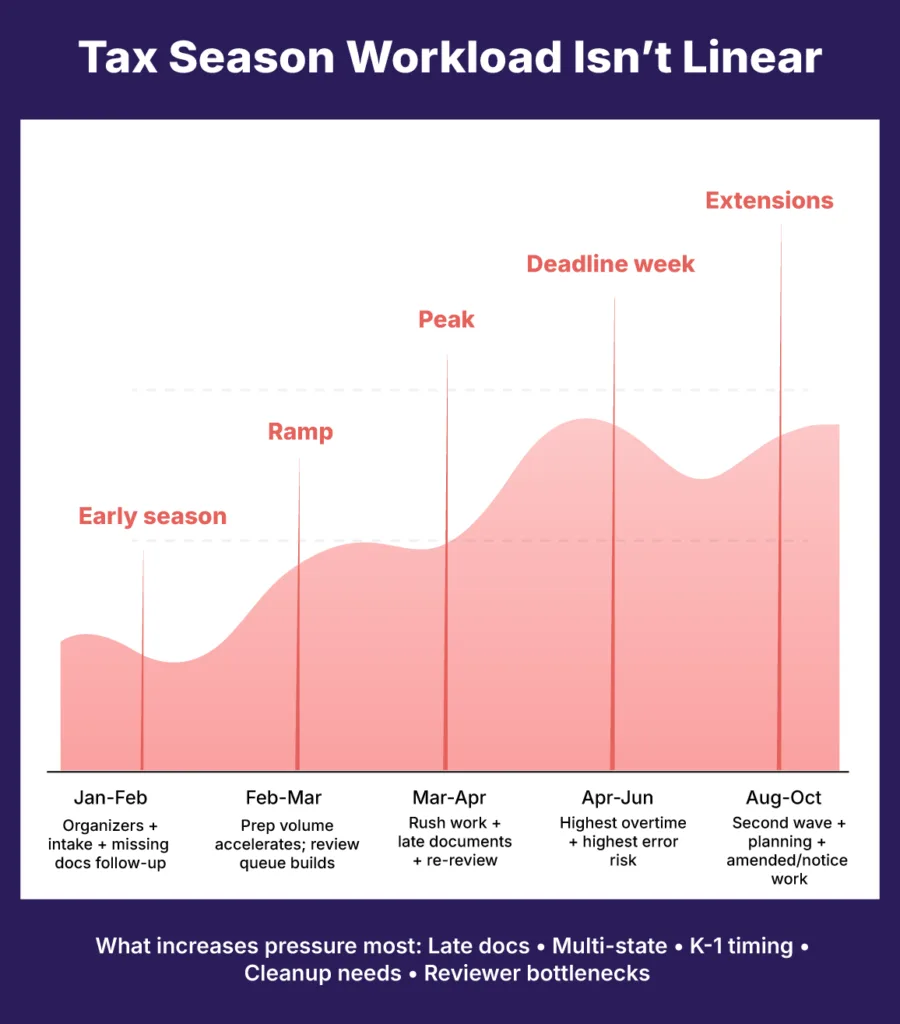
- Compressed timelines as clients delay deliverables, pushing work into peak weeks.
- More time in review and diagnostics due to messy books, portal workflows, and document quality.
- Firms experiencing recurring bottlenecks should also review the Tax Extension Season Capacity Planning Kit for practical planning strategies before peak filing periods.
- More firms adopting hybrid delivery: workflow automation plus outsourced prep to keep partner time focused on advisory and final review.
This is why many firms are updating tax preparation pricing for CPA firms and exploring outsourced tax preparation pricing to stabilize margins and delivery.
What CPA Firms Can Charge for Tax Preparation in 2026?
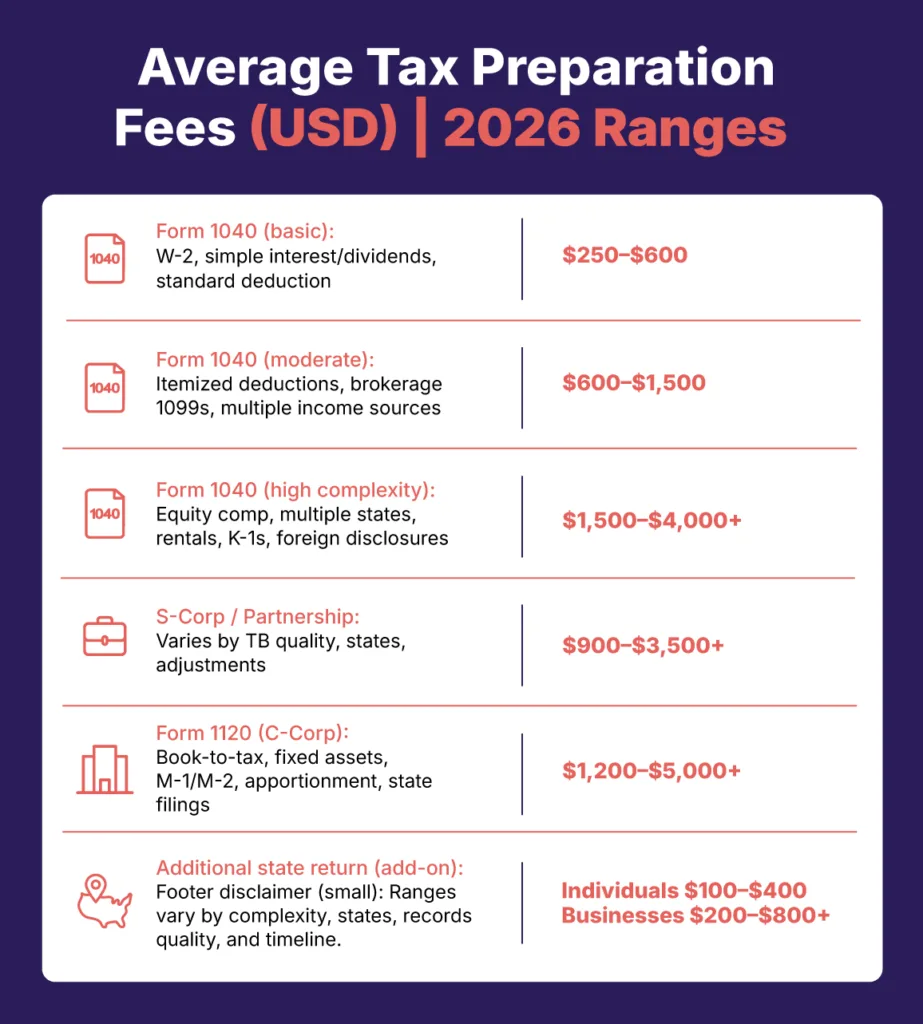
Below is a practical range view of average tax preparation fees and tax preparation service fees you can sanity-check against your market. These are not “one price fits all” use them as anchoring bands, then adjust using the cost drivers in the next section.
Individual Returns (Form 1040)
- Individual returns must comply with Form 1040 filing requirements, with fees varying significantly based on complexity.
- Itemized deductions + brokerage 1099s + multiple income sources: $600–$1,500
- High-complexity 1040 (RSUs/ISOs, multiple states, rental(s), K-1s, foreign disclosures): $1,500–$4,000+
- Add-on state return(s): typically $100–$400 per state (varies by complexity)
Business Returns
- S corporation / Partnership (complexity-dependent): $900–$3,500+
- C corporation: $1,200–$5,000+ depending on bookkeeping quality, adjustments, apportionment, and state filings
- Additional state business returns: $200–$800+ per state depending on nexus, apportionment, credits, and combined reporting
A useful way to present ranges to clients
Instead of quoting a single number too early, many firms present:
- Base fee + complexity bands (example: “1040 starts at $X; most clients land between $Y and $Z”)
- A menu of add-ons (extra states, K-1s, rentals, equity comp, foreign reporting)
This aligns expectations and reduces scope of disputes.
What Determines Tax Preparation Fees for CPA Firms?
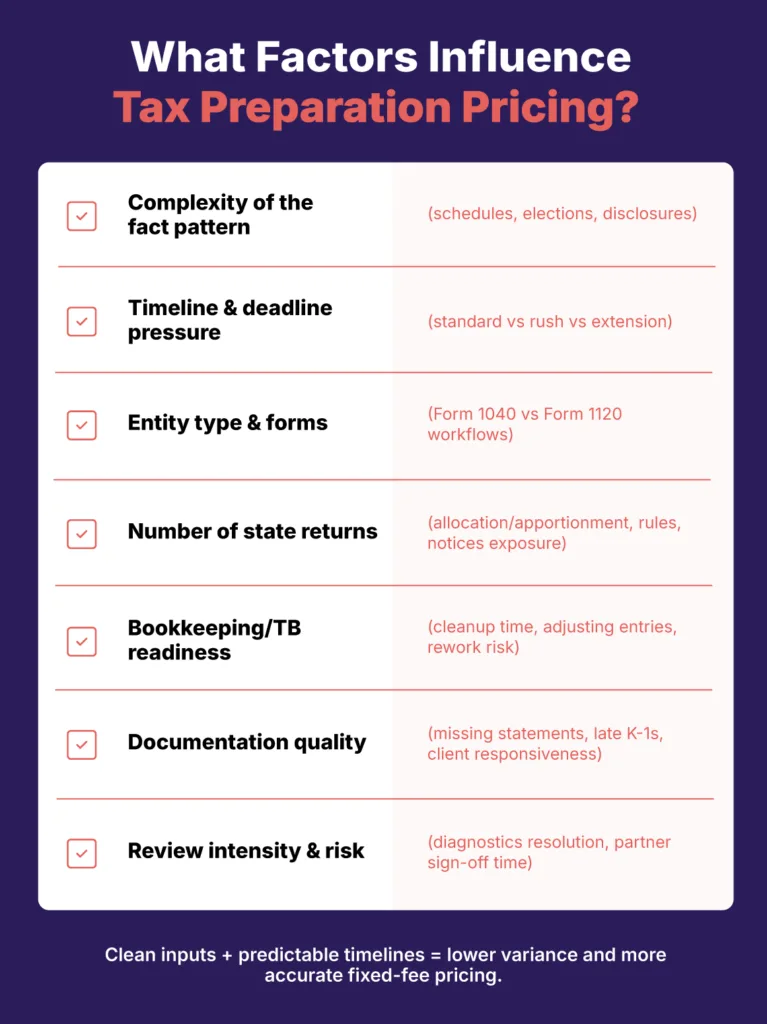
If your team struggles with consistency, it’s usually because pricing doesn’t map cleanly to effort and risk. Here are the key drivers you should bake into tax return pricing by complexity:
Complexity of the fact pattern
More schedules, more elections, more disclosures, and more research time. Complexity also increases review of intensity and partner risk.
Filing schedules and deadline pressure
A return delivered “clean” on February 20 is not priced the same as a return delivered incomplete on April 5 with an April 15 expectation.
Consider:
- Standard timeline pricing
- Rush / priority pricing tiers
- Extension vs. file-by-deadline workflow pricing
Entity type and forms (Form 1040 vs Form 1120)
Form choice drives the workflow:
- Form 1040 complexity often comes from K-1s, multi-state W-2 allocation, and investments.
- Form 1120 complexity often comes from book-to-tax adjustments, fixed assets, M-1/M-2, state apportionment, and provisions.
Number of state returns
Each additional state adds:
- Data validation (W-2 allocation, nexus, apportionment)
- Additional forms, e-file rules, and notices exposure
Bookkeeping quality and trial balance readiness
“Client-ready” books can cut prep time dramatically. Messy books add:
- Cleanup time
- Adjusting entries
- Client back-and-forth
- Higher rework risk
Documentation quality and responsiveness
Missing brokerage statements, unclear owner comp, late K-1s, these increase time in admin, follow-ups, and re-review.
Bottom line: your pricing system should reward clean inputs and predictable timelines, and price up the returns that consume review and project management time.
Tax Preparation Pricing Models CPA Firms Can Use
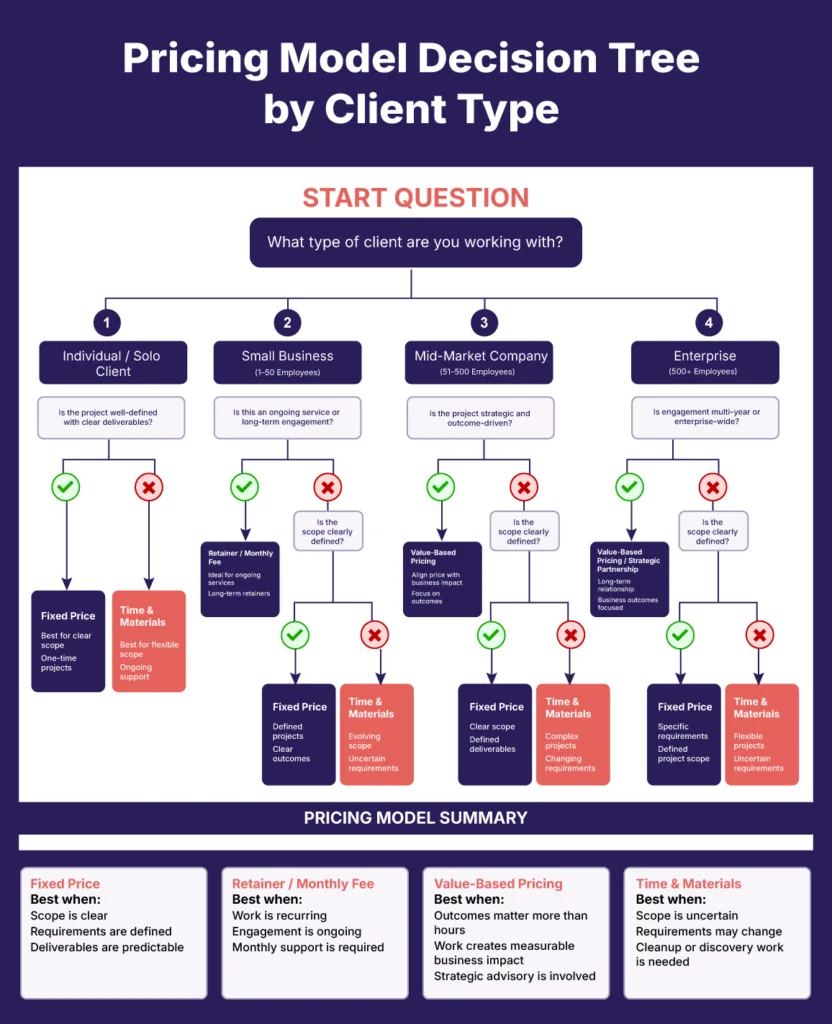
CPA firms usually choose pricing models based on how predictable the work is, how clean the client inputs are, and how much advisory value is included. Firms evaluating different accounting and bookkeeping outsourcing pricing structures should align their model to workflow complexity rather than hourly cost alone.
A per-return fixed fee is often the easiest model for standardized delivery because it works well when the firm has repeatable workflows, strong organizers, and clear complexity tiers. Hourly pricing fits uncertain or cleanup-heavy engagements, especially first-year clients, but it can create billing surprises if expectations are not set early.
For advisory-led firms, value-based pricing can work when the tax return is part of a broader relationship that includes planning, entity strategy, or SALT exposure management. Subscription or retainer pricing is better suited to year-round relationships where the firm is also involved in bookkeeping oversight, estimated taxes, payroll coordination, and annual returns.
Bundled packages can also work well for small business clients because tax quality often depends on the quality of bookkeeping and payroll inputs.
Tiered pricing, per-form add-ons, and hybrid models are useful when client complexity varies. Tiered pricing gives clients simple options, such as basic compliance, compliance with planning, or compliance with additional support. Per-form add-ons help firms price modular complexity such as extra states, rentals, K-1s, foreign forms, or fixed assets.
A hybrid model gives the firm a fixed base fee for predictable work while protecting against exceptions through hourly or change-order terms.
For firms evaluating long-term scalability, it is worth comparing different engagement models for outsourced accounting support before selecting a fixed-fee, dedicated team, or hybrid delivery structure.
Pro tip: Whatever model you choose, mirror it in your tax prep engagement letter pricing terms so scope, deliverables, deadlines, client responsibilities, and change-order rules are clear before work begins.
Comparing In-House and Outsourced Tax Prep Costs in 2026
A true comparison is more than “outsourcing is $X per return.” You need fully loaded cost, throughput, and quality controls. Before comparing per-return costs, firms should understand how offshore delivery models work, because delivery structure often has as much impact on profitability as pricing itself.
In-house cost categories firms often undercount
In-house tax preparation costs go beyond base salary or hourly wages. Firms also need to account for payroll taxes, benefits, overtime, bonuses, software seats, e-signature tools, client portals, document management systems, equipment, IT support, office overhead, and admin or project management time. Training and ramp time also add cost, especially when new preparers require manager shadowing, error correction, and workflow guidance during peak-season pressure.
The less obvious costs often come from rework, review, and seasonal utilization gaps. Missing disclosures, messy inputs, diagnostic cleanup, and repeated client follow-ups can push more work onto reviewers and partners. Firms also pay for capacity even when work is not perfectly level-loaded, which means bottlenecks often move to senior reviewers during the busiest filing weeks.
The Key Cost Factors in Outsourced Tax Preparation
- Outsourced tax preparation cost per return (by form and complexity tier)
- Onshore/offshore mix and how it affects turnaround time and communication
- Standardization requirements (organizers, TB mapping, naming conventions)
- Review time (you still own final sign-off)
- Vendor QA + your internal QC (sampling, checklists, feedback loops)
- Security/compliance (SOC reports, encryption, access controls)
- Hidden costs (rush fees, rework fees, versioning, “out-of-scope” forms)
A Realistic Tax Prep Cost Comparison
- For a complex Form 1040 handled in-house, assume 3.0 hours of preparation and 1.0 hour of review, creating 4.0 total hours of effort. At a fully loaded blended rate of $95 per hour, the in-house labor cost is $380 per return before adding software, overhead, training, or utilization costs.
- For the same complexity handled through an outsourced prep model, assume a vendor preparation fee of $180 per return, plus 1.0 hour of internal review at a $130 partner or manager rate. That brings the outsourced blended cost to $310 per return before any small admin or QC allocation.
In this example, outsourcing lowers the direct blended cost by about $70 per return before considering hiring, training, overtime, and utilization loss. For many CPA firms, the stronger business case is not only the per-return saving, but the added capacity and timeline protection during peak tax season.
Understanding Outsourced Tax Preparation Pricing in 2026
Outsourced pricing typically varies by:
- Return type (Form 1040 vs business returns)
- Complexity tier
- Volume commitments
- Turnaround SLA
- Workpaper standards and software compatibility
Common structures include:
- Per-return tiers (best for forecasting)
- Per-form add-ons (extra state, K-1 packages, rentals, fixed assets)
- Rush fees during peak weeks
- Monthly minimums or seasonal bundles
If you’re looking for cost-effective tax preparation services, don’t shop on price alone, shop on error rate + turnaround + review time saved.
Outsourced Tax Prep Costs: What CPA Firms Should Plan For
To quantify the ROI of tax preparation outsourcing, treat outsourcing as a capacity and margin strategy, not just a cost-cutting moves.
Step 1: Define the “unit economics” per return
For a given segment (e.g., complex Form 1040), estimate:
- Revenue per return (your fee)
- In-house cost per return
- Outsourced cost per return (vendor fee + internal review + admin)
Step 2: Add capacity value
Outsourcing can free reviewer/partner time to:
- Accept more returns
- Deliver planning engagements
- Reduce extensions and penalty exposure
- Improve client experience and retention
Step 3: Use a simple tax prep outsourcing ROI calculator
ROI % = (Net benefit ÷ Outsourcing investment) × 100
Where:
- Net benefit = (In-house cost avoided − Outsourced cost) + Incremental contribution margin from extra work + Overtime avoided − Added QC/admin costs
Firms that have already measured the broader ROI of outsourced bookkeeping often apply the same methodology when evaluating tax preparation outsourcing decisions.
Example Calculation
Assume your firm outsources 200 complex Form 1040 returns:
Current in-house economics
- Average fee collected: $1,200 per return
- In-house labor time: 4.2 hours per return (prep + review blended)
- Fully loaded blended labor rate: $95/hour
- In-house labor cost: 4.2 × $95 = $399 per return
Outsourcing economics
- Vendor fee: $180 per return
- Internal review: 1.0 hour per return × $130/hour = $130
- Extra admin/QC: $20 per return
- Outsourced cost: $180 + $130 + $20 = $330 per return
At this level, outsourcing saves $69 per return before factoring in hiring, training, overtime, or seasonal utilization losses.
Then add capacity value. By outsourcing prep, you free prep time (say 3.0 hours/return) for your team:
- Freed hours: 200 × 3.0 = 600 hours
- Those hours enable 60 additional standard 1040s at:
- Average fee: $550
- Contribution margin after direct labor: assume $300 each
- Incremental contribution: 60 × $300 = $18,000
Net benefit
- Direct cost savings from outsourcing: 200 × $69 = $13,800
- Incremental contribution from added work: $18,000
- Net benefit: $13,800 + $18,000 = $31,800
ROI
- Outsourcing investment (vendor fees only): 200 × $180 = $36,000
- ROI % = (31,800 ÷ 36,000) × 100 = 88.3%
That is a concrete, finance-friendly way to present the ROI of tax preparation outsourcing to partners: it’s often a throughput and capacity win even when per-return direct costs are similar.
The Role of Automation in Tax Preparation Pricing
Automation doesn’t replace pricing strategy, but it changes your cost base and your client experience.
Where firms see the biggest tax preparation workflow automation savings:
- OCR/document ingestion + standardized organizers
- Auto-imports for brokerage, payroll, and bookkeeping feeds
- Diagnostic templates and review checklists
- Client portals + e-sign workflow standardization
How it affects tax preparation pricing:
- More fixed-fee confidence (lower variance in prep time)
- Higher margin on clean clients (reward good behavior)
- Clearer justification for rush/cleanup fees (because variance is measurable)
Automation also makes outsourcing easier because clean, standardized inputs reduce vendor ramp time and rework.
How Automation Changes Tax Preparation Pricing
Use this as a fast, field-ready evaluation tool when comparing vendors, including “best tax preparation outsourcing companies USA” shortlists.
Vendor evaluation checklist
- Security & compliance: SOC 2-aligned security controls, encryption, access controls, background checks
- Process fit: your tax software compatibility, naming conventions, workpaper standards
- Pilot plan: sample returns across tiers (including multi-state and K-1 heavy returns)
- Quality metrics: error categories, rework SLAs, escalation path, root-cause reporting
- Turnaround SLAs: standard vs rush, peak-season capacity commitments
- Reviewer experience: does outsourced work reduce or increase your review burden?
- Communication: timezone overlap, ticketing system, change tracking/version control
- Staffing continuity: dedicated team vs pooled resources
- Pricing clarity: what’s included, what triggers add-ons, what triggers rush fees
- Data handoff: secure upload, portal integration, audit trail
- IRS compliance: alignment with IRS data security guidelines for tax professionals and documented data protection controls.
Hidden costs to identify early
- Add-on fees for “extra schedules/forms” not defined up front
- Charges for revisions due to late client documents
- Rush fees during deadline weeks
- Internal admin time to manage uploads, versions, and rework loops
- Extra manager/partner review time if workpapers are inconsistent
Firms should also validate how providers handle taxpayer information under IRS Section 7216 confidentiality requirements, especially when offshore teams are involved.
Conclusion
In 2026, the firms that perform best will treat tax preparation pricing as part of a broader operating strategy, not just a fee schedule. The right combination of pricing discipline, workflow standardization, automation, and outsourced support can improve profitability, protect reviewer bandwidth, and create capacity without constantly adding headcount.
Whether you are reassessing your pricing structure, evaluating outsourced tax preparation, or looking for ways to improve peak-season scalability, the goal remains the same: build a delivery model that supports growth without increasing operational strain.
Learn how QX Accounting Services USA helps CPA firms improve tax preparation efficiency through structured outsourcing models, scalable capacity support, and defined quality controls.
If you would like to discuss pricing structures, capacity planning, or outsourced tax preparation options for your firm, contact our team to explore the right approach for your workflow, growth plans, and tax season requirements.
Case Study
See how a CPA firm expanded delivery capacity without increasing internal hiring:
Download Now
FAQ
What factors influence tax preparation pricing?
Key factors include return complexity, filing schedules and deadline pressure, entity type (including Form 1040 vs Form 1120), number of state returns, bookkeeping quality, documentation readiness, and how much review/risk the firm must absorb under IRS standards.
How do outsource tax preparation costs compare with in-house teams?
In-house costs include fully loaded labor, overhead, software, training, utilization losses, and rework. Outsourcing shifts much prep labor into a per-return fee, but you still carry internal review, QC, and admin time. The best comparison is return-level unit economics plus capacity value (what additional work your team can now deliver).
Which pricing model offers the best value for CPA firms?
It depends on your workflow maturity and client mix. Fixed fee (per-return) with clear tiers is often best for standardized delivery. Hourly can fit messy, uncertain work. Value-based pricing for CPA firms fits advisory-driven relationships. Many firms succeed with a hybrid: a fixed base plus per-form add-ons and an hourly exception clause.
What hidden costs should firms evaluate when outsourcing tax preparation?
Common hidden costs include rush fees, revision/rework charges, add-ons for additional forms or states, internal time managing versions and uploads, increased reviewer time due to inconsistent workpapers, and security/compliance overhead.
How can firms calculate the ROI of outsourced tax preparation?
Build a “tax prep outsourcing ROI calculator” using: in-house cost avoided vs outsourced cost, overtime avoided, and incremental contribution margin from additional returns or advisory work enabled by freed capacity. Then compute ROI % = (net benefit ÷ outsourcing investment) × 100.
What services are typically included in tax preparation pricing?
Typically included: organizer/intake review, return preparation, basic e-file packaging, and standard review. Depending on the firm, pricing may also include one state return, basic notices support, or a brief delivery call. Clearly define inclusions/exclusions in tax prep engagement letter pricing terms (amended returns, audit representation, complex notices, cleanup, multi-state expansions).
How does automation affect tax preparation pricing?
Automation reduces variability in prep hours, improves intake quality, and shortens cycle time making fixed fees and tiered pricing more profitable and predictable. It can also reduce outsourcing friction by standardizing inputs and workpapers, improving both quality and turnaround.
Why do CPA firms choose QX Accounting Services for cost-effective tax preparation?
Many CPA firms choose QX Accounting Services when they want cost-effective tax preparation services with a structured outsourcing model, typically emphasizing documented workflows, scalable seasonal capacity, and defined quality controls designed to reduce review friction and stabilize delivery during peak IRS filing deadlines.
Enquire now

Cora Vollmar
With over 20 years of experience in accounting, talent strategy, operations, and business development, Cora Vollmar helps CPA firms solve capacity challenges and build scalable growth strategies. She is an expert in senior-level accounting and CPA recruiting, with a proven track record of helping firms develop talent pipelines, recruit leadership professionals, and address the ongoing accounting talent shortage.
Through strong relationships with State CPA Societies, accounting alliances, and industry organizations, Cora brings valuable insight into firm growth, talent trends, and the future of the profession. At QX Accounting Services, she helps firms leverage global talent, managed services, and workforce strategies to build sustainable capacity and support long-term growth.
Unauthorized copying or plagiarism of our content is a violation of intellectual property rights. We take such matters seriously and will pursue legal action to protect our original work. Anyone found engaging in such activities will be held accountable under applicable laws.
Don't forget to share this post!
Our Latest Insights




Let’s Work Together
Explore outsourcing solutions, request a no-obligation trial or discuss your practice’s needs with our expert consultants.
 Book a Virtual Meeting
  Get Your ROI Estimate