Why Leading CPA Firms Combine Tax Automation With Outsourced Tax Preparation?



Tax teams are being asked to move faster without turning every filing deadline into a staffing emergency. Automation can remove repetitive work from intake, data capture, routing, and status tracking. But software does not create unlimited preparation and review capacity, nor can it replace the judgment that a CPA firm must apply to client-specific facts.
That is why a hybrid model is gaining attention: use tax automation to standardize the workflow, outsource tax preparation services to add flexible production capacity, and internal professionals to retain review, client communication, technical judgment, and filing approval. The value comes from designing these elements as one controlled operating model, not buying disconnected tools or sending work out without clear governance.
“The firms that scale tax operations most effectively separate workflow efficiency, preparation capacity, and professional judgment, then assign each to the right delivery layer.”
Cora Vollmar, Sr VP Growth, QX Accounting Services
Why CPA Firms Combine Tax Automation and Outsourced Tax Preparation in 2026?
Tax work is both process-heavy and judgment-heavy. The process side includes collecting documents, naming files, extracting data, checking for missing items, assigning work, and monitoring status. The judgment side includes interpreting unusual facts, resolving exceptions, reviewing technical treatment, communicating with clients, and approving the final return.
Automation can accelerate the process side. Outsourcing can absorb eligible preparation volume. Internal CPAs can then focus on work that requires firm knowledge, professional judgment, and client context.
- Automate repetitive, digital, rules-based tasks.
- Outsource well-defined preparation work that can follow firm procedures.
- Keep complex positions, high-risk work, client advice, final review, and filing approval inside the firm.
What Tax Automation Can and Cannot Do for CPA Firms?
Tax preparation automation is most useful for document intake, classification, optical character recognition, data extraction, validation checks, workflow routing, reminders, and status visibility. These capabilities can reduce administrative friction and give managers a clearer view of where work is waiting.
The limitation is equally important. A populated field is not the same as a validated tax position. An exception flag is not a resolution. Returns still require preparers and reviewers who can verify source documents, apply firm procedures, understand client-specific facts, and decide whether the work is complete and reasonable.
The strongest positioning for AI-powered tax preparation is therefore a productivity layer. It helps people complete, monitor, and review work more consistently. It should not be presented as a substitute for professional accountability. AICPA Statements on Standards for Tax Services includes standards concerning data protection and reliance on tools.
How Outsourced Tax Preparation Expands Capacity?
Outsourced tax preparation can give CPA firms access to additional preparer capacity without permanently sizing the internal team for the busiest weeks of the year. The firm should still control client relationships, eligibility rules, software access, documentation standards, reviewer sign-offs, escalation decisions, and final filing approval.
The objective is not to send everything out. The objective is to route the right work to the right resource. Clean, recurring returns with complete documents and consistent workpapers are usually easier to standardize than engagements involving uncertain positions, unusual transactions, significant planning needs, or extensive client context.
Explore QXAS’s tax preparation outsourcing services for a service model designed for CPA firms seeking additional preparation capacity. Use the Tax Outsourcing Planning Sheet (2026) to assess what work to outsource, how much capacity to externalize, and when to begin.
A Hybrid Tax Workflow for CPA Firms
- Secure intake: Clients submit documents through the firm’s approved portal or intake channel.
- Automated organization: Technology classifies documents, extracts information, applies naming conventions, and flags gaps.
- Eligibility and routing: The firm routes work according to complexity, risk, standardization, deadlines, and review capacity.
- Outsourced preparation: Eligible returns are prepared within approved software, templates, checklists, and workpaper standards.
- Exception escalation: Questions, missing information, and unclear treatments are escalated through a defined channel.
- Internal review: Firm reviewers evaluate completeness, accuracy, technical treatment, workpapers, and client-specific considerations.
- Approval and client communication: The authorized firm professional retains filing approval and communicates with the client as needed.

What Tax Tasks Should CPA Firms Automate, Outsource, or Keep In-House?
A routing matrix reduces one-off decisions during peak periods. It also prevents a common mistake: adding outsourced preparation capacity without protecting enough internal review capacity.
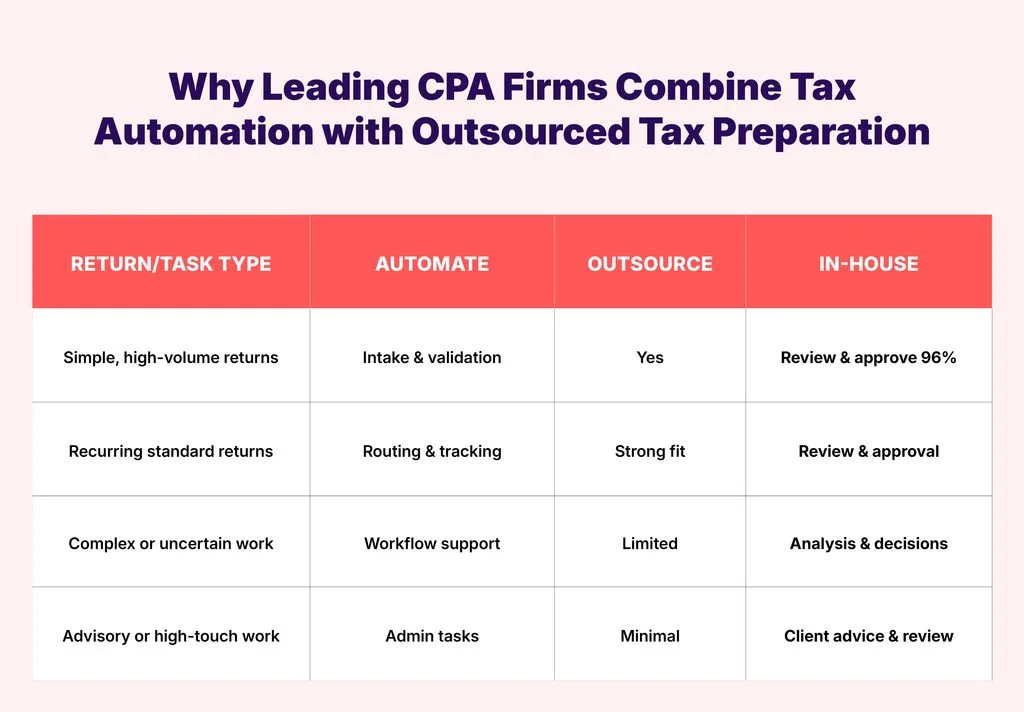
Use three filters when designing the matrix: complexity, standardization, and risk. Firms should also account for reviewer availability. A return may be suitable for outsourced preparation but still create a bottleneck if returned work cannot be reviewed promptly. The Tax Automation Buyer’s Checklist helps CPA firms evaluate workflow, security, reporting, scalability, and vendor-support considerations.
Also Read: Top Tax Preparation Outsourcing Companies
How CPA Firms Maintain Quality in a Hybrid Tax Model?
A hybrid model needs documented controls. Quality should be designed into the workflow rather than inspected only at the end.
- Standard preparation checklists and workpaper packages that specify reviewer expectations.
- A review-note taxonomy for missing documents, classification errors, technical issues, and client questions.
- Version control, audit trails, documented approvals, and clear ownership at each handoff.
- Turnaround measures by stage, including intake, preparation, review, client questions, and finalization.
- A correction process that turns recurring review notes into updated instructions, training, or automation rules.
Automation supports governance by making handoffs, status, timestamps, and queues more visible. Outsourced teams should work to the same documented standards as internal preparers, while the CPA firm retains responsibility for its review and approval process.
Security Requirements for Hybrid Tax Operations
Outsourced work may involve confidential taxpayer information, so security cannot be treated as a procurement checkbox. The firm should evaluate how its workflow protects data from intake through preparation, review, retention, and disposal.
- Controlled access based on job responsibilities and least privilege.
- Multi-factor authentication and approved remote-access methods.
- Limits on downloading, copying, printing, and moving data outside approved systems.
- Encryption, retention, incident-response, and access-review practices.
- A shared workflow that avoids unmanaged spreadsheets and unclear ownership.
- Documented escalation rules for missing information, unclear positions, and suspected security issues.
For current safeguards, review IRS Publication 4557: Safeguarding Taxpayer Data and the IRS Protect Your Clients; Protect Yourself resources. Firms should work with qualified legal, security, and compliance advisers to apply requirements to their circumstances. This article is educational and is not legal, tax, or compliance advice.
How to Choose the Right Tax Outsourcing Partner?
A good evaluation goes beyond hourly rates. Ask how the provider will operate inside the firm’s workflow and how the relationship will be governed.
- Tax experience and supported return types.
- Compatibility with the firm’s approved tax and workflow environment.
- Independent security reports, access controls, handling practices, and retention rules.
- Ability to follow firm naming conventions, checklists, workpapers, and escalation paths.
- Quality checks before return and a method for tracking and reducing corrections.
- Capacity forecasting, ramp-up, prioritization, and peak-period adjustments.
- Named communication owners, response expectations, and documented handoffs.
Why CPA Firms Should Start With a Pilot Program
A pilot makes the model testable. Select a contained group of eligible returns, document the current process, define success measures, and assign owners for preparation questions, review, client contact, and final approval. After the pilot, use actual review notes and cycle-time data to refine the routing matrix, checklists, training, and workflow rules before expanding.
Staff adoption matters as much as technology. Leaders should explain that the model is intended to reduce repetitive work and protect professional time for review, advice, and client service. Clear accountabilities reduce uncertainty and make the operating model easier to trust. See how a wine industry CPA firm used hybrid outsourcing to increase capacity while supporting operational integration, communication, and quality assurance.
Hybrid Tax Workflow Decision Checklist
- Where does work wait today: intake, preparation, review, client response, or approval?
- Which tasks are repetitive and digital enough to automate reliably?
- Which returns are standardized enough for outsourced preparation?
- Which engagements must remain close because of risk, complexity, or relationship context?
- How much internal review capacity is available at each deadline?
- What data-access, security, documentation, and approval controls are mandatory?
- Which pilot group will provide useful evidence without creating unnecessary risk?
Conclusion
Tax automation and outsourced tax preparation are complementary, not interchangeable. Automation creates a cleaner and more visible workflow. Outsourcing adds flexible preparation capacity. Internal professionals preserve judgment, review, client communication, and accountability. CPA firms that define the boundaries, controls, and handoffs before peak season are better positioned to scale without turning quality control into an afterthought.
A useful next step is to map one return segment from intake to filing, identify where it waits, and determine whether the constraint is repetitive process work, preparation capacity, or professional judgment. That diagnosis should guide the technology, outsourcing, and staffing decision.
If preparation capacity is part of the constraint, explore QXAS’s tax preparation outsourcing services to assess how outsourced support could fit within the firm’s workflow, controls, and review process.
FAQs
Does Combining Tax Automation and Outsourcing Help CPA Firms Handle Peak Tax Season?
Yes. Combining tax automation with outsourced tax preparation helps CPA firms manage seasonal workload spikes more effectively. Automation reduces manual administrative tasks such as document collection, workflow routing, and status tracking, while outsourced tax professionals add flexible preparation capacity. This allows internal teams to focus on review, client communication, and complex tax issues during peak season.
Which Tax Tasks Are Best Handled by Automation and Which Require Outsourced Professionals?
Automation is best suited for repetitive, rules-based tasks such as document intake, OCR-based data extraction, workflow routing, reminders, validation checks, and status tracking. Outsourced professionals are typically better suited for return preparation, workpaper organization, reconciliations, return assembly, and other preparation tasks that require human judgment but can follow defined firm procedures and review standards.
How Does the Combination of Tax Automation and Outsourcing Improve Tax Preparation Turnaround Time?
Automation helps reduce delays by organizing documents, tracking workflow status, flagging missing information, and routing returns efficiently. Outsourced tax preparation teams add additional production capacity, allowing more returns to move through the preparation stage without overloading internal staff. Together, these improvements help CPA firms complete returns more efficiently while maintaining review quality.
Can Tax Automation and Outsourcing Reduce Tax Preparation Costs for CPA Firms?
They can help improve operational efficiency and reduce the costs associated with manual work, overtime pressure, and capacity constraints. Automation streamlines repetitive processes, while outsourcing provides scalable preparation support without requiring firms to maintain excess internal staffing year-round. Actual cost impact depends on technology investments, outsourcing strategy, review requirements, and workflow efficiency.
How Do CPA Firms Maintain Quality Control When Using Both Automation and Outsourced Teams?
CPA firms maintain quality by using documented workflows, standardized checklists, defined review procedures, secure systems, escalation rules, and clear accountability at every stage of the process. Automation improves visibility and consistency, while outsourced teams follow firm-defined preparation standards. Internal reviewers retain responsibility for validating work, resolving exceptions, and approving final returns before filing.
Enquire now

Mangesh Singh
With nearly 20 years of experience in U.S. and Canadian tax, accounting, and operations, Mangesh is a PMP and CFP who drives service delivery, workflow efficiency, and team performance at QX Accounting Services. He supports CPA firms with scalable accounting and tax operations, helping improve accuracy, review quality, turnaround times, and client service. Known for his operational discipline and strategic insight, he turns complex delivery challenges into practical solutions that support consistency, accountability, and sustainable growth.
Unauthorized copying or plagiarism of our content is a violation of intellectual property rights. We take such matters seriously and will pursue legal action to protect our original work. Anyone found engaging in such activities will be held accountable under applicable laws.
Don't forget to share this post!
Our Latest Insights




Let’s Work Together
Explore outsourcing solutions, request a no-obligation trial or discuss your practice’s needs with our expert consultants.
 Book a Virtual Meeting
  Get Your ROI Estimate