How to Choose the Right Accounting Outsourcing Partner for Your CPA Firm?


Choosing an accounting outsourcing partner is not simply a capacity decision. It is a decision about quality, security, workflow ownership, review effort, and client service. The right provider should help your CPA firm complete work more predictably without shifting hidden rework or management burdens back to your internal team.
This guide provides a practical evaluation framework, including service-level agreements, performance indicators, due diligence questions, a weighted scorecard, pilot criteria, and red flags to investigate before you sign.
The first question to ask is: Can this provider deliver review-ready work, on our timeline, inside our controls? That question keeps the evaluation centered on outcomes rather than headcount or hourly rate alone.
“The right accounting outsourcing partner should not just add capacity. They should deliver review-ready work, protect client data, and make your CPA firm easier to run.”
Cora Vollmar, Sr VP Growth, QX Accounting Services
- 1. What Accounting Work Should Your CPA Firm Outsource
- 2. How to Evaluate Accounting Outsourcing Partner Fit
- 3. Which SLAs and KPIs Should an Accounting Outsourcing Agreement Include
- 4. What Security and Compliance Standards Should an Accounting Outsourcing Partner Meet
- 5. How to Evaluate Staffing, Continuity, and Quality Control
- 6. How to Assess Technology and Workflow Compatibility
- 7. How to Compare Accounting Outsourcing Pricing Models and Total Cost
- 8. How to Score and Compare Accounting Outsourcing Providers
- 9. Why CPA Firms Should Run a Pilot Before Scaling
- 10. Common Mistakes to Avoid When Choosing an Accounting Outsourcing Partner
- Conclusion
- FAQs
1. What Accounting Work Should Your CPA Firm Outsource
Start with the work your firm actually needs to move. A provider can be strong in recurring bookkeeping and still be a poor fit for multi-entity close work, tax workpapers, cleanup projects, or client accounting services that require more judgment and client context.
Document the following before requesting proposals:
- Service categories, such as bookkeeping, accounts payable, accounts receivable, reconciliations, month-end close, payroll support, tax workpaper preparation, reporting, or cleanup.
- Client profile, including industry, entity type, accounting basis, and any unusual reporting or compliance requirements.
- Complexity, including transaction volume, number of accounts, integrations, intercompany activity, class tracking, and nonstandard adjustments.
- Expected output, such as reconciled books, prepared schedules, documented open items, review-ready workpapers, or financial reporting support.
- Your review process, including who reviews the work, the deadline that supports that review, and the format reviewers need.
A precise scope makes proposals easier to compare and reduces scope drift after implementation.
2. How to Evaluate Accounting Outsourcing Partner Fit
The lowest rate will not compensate for a weak operating fit. Assess each provider across accounting capability, delivery model, communication, technology, and security.
| Dimension | What to verify | Evidence to request |
| Accounting fit | Experience with your work, clients, and review standards | Anonymized work samples, process walkthrough, pilot results |
| Delivery model | Named staff, supervision, backup coverage, continuity | Team structure, role descriptions, transition plan |
| Communication | Overlap hours, cadence, escalation, issue logging | Governance plan, sample status report, escalation matrix |
| Technology | Ability to work in your approved environment | Access workflow, tool experience, documentation standards |
| Security | Controls appropriate to the data and access involved | Security policies, assurance reports, incident response and offboarding process |
3. Which SLAs and KPIs Should an Accounting Outsourcing Agreement Include
Service-level agreements define what the provider commits to deliver. Key performance indicators show whether that commitment is being met. Together, they replace vague impressions with a shared operating language.
Essential SLAs for Accounting Outsourcing
- Turnaround windows by task type, urgency, and peak-period conditions.
- Response and resolution expectations for routine questions, blockers, and client-facing issues.
- Daily overlap hours and availability during close, tax season, or other critical periods.
- Quality-review requirements before work reaches your internal reviewer.
- Escalation contacts and timelines when delivery, quality, or security issues arise.
- Named-team continuity, backup coverage, and notice for staffing changes.
- Security-event notification, cooperation, and documentation obligations.
- Offboarding, including access removal, workpaper transfer, data return, and deletion.
Accounting Outsourcing KPIs That Measure Performance
- On-time delivery rate by work type and complexity.
- First-pass acceptance rate for deliverables that do not require material rework.
- Review notes per file, separated by minor comments and material errors.
- Rework turnaround after review comments are issued.
- Response and resolution time for questions and blockers.
- Staff continuity and the frequency of unplanned team changes.
- Escalation frequency and recurring root causes.
- Completion of agreed access reviews, training confirmations, and policy attestations.
Start with three to five measures tied to your firm’s main pain points. Too many metrics can create reporting activity without improving the relationship.
4. What Security and Compliance Standards Should an Accounting Outsourcing Partner Meet
CPA firms handle financial, payroll, identity, and tax information. Provider security therefore needs evidence, contractual clarity, and ongoing oversight, not a reassuring sales statement.
For tax professionals, the IRS publication Safeguarding Taxpayer Data describes security planning, access controls, multi-factor authentication, encryption, staff education, incident reporting, and compliance considerations. The IRS also maintains a Section 7216 information center covering restrictions and consent requirements related to tax-return information.
The FTC Safeguards Rule compliance guide explains that covered financial institutions must maintain an appropriate written information security program and address service-provider oversight. Applicability depends on the firm’s activities and circumstances, so firms should obtain qualified legal or compliance advice.
A SOC report can be one useful input in due diligence. The AICPA & CIMA SOC resource center describes System and Organization Controls as a suite of services CPAs may provide in connection with system-level controls at service organizations. A report should support, not replace, your own review of scope, exceptions, complementary controls, and current operating practices.
Security and Compliance Questions to Ask Providers
- Which written security policies apply to our work and data?
- Which assurance reports or certifications are current, and what is their scope?
- How are access requests approved, reviewed, logged, and removed?
- Are personal devices, local downloads, removable media, or unapproved storage permitted?
- Which controls apply to authentication, encryption, monitoring, and remote access?
- How are subcontractors approved and governed?
- What is the incident-notification process, including timing and named contacts?
- How will data be returned or deleted when the relationship ends?
The contract should clearly address confidentiality, data ownership, permitted use, subcontractors, breach notification, audit or assurance rights, access removal, offboarding, and data disposition.
5. How to Evaluate Staffing, Continuity, and Quality Control
Team size alone says little about delivery consistency. Ask who will prepare the work, who will review it, how long named staff are expected to remain assigned, and how replacements are trained.
- Look for clarity on whether your firm will work with named preparers and reviewers or a rotating pool of resources.
- Ask how quality checks happen before work reaches your team, especially for complex files, recurring issues, and deadline-sensitive work.
- Understand how the provider captures your firm’s review notes and turns them into training, checklists, or process updates.
- Confirm how backup coverage works so a staff change does not mean your internal team has to re-explain the client, the file, or the workflow.
The best sign is not that your reviewer finds nothing to fix. It is that review comments become fewer, clearer, and less repetitive as the relationship matures.
6. How to Assess Technology and Workflow Compatibility
Technology fit is less about knowing a long list of accounting tools and more about working cleanly inside your approved environment. The provider should be able to follow your access rules, manage files consistently, keep review notes visible, and avoid creating side processes that are hard to supervise.
- Check how permissions are requested, approved, reviewed, and removed when work ends or staff change.
- Make sure assignments, open questions, supporting documents, and review notes live in a place your team can easily monitor.
- Agree how files will be named, versioned, updated, and handed back so no one is working from the wrong document.
- Ask how exceptions, assumptions, and unresolved items are documented so reviewers do not have to chase the story behind the work.
A good workflow should get easier to manage as volume grows. If every extra client creates more manual follow-up, the technology is not really solving the operating problem.
7. How to Compare Accounting Outsourcing Pricing Models and Total Cost
Do not compare providers on hourly rate alone. A cheaper model can become expensive if your team spends more time onboarding, correcting work, clarifying scope, checking status, or managing technology access.
- Start by confirming what the base price covers and what sits outside the standard engagement.
- Clarify whether meetings, training, revisions, rush work, senior review, transition support, and reporting are included.
- Ask how pricing changes when volume rises, seasonality hits, or a client file turns out to be more complex than expected.
- Watch for minimum commitments, unused-capacity rules, termination fees, offboarding charges, or vague scope-change language.
A fair comparison starts with the same scope, assumptions, and service expectations. If each provider is pricing a different version of the work, the proposals are not truly comparable.
8. How to Score and Compare Accounting Outsourcing Providers
Use this weighted scorecard to compare accounting outsourcing providers on the factors that matter most after the sales conversation. The higher-weight items should carry more influence because they directly affect client service, risk, review effort, and day-to-day delivery.
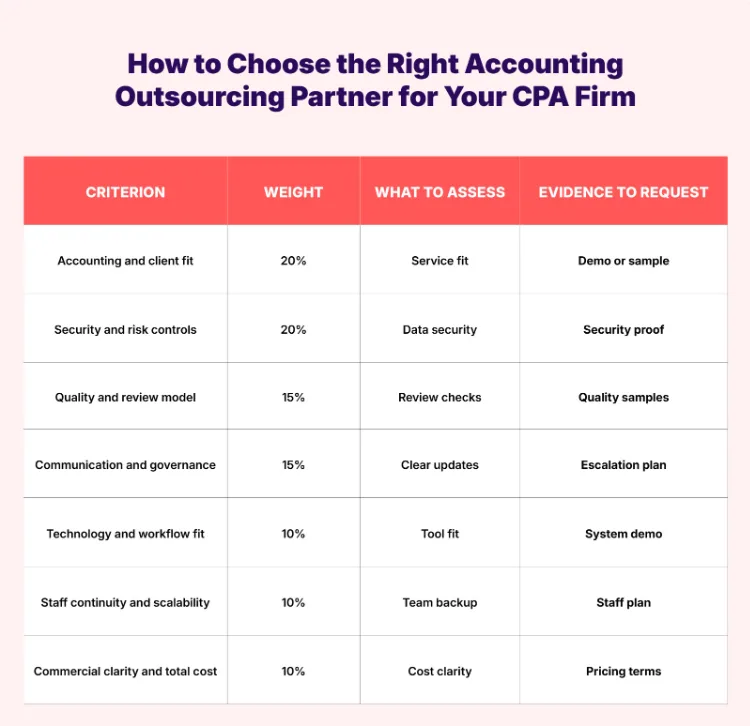
Score each provider from 1 to 5 for every criterion, then multiply the score by the assigned weight. For example, a score of 4 on a 20% criterion contributes 0.80 to the final weighted score.
Use the total score as a comparison aid, not an automatic approval. A provider can score well overall and still require further review if security, confidentiality, deadline ownership, or service fit is not strong enough.
9. Why CPA Firms Should Run a Pilot Before Scaling
A pilot is the best way to test operating fit under real conditions. Choose work that is representative enough to expose quality and communication issues but controlled enough to protect important deadlines and client relationships.
Before the pilot begins, define exactly what success will look like. The scope should be clear enough for both sides to understand which clients, systems, deliverables, timelines, and owners are included. Your team should also agree on what “review-ready” means, how turnaround and communication will be judged, which KPIs will matter most, and what access or security requirements must be followed throughout the test.
At the end of the pilot, hold a structured retrospective before adding more work. Review what went smoothly, where reviewers spent the most time, whether open items were documented clearly, and whether the provider managed deadlines without creating extra follow-up for your team. Scale gradually only when the process proves repeatable, review-ready, and easy to manage at the current level.
10. Common Mistakes to Avoid When Choosing an Accounting Outsourcing Partner
The biggest mistakes usually show up before the engagement even begins. If a provider cannot clearly explain who performs the work, who reviews it, how quality is monitored, or how issues are escalated, your firm may end up absorbing the very management burden it hoped to reduce. Vague answers around staffing, SLAs, KPI reporting, and escalation paths should be treated as early warning signs, especially when the work involves client deadlines and sensitive financial data.
Security and workflow gaps are equally important. Heavy reliance on personal email, local downloads, unapproved storage, undocumented incident response, unclear data ownership, or loose access removal can create risk that is difficult to control later. The same applies to frequent staff rotation without notice, undefined scope, unclear exclusions, or claims of expertise that are not supported by process evidence, representative deliverables, or a practical pilot.
One isolated gap may be fixable during onboarding. Several related gaps, however, often point to a deeper operating problem that can create more risk, more reviewer effort, and more follow-up than useful capacity.
Accounting Outsourcing Partner Due Diligence Checklist
- Define scope, complexity, outputs, systems, and internal ownership.
- Screen capability using representative workflows and evidence.
- Review delivery structure, staffing continuity, and governance.
- Agree SLAs, KPIs, escalation paths, and reporting cadence.
- Validate security controls, assurance evidence, contracts, and offboarding.
- Run a measured pilot and hold a documented retrospective.
- Scale only after the process proves repeatable and review-ready.
Conclusion
The right accounting outsourcing partner should make your firm easier to run. The relationship should have a clear scope, named accountability, measurable performance, review-ready output, controlled access, and a practical path for resolving issues.
As you compare providers, prioritize fit before scale and evidence before claims. Define the work, test the operating model, agree service levels, validate security, measure a pilot, and scale only when the workflow is repeatable.
Considering QXAS? Review QX Accounting Services USA’s outsourced accounting services and engagement options, then use the checklist above to structure a discovery conversation around fit, governance, security, and pilot design.
FAQs
How Should CPA Firms Evaluate an Outsourcing Provider’s Accounting Expertise?
CPA firms should evaluate an outsourcing provider based on relevant accounting experience, familiarity with CPA firm workflows, review readiness, and the ability to support the firm’s specific service lines. Rather than relying solely on credentials or marketing claims, firms should review representative work samples, request process walkthroughs, assess reviewer involvement, and validate capabilities through a controlled pilot engagement. Evaluating how the provider handles documentation, communication, quality control, and firm-specific feedback is equally important.
What Security and Compliance Standards Should an Accounting Outsourcing Partner Meet?
An accounting outsourcing partner should demonstrate strong security controls, documented compliance processes, and clear accountability for protecting client data. CPA firms should look for evidence of information security frameworks, security policies, access controls, incident-response procedures, and relevant assurance documentation. During due diligence, firms should also review how the provider manages authentication, encryption, monitoring, vendor oversight, data retention, and offboarding procedures. Security should be assessed as an ongoing governance requirement rather than a one-time certification review.
How Can CPA Firms Compare the Pricing Models of Outsourcing Providers?
CPA firms should compare outsourcing providers based on total cost, scope clarity, service levels, and ongoing management effort, not just hourly rates. Key factors include what’s included in the engagement, how scope changes are priced, whether the model is based on dedicated teams, managed services, or transaction volumes, and any additional costs for onboarding, reporting, or support. To better understand different engagement models and pricing structures, firms can review QX’s Accounting & Bookkeeping Outsourcing Pricing.
What SLAs and KPIs Should Be Included in an Accounting Outsourcing Agreement?
A well-structured outsourcing agreement should define service-level expectations and performance metrics from the outset. Common SLAs include turnaround times, response times, escalation procedures, overlap-hour requirements, quality-review expectations, staffing continuity commitments, and security-notification obligations. Useful KPIs include on-time delivery rates, first-pass review approval rates, rework rates, turnaround times, response resolution times, staff continuity metrics, and escalation frequency. Together, SLAs and KPIs create accountability, improve visibility, and provide a framework for continuous performance improvement.
How Can CPA Firms Avoid Common Mistakes When Selecting an Accounting Outsourcing Partner?
The most common mistakes include choosing a provider based primarily on cost, failing to define scope clearly, overlooking security requirements, neglecting SLAs and KPIs, and skipping the pilot phase. CPA firms can reduce selection risk by conducting structured due diligence, evaluating provider fit across accounting capability, governance, security, communication, technology, and scalability, and validating assumptions through a controlled pilot before expanding the relationship. Firms should also watch for warning signs such as vague processes, high staff turnover, weak documentation standards, and resistance to performance reporting.
What Makes QX Accounting Services a Suitable Accounting Outsourcing Partner for CPA Firms?
QXAS (QX Accounting Services) positions itself as more than a capacity provider by emphasizing governance, process improvement, security, communication quality, and long-term partnership. Its messaging focuses on helping CPA firms scale delivery, improve operational efficiency, strengthen advisory capacity, and maintain control through structured workflows, dedicated teams, performance management, and security-focused operating practices. QXAS also provides accounting outsourcing services tailored to CPA firms, along with implementation guidance, onboarding resources, pricing models, case studies, and operational frameworks designed to support sustainable growth.
Enquire now

Arjun Varshneya
Arjun Varshneya is an experienced Operations Leader with over 13 years of expertise in managing global delivery teams across Client Accounting Services, Tax, and U.S. operations. An auditor by background, he brings deep delivery knowledge and operational leadership to help CPA firms improve quality, strengthen working standards, optimize capacity, and drive review readiness across accounting and tax workflows. At QX Accounting Services, he focuses on building scalable operating models that support quality, risk management, execution excellence, and sustainable efficiency across complex, high-volume environments.
Unauthorized copying or plagiarism of our content is a violation of intellectual property rights. We take such matters seriously and will pursue legal action to protect our original work. Anyone found engaging in such activities will be held accountable under applicable laws.
Don't forget to share this post!
Our Latest Insights




Let’s Work Together
Explore outsourcing solutions, request a no-obligation trial or discuss your practice’s needs with our expert consultants.
 Book a Virtual Meeting
 Get Your ROI Estimate