October 15 Rush: Last-Mile Outsourcing Support for Individual and C-Corp Tax Returns



As September closes, the operational reality of the fall tax crunch begins to set in for accounting practices. Partners are chasing missing K-1s, staff are working longer hours, and client document delays are putting internal filing timelines under pressure. You know exactly what the trenches look like during this final stretch. The friction of assembling last-minute documentation creates bottlenecks that can affect client satisfaction, reviewer bandwidth, and team morale. This is why tax preparation outsourcing has become a practical capacity lever for firms that need reliable support before October 15.
Adding specialized external capacity at the final hurdle helps accounting practices manage late deadlines, ease reviewer bottlenecks, and reduce the risk of staff burnout. By rethinking how delayed client data moves through preparation and review, firms can build a more resilient operating model for the busiest weeks of the fall extension cycle.
“The October 15 rush is not just a deadline problem. It is a capacity problem. Last-mile outsourcing helps firms absorb late-season tax overflow while protecting reviewer bandwidth, staff morale, and client delivery standards.”
– Cora Vollmar, Sr VP Growth, QX Accounting Services
- The Operational Reality of the Fall Deadline Push
- Why Last-Mile Tax Preparation Changes the Game?
- Handling Individual Returns with Precision
- Conquering Complex Corporate Deadlines
- Workflow Fit: Better Handoffs, Fewer Waiting Cycles
- Safe Workflow Fit, Risk, and Firm Accountability
- Conclusion
- Plan Your October 15 Capacity Before the Final Rush
- FAQs
The Operational Reality of the Fall Deadline Push
Managing tax season capacity issues effectively requires acknowledging the systemic flaws in traditional accounting firm workflows. During the lead-up to the fall extension deadlines, the primary friction point is rarely data entry; rather, it is severe reviewer capacity constraints.
Senior managers and partners often find themselves bogged down in junior-level validation tasks simply because documents arrived too late to pass through the standard internal chain of command. When comparing outsourced vs in-house tax compliance models, the traditional in-house approach often falters under the weight of these compressed timeframes.
Client document delays compound this issue. When a high-net-worth client finally delivers complex investment schedules in early October, the resulting rush can lead to rework. Staff may move quickly through initial preparation, leaving subtle issues for senior reviewers to identify and correct later.
That cycle of late documentation, rushed preparation, and follow-up rework is one of the biggest drivers of staff burnout. Tax season capacity planning should begin before the fall rush, but it still needs a reliable system for handling late-season tax overflow when delays happen.
Also Read: Tax Outsourcing Companies in the USA
Why Last-Mile Tax Preparation Changes the Game?
Traditional staffing models dictate that you either hire full-time employees to sit idle during the summer or scramble to find temporary contractors in September. However, leveraging staff augmentation for CPA firms provides a much more dynamic solution. Last-mile tax preparation specifically targets that critical window between late September and the final deadline, injecting highly qualified professionals directly into your existing processes.
The core benefits of last-mile tax delivery include immediate scalability, reduced overhead, and the ability to maintain a calm, methodical approach even when client data arrives at the eleventh hour.
When firms evaluate how to bridge the fall gap without adding permanent headcount, the operating question is simple: can you scale tax preparation without expanding internal teams while still protecting reviewer bandwidth and turnaround times?
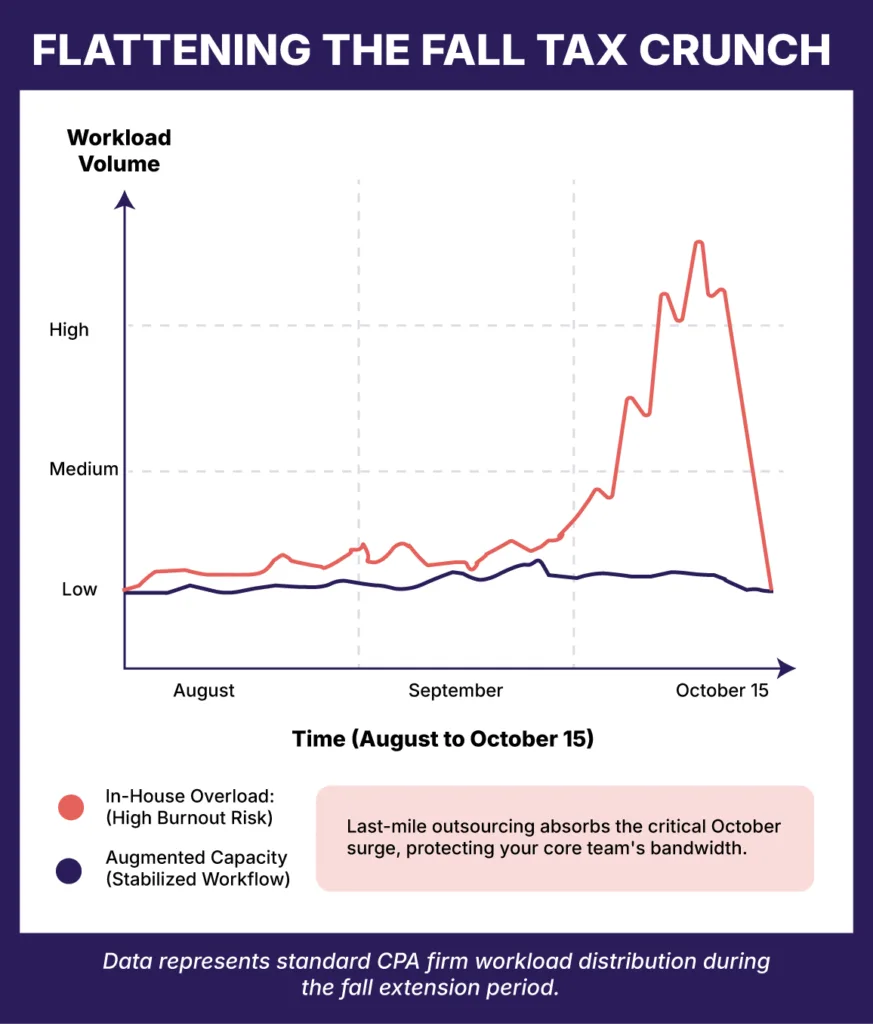
One of the most vital components of this approach is integrating outsourced tax review services. By having an external team handle the first-level review of late-arriving returns, your senior internal staff can focus purely on final sign-offs and strategic client advisory.
This workflow integration dramatically assists in reducing turnaround time for extended returns, ensuring that your firm is never the cause of a late filing. For many firms, the most reliable path is to formalize outsourced tax preparation support with clear intake rules, workpaper standards, and review checkpoints.
Handling Individual Returns with Precision
The October extension deadline for individual and calendar-year C-Corp returns creates a dual-front workload for multi-service accounting practices. When it comes to handling high volumes of personal filings, knowing how to outsource individual tax returns becomes a tactical advantage. Form 1040 packages, especially those involving complex K-1 income, gig-economy schedules, or real estate transactions, demand meticulous attention to detail.
Individual tax return outsourcing allows internal staff to offload the time-consuming mechanics of data input and initial schedule generation while preserving internal control over review and final filing decisions.
As a baseline, your outsourced team should be preparing against the same checklists your firm uses to meet Form 1040 filing requirements, with your internal reviewers confirming position support and final sign-off before submission.
To maintain brand consistency and client trust, successful firms rely on white label tax preparation support. This means the offshore or external team operates entirely behind the scenes, utilizing your firm’s standardized workpapers, naming conventions, and software environments. The client never experiences a shift in communication or presentation quality.
By adopting an end-to-end tax preparation workflow that incorporates external preparers, your firm can seamlessly scale up its capacity without sacrificing the personalized touch that individual clients expect from their trusted advisors.
Conquering Complex Corporate Deadlines
While personal returns require high-volume efficiency, corporate returns demand deep technical proficiency. Navigating Form 1120 income tax return requirements during the final weeks of the extension window is notoriously difficult due to complex depreciation schedules, state apportionment calculations, and stringent balance sheet tie-outs.
C-Corp tax return outsourcing offers a sophisticated lifeline for practices drowning in complex entity work. External specialists trained in advanced corporate compliance can meticulously draft these filings, allowing your partners to step in solely for the final high-level review.
When a corporate client delays delivering their final trial balance until October 1, having an outsourced team ready to immediately digest that data is invaluable. This level of peak tax season support ensures that the intricate mechanics of Form 1120 are handled with precision, adhering strictly to the guidelines established by the Internal Revenue Service (IRS).
Because corporate returns often dictate the flow-through income for your high-net-worth individual clients, accelerating the corporate preparation phase is critical to unlocking the rest of your pending October workload.
Workflow Fit: Better Handoffs, Fewer Waiting Cycles
Last-mile execution is rarely blocked by effort; it is blocked by handoffs. The firms that get through October cleanly typically standardize a relay workflow, clarify who owns open questions, and create a predictable review window. If your leadership team needs a practical baseline for how offshore delivery models work, start there, then map those same controls to your tax prep and review lanes.
In practice, the strongest delivery models use time as a lever: work moves while your local team sleeps, so you wake up to prepared workpapers and resolved prep-level questions. That time zone advantage in offshore bookkeeping often translates directly to faster tax-cycle throughput during the October rush.
To keep the model controlled (not chaotic), many firms build a dedicated tax preparation team they can train on firm-specific workpapers, organizer standards, and reviewer preferences. And when you step back to measure outcomes, the right model is not just about cost; it is about operating leverage and throughput, similar to what firms look for in the ROI of outsourced bookkeeping.
For many firms, tax capacity pressure is not isolated to October. If you want to extend the same delivery discipline to month-end close and year-round throughput, consider pairing tax support with bookkeeping outsourcing services so your team is not rebuilding workflows every busy season.
Safe Workflow Fit, Risk, and Firm Accountability
A common hesitation among firm owners regarding tax return outsourcing for CPA firms revolves around data security and operational control. Effectively managing workflow fit means ensuring that your external team does not operate in a silo, but rather functions as an organic extension of your local office. This requires establishing secure, cloud-based environments where data never physically leaves your firm’s controlled servers and aligning policies with IRS data security guidelines for tax professionals.
Risk management in tax offshoring is entirely dependent on strict adherence to established regulatory frameworks. Quality assurance in tax outsourcing is maintained by partnering with providers who operate under rigorous SOC 2-aligned security controls, ensuring that internal controls regarding data privacy are continuously audited and verified. Furthermore, compliance with IRS Section 7216 confidentiality requirements is non-negotiable; your outsourcing partner must support consent workflows, access controls, and documentation standards that protect taxpayer information unconditionally.
High-quality outsourced tax return preparation is built on a foundation of proven trust signals, including ISO-certified operational processes and consistently documented error-free delivery rates. However, it is imperative to establish a clear boundary regarding ultimate responsibility. Utilizing external support does not shift liability; the CPA firm retains total and absolute accountability for the accuracy, compliance, and timely submission of all tax filings.
If you want a plain-English refresher on how CPA firms remain responsible for outsourced work, align that guidance with your firm’s engagement letters and review sign-off protocols.
If security and auditability are part of your buying criteria, review QX Security, Quality & Trust to see what to validate before you share any client data.
Conclusion
The October 15 rush is not a one-off fire drill; it is a predictable operating constraint driven by client document delays and a compressed review window. A last-mile outsourcing model works because it adds experienced preparation and first-pass review capacity exactly where most firms break right before partner sign-off while keeping the CPA firm in full control of standards, review, and final filing responsibility. When you treat fall extensions as a capacity-planning problem, not a heroics problem, you reduce bottlenecks, protect reviewer bandwidth, and close the season with fewer late nights and less rework.
If you are evaluating partners for this final stretch, QX Accounting Services supports CPA firms with structured, secure delivery models designed for deadline-driven work.
Plan Your October 15 Capacity Before the Final Rush
Navigating the final stretch of the autumn compliance season does not have to involve exhausted staff, frustrated partners, and compromised realization rates. By proactively securing October 15 tax extension support, your practice can transform a traditionally chaotic period into a highly structured, profitable operational victory. The foundation of a scalable, resilient accounting practice lies in recognizing when internal capacity has reached its limit and intelligently leveraging external expertise to bridge the gap.
If your team is already feeling the pressure of delayed K-1s and pending corporate schedules, the time to act is right now. Do not wait until reviewer bottlenecks bring your internal workflow to a complete halt. contact our team today to discover how our tailored, secure last-mile tax preparation services can seamlessly integrate into your firm, protect your staff from burnout, and guarantee every client filing crosses the finish line with absolute precision.
FAQs
How can CPA firms prepare for the October 15 tax filing rush?
CPA firms prepare for the October 15 tax filing rush by setting a fall-extension capacity plan in August, pre-assigning reviewers, and defining a triage process for late client documents. Align your intake deadlines, workpaper standards, and review checkpoints so late-arriving K-1s and trial balances do not derail the filing queue.
How does last-mile outsourcing help CPA firms meet extension deadlines?
Last-mile outsourcing helps CPA firms meet extension deadlines by adding experienced preparation and first-pass review capacity during the exact weeks when internal teams are constrained. It shortens waiting cycles, absorbs late-season volume, and lets partners focus on final technical judgment and sign-off.
What should firms look for in a tax outsourcing partner during peak season?
Firms should look for a tax outsourcing partner with proven experience in Form 1040 and Form 1120 workflows, documented QA processes, secure access controls, and the ability to work inside the firm’s software and workpaper standards. Just as important, the partner should support clear SLAs, escalation rules, and reviewer-ready delivery so the engagement stays predictable under deadline pressure.
How can outsourcing reduce filing bottlenecks before October 15?
Outsourcing reduces filing bottlenecks before October 15 by shifting preparation, reconciliation, and workpaper completion to an augmented team so internal reviewers are not buried in prep-level tasks. With a defined relay workflow and daily handoffs, returns move forward even when client inputs arrive late.
How do CPA firms maintain quality while outsourcing last-minute tax returns?
CPA firms maintain quality while outsourcing last-minute tax returns by enforcing firm-standard workpapers, using checklist-driven preparation, and keeping a consistent internal review and final approval process. Outsourcing can accelerate throughput, but the CPA firm retains responsibility for accuracy, positions taken, and on-time filing.
What security measures should firms expect from outsourced tax providers?
Firms should expect security measures such as secure remote access (no local downloads), multi-factor authentication, role-based permissions, audit trails, and policies aligned with IRS data security guidelines for tax professionals. Providers should also be able to evidence SOC 2-aligned security controls and operational compliance with IRS Section 7216 confidentiality requirements.
Why do CPA firms rely on QX Accounting Services during the October 15 rush?
CPA firms rely on QX Accounting Services during the October 15 rush because the model is designed to add controlled last-mile capacity without breaking review discipline or data security expectations. Teams can integrate into firm workflows, deliver reviewer-ready workpapers, and support deadline-driven execution while the CPA firm maintains full accountability for final filing.
Enquire now

Cora Vollmar
Cora Vollmar is a growth-focused executive with over 20 years of experience spanning accounting, operations, talent strategy, and business development. She has a proven track record of scaling high-performing teams, including driving triple-digit growth by building a deep bench of senior-level accounting and CPA talent within a leading staffing organization.
Cora began her career in the construction sector, where she quickly established herself as a results-driven leader. She has since built a reputation for helping organizations navigate the U.S. accounting talent shortage, combining strategic hiring, global talent models, and innovative, STEM-driven solutions to unlock capacity and accelerate growth. She is also a sought-after voice in the industry, leading capacity and workforce strategy discussions nationwide.
Her leadership contributed to recognition on the Inc. 5000 list for one of America’s fastest-growing construction companies for three consecutive years, underscoring her ability to drive sustained, scalable growth.
Today, Cora brings her deep market expertise and strategic mindset to QX Global Group, where she is focused on enabling firms to rethink traditional talent models and build future-ready operating structures.
Outside of work, Cora is an avid traveler who enjoys exploring new cultures, with journeys spanning North America, Europe, the Caribbean, and Central America.
Unauthorized copying or plagiarism of our content is a violation of intellectual property rights. We take such matters seriously and will pursue legal action to protect our original work. Anyone found engaging in such activities will be held accountable under applicable laws.
Don't forget to share this post!
Our Latest Insights




Let’s Work Together
Explore outsourcing solutions, request a no-obligation trial or discuss your practice’s needs with our expert consultants.
 Book a Virtual Meeting
  Get Your ROI Estimate