Security Measures in Offshore Bookkeeping for USA CPA Firms


Offshore bookkeeping is a growing trend among USA CPA firms. It offers cost savings and access to skilled professionals. However, it also brings unique security challenges.
Protecting financial data is crucial. Breaches can lead to severe consequences, including financial loss and reputational damage. Therefore, robust offshore bookkeeping security measures are essential.
Financial data security must be comprehensive. It should cover encryption, access controls, and secure data transfer protocols. These data security measures help safeguard sensitive information.
Compliance with relevant data protection and cybersecurity requirements is also vital. It ensures that offshore bookkeeping practices meet expected standards and reduces client risk. This compliance builds trust.
Choosing the right offshore partner is critical. Firms must evaluate security credentials, controls, and ongoing monitoring practices. This helps ensure client data stays secure.
In this guide, we cover practical offshore bookkeeping security measures USA CPA firms can use to reduce risk while still capturing the operational benefits of outsourcing. If you’re actively evaluating outsourcing bookkeeping, treat security as a first-class requirement-not an add-on.
“For CPA firms, offshore bookkeeping is only as strong as the security controls behind it. Cost savings matter, but client trust depends on how well access, data movement, and accountability are managed every day.”
– Cora Vollmar, Sr VP Growth, QX Accounting Services
Offshore Bookkeeping Security Checklist for CPA Firms
If you want a simple yardstick for offshore bookkeeping security, look for these outcomes:
- Only the right people can access client data,
- Every access is logged,
- Sensitive files are encrypted end-to-end, and
- Incidents are handled fast with a tested recovery plan.
If a provider can’t show evidence for these four outcomes, your risk is higher-regardless of price or experience. If your decision includes comparing costs, review accounting and bookkeeping outsourcing pricing alongside security controls so you’re not trading risk for savings.
Industry insight: ‘When financial data crosses borders, security controls-not distance-define trust.’
Offshore Bookkeeping Security Risks: Key Challenges for CPA Firms
Offshore bookkeeping means outsourcing financial record-keeping to another country. This approach can deliver efficiency and access to specialized talent. But moving financial data across borders introduces security and governance complexity: the geographic distance can make oversight, incident response, and enforcement harder if controls are not clearly defined.
In practice, security challenges often show up as weak perimeter controls or misconfigured cloud storage, poor identity management and shared credentials, inconsistent security maturity between your firm and the provider, and unclear cross-border data handling or retention rules. The goal is to reduce these risks with clear technical controls, contractual safeguards, and ongoing verification.
Also Read: How offshore bookkeeping works for CPA firms
Common Offshore Bookkeeping Workflows Where Data Security Breaks Down
To make this concrete, here are a few common offshore bookkeeping workflows-and the security gaps that tend to appear if the engagement isn’t structured well:
- Month-end close handoff: Bank feeds, GL exports, and adjusting entries are shared via email or open links. Risk: unintended forwarding, stale links, and no audit trail.
- QuickBooks Online/Xero access: A provider is added as a generic ‘accountant user’ and kept indefinitely. Risk: over-permissioned access and slow offboarding.
- Payroll support: Payroll registers, employee PII, and direct deposit details get stored locally or in personal cloud accounts. Risk: data sprawl and uncontrolled copies.
- AP/AR document processing: Vendor invoices and W-9s are downloaded to desktops for OCR/manual entry. Risk: sensitive files on unmanaged endpoints.
These examples are why offshore bookkeeping security measures must cover both technology and process: how work is done day-to-day, not just what a policy says.
Why Financial Data Security Matters for CPA Firms
For USA CPA firms, financial data security is tied directly to client trust and professional responsibility. Bookkeeping files can include bank account details, payroll data, tax IDs, and internal financial reporting-exactly the kind of information attackers target.
Breaches can trigger client notification and remediation costs, business interruption and lost productivity, regulatory or contractual penalties, and reputation damage that is hard to recover from. Strong offshore bookkeeping security measures and a disciplined partner-management process help minimize those outcomes.
Offshore Bookkeeping Security Measure
Effective offshore bookkeeping security is layered. No single control is enough-especially when access is remote and workflows span time zones.
Core financial data security and data security measures to implement include data encryption (in transit and at rest), multi-factor authentication (MFA) with least-privilege access, secure file exchange and cloud configuration hardening, endpoint security on devices that access client data, centralized logging with monitoring/alerting, tested backups and recovery, and ongoing security awareness training.
Data Encryption for Offshore Bookkeeping (In Transit & At Rest)
Encryption protects data by making it unreadable without the correct keys. For offshore workflows, you typically need encryption in transit (for example, TLS) to protect data while it moves between systems, plus encryption at rest to protect data stored in databases, cloud drives, and backups. Ask your provider how encryption keys are managed (rotation, access, storage) and whether encryption is applied by default in every environment.
MFA & Least-Privilege Access Controls
MFA reduces risk dramatically by requiring more than a password. Pair MFA with strict access controls so offshore staff can only reach what they need for their assigned clients and tasks. Practical access-control steps include role-based access control (RBAC) with least privilege, unique user accounts (no shared logins), time-bound access where possible (just-in-time access), and immediate deprovisioning during offboarding.
Secure File Sharing, Data Transfer Protocols, and Cloud Security
Avoid ad-hoc file sharing for client financials. Use secure transfer methods and harden cloud storage configurations. Common approaches include managed secure portals or client vaults with audit logs, encrypted SFTP with strong credential policies, VPN access where appropriate (with MFA), and cloud storage with least-privilege sharing, link-expiration, and DLP controls. For cloud services, confirm basics like private-by-default storage, strong admin controls, and routine configuration reviews.
Endpoint Security for Offshore Bookkeeping Teams
Endpoints are a common weak point in offshore delivery. Require baseline device controls for any laptop/desktop that accesses your bookkeeping systems. Minimum expectations often include full-disk encryption, anti-malware/EDR, patch management with defined SLAs, screen lock policies, and restrictions on removable media and local downloads (where feasible).
Security Audits, Logging, and Continuous Monitoring
Security audits help identify control gaps, while continuous monitoring helps you catch issues quickly. At a minimum, you want centralized logs for authentication, file access, and admin actions; alerts for suspicious activity (impossible travel, repeated failed logins, abnormal downloads); and regular vulnerability scanning with remediation tracking. Make sure audit findings turn into action: owners, timelines, and verification that fixes were implemented.
Security Awareness Training (Phishing & Human Risk)
Phishing and social engineering remain top risks. Offshore teams should receive role-based training that matches your workflows (bookkeeping platforms, secure file handling, and client confidentiality expectations). Training should cover recognizing phishing and business email compromise, secure handling of client PII and financial documents, password hygiene and MFA usage, and escalation steps if something looks off. Practical awareness guidance is available from CISA.
Backups, Disaster Recovery, and Business Continuity
Backups protect you from ransomware, accidental deletions, and system failures. Confirm the provider’s backup frequency, retention, and whether backups are isolated (so ransomware can’t encrypt them too). Also clarify recovery expectations like RTO (how quickly services should be restored) and RPO (how much data loss is acceptable).
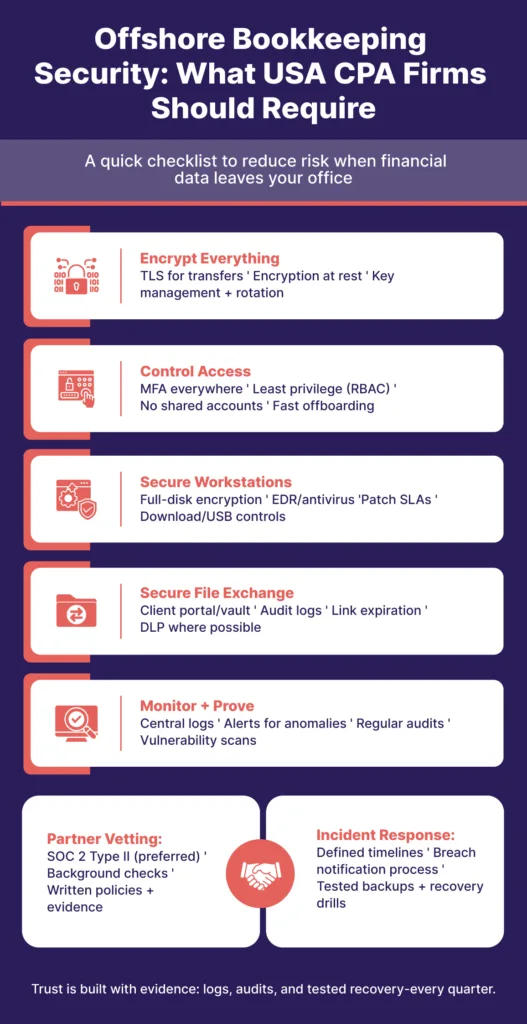
Vendor Due Diligence: Controls & Evidence to Request (SOC 2, MFA, Encryption)
Ranking well is one thing; protecting client data is another. For real-world due diligence, align each control with evidence you can verify-ideally before granting any production access.
| Control Area | What to Require | Evidence to Request |
| Identity & access | MFA + least privilege (RBAC), no shared accounts, fast offboarding | Screenshots/policy for MFA enforcement; sample access review; offboarding SLA |
| Encryption | TLS in transit + encryption at rest + key management | Architecture diagram; key rotation policy; list of encrypted repositories |
| File exchange | Secure portal/vault with audit logs; link expiration | Portal workflow; example audit log; retention settings |
| Endpoints | EDR/AV, patching, disk encryption, download controls | Device management policy; patch cadence; EDR coverage report |
| Monitoring | Central logs + alerts for anomalies | Log sources list; alert examples; escalation timeline |
| Backups & recovery | Isolated backups + tested restores | Backup policy; last restore test report; stated RTO/RPO |
| Assurance | SOC 2 Type II preferred | SOC 2 report scope + exceptions + remediation notes |
Vendor Security Questionnaire for Offshore Bookkeeping Partners
Use this as a fast, practical checklist when evaluating offshore bookkeeping providers. Strong providers can answer clearly and provide evidence.
- Do you enforce MFA for all users accessing client systems and file repositories?
- How do you implement least-privilege access (RBAC) and approve permission changes?
- What tools do you use for secure file exchange, and do you maintain access and download logs?
- How is data encrypted in transit and at rest-and how are encryption keys managed and rotated?
- Are endpoints managed (EDR, patching, full-disk encryption), and are local downloads restricted?
- What is your offboarding SLA (how quickly access is removed) when someone leaves or changes roles?
- Do you have an incident response plan, and when was it last tested?
- What is your backup strategy (frequency, retention, isolation), and what are your RTO/RPO targets?
- Do you have a SOC 2 report (preferably Type II)? If yes, what is in scope, and were there exceptions?
- Do you use subcontractors? If yes, how do you assess and monitor their security controls?
Ultimate Guide to Outsourcing Bookkeeping
Grab the guide to align scope, controls, workflow, and governance.
Download Now
Compliance & Standards for Secure Offshore Bookkeeping (SOC 2, IRS, FTC, NIST)
Compliance is a big part of offshore bookkeeping security measures because it forces clarity: what data is being handled, who can access it, where it resides, and how incidents are managed.
Depending on your client base and engagement model, you may need to consider a mix of privacy requirements (for example, state privacy laws and contractual privacy obligations), security frameworks and attestations (such as SOC 2), industry expectations for safeguarding taxpayer and financial information, and cross-border data transfer and subcontractor controls.
If you want to see how QX approaches governance, controls, and assurance, review QX Security, Quality & Trust.
For many firms, two practical reference points are the IRS Publication 4557 (safeguarding taxpayer data) and the FTC Safeguards Rule overview (what covered financial institutions and service-provider relationships should address).
Cross-Border Data Handling and Data Protection Standards
If any client data is subject to international privacy requirements, your processes must support those obligations (for example, data minimization, retention limits, access logging, and breach-response readiness). Even when not legally required, aligning to reputable security practices can reduce risk. For a practical, widely adopted baseline, review the NIST Cybersecurity Framework.
SOC 2 for Offshore Bookkeeping: What CPA Firms Should Check
SOC 2 is a common third-party attestation used to evaluate service organizations’ controls related to security, availability, confidentiality, processing integrity, and privacy.
When reviewing a provider’s SOC 2 materials, focus on SOC 2 Type II (tests operating effectiveness over a period of time, not just a point-in-time design review), scope (which systems/locations are included), exceptions (any noted control failures and whether they were remediated), and subservice organizations (whether key vendors are carved out or included). For background, see the AICPA overview on SOC reports for service organizations.
SOC 2 doesn’t guarantee ‘perfect security,’ but it’s a strong signal of process maturity when paired with your own due diligence.
Contracts, SLAs, and Legal Safeguards
Contracts should make security expectations enforceable and measurable. They should clarify how data is handled, who owns it, and what happens during a security incident. Key contractual elements often include confidentiality and data handling clauses (including data return/destruction), breach notification timelines and cooperation requirements, right-to-audit language (or agreed third-party audit reporting), subcontractor restrictions and approval requirements, and minimum security controls (MFA, encryption, logging, background checks, etc.).
How to Choose a Secure Offshore Bookkeeping Partner (CPA Firm Checklist)
Selecting a secure offshore bookkeeping partner should be treated like a vendor risk assessment, not just a staffing decision. Start with evidence, not promises. Ask for documentation and verify it where possible.
A practical evaluation checklist includes security attestations and certifications (for example, SOC 2 reports; ISO 27001 if available), written security policies (access control, incident response, data retention), identity and access management details (MFA, RBAC, offboarding), network and endpoint controls (EDR, patching, device encryption), incident response playbook and test cadence, and background checks plus training for staff handling financial data.
Also align the delivery structure up front. If you’re comparing options, review engagement models to see how dedicated, managed, or flexible setups can affect access control, oversight, and accountability.
Finally, confirm how day-to-day work will be done: which tools they use, how files are shared, where data is stored, and how access is logged. This is where many real-world gaps show up.
Trends: AI Monitoring, DLP, and Identity Security
Modern offshore teams increasingly use automation and enhanced monitoring to reduce manual handling of sensitive data. Trends to watch include AI/ML-assisted threat detection and anomaly monitoring (useful for spotting unusual access patterns), data loss prevention (DLP) policies for email/cloud/endpoints, and stronger identity security (conditional access, device posture checks). As these tools evolve, the biggest win is visibility: knowing who accessed what, when, from where, and whether that activity matches expected workflows.
Operational Best Practices for CPA Firms Using Offshore Bookkeeping
To keep offshore bookkeeping secure over time, combine strong controls with consistent oversight. Standardize approved tools for secure portals, cloud storage, and communication; run onboarding/offboarding checklists; review access logs and permissions on a schedule; test incident response and recovery procedures at least annually; and track a few simple KPIs (MFA coverage, patch compliance, audit findings, training completion).
Conclusion
Offshore bookkeeping can work well for USA CPA firms, but only when security is built into the engagement from day one. Strong encryption, access controls, secure transfer methods, continuous monitoring, and clear vendor oversight are the foundation of financial data security.
When you pair these data security measures with solid contracts and evidence-based vendor assessment (including SOC 2 where applicable), you reduce risk and build confidence-for your firm and your clients. For a real-world example of scaling delivery with offshore support, see How JBA CPA LLC scaled delivery using a lean offshore model.
If you’d like to explore a secure delivery setup, visit QX Accounting Services USA.
FAQs
What Key security measures are essential in offshore bookkeeping?
At a minimum: encryption in transit and at rest, MFA for every user, least-privilege access, secure portals (not ad-hoc file sharing), endpoint protection and patching, audit logs with monitoring, and tested backups with recovery procedures.
What compliance standards ensure secure offshore bookkeeping services?
Common indicators include SOC 2 (preferably Type II) and, in some cases, ISO 27001. Beyond certifications, the key is whether the provider can demonstrate documented policies, evidence of control operation, and a working incident response process.
How do offshore bookkeeping providers protect sensitive financial data?
Secure providers combine encryption, controlled access (RBAC + MFA), secure file exchange, hardened cloud configurations, endpoint security, and monitoring. They also limit data exposure through data minimization, retention controls, and disciplined handling procedures.
How can CPA firms assess the security of offshore bookkeeping partners?
Use a vendor due diligence process: review SOC 2/other audit materials, validate encryption and MFA, examine access/offboarding procedures, confirm endpoint and patch management, and walk through their incident response plan. Also map the actual workflow (tools, storage locations, file sharing, logging) to uncover practical gaps.
What role does SOC 2 compliance play in offshore bookkeeping security?
SOC 2 provides third-party validation that security-related controls are designed (and in Type II, operating effectively over time). It helps you compare providers consistently and spot control weaknesses through reported exceptions and scope details.
Enquire now

Cora Vollmar
With over 20 years of experience in accounting, talent strategy, operations, and business development, Cora Vollmar helps CPA firms solve capacity challenges and build scalable growth strategies. She is an expert in senior-level accounting and CPA recruiting, with a proven track record of helping firms develop talent pipelines, recruit leadership professionals, and address the ongoing accounting talent shortage.
Through strong relationships with State CPA Societies, accounting alliances, and industry organizations, Cora brings valuable insight into firm growth, talent trends, and the future of the profession. At QX Accounting Services, she helps firms leverage global talent, managed services, and workforce strategies to build sustainable capacity and support long-term growth.
Unauthorized copying or plagiarism of our content is a violation of intellectual property rights. We take such matters seriously and will pursue legal action to protect our original work. Anyone found engaging in such activities will be held accountable under applicable laws.
Don't forget to share this post!
Our Latest Insights




Let’s Work Together
Explore outsourcing solutions, request a no-obligation trial or discuss your practice’s needs with our expert consultants.
 Book a Virtual Meeting
  Get Your ROI Estimate