ROI of Outsourced Bookkeeping for CPA Firms



Introduction: Why ROI Matters More Than Cost Savings Alone
Most CPA firms do not struggle to understand that outsourcing can reduce pressure. The harder question is whether it creates measurable business value.
That is where many outsourcing decisions get misread.
If ROI is judged only by hourly rate or headcount savings, the analysis stays shallow. For CPA firms, the real return on investment of outsourced bookkeeping shows up in a different place: review capacity stays protected, month-end becomes more manageable, recurring work moves faster, and internal teams spend more time on client work that actually drives revenue.
That is why the ROI of outsourced bookkeeping for CPA firms should be measured as an operating decision and not just a cost discussion.
“For CPA firms, outsourced bookkeeping creates ROI by giving teams more review capacity, stronger delivery control, and room to grow without putting more pressure on the same people.”
Cola Vollmar, Sr VP Growth – QX Accounting Services
If your firm is already evaluating outsourced bookkeeping services, the next step is not only to ask what outsourcing costs. The next step is to ask what outsourcing helps the firm improve: delivery consistency, reviewer productivity, turnaround time, margin protection, and long-term scalability.
What Does ROI Outsourced Bookkeeping Actually Mean for CPA Firms?
For a CPA firm, outsourced bookkeeping ROI is not limited to bookkeeping outsourcing cost savings. It also includes gains in delivery control, reviewer efficiency, and growth capacity.
In practice, ROI usually shows up in four places.
1. Direct Cost Savings
Outsourcing can reduce the cost of recurring bookkeeping delivery compared with expanding internal headcount for the same work. That matters, but it is only one part of the return. The better question is not simply whether outsourced bookkeeping costs less. It is whether the model delivers the same or better output with less internal pressure, fewer delays, and less management friction.
2. Protected Review Capacity
Reviewer time is often one of the most limited resources inside a CPA firm.When preparation work is completed cleanly and consistently, senior team members spend less time correcting work and more time reviewing, advising, and moving clients forward. That shift matters because review capacity directly affects delivery quality, client responsiveness, and profitability.
3. Faster Turnaround and Better Continuity
A strong outsourced model helps keep recurring work current, reduces backlog, and improves month-end readiness. That is where the return on investment of outsourced bookkeeping becomes operationally visible. The value is not just that work gets done. The value is that work moves through the firm with fewer interruptions.
4. Growth Without Immediate Hiring Pressure
CPA firms often use outsourced bookkeeping to support new client volume before making permanent hiring decisions. This gives the firm more room to grow without forcing every increase in workload onto the same internal team. So the better ROI question is not only:
“Did we save money?”
It is:
“Did the model improve how our firm delivers work?”
How CPA Firms Can Calculate the ROI of Outsourced Bookkeeping
A useful bookkeeping outsourcing ROI calculation starts by separating cost input from operating return.
Start With the Cost Side
First, measure the full cost of the outsourced model:
- monthly or project fee
- onboarding and transition time
- additional review or reporting requirements
- software, cleanup, or migration work outside scope
- internal time spent managing the provider
If you want to evaluate the input side first, start with cost of outsourced bookkeeping services and then assess ROI through time saved, rework reduced, and delivery continuity.
Measure Time Saved and Rework Reduced
Next, quantify what changed operationally:
- reviewer hours reduced
- fewer corrections after review
- less time spent on recurring prep work
- lower backlog at month-end
- fewer delays in reconciliations and close preparation
This is where outsourced bookkeeping ROI becomes more meaningful than a rate comparison. If the model saves reviewer time and lowers correction cycles, the firm is already gaining return before broader growth effects show up.
Assess Delivery Improvements
Then ask:
- Did turnaround improve?
- Did month-end become more predictable?
- Did daily work stay more current?
- Did exception handling become easier to manage?
- Did the team spend less time chasing updates?
These operational improvements are central to bookkeeping outsourcing benefits for CPA firms because delivery quality affects both client experience and internal margin.
Include Growth and Capacity Value
Finally, include the value of not having to add internal headcount immediately. If outsourced bookkeeping allows the firm to absorb more client work without increasing internal pressure at the same rate, that is part of ROI.
A practical working formula is:
ROI = (Direct savings + operational value created − outsourcing cost) ÷ outsourcing cost
The goal is not a perfect spreadsheet. The goal is a more honest comparison between the outsourced model and the burden the firm would otherwise carry internally.

Beyond Cost Savings: Where Outsourced Bookkeeping Creates Business Value
Cost savings are easy to understand. Business value is what makes firms continue with outsourcing long term. That value usually shows up in areas that affect profitability more directly over time.
More Time for Advisory and Client Work
When routine bookkeeping execution is handled reliably, internal staff can spend less time on transaction prep and more time on review, planning, and client-facing work. That creates a stronger revenue mix inside the firm.
Stronger Delivery Consistency
A well-run outsourced model brings standardization. Work arrives in a more repeatable format, exceptions are easier to track, and internal teams spend less time navigating variation across clients or cycles. Consistency is one of the most important but often undermeasured drivers of ROI.
Lower Risk of Backlog and Delayed Closes
If recurring work is kept current, the firm spends less time recovering from late reconciliations, missing schedules, or compressed close windows. Backlog is not just an operational issue. It affects team morale, client responsiveness, and partner confidence.
Better Client Experience
Clients may never ask whether bookkeeping was outsourced. They will notice whether reports are timely, questions are answered quickly, and month-end feels controlled. This is where the ROI conversation becomes more commercial. The return is not only about cost. It is about whether the model improves how the firm delivers value to clients.

What Operational Efficiencies Contribute Most to Bookkeeping Outsourcing ROI?
The strongest ROI usually comes from a handful of repeatable efficiency gains.
Workflow Standardization
When processes are clearly defined, work becomes easier to deliver consistently. Standardization reduces variation and makes review more efficient. This includes:
- clear task checklists
- documentation standards
- defined “ready for review” rules
- escalation paths for exceptions
- consistent file and folder structures
Reduced Rework
Rework is one of the biggest hidden costs in bookkeeping delivery. If outputs arrive incomplete, unsupported, or inconsistent, the firm still pays for the work through reviewer time. A strong outsourced model reduces that burden by making work easier to validate.
Smoother Handoffs and Review Readiness
Clear notes, supporting documentation, and structured exception handling reduce friction between preparation and review. This is where “how offshore bookkeeping works for CPA firms” supports the buyer journey because it explains the operating model behind execution, review, and accountability.
More Predictable Month-End Execution
Month-end often becomes reactive when too many tasks compete for the same review window. A stable outsourced model improves readiness before the close becomes compressed. If time-zone execution is part of the delivery model, the time-zone advantage in offshore bookkeeping for CPA firms can show how faster handoffs, reduced waiting cycles, and review-ready work improve turnaround.The return comes from fewer delays, fewer corrections, and fewer points of friction across the delivery cycle.
How Long Does It Take to See ROI from Outsourced Bookkeeping?
ROI usually appears in stages.
Early Wins
The first gains tend to be operational:
- backlog starts to reduce
- recurring work stays more current
- senior staff spend less time on preparation
- daily or weekly task completion becomes more predictable
These early wins are useful because they show whether the model is stabilizing work quickly.
Medium-Term Gains
As the workflow settles, firms often see:
- lower rework
- smoother reviews
- more predictable month-end execution
- fewer recurring bottlenecks
- clearer visibility into work status
This is where the outsourced model starts to feel less like “extra help” and more like a dependable delivery layer.
Long-Term ROI
The full return usually becomes visible when the model starts supporting growth:
- client volume increases without immediate hiring
- internal review capacity stays protected
- the firm can scale without losing delivery quality
- margins improve because workflow capacity becomes more predictable
That is why the right question is not just:
“How soon do savings show up?”
It is:
“When does the model begin to change the way the firm operates?”
How Outsourced Bookkeeping Improves Profitability During Peak Tax and Audit Seasons
Peak periods are where the profitability of outsourced bookkeeping becomes easiest to see. When tax deadlines, audit prep, and month-end all compete for the same internal attention, firms either protect delivery or watch margin erode through overtime, delays, and reviewer overload. Outsourced bookkeeping improves profitability during these periods in three practical ways.
1. It Reduces Review Bottlenecks
If prep-heavy work is handled before the review window, senior staff can focus on sign-off and judgment instead of assembly and correction. That protects both turnaround and quality.
2. It Protects Senior Staff Time
Senior review time is usually the least scalable and most expensive capacity inside the firm. When that time is used for correction instead of review, profitability suffers. Outsourced bookkeeping creates ROI when it reduces that drain.
3. It Makes Capacity More Predictable
A structured outsourced model makes busy seasons easier to absorb without forcing permanent staffing changes every time workload spikes. This is where outsourced bookkeeping ROI becomes very practical. A smoother busy season is not just a quality gain. It is a margin-protection strategy.
What Gets in the Way of ROI?
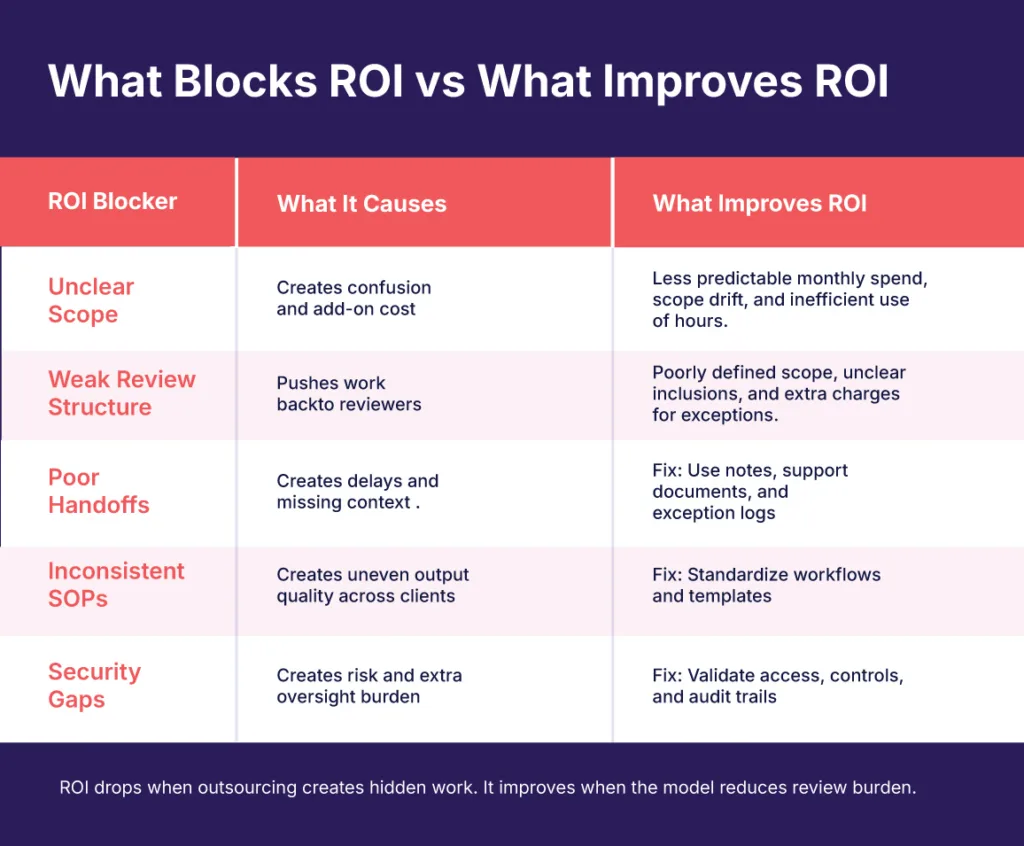
Outsourcing does not automatically create return. Poorly designed models can reduce it. The most common blockers are usually operational, not financial.
Unclear Scope
If the firm and provider define the work differently, the result is usually confusion, add-on cost, and inconsistent delivery.
Scope clarity should include:
- what work is included
- what is excluded
- what counts as an exception
- what requires approval
- what “done” means for each task
Weak Review Structure
If review standards and approval rules are not clear, the firm ends up redoing work instead of reviewing it. That weakens ROI because the firm still carries the most expensive part of the workflow. A clearer review structure helps define what is ready for approval, what needs correction, and who owns each decision. Without that clarity, outsourcing can shift work around instead of reducing it.
Poor Handoffs or Inconsistent SOPs
Even a low-cost model loses value if work arrives late, undocumented, or difficult to validate. The model only creates return when the output is usable by the reviewer. Consistent SOPs help both teams understand how work should be prepared, documented, and escalated when something is unclear. Without that structure, reviewers spend more time interpreting the work than approving it.
Security and Compliance Gaps
ROI weakens quickly if the firm has to spend extra time managing confidentiality concerns, unclear controls, or weak documentation.
CPA firms remain accountable for client work even when execution is outsourced. That is why guidance on outsourcing and professional liability should be part of the ROI assessment, not treated as a separate afterthought.
Data protection also belongs inside the ROI discussion. Firms handling taxpayer information should pay close attention to IRS data security guidance for tax professionals, especially where client financial data, access controls, and written safeguards are involved.
Where tax return information is involved, firms should also consider Section 7216 implications for taxpayer information because disclosure and use of taxpayer information must be handled carefully.
For firms working with financial reporting, bookkeeping quality also supports reporting integrity under FASB accounting standards. From a control environment perspective, many firms treat SOC reporting for service organizations as a useful benchmark when evaluating outsourced service providers.
How Outsourcing Bookkeeping Supports Long-Term Growth and Scalability
Long-term ROI is not about doing the same work for less money forever. It is about creating a support model that grows with the firm. That usually happens in three ways.
Growth Without Constant Hiring Pressure
Instead of restarting the hiring cycle every time volume increases, firms can expand through a more scalable support structure. This is especially useful for CPA firms in the United States facing hiring delays, retention pressure, or uneven demand across the year.
More Predictable Delivery as Client Volume Grows
A structured outsourced model can absorb more recurring work without forcing month-end into the same bottleneck every cycle. That makes growth less dependent on heroic effort from the same internal team.
Margin Protection Through Better Workflow Capacity
If the firm can serve more clients without adding the same amount of internal overhead and management strain, the model starts creating real operating leverage. This is where scalable bookkeeping support for CPA firms becomes part of the ROI conversation, not just a side benefit.
If your firm is also comparing cost structure and operating fit, the guide on pricing models for bookkeeping outsourcing companies can help connect pricing decisions with ROI potential.
For firms evaluating delivery models more broadly, outsourced bookkeeping for U.S. CPA firms can also support the scalability discussion.
Why CPA Firms Choose QX Accounting Services to Maximize Bookkeeping Outsourcing ROI
CPA firms usually do not maximize ROI by choosing the lowest-cost option. They maximize it by choosing a model that reduces rework, supports review, and scales cleanly.
QX Accounting Services supports CPA firms with outsourced bookkeeping models designed around workflow accuracy, reporting visibility, review readiness, and scalable delivery. That matters because ROI depends on more than whether work is completed. It depends on whether the work is delivered in a way that reduces internal pressure and supports the firm’s operating model.
For CPA firms, the strongest ROI comes when outsourcing improves:
- delivery consistency
- review efficiency
- month-end readiness
- workflow visibility
- scalability during growth or peak periods
That is the right lens for evaluating outsourced bookkeeping ROI: not just whether the provider is cheaper, but whether the model improves the way the firm delivers work.
Conclusion
The ROI of outsourced bookkeeping is not just about lowering bookkeeping cost. It is about improving how the firm delivers work, protects review capacity, and scales profitably with the right support model. For CPA firms comparing delivery options, QX Accounting Services can be a useful starting point to understand how structured offshore support fits into long-term firm growth.
For some firms, the clearest return will show up in reduced backlog and better month-end performance. For others, it will appear through stronger margins during busy season, less reviewer strain, or the ability to grow without immediate hiring pressure.
What matters most is not whether outsourcing saves money in theory. What matters is whether the model improves delivery in a way the firm can sustain.
If your firm is evaluating ROI now, measure it the way you would measure any meaningful operating decision: by cost, yes, but also by continuity, control, scalability, and the time it gives back to your best people. When you are ready to explore what that model could look like for your firm, contact us to start the conversation.
FAQs
How can CPA firms accurately calculate the ROI of outsourced bookkeeping?
CPA firms can calculate outsourced bookkeeping ROI by comparing total outsourcing cost against the internal effort it replaces. The calculation should include time saved, rework reduced, turnaround improved, backlog avoided, and the ability to support more client volume without immediate hiring. The most useful ROI calculation includes both direct cost savings and operational value.
Beyond cost savings, how does outsourced bookkeeping create business value for CPA firms?
Outsourced bookkeeping creates business value by reducing review burden, improving delivery consistency, keeping month-end more predictable, and freeing internal staff for higher-value client and advisory work. The return is not only financial. It also shows up in better workflow control and improved client responsiveness.
How long does it take for CPA firms to realize ROI from outsourced bookkeeping services?
ROI usually appears in stages. Early gains may include reduced backlog and faster recurring execution. Medium-term gains often come from lower rework and better review readiness. Long-term ROI appears when the model supports growth, margin protection, and scalable delivery.
How does outsourced bookkeeping improve profitability during peak tax and audit seasons?
Outsourced bookkeeping improves profitability during peak periods by reducing prep-heavy work, protecting senior review time, and making capacity more predictable when deadlines compress. This helps firms avoid overtime pressure, delivery delays, and margin erosion during busy seasons.
What operational efficiencies contribute most to bookkeeping outsourcing ROI?
The biggest drivers are workflow standardization, reduced rework, smoother handoffs, stronger documentation, clearer exception handling, and more predictable month-end execution. These efficiencies reduce hidden workload and help the firm move work through review faster.
How does outsourcing bookkeeping support long-term growth and scalability for CPA firms?
Outsourcing bookkeeping supports growth by giving CPA firms a way to increase delivery capacity without expanding internal headcount at the same pace. It helps firms support more client work while keeping workflows more stable and review teams less overloaded.
Why do CPA firms choose QX Accounting Services to maximize bookkeeping outsourcing ROI?
CPA firms choose QX Accounting Services because ROI depends on how well the outsourcing model is structured. QX supports workflow accuracy, reporting visibility, review readiness, governance, and scalable delivery so firms can reduce hidden operating cost and improve long-term delivery performance.
Enquire now

Bhagyashree Patankar
With over 14 years of global experience in finance and accounting, Bhagyashree is a Chartered Accountant and US CPA with a master’s in Accounting and Finance. She leads an 80+ member team across accounting, audit, and tax, driving operational excellence, talent development, and high-quality delivery. Known for her precision and strategic insight, she transforms financial data into actionable business strategies that enhance decision-making, efficiency, and sustainable growth.
Unauthorized copying or plagiarism of our content is a violation of intellectual property rights. We take such matters seriously and will pursue legal action to protect our original work. Anyone found engaging in such activities will be held accountable under applicable laws.
Don't forget to share this post!
Our Latest Insights




Let’s Work Together
Explore outsourcing solutions, request a no-obligation trial or discuss your practice’s needs with our expert consultants.
 Book a Virtual Meeting
  Get Your ROI Estimate