Accounting Outsourcing vs. Automation: Key Differences for CPA Firms



How CPA firms can decide what to automate, what to outsource, and where a hybrid operating model creates the most value.
Accounting Outsourcing vs. Automation: Why the Difference Matters
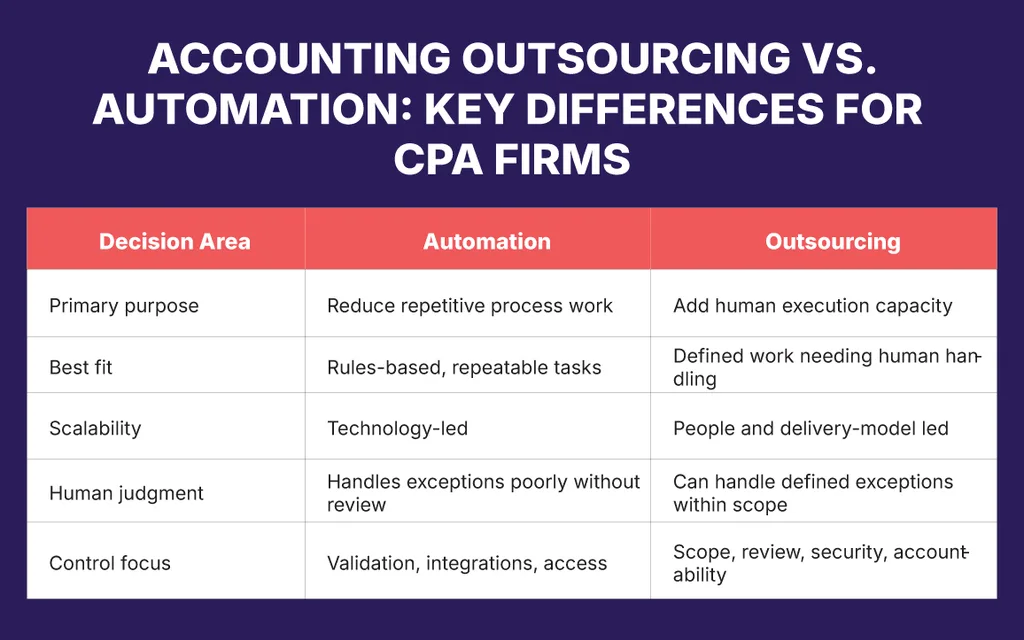
CPA firms are under pressure to increase capacity, reduce repetitive work, protect review quality, and deliver faster without placing every operational burden on partners and managers. Accounting outsourcing and accounting automation can both help, but they solve different problems.
Automation applies technology to repeatable, rules-based steps. Outsourcing adds human execution capacity for defined accounting work. If your firm is evaluating additional delivery capacity, explore QXAS accounting outsourcing services alongside the decision framework below.
The practical question is not which model wins. It is which work should be automated, outsourced, retained internally, or supported by both so the firm can scale while keeping appropriate review and accountability.
“The real shift is from automation to orchestration. Technology can accelerate the work, but firms still need clear ownership, review, exception handling, and governance around the workflow.”
Cora Vollmar, SVP, Growth, QX Accounting Services
- What Is Accounting Automation?
- What Is Accounting Outsourcing?
- When Should CPA Firms Use Accounting Automation?
- When Should CPA Firms Use Accounting Outsourcing?
- Why Automation Alone Does Not Solve a Capacity Problem
- Why Outsourcing Alone Does Not Fix a Broken Workflow
- How a Hybrid Accounting Model Combines Automation and Outsourcing
- How to Decide What to Automate, Outsource, or Keep In-House
- Risks and Controls to Consider Before You Scale
- Conclusion
- FAQs
What Is Accounting Automation?
Accounting automation uses software, integrations, workflow rules, and increasingly AI-assisted tools to reduce manual effort in repetitive accounting processes. It is best suited to standardized tasks where inputs, rules, and expected outputs can be clearly defined.
Examples can include data capture, transaction classification, reconciliations, reminders, routing, status updates, and standard reporting workflows. AICPA & CIMA notes that automating recurring data entry and status updates can free accounting professionals to focus on higher-value activities.
What Is Accounting Outsourcing?
Accounting outsourcing assigns defined accounting work to an external delivery team under an agreed scope, workflow, review process, and service model. Unlike automation, it adds human capacity, making it useful when work still requires accounting knowledge, exception handling, preparation, or documented judgment within the firm’s control framework.
Depending on scope, firms may outsource bookkeeping, reconciliations, accounts payable and receivable support, payroll processing, tax preparation support, or other repeatable accounting work while retaining client ownership, final review, and higher-risk decisions internally.
When Should CPA Firms Use Accounting Automation?
Automation is a strong fit when a process is high-volume, repeatable, digitally available, and governed by consistent rules. Before automating, standardize the process, identify exception paths, define who validates outputs, and confirm how data moves between systems.
This is particularly valuable when the operational problem is unnecessary manual touchpoints rather than a shortage of skilled execution capacity. The IRS also permits businesses to choose a recordkeeping system suited to their needs as long as it clearly shows income and expenses, reinforcing the need for reliable and reviewable records.
When Should CPA Firms Use Accounting Outsourcing?
Outsourcing is a stronger fit when the constraint is capacity, staffing flexibility, preparation of bandwidth, or the amount of defined accounting work that still requires human handling. It can give internal teams more room for review, client communication, advisory work, and exceptions that require firm-specific context.
The operating model matters. Firms should define scope, documentation standards, access, escalation points, review ownership, and performance measures before moving work to an external team.
Why Automation Alone Does Not Solve a Capacity Problem
Automation can make a step faster, but it does not automatically create accounting judgment, reviewer bandwidth, or ownership for exceptions. If a workflow is unclear, adding technology can leave the underlying handoffs and bottlenecks unresolved.
CPA.com describes highly automated firms as combining standardized technology, integrated processes, and people supported by technology. That reinforces a practical point: automation should sit inside an operating model rather than function as an isolated tool.
Why Outsourcing Alone Does Not Fix a Broken Workflow
Moving an inconsistent process to an external team can reproduce the same ambiguity at a different location. Before outsourcing, firms should document inputs, ownership, expected outputs, review standards, access controls, turnaround expectations, and escalation procedures.
For taxpayer or other sensitive financial information, security and confidentiality requirements should be part of provider due diligence, not an afterthought.
How a Hybrid Accounting Model Combines Automation and Outsourcing
For many CPA firms, the most scalable model is a deliberate combination: automate standardized process steps, outsource clearly defined execution work, and keep higher-risk judgment, client communication, exceptions, and final review with the appropriate internal professionals.
A simple workflow may look like:
Digital Intake → Automated Routing and Validation → Outsourced Preparation or Transaction Processing → Internal Exception Handling and Review → Client Delivery.
How to Decide What to Automate, Outsource, or Keep In-House
- Automate work that is repetitive, rules-based, high-volume, and easy to validate.
- Outsource well-defined work that still needs human preparation, accounting knowledge, or flexible capacity.
- Keep internally the work that depends heavily on client context, high-risk judgment, final approval, or firm-specific accountability.
- Use a hybrid model when automated workflow steps can prepare and route work for an outsourced team, with internal professionals retaining review and exception ownership.
Case Study
QXAS reports $99,000 in annual financial benefits and describes the relationship as supporting service continuity and seasonal right-sizing.
Download Now
Risks and Controls to Consider Before You Scale
Whether a firm automates, outsources, or combines both, governance should scale with the operating model. Key controls include documented access, review responsibilities, exception handling, change management, and reliable record retention.
For tax practices, IRS Publication 4557 provides data-security guidance for tax professionals, including safeguards for taxpayer information. See IRS Publication 4557.
Conclusion
The accounting outsourcing vs. automation difference comes down to the problem being solved. Automation reduces repetitive process effort. Outsourcing expands human execution capacity. A hybrid model can combine both when the workflow is standardized and responsibilities are clear.
Start with the workflow, not the solution. Map the work, identify bottlenecks, separate routine processing from judgment-heavy activity, and decide what should be automated, outsourced, reviewed internally, or redesigned. For more on QXAS services, delivery models, and automation-enabled support, visit the QX Accounting Services USA.
Ready to build a more scalable accounting delivery model? Contact us to discuss where automation and outsourced capacity could fit within your firm’s workflow.
FAQs
Is accounting outsourcing better than accounting automation?
Not always. Outsourcing is better when the firm needs human capacity, accounting knowledge, or flexible execution. Automation is better when the main problem is repetitive manual work in a standardized process. Many firms benefit from using both for different parts of the same workflow. The right choice depends on the workflow, the level of judgment involved, and the firm’s immediate constraint. Review requirements, data access, and exception ownership should also influence the decision.
Can CPA firms use accounting automation and outsourcing together?
Yes. Automation can capture, route, validate, and track work, while an outsourced team completes defined accounting tasks. Internal professionals can then concentrate on exceptions, review, client communication, and final accountability. This combination works best when handoffs, responsibilities, and approval points are documented in advance. Firms should also monitor exceptions and rework to ensure the integrated workflow remains controlled.
Which accounting tasks are best suited for automation?
High-volume, rules-based tasks with consistent inputs are usually the best candidates. Examples include recurring data entry, workflow reminders, status updates, routing, and some reconciliation steps, provided the firm defines validation and exception controls. The process should also use structured digital inputs and produce outputs that can be checked consistently. Tasks with frequent policy changes or unusual client circumstances normally require stronger human oversight.
Which accounting tasks are best suited for outsourcing?
Defined, process-driven work that needs human execution can be a good fit for outsourcing. Common examples include bookkeeping, reconciliations, AP/AR support, payroll processing, and preparation work, with scope and review responsibilities clearly documented. The strongest candidates have clear inputs, expected outputs, turnaround standards, and escalation paths. Final review and decisions involving significant risk should remain with the appropriately authorized firm professionals.
Does automation eliminate the need for accountants?
No. Automation changes where people spend their time. Professionals remain important for exceptions, client-specific context, quality review, interpretation, judgment, and accountability that cannot simply be delegated to a workflow rule. Instead, it can shift professional time away from repetitive processing and toward review, analysis, client communication, and advisory support. Firms still need people to govern the system and respond when outputs fall outside defined rules.
How should a CPA firm choose between outsourcing and automation?
Start by diagnosing the constraint. If work is slow because repetitive steps consume time, automation may help. If the process is sound but the firm lacks execution capacity, outsourcing may be more appropriate. If both problems exist, assess a controlled hybrid model. Map the current workflow and measure where delays, rework, and review pressure occur before selecting a model. A limited pilot can help the firm test controls, service quality, and operational fit before scaling.
What should firms review before outsourcing accounting work?
Define the scope, required documentation, access permissions, data-security expectations, escalation paths, review ownership, turnaround expectations, and measurable service levels. A pilot or phased rollout can help validate the operating model before broader adoption. Firms should also confirm how changes to scope, staffing, systems, and regulatory requirements will be handled. Regular governance reviews can help identify control gaps and resolve recurring issues early.
How can firms measure whether the model is working?
Track measures tied to the original problem, such as turnaround time, rework, review hours, backlog, error or exception rates, capacity utilization, and client-service responsiveness. Compare performance before and after the change rather than relying on cost alone. Measures should be reviewed by process and service line so improvements or bottlenecks are visible. Firms should also track whether added capacity creates more time for review, client service, and higher-value work.
Enquire now

Shwetank Shekhar
Shwetank Shekhar leads the Centre of Excellence for Audit across both the US and UK at QX Accounting Services. With strong expertise in audit operations, he supports CPA firms with workflow design, documentation quality, review readiness, and delivery governance. He helps teams build clear audit processes, improve visibility, and maintain consistent working-paper standards across audit engagements. Known for his structured and quality-focused approach, he helps firms manage complex audit workloads with greater control, consistency, and accountability.
Unauthorized copying or plagiarism of our content is a violation of intellectual property rights. We take such matters seriously and will pursue legal action to protect our original work. Anyone found engaging in such activities will be held accountable under applicable laws.
Don't forget to share this post!
Our Latest Insights




Let’s Work Together
Explore outsourcing solutions, request a no-obligation trial or discuss your practice’s needs with our expert consultants.
 Book a Virtual Meeting
  Get Your ROI Estimate