What to Look for in an Offshore Accounting Partner Before Busy Season Starts?



Summary: Evaluate offshore accounting partners on six criteria: staffing continuity, internal review depth, escalation process, security certification, tech stack competitiveness result in significant saving of reviewer hours rather than just adding headcount.
Most firms start looking for an offshore partner in December, when the only things they can compare quickly are price and availability. What about quality, continuity, and reliability? These take weeks to reveal themselves and the window that actually works is the one open right now, before the October deadline and year-end, when there is still time to pilot, test and correct. What follows is the evaluation that window is for.
- What should CPA firms look for in an offshore accounting partner?
- How do you know if an offshore partner will actually hit deadlines?
- Does outsourcing actually add capacity, or just add people?
- What causes rework with offshore accounting teams?
- How do you evaluate an offshore provider's data security?
- Can an offshore team inside your existing tech stack?
- Can offshore teams handle multi-state and business returns?
- How much does outsourced accounting actually cost?
- When should CPA firms start preparing for busy season?
- What does a strategic partnership look like in practice?
- FAQs
What should CPA firms look for in an offshore accounting partner?
CPA firms should look for three things:
- Capacity that is trained and in place before January
- Turnaround times that hold under peak volume
- A provider that works inside the firm’s existing systems.
Everything else can come at the secondary stage.
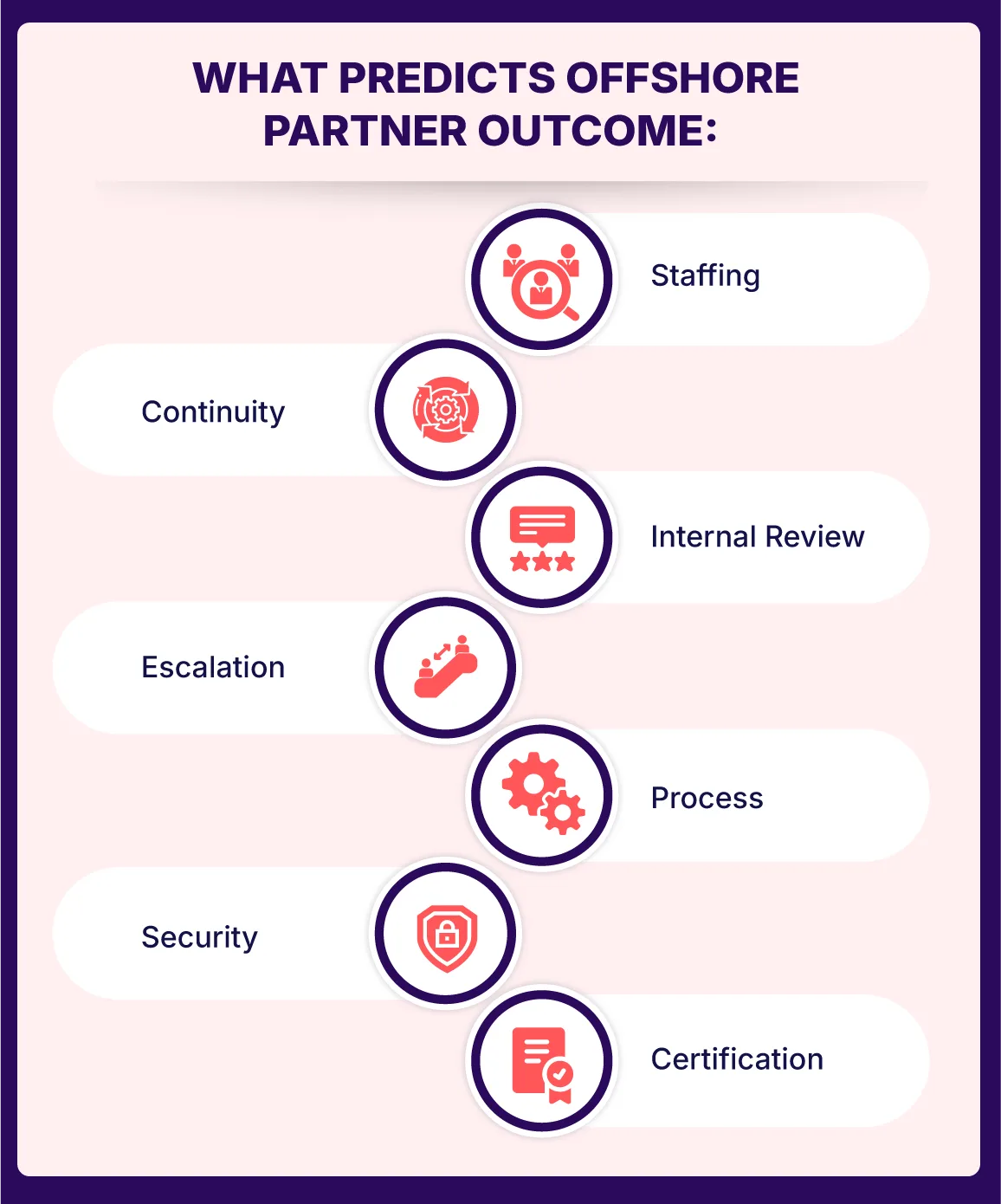
The six criteria that actually predict outcomes:
| Criterion | What to verify | Warning sign |
| Staffing continuity | Named, consistent team assigned to your firm | A rotating pool of whoever is available |
| Internal review | Quality check happens before work reaches you | Your reviewers are the first line of defence |
| Escalation process | Documented path with named owners | General assurances about “communication” |
| Security certification | Independent audit such as SOC 2, recently renewed | A badge with no report summary behind it |
| Tech compatibility | Team works daily in your existing platforms | You are asked to change systems to suit them |
| Total cost of ownership | Rate plus your reviewer hours and rework rate | Rate quoted in isolation |
Timing is what makes these verifiable. Evaluate early and you can run a small piece of real work through a provider and watch what happens. Carefully examine how do they handle a file with documents missing? A client who goes quiet? A return that turns out to be twice as complex as it looked? Behavior under normal conditions is the best available predictor of behavior under pressure, and you can only observe it when there is no pressure.
Also Read: Top Outsourced Accounting Firms in USA
A genuine partner will welcome that. A staffing vendor will push you to sign and scale up. The difference will split open, right in front of you, making the next steps much clearer.
How do you know if an offshore partner will actually hit deadlines?
The most critical three things to verify is: How the partner staffs your work, how work moves through review, and what happens when something goes wrong. A stated turnaround time on a proposal tells you almost nothing on its own. Let us learn about these pointers in detail.
1. How is your work staffed.
Ask whether you get a named, consistent team or whoever happens to be free that week. A rotating pool costs you time on every file, because context has to be rebuilt each time someone new picks it up. A consistent team learns about your clients, your templates and your preferences, and gets faster as the season progresses, which is exactly when you need the speed.
2. How work moves through review.
Ask what happens between “prepared” and “delivered to you.” Is there an internal review layer, or does the first real quality check happen on your desk? This single question separates the capacity from the workload.

3. What happens when something goes wrong.
This is the most critical of the three. Ask what happens when a file is incomplete, or a return is mis scoped. A provider with a real escalation path answer immediately and specifically. A provider without one answer just speaks fluff.
Five questions to ask in the first call:
- Is my team named and dedicated, or drawn from a shared pool?
- Who performs internal review before work reaches us, and what is their background?
- What is your escalation path when a file is incomplete or mis scoped?
- What does your capacity look like in March and April specifically
- What turnaround time will you commit to in writing during peak weeks?
Does outsourcing actually add capacity, or just add people?
Outsourcing adds genuine capacity only when work returns review ready. If outsourced staff need constant direction or produce work requiring heavy rework, the firm has added a supervision burden rather than capacity.
Work is not shrinking; let us face this reality.
CPA Trendlines’ Busy Season Barometer found most firms entered 2026 expecting revenue growth from higher prices rather than more clients, while a majority also anticipated another heavy extension season. As one practitioner put it:“The returns aren’t harder, they’re just later.”
The pressure this creates is measurable. In a survey of public accounting professionals across North America covering the 2025/26 busy season:
- 78% worked more than 50 hours per week
- 51 to 60 hours was the most common working week
- 30% of managers worked 61 to 70 hours; 17% worked 71 to 80
- Over half of managers rated their work-life balance as poor
That is what an unresolved capacity gap looks like in practice. Not missed deadlines, usually. Just the same deadlines met by people working hours that cannot be sustained year after year.
Hiring your way out does not work for a three-month peak. You cannot recruit, train and productively deploy new staff in time, and you cannot justify the cost across the other nine months.
Capacity versus headcount, in practice:
| You added headcount | You added capacity |
| Work returns needing correction | Work returns review-ready |
| Questions route to your partners | Questions resolve within the provider’s team |
| Reviewers spend time explaining | Reviewers spend time reviewing |
| Senior staff do their work plus oversight | Senior staff do more senior work |
The test after month one is simple. Are your senior people doing more senior work, or the same work plus supervision? If it is the second, the model is not working, regardless of how many people are assigned to your account.
What causes rework with offshore accounting teams?
Rework traces back to three avoidable causes: unclear scoping at the start, no shared review standard, and communication that depends on individuals rather than process. None are primarily talent problems. All three are visible during evaluation if you know what to ask.
| Root cause | How it shows up | What to ask during evaluation |
| Unclear scoping | Work is technically finished but practically unusable | “Show me how you document what ‘complete’ means by return type” |
| No shared review standard | Every file returns slightly wrong in a slightly different way | “How do you capture and embed our review standards?” |
| Individual- | Process stops when one responsive person is on leave | “What is the communication cadence and who owns escalation?” |
The missing review standard is the most expensive of the three and the least often priced in. Your firm has standards. They live in your reviewers’ heads, built over the years. Unless they are written down and embedded in the partner’s internal review, you pay the gap on every file.
This is why the cheapest quoted option so often is not the cheapest actual option.
How do you evaluate an offshore provider’s data security?
Ask for independent certification, a traced picture of how data moves, documented access controls, and a written incident response process. A signed NDA and an assurance of care is not a security posture.
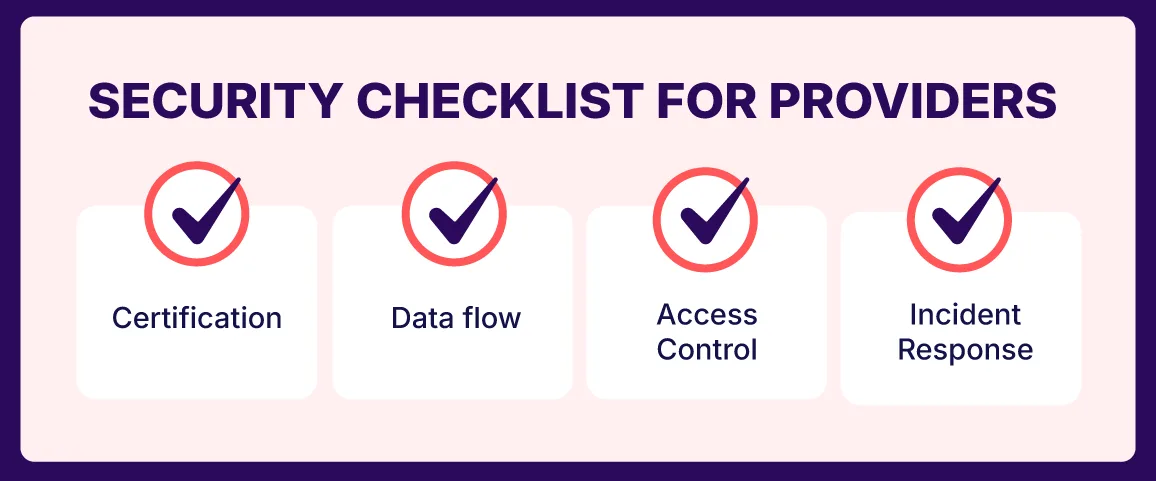
Let us deep dive into the security checks, one by one:
- Certification. An independent audit such as SOC 2 means someone outside the provider tested their controls rather than described them. Ask for the report summary, not the badge. Ask when it was last renewed.
- Data flow. The strongest setups do not move client data at all. Work happens inside a controlled environment, on your systems or a secure remote desktop, with no local downloads, no personal devices, and no client information travelling by email. Ask the provider to walk you through the journey of one file from arrival to delivery.
- Access control. Who can see your clients’ data? How is access granted and withdrawn? What happens on the day someone leaves the team?
- Incident response. What is the process? Who tells you, how quickly, and what happens next? Most providers have a polished answer to the first three questions. Considerably fewer have one here.
This has become a commercial issue rather than an IT one. If you serve high-net-worth individuals or clients in regulated industries, those clients are asking you these questions. Your partner’s answers become your answers.
Can an offshore team inside your existing tech stack?
A capable partner works in your software, on your workflows. Being asked to change systems to suit the provider is a warning sign.
Push past a general yes:
- Which platforms has the team worked in day to day, not just been trained on?
- How do they handle your document management, workflow tracking, and client communication tools?
- Have they supported firms running a setup similar to yours?
Every gap between their process and your systems becomes a manual step, and manual steps become bottlenecks in March. If a platform change is already on your roadmap, keep the two decisions apart. Moving systems and onboarding an outsourcing partner in the same season is one change too many.
Can offshore teams handle multi-state and business returns?
Capable partners handle multi-state work, partnership and corporate returns, and complex allocations, but this requires direct verification rather than inference from general tax experience. Volume 1040 preparation and complex business returns are different disciplines.
Ask specifically:
- What proportion of the team has worked on business returns?
- Which states do they have genuine, repeated experience with?
- Who reviews the complex files, and what is that reviewer’s background?
- Can you show work samples or references in a comparable complexity band?
Watch for the opposite mistake too, which is more common than firms expect. Some firms assume offshore teams should only take simple returns, and end up outsourcing the work that was never the bottleneck. If your partners remain buried in complex returns while straightforward ones queue behind them, the capacity problem has not moved.
The right split is whichever one leaves your most experience
Not sure which engagement model fits your firm?
Dedicated team, flexible pod, or a scoped pilot. The right answer depends on your volume pattern, your review capacity, and how much change your firm can absorb before January.
Map my engagement model
How much does outsourced accounting actually cost?
The real cost is the quoted rate plus the time your own team spends on review, rework, supervision and chasing. A low rate generating heavy rework costs more than a higher rate returning review-ready work.
The difference never appears on an invoice. It surfaces in reviewer hours, in overtime, in write-offs on fixed-fee engagements, and in deadlines that slip a day at a time until they slip a week.
Compare on three numbers, not one:
- Quoted rate per hour or per FTE
- Estimated reviewer hours per file on your side
- Expected rework rate as a percentage of files returned
Ask each provider to commit to numbers two and three. Whether they are willing to is informative in itself.
Count what disappears when capacity becomes reliable:
- Seasonal recruitment spend
- Training time for temporary staff
- Overtime and premium hours
- Cost of turnover driven by unsustainable peak workload
Identifying the cheapest and most expensive options is easy. The question worth answering is which one leaves your senior people with the most usable time in March.
When should CPA firms start preparing for busy season?
Start between October and November so the partner is productive before January rather than learning during it. In practical terms, that means using the window immediately after the October 15 deadline.
A five-step pre-season plan:
Define the work.
Decide which returns move out and what “review-ready” means for each. This is internal work, and the step firms skip most often, which is why so many partnerships start with a scoping problem already built in.
Run a genuine pilot.
Use live files, not a prepared sample. Include at least one messy case.
Set standards in writing.
Review checklists, escalation routes, communication cadence, turnaround expectations, security requirements. Document before volume arrives.
Review on the right measures.
Rework rate and reviewer time tell you whether you gained capacity. Files completed does not.
Agree the peak plan.
Confirm how capacity scales through March and April, and what happens if volume runs ahead of forecast.
What does a strategic partnership look like in practice?
The difference between a staffing fill-in and a growth partner is not a claim on a website. It is visible in the operating detail: who owns quality, how escalation works, what governance looks like across a season, and what your partners are able to do with the hours it returns.
Book a 30-minute working session with a QX engagement lead. We will walk through your current season, show you how partnership-model delivery is structured, and be straight with you about whether it is the right fit for where your firm is now.
FAQs
When should a CPA firm start evaluating an offshore accounting partner?
Between October and November so onboarding and a pilot can complete before January volume arrives. Evaluating in December limits you to comparing price and availability, because quality and reliability take weeks to observe.
What is the single best indicator that an offshore partner will hit deadlines?
Whether internal review happens before work reaches your desk. If your reviewers perform the first quality check, you have relocated the bottleneck rather than removed it.
Should a firm start with a pilot or a dedicated team?
A pilot, in almost every case. A scoped, time-boxed pilot on real files reveals rework rate and reviewer burden before you commit to a full team.
What security certification should an offshore accounting provider hold?
An independent audit such as SOC 2, with a shareable report summary and a recent renewal date. Ask separately about data residency, access controls, and documented incident response.
Can offshore teams prepare business and multi-state returns?
Capable providers can, but verify it specifically. Ask what proportion of the team has business-return experience, which states they have worked in repeatedly, and who reviews complex files.
Is outsourcing cheaper than hiring?
Usually yes, because you avoid recruitment, training and unused capacity. Compare on total cost of ownership rather than rate alone. See here for more details.
Enquire now

Mangesh Singh
With nearly 20 years of experience in U.S. and Canadian tax, accounting, and operations, Mangesh is a PMP and CFP who drives service delivery, workflow efficiency, and team performance at QX Accounting Services. He supports CPA firms with scalable accounting and tax operations, helping improve accuracy, review quality, turnaround times, and client service. Known for his operational discipline and strategic insight, he turns complex delivery challenges into practical solutions that support consistency, accountability, and sustainable growth.
Unauthorized copying or plagiarism of our content is a violation of intellectual property rights. We take such matters seriously and will pursue legal action to protect our original work. Anyone found engaging in such activities will be held accountable under applicable laws.
Don't forget to share this post!
Our Latest Insights


Marketing Services
Outsourced Marketing Services vs In-House Team for CPA Firms...
23 September 2026

Marketing Services
How to Choose an Outsourced Marketing Partner for Your CPA F...
21 September 2026

Let’s Work Together
Explore outsourcing solutions, request a no-obligation trial or discuss your practice’s needs with our expert consultants.
 Book a Virtual Meeting
  Get Your ROI Estimate