



If you’re leading a growing accounting firm, you’ve probably experienced this paradox.
Revenue is increasing. New clients are coming in. Your team is busier than ever. Yet somehow, growth feels harder than it should.
Partners are spending more time reviewing work. Managers are firefighting capacity issues. Recruitment remains a constant challenge. Margins are under pressure despite rising fees.
Sound familiar?
The reality is that many accounting firms aren’t constrained by demand. They’re constrained by leverage.
In fact, research cited in Xero’s Accounting and Bookkeeping Industry Report found that 79% of accounting practices reported revenue growth, yet many firms continued to struggle with capacity, delivery bottlenecks, and resource constraints. The challenge wasn’t winning work. It was scaling delivery efficiently.
This is where the conversation around accounting firm growth leverage becomes critical.
The highest-performing firms rarely grow because they hire more people faster than everyone else. They grow because they build systems, structures, and operating models that allow each person, process, and pound invested to generate greater output.
In simple terms, they build leverage.
Let’s explore the four types of leverage every accounting firm should intentionally develop if it wants to achieve long-term, scalable growth.
In business, leverage is the ability to generate greater results without proportionately increasing effort, costs, or resources.
Think of it this way:
A firm that doubles revenue by doubling headcount has grown.
A firm that doubles revenue while increasing headcount by only 20% has created leverage.
That’s the difference between growth and scalable accounting firm growth.
The firms that dominate the next decade will be those that systematically build leverage into every part of their operating model.
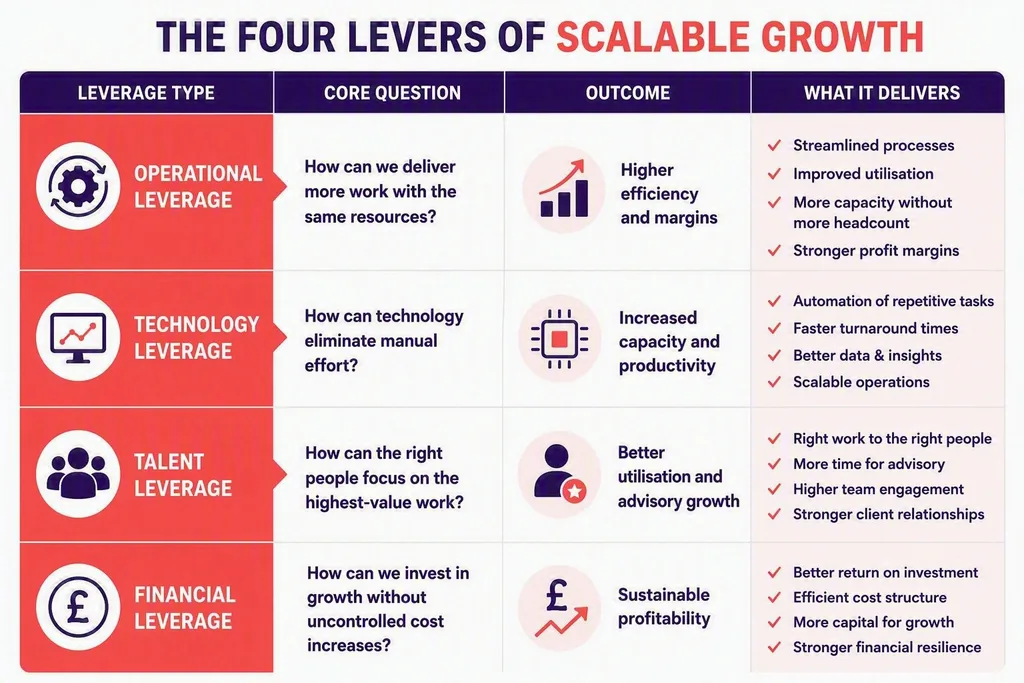
Of all the forms of leverage, operational leverage in accounting firms is often the most overlooked.
Many firms try to solve growth challenges through recruitment alone. That’s where the problem arises. Hiring more people often creates more complexity. More communication. More reviews. More management layers. More bottlenecks.
Operational leverage focuses on redesigning how work flows through the business.
Instead of asking: “How do we hire more people?”
The better question becomes: “How do we process more work through the same system?”
Operational leverage typically comes from:
When work moves consistently through the firm, productivity increases naturally. Managers spend less time chasing status updates. Partners spend less time reviewing routine compliance work. Teams spend less time switching between tasks.
The result is stronger accounting firm operational efficiency and improved profitability.
Many firms discover that their biggest growth bottleneck isn’t lead generation. It is delivery capacity.
New clients keep arriving. Existing clients need more support. Meanwhile, internal teams become overwhelmed.
Growth slows not because demand disappeared, but because capacity failed to keep pace.
That is precisely why many firms are turning to accounting outsourcing services for growth as a strategic operating model rather than a short-term staffing solution.
A scalable delivery engine creates leverage by allowing capacity to expand independently of local recruitment conditions.
The second type of leverage is technology. But not technology for technology’s sake.
The best firms don’t buy more software. They build better workflows.
Research highlighted by industry technology providers shows that 75% of firms are investing in cloud accounting, automation, and data analytics, while AI adoption continues to accelerate across the profession.
Technology leverage occurs when systems help people produce more value in less time.
| Traditional Firm | Leveraged Firm |
|---|---|
| Manual data collection | Automated data capture |
| Spreadsheet-driven workflows | Integrated cloud systems |
| Reactive client communication | Automated client workflows |
| Extensive admin effort | Exception-based management |
| Compliance-focused output | Advisory-focused output |
The biggest opportunities often include:
These technologies reduce repetitive effort and free teams to focus on higher-value activities.
This is the essence of technology leverage for accounting firms. Technology does not replace accountants. It amplifies them.
The firms achieving the greatest returns are those that use automation to reduce compliance workload and redirect capacity toward advisory, client relationships, and strategic growth initiatives.
One of the most common growth barriers in accounting firms is that highly skilled people spend too much time doing work below their level. Partners review work that managers could handle. Managers perform tasks that seniors could complete. Seniors spend time on activities that could be automated or outsourced.
This creates a significant productivity drain.
Historically, firms relied on a classic pyramid structure with large numbers of juniors supporting a smaller group of managers and partners. Today’s environment is different.
Talent shortages continue to challenge firms across the UK market. Many firms are finding it increasingly difficult to recruit qualified staff while maintaining profitability.
This is where talent leverage in accounting becomes essential.
Talent Leverage Means:
The goal is simple: Every member of the team should spend most of their time performing the highest-value work they are capable of delivering.
| Team Member | Focus Without Leverage | Focus With Leverage |
|---|---|---|
| Partner | Reviews and administration | Advisory and growth |
| Manager | Workflow coordination | Client relationships |
| Senior Accountant | Data processing | Analysis and insights |
| Outsourced Team | N/A | Compliance production |
| Technology | N/A | Repetitive task execution |
This shift transforms capacity while improving employee engagement and client outcomes.
The final form of leverage is financial.
When most firm owners hear the term financial leverage, they immediately think of debt. In reality, financial leverage is broader than borrowing. It is about ensuring investments generate disproportionate returns.
The best investments create a multiplier effect. One pound invested should create several pounds of future value. This is the foundation of financial leverage for business growth.
One of the key indicators of a scalable firm is this: Does revenue grow faster than costs?
Many firms can increase revenue. Far fewer can improve profitability while doing so.
True leverage occurs when revenue and capacity expand while costs grow at a slower rate.
Also Check: Best Accounting Outsourcing Firms in the UK
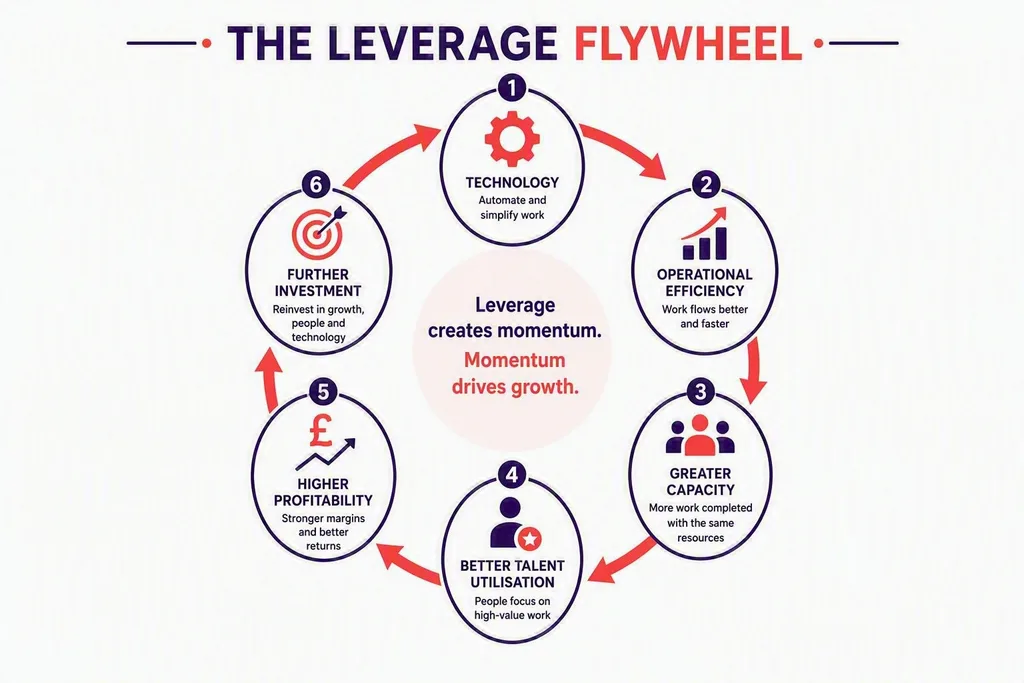
The most successful firms don’t focus on just one type of leverage. They combine them.
Imagine a firm that:
Those strategies reinforce each other. Technology improves operational efficiency. Operational efficiency improves talent utilisation. Talent utilisation improves profitability. Profitability funds further growth.
This creates a powerful growth flywheel.
At QX Accounting Services, we work with UK accounting firms that have ambitious growth goals but face the same challenges many firms do today:
Our approach focuses on helping firms build leverage across all four areas.
Dedicated offshore teams create scalable delivery capacity and standardised workflows.
We support firms with process optimisation, automation opportunities, and technology-enabled delivery models.
Partners and managers can focus on higher-value client work while experienced accounting professionals handle compliance production.
The result is a more scalable cost structure that supports profitable growth without proportionately increasing overheads.
Ultimately, our goal is simple: To help firms grow faster, improve operational efficiency, and create sustainable long-term scale.
If there is one idea I would leave you with, it’s this: Growth alone is not the objective. Leverage is.
Anyone can grow by adding more people, more hours, and more complexity. he firms that truly scale are different. They build systems that allow every person, process, technology investment, and pound spent to create greater value over time.
Operational leverage. Technology leverage. Talent leverage. Financial leverage.
Together, these four forces create the foundation for a modern accounting firm that can grow sustainably, profitably, and predictably in the years ahead.
Accounting outsourcing creates operational leverage by increasing delivery capacity without requiring firms to proportionately increase local headcount. It helps standardise processes, reduce recruitment pressure, improve turnaround times, and free internal teams to focus on higher-value client work.
Technology creates leverage by automating repetitive tasks, improving workflow visibility, reducing manual effort, and increasing productivity. This allows firms to handle a larger volume of work without significantly increasing headcount.
Talent leverage ensures the right people focus on the right activities. When compliance work is delegated, automated, or outsourced, senior professionals can spend more time on advisory services, client relationships, and business development.
Firms can increase revenue more efficiently by improving operational efficiency, leveraging automation, adopting outsourcing models, standardising workflows, and focusing senior talent on higher-value services rather than routine compliance work.
All four types of leverage work together, but operational leverage often has the most immediate impact because it directly improves productivity, utilisation, and delivery efficiency across the business.
They can achieve this by combining process optimisation, workflow automation, cloud technology, strategic outsourcing, and clear role allocation to increase capacity without proportional hiring.
Leading firms create integrated operating models where technology automates routine tasks, outsourced teams provide scalable capacity, and internal talent focuses on client relationships, advisory services, and strategic growth initiatives. This combination creates sustainable, scalable growth while protecting profitability.

Namrata is an Accounting and Learning & Development professional with over 10 years of experience in the outsourcing industry, specialising in UK bookkeeping, VAT, final accounts, and taxation. She is proficient in a wide range of accounting software, ensuring accurate and efficient financial solutions. With nearly 2 years of hands-on experience in Learning & Development, she also contributes to employee training, skill enhancement, and process improvement strategies aligned with organisational goals.
Unauthorized copying or plagiarism of our content is a violation of intellectual property rights. We take such matters seriously and will pursue legal action to protect our original work. Anyone found engaging in such activities will be held accountable under applicable laws.
Explore outsourcing solutions, request a no-obligation trial or discuss your practice’s needs with our expert consultants.





 Book a Virtual Meeting
  Book an In-person Meeting