



Many accounting firms in the UK are weighing offshore and onshore tax preparation because the old busy-season model is under pressure: more compliance work, fewer available people, and higher client expectations.
HMRC said more than 11.48 million people filed Self Assessment returns for the 2024 to 2025 tax year by 31 January, while AAT reported in October 2025 that a third of UK businesses had struggled to recruit for finance and accounting positions in the previous year. ACCA’s UK Talent Trends research also shows the profession is dealing with changing expectations around work, skills and retention Against that backdrop, the real issue is not simply “cheap versus local”. It is whether your firm can protect quality, meet HMRC deadlines, comply with UK GDPR, and keep partners free for advisory work.
The offshore vs onshore tax preparation difference is mainly where the preparation team sits, how the work is managed, and what operating controls are wrapped around it. Onshore tax preparation is delivered within the UK, often by in-house staff, temporary hires, or a UK-based outsourced provider. Offshore tax preparation services UK are delivered by teams outside the country, commonly as an extension of your practice team, with files exchanged through secure systems and reviewed before being sent back.
For UK accounting firms, the practical difference is felt in capacity, communication rhythm, cost base, and oversight. Onshore support may feel easier for ad hoc conversations and face-to-face training, but it can be harder to scale quickly during Self Assessment season. Offshore tax outsourcing for UK accounting firms can provide scalable tax preparation support, but it only works well when the provider understands UK tax workflows, HMRC expectations, MTD-compatible software, and the firm’s review standards.
The best choice depends on the type of work, the maturity of your internal processes, and your appetite for delegation. A small owner-managed practice may use offshore support for standard Self Assessment returns, while keeping complex advisory-heavy cases onshore. A larger multi-office firm may prefer a hybrid model, with offshore preparation, onshore review, and partner sign-off.
| Factor | Offshore tax preparation | Onshore tax preparation |
|---|---|---|
| Cost | Usually lower delivery cost, especially for repeatable preparation work | Usually higher employment or contractor cost |
| Scalability | Strong for seasonal volume if onboarding is early | Limited by UK hiring availability |
| Turnaround | Can be fast if workflow, query rules and review queues are clear | Can be fast, but peak-season bottlenecks are common |
| Communication | Needs disciplined handovers and documented queries | Easier real-time discussion during UK hours |
| UK expertise | Depends heavily on provider training and specialisation | More familiar by default, but still varies by individual |
| Control | Requires clear review, security and escalation procedures | Direct supervision is simpl |
Tax preparation quality control is the decisive factor in any outsourcing model. Whether offshore or onshore, weak source documents, unclear workpapers, and rushed partner review will create errors. A good outsourced model separates preparation from review, uses checklists by return type, records assumptions, and gives your team a clear query trail.
For accounting firms, that means checking whether the provider can handle PAYE income, dividends, pensions, rental income, capital gains, foreign income, sole trader schedules, and MTD-related record keeping where relevant. It also means agreeing what “complete” means before work begins. A return that is technically prepared but full of unresolved queries is not complete; it has simply moved the bottleneck back to your manager.
A practical quality framework should include:
Offshore vs onshore tax preparation costs are often discussed too narrowly. Offshore models usually reduce the cost of preparation labour, but the real commercial benefit is capacity: the ability to accept more work without permanent recruitment, reduce overtime, and protect fee-earners from low-value administration. Onshore models may be more expensive, but they can suit specialist work where proximity and immediate technical discussion matter.
Tax preparation outsourcing services should therefore be costed across the whole workflow, not just per return. Include internal review time, manager queries, software access, training, rework, client chasing, and peak-season overtime. A low preparation fee is not attractive if it creates review drag; a higher-cost model may still be good value if it consistently returns clean files.
Tax preparation turnaround time improves when files are batched sensibly, source documents are complete, and query rules are agreed in advance. Offshore teams can use time-zone differences to progress work outside UK office hours, but that advantage disappears if every file is missing basic information. Onshore teams can resolve queries quickly, but they face the same January capacity crunch as everyone else.
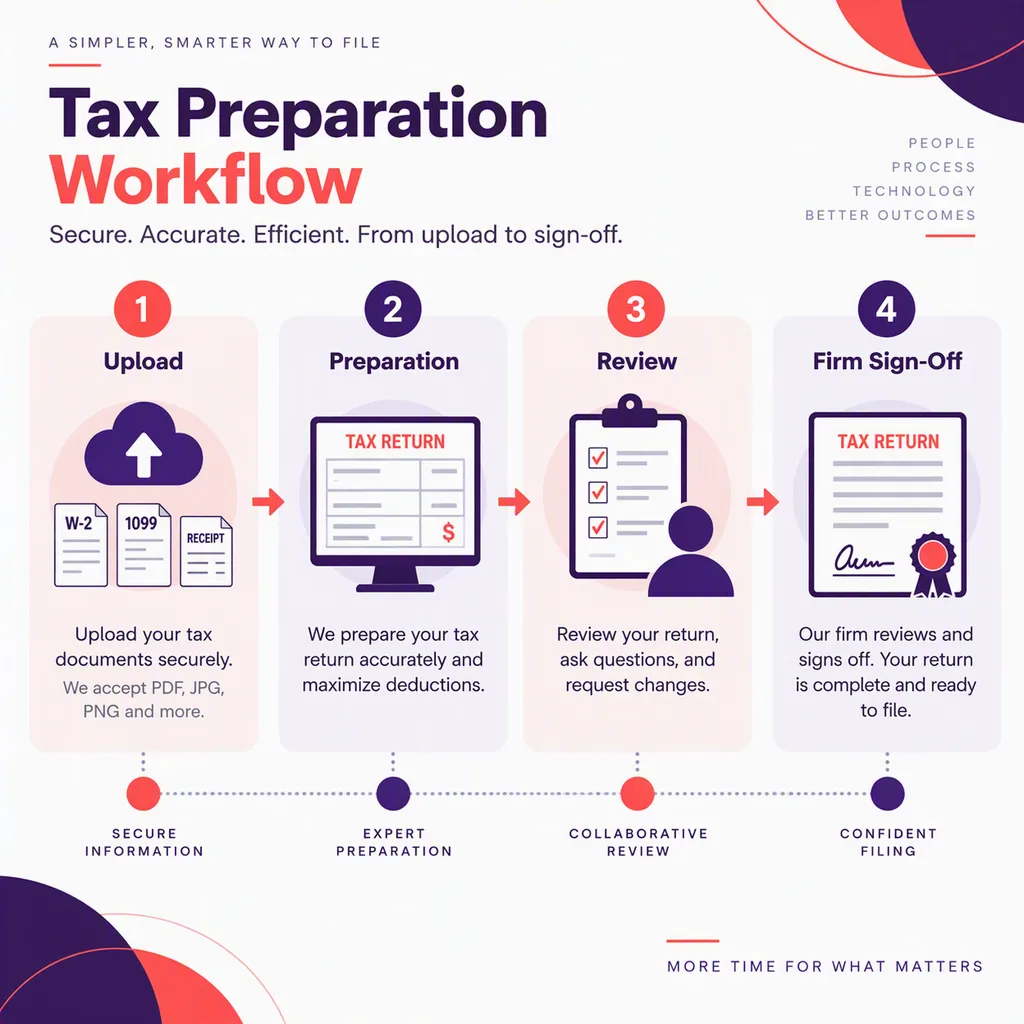
The most reliable firms use a daily production rhythm. They upload work by an agreed cut-off, receive queries in a standard format, assign a UK contact for clarifications, and monitor status through a tracker. This creates visibility across “not started”, “in preparation”, “with query”, “in review” and “ready for firm review”.
Offshore vs onshore tax preparation services both involve personal and financial data, so security cannot be an afterthought. For offshore arrangements, UK GDPR, controller-processor responsibilities, international transfers, access controls, and audit trails need careful review.
ICO guidance says organisations transferring personal information internationally must have appropriate security measures and consider UK GDPR transfer obligations; firms should take professional advice where needed rather than treating this article as legal advice.
Ask any provider for evidence of security controls, not just reassurance. Useful checks include ISO certifications, data processing agreements, breach response processes, staff confidentiality training, restricted system access, multi-factor authentication, secure portals, and policies for deleting or returning data after completion.
QX Accounting Services (QXAS) is a market-leading outsourcing provider for accounting firms, offering tax, accounting, bookkeeping, payroll, audit, and automation support. Our personal tax outsourcing support is powered by QX TaxReady, a managed tax preparation service for UK accounting and tax firms.
QX TaxReady uses a secure portal for uploading client documents, AI-assisted document processing, tax professionals who validate and prepare returns, and a four-eyed review before files are returned for the firm’s own review.
From a process perspective, QXAS is most relevant where firms want an extended-team model rather than one-off overflow help. Tax preparation service is powered by UK-ready tax experts, support across simple and more complex Self Assessment returns, and onboarding that can help firms build additional capacity quickly. For security, we are GDPR-compliant and hold ISO 27001 and ISO 27701 certifications, with data protection agreements and breach response planning.
Also Read: Top Tax Outsourcing Companies in UK
Before choosing offshore, onshore, or hybrid tax preparation outsourcing, partners should map the work by risk and complexity. Straightforward returns are often easier to systemise. Complex residency, remittance, trust, high-value CGT, or enquiry-sensitive cases may need senior UK review from the outset.
Use this checklist before committing:
Yes, offshore tax preparation can be suitable for UK accounting firms when the work is clearly scoped, the provider understands UK tax, and the firm retains proper review and client control. It is best for repeatable compliance work where processes, checklists and review standards are documented.
Often, yes, offshore tax preparation has a lower delivery cost than onshore support. However, the true cost depends on review time, rework, software access, training and management overhead. Firms should compare total workflow cost, not headline rates.
It can be, but it is not automatically compliant. The firm should check data processing agreements, international transfer arrangements, security controls, access rights, audit trails and provider certifications. Take specialist advice where needed.
It can provide faster turnaround times where files are complete and workflows are disciplined. Time-zone coverage can help, but incomplete records and unclear query handling will slow any model, offshore or onshore.
Most firms should consider a hybrid model. Offshore teams can provide scalable preparation capacity, onshore staff can manage client communication and technical review, and partners can focus on risk, advice and sign-off.
Offshore vs onshore tax preparation is not a binary argument. The right answer is the model that protects quality, keeps data secure, meets HMRC deadlines, and gives your firm reliable capacity during peak season. For many UK accounting firms, the strongest route is a controlled hybrid approach: offshore support for scale, onshore oversight for judgement, and a workflow robust enough to make both parts work together.

Dinesh is a seasoned accounting and tax professional with more than 20 years of experience, specialising in UK personal tax. He has a proven track record of streamlining tax processes and building strong client relationships, consistently delivering accurate and compliant taxation services tailored to client needs.
Unauthorized copying or plagiarism of our content is a violation of intellectual property rights. We take such matters seriously and will pursue legal action to protect our original work. Anyone found engaging in such activities will be held accountable under applicable laws.
Explore outsourcing solutions, request a no-obligation trial or discuss your practice’s needs with our expert consultants.





 Book a Virtual Meeting
 Book an In-person Meeting