



For many UK accounting firms, tax capacity has become less predictable just as client expectations have become more demanding.
The challenge is not simply getting through January. Firms need enough skilled capacity to process work accurately, maintain turnaround times, protect margins and give senior people enough time to review complex matters and advise clients.
That is becoming increasingly difficult through recruitment alone. ICAEW research found that 67% of surveyed mid-tier firms identified recruiting qualified staff as a top-three talent challenge, while 60% cited retaining staff. Half of the firms surveyed had already offshored or outsourced at least one service line, with tax among the most commonly outsourced areas.
Tax volumes add another dimension. More than 12 million Self Assessment returns were expected for the 2024/25 tax year, with approximately 11.49 million received by the 31 January 2026 deadline.
For firms dealing with hundreds or thousands of returns, even relatively small fluctuations in client responsiveness, staff availability and complexity can therefore create significant delivery pressure.
This is where offshore tax preparation services in the UK increasingly form part of a broader resourcing strategy.
Offshore tax preparation gives UK accounting firms a controlled way to add tax capacity without adding permanent headcount. In practice, it means a trained external team prepares draft returns, working papers, and supporting schedules through secure workflows, while the UK firm retains client ownership, professional judgement, and final review.
But successful offshore tax preparation is not simply about moving work to a lower-cost location. It requires the right operating model, workflows, controls, technology, security and accountability.
This guide explains what UK accounting firms need to know.
Offshore tax preparation services are specialist support services where a UK accounting or tax firm delegates defined tax compliance tasks to a team based in another jurisdiction, often as part of a managed outsourcing model. The offshore tax preparation team may prepare Self Assessment returns, corporation tax computations, working papers, data extraction, reconciliations, schedules, and review packs, but the UK firm normally remains responsible for client communication, technical judgement, filing approval and quality sign-off.
For UK firms, this is not the same as “handing over” a client relationship. A well-designed offshore tax preparation process works as an extension of the practice: files are shared through secure channels, tasks are documented in a scope, preparers follow the firm’s templates and software preferences, and completed work returns to the in-house team for review. The aim is to create scalable tax preparation support during peak filing periods while keeping control over risk, standards and client service.
This model has become more relevant because compliance demand is concentrated, deadline-driven and increasingly digital. HMRC reported that more than 11.5 million taxpayers filed Self Assessment returns by the 31 January deadline for the 2023/24 tax year, with 97.36% filed online, showing both the scale of the annual workload and the digital nature of modern compliance.
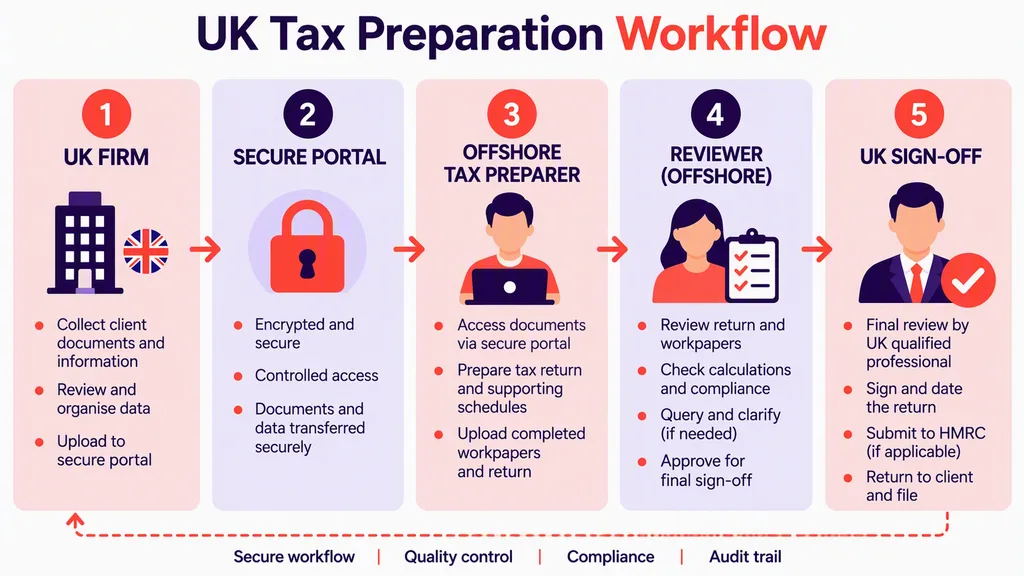
Accounting firms in the UK are considering offshore tax preparation because capacity pressure, recruitment constraints, and tax-season peaks are colliding with more complex compliance expectations. Outsourcing does not remove the need for skilled UK tax professionals. It helps them spend more time on review, advisory conversations, client relationships, and exception handling rather than repetitive preparation work.
Industry data supports the capacity argument. ICAEW research on mid-tier firms found that talent-related issues were listed among the top three concerns by most respondents, and that half of respondent firms had already outsourced or offshored at least one service line, commonly including accountancy, tax, audit and payroll. It also reported that chargeable hours offshored by firms using these models had risen by 86% over three years, with a further 71% increase expected in the next three.
Skills pressure is not limited to large practices. A 2025 study reported that 92% of employers experienced skills shortages in the previous year, while 77% expected a shortage of suitable applicants in the coming months. AAT also reported in 2025 that four in five UK employers struggled with skills shortages, with consequences including reduced productivity and lower work quality.
For firms managing tax return preparation outsourcing, the practical implication is clear: capacity planning can no longer rely solely on last-minute hiring.
Cost remains important, but the strategic case for offshore tax preparation goes much further.
Perhaps the clearest benefit is capacity. Instead of recruiting permanent employees around peak workloads, firms can develop offshore capacity aligned with expected volumes.
This can be particularly useful during:
For growing firms, scalable tax preparation support can allow additional work to be absorbed without increasing UK headcount at precisely the same rate.
Offshore models may enable firms to convert part of the cost of tax delivery into more predictable per-return, per-hour, or dedicated-team expenditure.
That can make forecasting easier, particularly for firms with reliable historical volume data.
Moving routine preparation activities offshore can create space for UK teams to focus on work requiring greater professional judgement.
That might include:
This is often where the strategic value of outsourcing becomes greater than the headline labour-cost differential.
A tax function dependent on a small number of individuals is vulnerable. Illness, resignations, holidays or recruitment delays can quickly affect turnaround.
An appropriately structured offshore team can broaden the firm’s delivery capacity and reduce dependence on individual resources.
An experienced outsourcing provider should already have structured workflows for allocating work, tracking progress, handling queries, conducting reviews and reporting performance.
For firms without mature workflow systems internally, that discipline can be valuable in itself.
The main difference is not simply location. It is the economics and structure of the delivery model.
| Factor | Offshore tax preparation | Onshore/in-house preparation |
|---|---|---|
| Location | Delivery team based outside the UK | UK-based team |
| Capacity | Can be expanded through external resources | Dependent primarily on recruitment/internal capacity |
| Cost structure | Often lower delivery cost | Higher UK employment cost base |
| Scalability | Potentially easier to flex | Requires hiring, overtime or temporary resources |
| Communication | Requires structured hand-offs | More direct internal communication |
| Security | Requires strong remote-access/data controls | Requires internal security controls |
| Governance | Requires vendor governance and SLAs | Managed through internal management structures |
| UK oversight | Firm should retain appropriate review and accountability | Built into existing hierarchy |
Neither approach is automatically better.
Many firms ultimately operate a hybrid model: offshore teams undertake defined preparation activities while UK staff retain client ownership, specialist judgement and final review.
For larger firms, this can become a strategically designed operating model rather than an external supplier arrangement.
Tax preparation outsourcing for accounting firms works best when the scope is precise. “Tax” is too broad; a good engagement separates preparation, checking, query management, filing support, and advisory judgement.
Common outsourced tax preparation services UK firms may consider include:
The safest line is to outsource structured compliance preparation and retain judgement-heavy advisory work in-house unless the provider’s role, qualifications and review process are clearly documented.
There is no single universal offshore tax preparation process, but effective models generally separate preparation, review, and approval clearly.
A typical workflow may look like this:
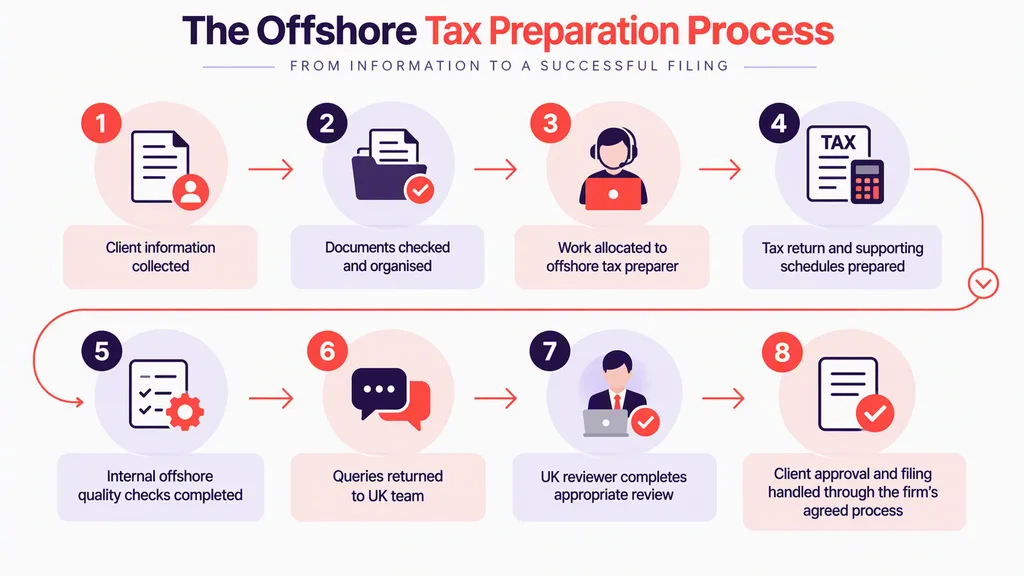
The workflow should establish clear responsibilities at every stage. This includes identifying who owns outstanding information, who can raise client queries, what happens when information is incomplete, what review thresholds apply, and how exceptions are escalated.
The smoother the inputs, the more efficient the outsourced model becomes.
Different outsourcing models suit different firms. A sole practitioner may need overflow support for January; a mid-tier firm may need a dedicated offshore tax preparation team for several months; a larger firm may need governance, dashboards and documented quality procedures.
| Model | Best suited to | Strengths | Watch points |
|---|---|---|---|
| Ad hoc overflow support | Smaller firms with seasonal spikes | Flexible capacity for urgent or lower-complexity work | Can become inconsistent if templates and review rules are weak |
| Dedicated offshore preparer | Firms with recurring monthly or seasonal volumes | Better continuity, software familiarity and process knowledge | Requires enough volume to keep the resource productive |
| Managed team | Growing and mid-tier firms | Team leadership, reporting, escalation and quality layers | Needs clear service-level agreements and volume forecasting |
| Hybrid onshore/offshore model | Firms needing client-facing or in-office support plus scale | Combines local communication with offshore processing depth | Scope boundaries must be clear to avoid duplication |
The right model depends on volume, complexity, technology, review capacity, and client expectations. A firm with 300 similar personal tax returns may benefit from a different structure than a firm with 80 high-complexity owner-managed business clients.
There is no universal rate for offshore tax preparation services UK firms can use as a benchmark.
Pricing depends heavily on:
QX Accounting Services has recently launched QX TaxReady, a fully managed tax preparation service for accounting firms, starting at just £30 per return. The service combines AI-powered preparation with two-level human review, minimising errors and improving turnaround times.
Choosing an offshore tax outsourcing UK provider should involve substantially more due diligence than comparing prices.
Ask:
UK tax experience should be demonstrable rather than assumed.
Understand how work moves from preparer to reviewer. A strong tax outsourcing quality control model should define:
Ask what happens if volumes increase 20%, 50% or more. A partner that works well at 100 returns may not necessarily work at 5,000.
Assess resource planning, cross-training, business continuity and how quickly additional capacity can practically be made available.
The offshore team should be able to operate effectively within the firm’s technology environment where appropriate.
Consider tax software, document management, workflow systems, communication platforms and secure access arrangements.
There should be named ownership on both sides. Regular operational meetings, reporting, escalation routes and documented service levels prevent minor operational issues becoming larger delivery problems.
Secure tax data outsourcing is a core requirement, not a sales feature. Tax files contain personal data, income records, bank details, national insurance numbers, payroll information, investment data, and sometimes sensitive family or residence information. Under UK GDPR, firms need to understand controller and processor roles, governance responsibilities, and how personal data is handled by third parties. ICO guidance explains the distinctions between controllers, processors, joint controllers and sub-processors, and why these roles matter.
A UK accounting firm should assess security before any live client file is shared. At minimum, the provider should be able to explain how data is transferred, stored, accessed, retained, and deleted. They should also document whether work is performed on a secure portal, virtual desktop environment or client system, and whether files can be downloaded locally.
Use this checklist during due diligence and annual review:
Security should also be operational. For example, a secure portal is valuable only if the firm avoids sending client tax packs through unmanaged email attachments. Good governance requires both parties to follow the process every time.
Offshoring tax preparation can involve sending or making UK personal information available internationally.
The Information Commissioner’s Office provides detailed guidance covering when UK GDPR international-transfer rules apply and how organisations should approach restricted transfers. Its international-transfer resources include guidance on adequacy regulations, appropriate safeguards, the UK International Data Transfer Agreement (IDTA), the UK Addendum and transfer risk assessments.
Consequently, before establishing an offshore arrangement, firms should determine the applicable data flows and legal requirements with their privacy/legal advisers rather than assuming that a standard outsourcing contract is sufficient.
Questions to establish include:
The ICO specifically advises organisations to consider international-transfer rules alongside their wider UK GDPR responsibilities.
Data protection should therefore be designed into the outsourcing model from the beginning.
This section provides general information and should not be treated as legal advice.
Also Read: Top Tax Outsourcing Companies in UK
Tax preparation turnaround time depends on file completeness, return complexity, software access, query response times, and reviewer availability. Many firms make the mistake of measuring only the provider’s preparation time. In reality, total turnaround runs from client record collection to final approval, and offshore preparation is only one stage.
A practical approach is to segment returns into bands:
Capacity planning should start before the filing season. HMRC’s Making Tax Digital for Income Tax rules now add further planning pressure: qualifying sole traders and landlords over £50,000 were required to use MTD from 6 April 2026, with thresholds reducing to £30,000 from 6 April 2027 and £20,000 from 6 April 2028. HMRC also stated that around 780,000 self-employed individuals and landlords were enrolled in MTD from April 2026, with a further 970,000 joining from April 2027. This means many firms need year-round compliance capacity, not just January firefighting.
If outsourcing is measured only by cost, firms can miss both problems and value. A more complete scorecard should combine quality, speed, economics and operational performance.
Useful KPIs include:
| KPI | What it tells you |
|---|---|
| First-time quality / acceptance rate | How much work passes review without material correction |
| Rework rate | How much work must be returned |
| Turnaround time | Speed between receipt and agreed delivery point |
| SLA achievement | Reliability against agreed service levels |
| Query rate | Frequency of clarification needed |
| Cost per completed return | Actual delivery economics |
| UK review time per return | Whether outsourcing is genuinely releasing capacity |
| Volume capacity | Ability to absorb planned/peak work |
| Escalations | Operational stability |
| Security/compliance incidents | Control effectiveness |
Measure outcomes, not activity
A team completing more returns is not necessarily performing better if UK reviewers spend significantly longer correcting them.
A particularly useful measure is:
Preparation cost + UK review/rework cost = effective cost per completed return
That creates a more honest picture of outsourcing economics.
Likewise, firms should monitor whether outsourced capacity is actually freeing senior people for higher-value work.
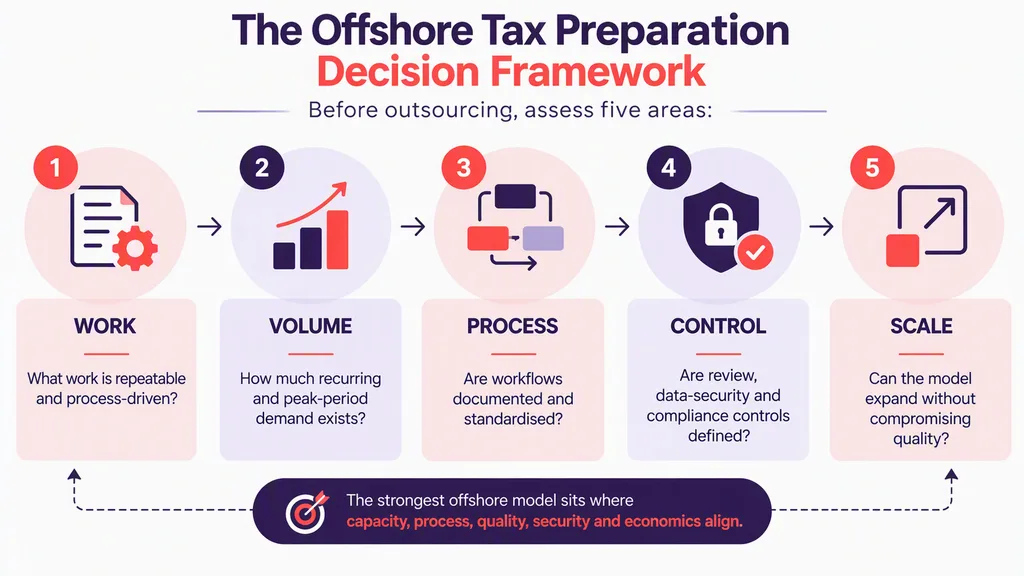
The strongest offshore model sits where capacity, process, quality, security and economics align.
QX Accounting Services is a market-leading outsourcing provider serving accounting firms in the UK with services across accounting, tax, payroll, audit and automation. We support 500+ accounting firms worldwide, including Top 100 and PE-backed firms, and have 1,200+ accounting professionals within a wider global team of 3,500+ across India, the US and the UK. We deliver ISO-certified, GDPR- and SOC 2-compliant services.
For personal tax outsourcing services specifically, QX has recently launched QX TaxReady, a completely managed tax preparation service for UK accounting and tax firms. The service is a secure, AI-powered tax preparation model with fixed pricing per return year-long, designed to help firms add capacity without extra hiring.
The process includes document upload through the QX Portal, AI-supported extraction and organisation, working paper creation, preparer review, and expert sign-off before the completed return is delivered back to the firm.
QX Accounting Services (QXAS) TaxReady offers features such as 50%+ lower preparation cost, 95% data-entry automation, and two-level expert review. Our expertise is backed by more than 25,000 tax returns annually and a 97% customer satisfaction score.
QXAS may be relevant for firms looking for offshore tax preparation for UK accounting firms that combines managed workflow, security documentation, automation, and human review. As a best practice, firms should run a pilot, check data processing terms, confirm service-level expectations, and review sample outputs against internal standards before scaling.
UK accounting firms can outsource a range of preparation and compliance activities, depending on their risk policies and operating model. These may include Self Assessment and Corporation Tax return preparation, tax computations, supporting schedules, capital allowances calculations, workpaper preparation, tax-software processing, and routine compliance administration.
The UK firm should establish which activities remain subject to internal review and approval.
There is no reliable universal saving percentage because the outcome depends on salary costs, return complexity, provider pricing, volumes, review requirements and rework.
The better calculation compares the firm’s fully loaded internal cost per return with the effective outsourced cost per completed return, including UK review and correction time.
With QXAS TaxReady, you get fully managed tax preparation support starting at just £30, locked in for the whole year, thus saving you over 50% of in-house costs.
Quality comes from the operating model, not geography. Firms should define preparation standards, required documentation, review checklists, escalation rules, and acceptance criteria before moving significant volumes offshore.
The most useful metrics include first-time acceptance, rework levels, UK review time, turnaround, and recurring error categories. This creates measurable tax outsourcing quality control rather than relying on subjective perceptions of quality.
There is no single standard transition period. Timescales depend on volume, process maturity, software, complexity, team size, security requirements, and how much training or knowledge transfer is needed.
A controlled transition normally benefits from starting with clearly defined, repeatable work before expanding scope based on measured performance.
Assess at least six areas:
Firms should also investigate governance, staff training, business continuity, subcontracting and performance reporting. Price should be considered alongside these factors, not ahead of them.
Yes. Additional offshore capacity can help firms process higher workloads without relying entirely on overtime, temporary staff or last-minute recruitment.
The potential is particularly relevant given the concentration of Self Assessment activity: HMRC reported that 475,722 taxpayers filed on 31 January 2026 alone.
However, offshore support works most effectively when capacity is planned before peak season rather than introduced only once a backlog has developed.
Offshore tax preparation services are becoming part of a broader rethink of how UK accounting firms build capacity.
Talent constraints, margin pressure, concentrated tax deadlines, and the need to move skilled UK professionals towards higher-value activity are making the traditional model of hiring locally for every increment of growth increasingly difficult.
ICAEW’s research already shows outsourcing and offshoring are established across tax and other major service lines among the mid-tier firms surveyed. Yet offshore tax preparation succeeds only when the operating model is right.
The firms most likely to generate value from it will not simply ask: “How cheaply can this return be prepared?”
They will ask: “How do we build a secure, scalable and measurable tax delivery model that gives our best people more capacity?”
That is a much more strategic question. And in an environment where capacity increasingly determines how quickly a firm can grow, it may be the more important one.

Paresh Agarwal is Senior Manager (Operations) at QX, where he plays a pivotal role in driving operational excellence and business performance. As an MTD (Making Tax Digital) expert at QX, he brings deep knowledge of digital tax compliance, process optimisation, and strategic leadership. With a strong focus on enhancing operational frameworks and supporting client success, Paresh consistently delivers efficient, technology-led solutions for accounting and tax operations.
Unauthorized copying or plagiarism of our content is a violation of intellectual property rights. We take such matters seriously and will pursue legal action to protect our original work. Anyone found engaging in such activities will be held accountable under applicable laws.

29 September 2026
Explore outsourcing solutions, request a no-obligation trial or discuss your practice’s needs with our expert consultants.




 Book a Virtual Meeting
  Book an In-person Meeting