



UK businesses should expect payroll outsourcing SLAs to specify processing deadlines, accuracy measures, query response times, and responsibilities for HMRC reporting. For accounting firms serving SME clients, the agreement should connect each provider commitment to client data cut-offs and approval dates. This guide explains what to include, how to negotiate realistic service levels and turnaround times, and how to handle missed commitments.
The scale matters: the UK had approximately 1.4 million private-sector businesses with employees at the start of 2025, according to government business population estimates. Those estimates also put SME employment at 16.9 million, including working proprietors. These are business-context figures, not evidence of outsourcing performance; your provider’s commitments need their own scrutiny.
A payroll outsourcing service level agreement defines the payroll services a provider will deliver, the performance expected, how results are measured, and what happens when commitments are missed. Its purpose is to turn broad promises about speed and reliability into obligations both parties can understand and monitor. This follows the wider function of an SLA: documenting service expectations, responsibilities and remedies.
For an accounting practice, make the three-way relationship explicit: the employer supplies information, the firm coordinates or approves work, and the outsourced team performs agreed tasks. Avoid assuming that “fully managed” answers who authorises payments or submits returns. HMRC states that employers remain legally responsible for PAYE tasks even when they pay a provider to undertake them.
Build payroll provider SLAs around deliverables rather than adjectives. “Prompt processing” leaves room for disagreement; “draft reports returned by the agreed date after complete inputs are accepted” gives everyone something measurable. Use a schedule for each payroll frequency, with named contacts and deputies.
Include these essentials:
Ask the provider to walk through one ordinary payroll and one late-change scenario before signing. If the responsibilities become unclear during that conversation, tighten the wording before onboarding.
A realistic payroll processing turnaround time is one the provider can demonstrate for your payroll’s size, complexity and input quality, while leaving time for review and corrections. Negotiate from a representative sample rather than treating a headline turnaround promise as suitable for every client. Specify when the clock starts, when it pauses and what counts as completion.
The following is an illustrative negotiation schedule, not an industry benchmark or a statement of QX’s terms:
| Stage | Suggested commitment to discuss | Important qualification |
|---|---|---|
| Input validation | Check completeness within one working day | Missing items identified together where possible |
| Routine draft payroll | Return within two working days of accepted inputs | Agree volume and complexity limits |
| Corrections | Agree a same-day slot before the approval cut-off | Separate provider errors from new client instructions |
| Final outputs | Deliver by a named pre-payday deadline | Allow for banking and authorisation requirements |
Test the proposed payroll processing SLAs during onboarding. Include starters, leavers, variable pay and statutory pay cases rather than testing only an unchanged salaried payroll. Keep migration work and exceptional recalculations outside the routine timetable unless expressly included.
Set payroll support response times separately from resolution targets. A useful first response should identify the owner, confirm the issue and explain the next action, not merely acknowledge receipt. Ask for an update deadline when immediate resolution is impossible.
For negotiation, consider a one-working-hour acknowledgement for a payroll-blocking incident during covered hours, four working hours for an urgent calculation query, and one working day for routine requests. These are proposed targets, not established market standards. Tie each payroll query response time to severity, approved communication channels, and escalation arrangements; a missing payment file deserves different treatment from a historic payslip request.
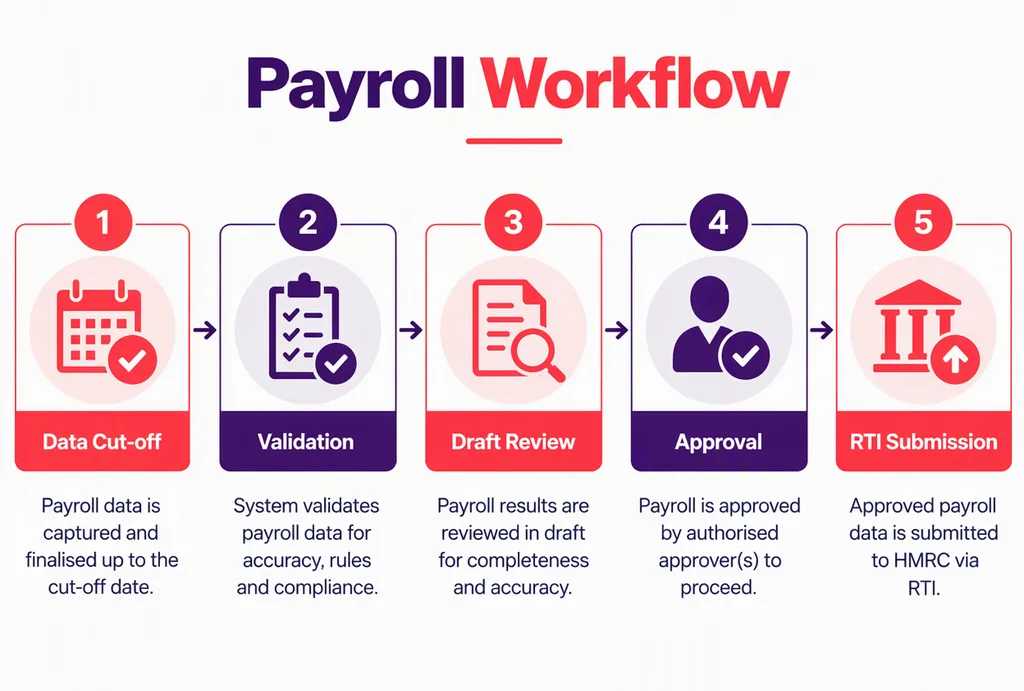
Make HMRC payroll submission deadlines explicit within the operating calendar. Real Time Information, or RTI, is the reporting framework through which payroll information reaches HMRC. A Full Payment Submission (FPS) normally needs to be sent on or before employees’ payday, subject to specified exceptions.
Distinguish reporting from payment. An Employer Payment Summary (EPS) claiming a reduction should reach HMRC by the 19th of the following tax month. Monthly PAYE payments generally fall due by the 22nd, or must reach HMRC by the 19th when paid by cheque through the post.
Work backwards from these requirements to set internal payroll processing deadlines. Require evidence of successful submission, a named owner for rejected files, and immediate escalation where approval delays threaten filing. Agree how bank holidays, changed paydays, and unavailable approvers will be handled; do not let a draft-production target become mistaken for confirmation that reporting is complete.
For a payroll accuracy SLA, ask what the percentage measures: payslips, employees, individual fields, or entire payroll runs. Recommend recording provider-attributable errors separately from incorrect client instructions, while retaining visibility of both. Otherwise, an apparently strong percentage may conceal repeated problems affecting the same client.
Define the correction process alongside the target: who investigates, who approves changes, and when corrected outputs are due. Request a monthly review showing errors, late runs, unresolved queries, and recurring causes. Make prevention part of the discussion, not just the speed of fixing mistakes.
QX Accounting Services is a market leading payroll outsourcing company to UK accountants. We support accounting firms with payroll processing across several frequencies, RTI submissions, pension administration, and reporting. We also set out required client inputs, including payroll data and changes such as starters, leavers, and tax-code notices.
For governance, QXAS’s broader Next-Gen Outsourcing covers four-eyed review and dashboards with SLA and backlog visibility. We provide support with end-to-end payroll management and have expertise spanning 22 years in serving accounting firms.
When considering QXAS, request the proposed payroll SLA and confirm which controls apply to your engagement. Ask for written processing windows, query priorities, accuracy definitions, escalation contacts and remedies. Evaluate the agreed schedule against your client portfolio rather than relying on general service descriptions.

Alongside delivery targets, include the dependencies that make them achievable. Specify client input duties, approval authority, exceptions, reporting, and escalation. Recommend aligning these obligations with your own client engagement terms so the two arrangements do not promise incompatible deadlines.
Ask for a documented turnaround based on a trial using representative payrolls. Confirm whether the promise covers a checked draft or final outputs, and whether amendments restart the clock. Treat any proposed two-working-day schedule as negotiable, not universal.
Negotiate priority-based acknowledgement and update windows. Require the provider to distinguish an automated receipt from substantive action, and test how an urgent query reaches someone authorised to intervene before payroll closes.
When finalising payroll outsourcing services, the agreement should specify the response. Recommend immediate mitigation, documented causes and corrective actions, followed by escalation for repeated failures. Where service credits or termination rights are negotiated, record their triggers and conditions clearly.
Yes: identify the applicable obligations, filing owner and evidence required. Do not suggest that outsourcing transfers the employer’s statutory responsibility; HMRC explicitly retains that responsibility with the employer.
The strongest payroll outsourcing service levels are specific, achievable, and visible. Before committing, check that each deadline has an owner, each metric has a definition, and each failure has a recovery route. A testable agreement is more useful than an impressive promise.

Mitul is a highly experienced UK Payroll professional with over 14 years of expertise in payroll processing, compliance, client management, and team leadership. He is recognised for ensuring seamless compliance with UK payroll regulations and building strong client relationships through the delivery of accurate, high-quality payroll services.
Unauthorized copying or plagiarism of our content is a violation of intellectual property rights. We take such matters seriously and will pursue legal action to protect our original work. Anyone found engaging in such activities will be held accountable under applicable laws.
Explore outsourcing solutions, request a no-obligation trial or discuss your practice’s needs with our expert consultants.





 Book a Virtual Meeting
 Book an In-person Meeting