



Busy season exposes a difficult contradiction for accounting firms. Your team is working at full capacity. Deadlines are approaching. Review queues are growing. Clients need answers. At precisely the point when the firm has the least time for business development, it cannot afford to stop building its future pipeline.
Yet that is what often happens. Marketing activity slows down. Enquiries sit unanswered. Follow-up emails are postponed. Partners tell themselves they will restart business development once the pressure eases.
By then, the pipeline has weakened.
The result is a familiar cycle: intense delivery work during the busy period, followed by anxiety about where the next wave of revenue will come from. Improving your accounting firm pipeline during busy season is therefore not about pushing an already stretched team to sell harder. It is about creating a simpler, more disciplined approach that protects tomorrow’s growth without compromising today’s client work.
Most firms treat busy season as an operational challenge. In reality, it creates three connected risks:
These risks are particularly important in the UK accounting industry that’s already dealing with talent constraints, rising client expectations, and continuing regulatory change. Research highlights a growing finance and accounting skills gap affecting employers, productivity, and talent pipelines.
At the same time, firms are investing more heavily in technology and new service lines. Research covering more than 100 leading accountancy firms found that 75% were investing in cloud accounting, automation, and data analytics. It also reported growing interest in advisory services among small and mid-sized firms.
That creates both an opportunity and a warning.
The opportunity is that clients need more from their accountants. The warning is that firms cannot capture this demand if their accounting firm sales process depends entirely on partners finding spare time between deadlines.
Stopping marketing may provide short-term relief, but it creates a delayed commercial problem.
The prospect who discovers your firm today may not appoint you this week. Their buying process could take several months, particularly for audit, advisory, outsourced finance, or complex tax work. If your visibility disappears for an entire quarter, the impact may not show immediately. It will appear later as fewer enquiries, fewer qualified conversations, and greater pressure to generate work quickly.
Marketing during busy season does not have to mean launching several campaigns or publishing content every day. It means preserving a minimum level of market presence.
That might include:
The goal is continuity, not noise.
Effective busy season pipeline management requires firms to decide what must continue, what can be automated, and what should be paused.
| Pipeline activity | Busy-season approach | Primary owner |
|---|---|---|
| Inbound enquiries | Respond quickly and qualify against agreed criteria | Marketing or business development |
| Existing warm opportunities | Maintain personalised follow-up | Relationship owner |
| Content marketing | Reduce frequency, retain consistency | Marketing team |
| Referral generation | Build into existing client conversations | Partners and client managers |
| Prospect nurture | Use segmented, automated sequences | Marketing |
| Proposals | Prioritise qualified, commercially relevant opportunities | Partner or service-line lead |
| Cold outreach | Focus on a small number of high-fit accounts | Business development |
| CRM management | Update stages, next actions and expected values weekly | Opportunity owner |
This prevents the firm from treating every pipeline activity as equally urgent.
A proposal for a high-fit prospect should not compete for attention with an unqualified website download. Likewise, a warm referral deserves a different follow-up process from a cold contact who has never engaged with the firm.
Also Read: Best Accounting Outsourcing Firms in the UK
A larger accounting firm pipeline is not necessarily a better one. If your pipeline is filled with price-sensitive prospects, poor-fit sectors, or work your team does not have the capacity to deliver, additional accounting firm lead generation UK can make the problem worse.
Before increasing activity, define your ideal opportunities. Consider:
This gives your strategy a clearer focus. Instead of trying to attract every business needing an accountant, you can target organisations with the right needs, complexity, size, and growth profile.
Busy teams need quick decisions. Create a straightforward scoring model using four factors:
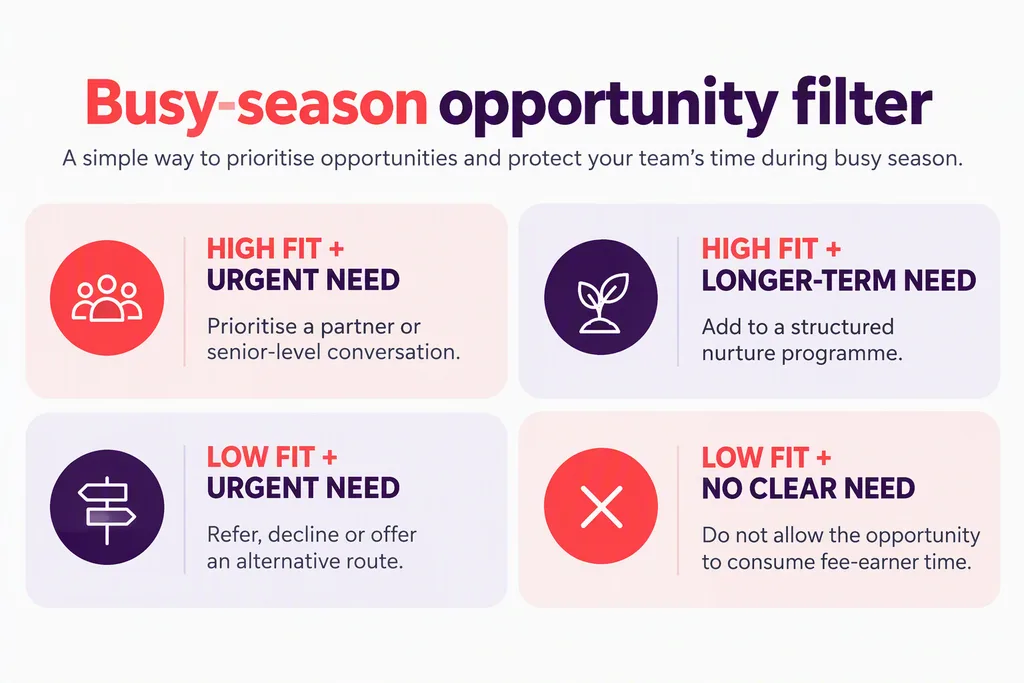
This protects partners from low-value conversations while ensuring strong opportunities do not disappear through slow follow-up.
In many firms, the sales process exists mainly in individual inboxes and personal relationships. Partners remember whom they need to contact, proposals are prepared differently each time, and CRM updates happen only when someone asks for a report.
That approach becomes fragile during busy season.
A more resilient accounting firm sales pipeline should have:
Keep the stages simple. For example:
New enquiry → Qualified → Discovery arranged → Proposal issued → Decision pending → Won or lost
The purpose is not administrative perfection. It is to make sure opportunities keep moving even when senior people are under pressure.
During busy season, prospects are rarely looking for abstract commentary. They want answers to immediate problems.
For example:
Build content around these questions. A useful article, checklist, webinar, or short video can start a commercial conversation without requiring a partner to repeat the same explanation to every prospect.
This is where marketing for accounting firms should work closely with business development. Content should not be created simply to fill a calendar. It should address the concerns appearing in prospect meetings, search queries, client conversations and lost-opportunity feedback.
For stronger visibility in search engines and AI-powered discovery tools, give each page:
The fastest route to pipeline growth may be within your current client base.
Busy season creates frequent client contact, giving firms an opportunity to notice emerging needs. A year-end discussion may expose requirements around forecasting, payroll, management accounts, systems, succession planning or finance transformation.
Equip client managers with a few simple questions:
These are not aggressive sales questions. They encourage a more valuable conversation and can identify opportunities that would otherwise remain hidden.
Generating leads is pointless if prospects wait several days for a response.
Create a busy-season service level for new enquiries. For example:
The initial response does not always have to come from a partner. Marketing or business development teams can acknowledge the enquiry, gather essential information and set expectations.
Speed matters because it signals how the firm is likely to communicate once the prospect becomes a client.
A busy-season dashboard should be short enough to be useful.
Track:
| Metric | What it reveals |
|---|---|
| Qualified opportunities created | Whether marketing is attracting appropriate prospects |
| Enquiry response time | Whether demand is being handled effectively |
| Opportunities without a next action | Where potential revenue is at risk |
| Proposal-to-win rate | The quality of qualification and proposals |
| Average sales cycle | How long opportunities take to convert |
| Pipeline value by service | Where future revenue may come from |
| Source of won business | Which channels deserve continued investment |
| Capacity required if opportunities convert | Whether growth can be delivered sustainably |
Reviewing these measures weekly for 15 to 20 minutes can be more useful than a long monthly sales meeting based on incomplete information.
There is little value in accelerating client acquisition for UK accounting firms if the firm cannot deliver the resulting work.
Capacity planning should therefore sit alongside pipeline planning. For every significant opportunity, ask:
Accounting outsourcing services can help separate firm growth from local recruitment constraints. It can provide scalable support for recurring, process-led work while internal teams focus on reviews, client relationships and advisory services.
The wider market is already moving in this direction. Access to specialised skills was the most frequently cited driver, ahead of cost reduction.
QX Accounting Services helps UK accounting firms build the delivery capacity needed to pursue growth without placing additional pressure on already stretched teams.
By supporting process-driven accounting, tax, audit, bookkeeping and payroll work, QXAS can help firms:
This is the connection firms often miss: pipeline performance is not controlled by marketing alone.
A firm’s operating model determines how confidently it can pursue opportunities. When delivery capacity is more flexible, the firm can keep the accounting firm business development engine running throughout the year rather than repeatedly switching between selling and servicing.
Busy season should not force accounting firms to choose between client delivery and future growth.
The better approach is to build an accounting firm pipeline management system that can continue operating when partner availability falls. That means concentrating on high-fit opportunities, maintaining consistent visibility, responding quickly, using structured nurture activity, and connecting sales decisions to delivery capacity.
The firms that grow sustainably are not necessarily those generating the most leads. They are the firms that know which opportunities to pursue, how to keep them moving and how to deliver the work once they convert.
Your pipeline should not disappear when the workload rises. It should become more focused.
UK accounting firms can generate leads during busy periods by concentrating on activities that do not depend heavily on partner time. These include targeted email nurture campaigns, referral requests, useful search-led content, LinkedIn thought leadership, webinars, and structured follow-up with previous prospects. Marketing teams can qualify initial enquiries before involving fee-earners.
Yes. Accounting firms should continue marketing during busy season, although the frequency and channel mix may need to change. Stopping completely can weaken future pipeline coverage because many prospects take weeks or months to appoint a firm. Prioritise consistent, high-value activity rather than trying to maintain the same volume as quieter periods.
Accounting firms can maintain a healthy pipeline during tax season by defining clear sales stages, assigning an owner and next action to every qualified opportunity, automating longer-term nurture, and holding short weekly pipeline reviews. High-fit, time-sensitive opportunities should receive personal attention, while early-stage prospects can be supported through useful content and email workflows.
Outsourcing marketing can provide consistent campaign execution, content creation, lead nurture, and reporting when internal teams are focused elsewhere. However, an outsourced marketing provider still needs access to the firm’s expertise, positioning, and commercial priorities. Marketing support should complement, not replace, partner involvement in high-value opportunities.
Operational outsourcing can also support pipeline growth by releasing internal capacity for business development and ensuring the firm can deliver new work as opportunities convert.
Ideally, firms should begin building their busy-season pipeline at least three to six months in advance. More complex services may require a longer lead time. Firms should map their typical sales cycle backwards from the desired client start date, allowing sufficient time for awareness, qualification, discovery, proposal development and decision-making.

Pramith Naidu is an accounting and payroll expert with a deep understanding of accounting firms’ challenges. He helps accounting and payroll businesses achieve efficiency and cost savings through customised outsourcing solutions. His focus is on delivering engagement models that address both immediate priorities and long-term goals, enabling firms to streamline operations and drive sustainable growth.
Unauthorized copying or plagiarism of our content is a violation of intellectual property rights. We take such matters seriously and will pursue legal action to protect our original work. Anyone found engaging in such activities will be held accountable under applicable laws.
Explore outsourcing solutions, request a no-obligation trial or discuss your practice’s needs with our expert consultants.





 Book a Virtual Meeting
  Book an In-person Meeting