



Marketing is taking on a more strategic role across the accountancy sector.
Research published in 2025 on accounting-firm marketing budgets found that high-growth firms allocated an average of 2.1% of annual revenue to marketing, excluding compensation, compared with around 1% among slower-growing firms. The research, conducted by Hinge Research Institute and the Association for Accounting Marketing, covered 87 accounting firms and found higher-growth firms investing across digital marketing, SEO, content, events, and thought leadership.
This is why an increasing number of accounting firms are now leaning toward marketing services.
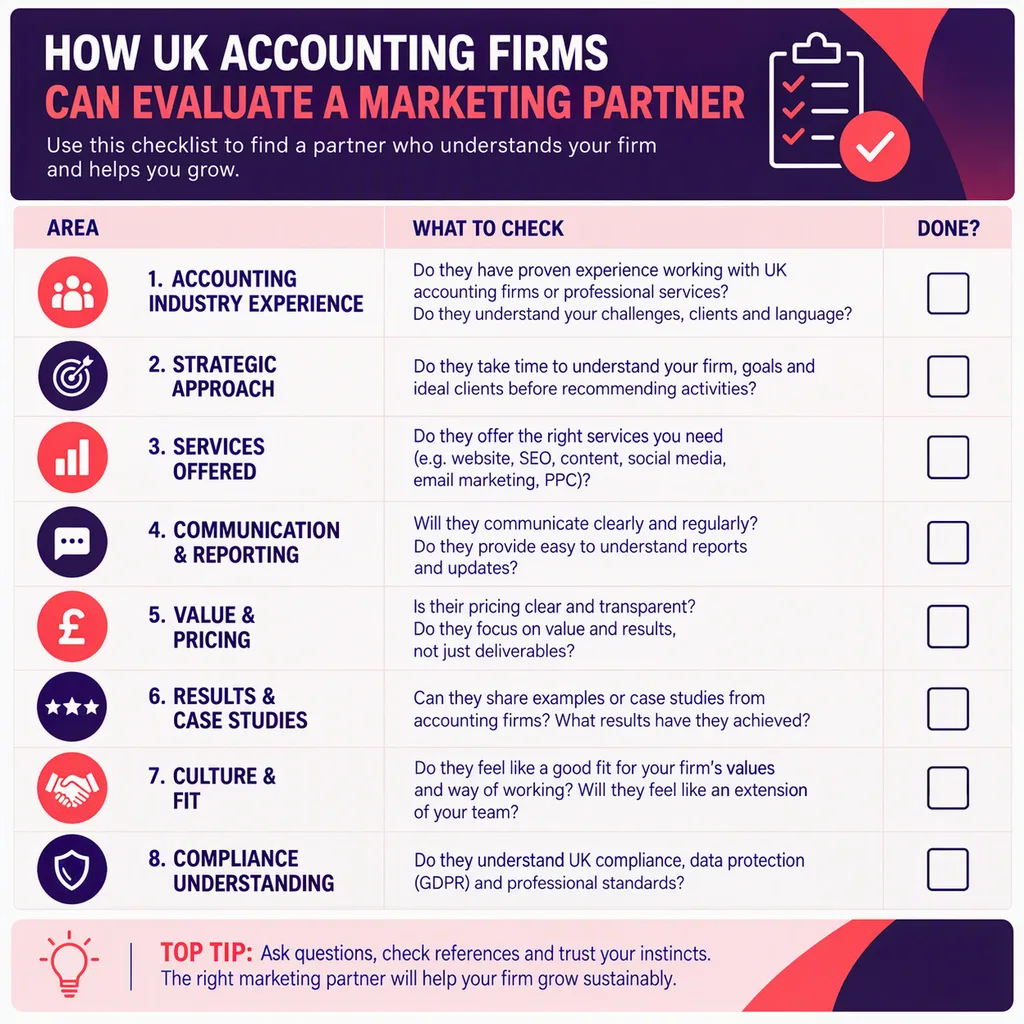
However, choosing an accounting firm marketing partner is very different from hiring someone to redesign a website or post regularly on LinkedIn. The right partner should understand where the firm wants to grow, which clients it wants to attract, how its expertise can be differentiated, and how marketing activity contributes to commercial outcomes.
Let’s explore what accounting firms should look for in a marketing partner.
UK accounting firms should look for a partner with sector knowledge, compliance awareness, clear commercial strategy, transparent reporting, secure data handling, and evidence of relevant results. The right marketing partner for accounting firms UK will understand how partners buy, how SMEs search for advice, and why trust matters more than loud promotion.
The need is practical, not theoretical. In the UK Government’s 2024 SME survey, 78% of SME employers in the professional and scientific sector used technologies or web-based software to sell to customers or manage the business, showing how digital expectations now shape professional services buying behaviour. For accountancy practices, that means marketing has to be visible, useful, and measurable.
An accounting firm marketing agency UK should understand services such as tax, audit, payroll, bookkeeping, advisory, cloud accounting, and outsourced finance. Sector expertise helps avoid weak messaging such as “we save you time” without explaining which client problem is being solved.
Ask:
Red flag: An agency that talks only about impressions, likes or generic “business growth” without discussing fee value, service lines or client fit.
Marketing services for accounting firms UK must respect professional standards, confidentiality, and careful claims. Your partner does not need to act as your regulator, but they should know that accountancy marketing cannot overpromise tax outcomes, guarantee savings, or publish client details casually.
Check for:
Red flag: Pressure to use exaggerated guarantees, copied competitor content, or testimonials without proper permission.
Outsourced marketing for accounting firms can include SEO, paid search, LinkedIn, email campaigns, website optimisation, content marketing for accountants, CRM support, and reporting. The right scope depends on whether your firm wants more local SMEs, specialist sector clients, higher-value advisory work, or recruitment visibility.
Evaluate:
A narrow supplier may be useful for one channel. A broader accounting firm marketing partner should show how every channel supports client acquisition for accounting firms.
A marketing strategy for accounting firms should define audience, positioning, service priorities, channels, budget, responsibilities, and success measures. It should also reflect seasonality, such as tax deadlines, payroll cycles, and year-end pressures.
A practical strategy includes:
Red flag: A proposal that jumps straight to posting on social media without diagnosing your pipeline, website, or proposition.
Good measurement connects marketing activity to commercial outcomes. Look beyond rankings and clicks; ask how leads are qualified, attributed and reviewed with partners.
Useful metrics include:
Ask: “How will you distinguish a student tax query from a serious SME advisory lead?” If they cannot answer, reporting may look tidy but fail commercially.
The technology stack is the set of tools used to manage campaigns, analytics, automation, CRM, and reporting. For digital marketing for accounting firms UK, tools should support insight without creating unnecessary complexity.
Look for:
Red flag: Tools presented as strategy. Software helps, but it does not replace clear positioning or disciplined follow-up.
Case studies should show context, challenge, work delivered, and measurable outcome. For accounting firms, relevance matters more than dramatic numbers from unrelated industries.
Ask for evidence of:
Red flag: Anonymous screenshots, unverifiable claims, or results that depend on a one-off spend your firm would never approve.
Marketing fails when responsibility is unclear. Agree who signs off technical content, who supplies subject knowledge, who monitors enquiries, and who updates the CRM.
Healthy communication includes:
Ask: “What do you need from our partners each month?” If the answer is “nothing”, expect shallow content and weak differentiation.
Marketing partners may charge fixed retainers, project fees, channel-specific fees, or performance-related elements. Fixed retainers suit ongoing SEO, content, and reporting; projects suit websites, audits, or campaign setup.
Compare pricing by asking:
Red flag: Vague bundles with no deliverables, or very cheap packages that rely on templated content.
A contract should protect both sides. Service-level agreements, or SLAs, define expected response times, deliverables, reporting dates, and review points.
Check before signing:
Red flag: Long lock-ins before discovery, or no documented process for missed deliverables.
Strong onboarding turns your firm’s knowledge into usable marketing assets. Expect discovery interviews, access setup, analytics review, competitor scan, message development, and a 90-day action plan.
A good onboarding checklist includes:
Red flag: Campaigns launched before the partner understands your ideal client, fee structure, or internal capacity.
Clarify who owns website assets, copy, designs, landing pages, analytics accounts, keyword research, and campaign data. Your firm should retain access to core marketing assets if the relationship ends.
Ask:
Red flag: An agency that insists on owning your accounts or refuses to provide exportable reporting data.
Client acquisition for accounting firms often involves sensitive enquiry data. Your marketing partner should handle personal data securely and understand UK GDPR obligations.
Check for:
Red flag: Shared logins, unclear data storage locations, or no documented breach process.
For accounting firms considering a more integrated approach to marketing, QX Accounting Services UK can provide outsourced marketing support designed around the needs of the accountancy sector.
The advantage of a specialist approach is context.
Marketing an accounting firm requires an understanding of professional services, the audiences firms want to reach, and the need to turn technical expertise into clear commercial propositions.
QX Accounting Services (QXAS) is a leading marketing partner for UK accounting firms, particularly for practices that want sector-specific support rather than a generalist agency. Our marketing services cover website design and development, SEO, Google Ads, LinkedIn advertising, content, copywriting, and social media for accounting firms.
QXAS also brings wider accountancy outsourcing context. For over two decades, we’ve supported UK accounting firms with outsourced accounting, bookkeeping, tax, payroll, and audit support, with onshore presence in Skipton and London and delivery centres in India. That background may help when aligning marketing messages with real operational capacity, service delivery, and practice growth plans.
Also Read: Top Marketing Companies in the UK for Accounting Firms
The best accounting firm marketing partner combines commercial focus with professional judgement. They should understand UK accountancy, challenge weak assumptions, protect your reputation, and make results visible. If a provider can explain strategy, delivery, ownership, data protection and ROI in plain English, they are far more likely to become a useful growth partner than another supplier chasing clicks.
There is no single benchmark that applies to every UK accounting firm. Costs depend on the firm’s size, growth objectives, required marketing capabilities, target audience, and the balance between in-house and outsourced resources. External benchmark research indicates that marketing investment can vary significantly between accounting firms, with higher-growth firms in one 2025 study allocating a greater percentage of revenue to marketing than slower-growing firms.
Rather than selecting a budget arbitrarily, start with the commercial objective and work backwards to determine the investment required.
For many firms, specialist industry knowledge can be a significant advantage. A partner familiar with accounting services is more likely to understand complex propositions, professional-services buying journeys, and the importance of technical credibility.
However, sector expertise alone is not enough. Firms should also evaluate strategic capability, creative quality, digital expertise, reporting, and commercial understanding.
Common areas suitable for outsourcing include SEO for accounting firms, content creation, campaign management, digital marketing, social media, email campaigns, creative production, website content, and lead generation.
The right mix depends on what capabilities already exist internally. Outsourcing should fill expertise or capacity gaps rather than duplicate them.
Start by agreeing the objective of each programme and defining corresponding measures.
Track performance from visibility and engagement through to enquiries, qualified leads, sales opportunities, and new clients wherever reliable attribution is possible. Avoid judging performance entirely through metrics such as impressions, followers, or traffic.
Marketing ROI should ultimately be discussed in the context of pipeline and sustainable firm growth.
Both models can work. An in-house team offers proximity to the business and deep institutional understanding. An outsourced partner can provide access to a wider range of specialist skills without requiring the firm to recruit individually across strategy, SEO, content, campaign management, and creativity.
Many firms may benefit from a hybrid approach, with internal leadership or coordination supported by specialist outsourced expertise.
Test their understanding before appointing them. Ask about the sectors and services they have marketed, review relevant work, and pay particular attention to the questions they ask about your business.
A strong specialist should want to understand your service mix, priority markets, ideal clients, competitors, growth objectives, business-development process, and technical subject matter before proposing campaigns.

Unauthorized copying or plagiarism of our content is a violation of intellectual property rights. We take such matters seriously and will pursue legal action to protect our original work. Anyone found engaging in such activities will be held accountable under applicable laws.

29 September 2026

25 September 2026
Explore outsourcing solutions, request a no-obligation trial or discuss your practice’s needs with our expert consultants.



 Book a Virtual Meeting
  Book an In-person Meeting