



Most partners are under pressure to deliver more tax work with limited internal capacity, especially around Self Assessment and other deadline-heavy periods. A clear tax preparation service level agreement helps you set expectations before work starts, so your team, your clients, and your personal tax outsourcing partner understand what “good” looks like.
This article explains outsourced tax preparation SLAs, the metrics to include, and how UK firms can manage tax outsourcing service levels without creating unnecessary administration.
Outsourced tax preparation SLAs should turn a broad outsourcing arrangement into measurable working rules: what will be prepared, when it will be delivered, how quality will be checked, and what happens if standards are missed. For accounting firms in the UK, that matters because tax compliance is volume-sensitive and deadline-driven.
HMRC reported that more than 11.48 million people filed 2024 to 2025 Self Assessment returns by 31 January, with more than 12 million expected to file overall.
An SLA is not just a legal appendix. It is an operating document for partners, managers, reviewers, and the outsourced team. Done well, it reduces ambiguity around client records, workpaper formats, review notes, software access, data handling, status updates, and escalation routes.
UK tax compliance remains a significant workload for firms and their clients. ICAEW reported that business tax compliance costs £15bn a year, including £6.6bn in fees paid to agents, accountants and other intermediaries. That pressure helps explain why tax outsourcing SLAs for accounting firms are becoming more detailed. Firms surely need capacity, but they also need control.
There is also a market shift towards external delivery models. ICAEW research on mid-tier firms found that half of respondent firms had already outsourced or offshored at least one service line, commonly including accountancy, tax, audit, and payroll.
Meanwhile, Making Tax Digital (MTD) for Income Tax is live for sole traders and landlords with qualifying income over £50,000, followed by lower thresholds in later years, adding quarterly digital reporting duties for many clients.
For a practice, the practical implication is simple: outsourced tax preparation SLAs must be specific enough to support growth, deadline control, and client service, while leaving room for genuine complexity.
An SLA for tax preparation outsourcing services should cover the full delivery cycle, not only the final return. The best agreements define inputs, outputs and dependencies, because outsourced teams can only meet deadlines when records, queries, and approvals move on time.
| SLA component | What to define | Why it matters |
|---|---|---|
| Scope of work | Return types, schedules, computations, working papers and exclusions | Prevents assumptions about advisory, filing or client contact |
| Turnaround bands | Standard, complex and urgent work categories | Sets realistic tax preparation turnaround time expectations |
| Quality review | Review levels, sampling, sign-off and rework process | Supports tax quality and accuracy standards |
| Client data requirements | Record format, missing information process and cut-off dates | Reduces avoidable delays |
| Communication | Channels, status updates, query format and response times | Keeps managers informed without constant chasing |
| Escalation | Named contacts, severity levels and resolution times | Gives both sides a route for blocked work |
| Security | Access controls, confidentiality and data transfer rules | Protects client information and firm reputation |
| Capacity | Peak-season volume, notice periods and surge planning | Avoids last-minute capacity surprises |
This table can also be used as a pre-signature checklist. If a provider cannot explain how each point works in practice, the SLA may be too vague to manage.
Outsourced tax preparation KPIs should show whether work is being delivered on time, to the right standard, and with manageable levels of review effort. They should be tracked consistently, but not in a way that encourages the wrong behaviour. For example, measuring only speed may push incomplete work into review, while measuring only error rates may hide bottlenecks.
| KPI | Definition | Example SLA use |
|---|---|---|
| On-time delivery rate | Percentage of jobs delivered within the agreed turnaround band | Track by return type and complexity |
| First-review acceptance | Percentage of jobs requiring no significant rework after firm review | Measures preparation quality, not just completion |
| Query ageing | Average time queries remain unresolved with either party | Highlights client-record or communication bottlenecks |
| Rework rate | Percentage of jobs returned for correction after review | Supports continuous improvement and training |
| Peak-capacity fulfilment | Ability to handle agreed seasonal volumes | Tests whether resource planning matches promises |
| Status reporting compliance | Whether agreed reports are sent on time and in the agreed format | Keeps workflow visible |
These tax outsourcing performance metrics should be reviewed by portfolio, preparer group, and deadline period. A single average can hide important differences between straightforward returns and complex cases with overseas income, capital gains, rental schedules or incomplete records.
Tax quality and accuracy standards should be written in practical language. Rather than saying work must be “accurate”, the SLA should define required checks: reconciliation to source records, prior-year comparison, reasonableness review, disclosure notes, software diagnostics, reviewer comments, and evidence retained in the working paper file.
The agreement should also separate provider errors from client-side or firm-side issues. Missing bank statements, late P60s, unclear bookkeeping, or delayed answers to queries can all affect delivery. A fair SLA records dependencies, so missed deadlines are investigated before being counted as failures.
Accuracy targets should be paired with a correction process. The SLA can define how rework is logged, how quickly corrections should be completed, who decides whether a point is material, and how recurring issues feed into training. That makes the document a management tool, not a blame mechanism.
There is no single correct tax preparation turnaround time for every engagement. A simple employment and bank-interest return is different from a landlord with multiple properties, disposals, pension adjustments, and late records. Your SLA should therefore define turnaround bands by complexity and by the moment the clock starts.
A useful approach is to state that turnaround begins only when the provider has complete records, access to the relevant software, prior-year files, standing data, and clear preparation instructions. You can then add separate response-time expectations for queries, review notes, and urgent deadline cases. This prevents disputes where work is “with outsourcing” but blocked by missing information.
SLA governance should include a reporting cadence, exception review, and route for improvement. Weekly reporting may suit peak season, while monthly reviews may be enough outside deadline periods. Reports should show work received, work completed, work in query, overdue items, quality points, and capacity outlook.
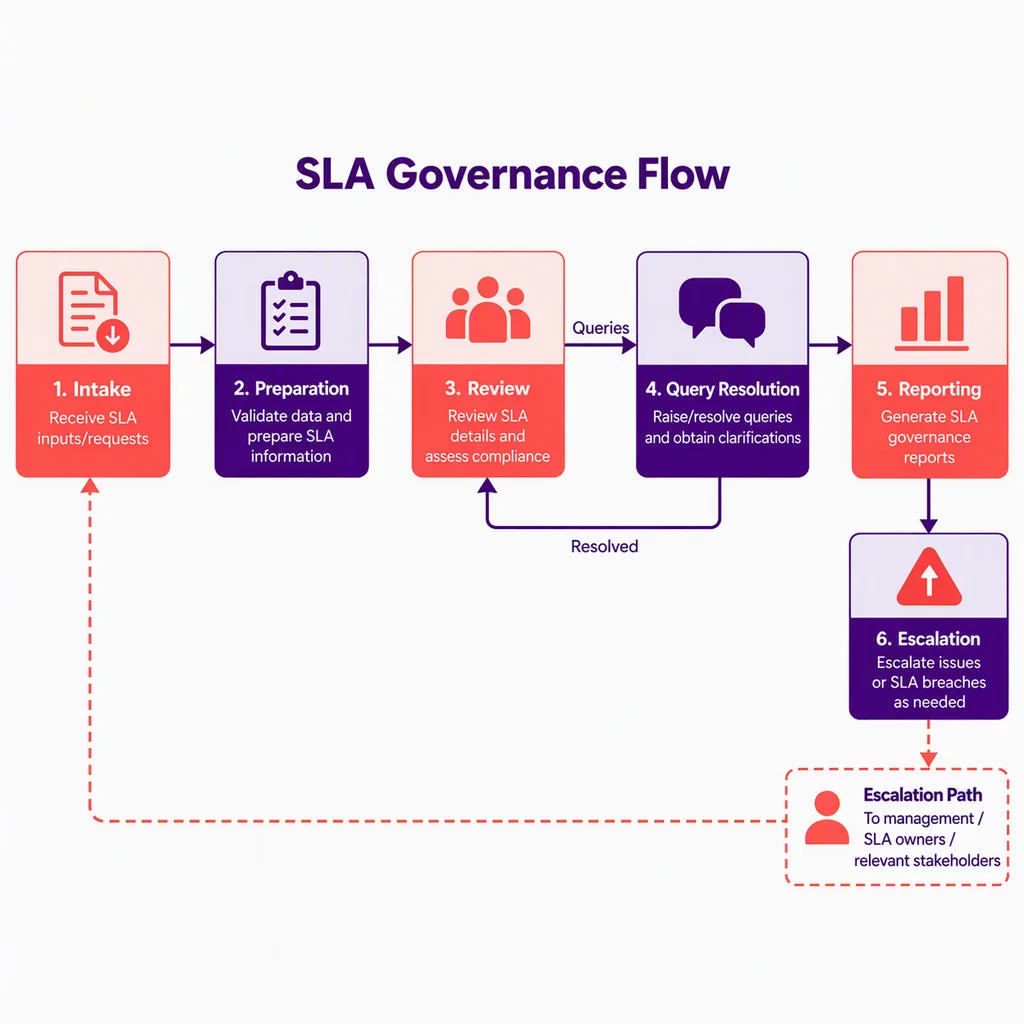
This is a useful place to insert a simple infographic showing the SLA governance cycle: work intake, preparation, first review, query resolution, delivery, KPI reporting, escalation, and process improvement. The aim is to help managers see where control sits at each stage, rather than treating outsourcing as a black box.
Also Read: Top Personal Tax Outsourcing Companies for UK Accounting Firms: What Makes Them Stand Out?
Common SLA Mistakes to Avoid
Many firms make the SLA too narrow. They define deadline promises but not input quality, review responsibilities or escalation rules. That leaves managers to resolve issues informally when volume rises.
Other common mistakes include:
A good tax outsourcing SLA is balanced. It protects the firm’s client service standards while recognising that outsourced teams need complete information, stable processes, and timely feedback to perform well.
How QX Accounting Services UK prepares and handles SLAs for smooth onboarding should be understood as a structured operating process. Discovery comes first: the firm and provider clarify return types, volumes, software, workflows, review responsibilities, client-record standards, and seasonal deadlines.
The next step is defining metrics. This usually includes turnaround bands, review outcomes, query response expectations, reporting fields, and escalation points. A reporting cadence is then agreed, such as weekly operational updates during busy periods and less frequent reviews outside peak season.
Pilots can help test the SLA before larger volumes move across. A pilot allows both sides to check file quality, instruction clarity, review comments, communication channels, and practical tax outsourcing service levels. Capacity planning should then map expected volumes against preparer availability, deadline peaks and notice periods for additional work.
Communication protocols should be documented during onboarding. That includes who raises queries, who approves responses, how exceptions are logged, and when unresolved issues move to escalation. The purpose is to reduce handover friction and make performance measurable from the beginning.
Outsourced tax preparation SLAs are most valuable when they are specific, measurable, and actively governed. UK accounting firms should expect clear service levels, transparent reporting, practical quality controls, and agreed routes for handling exceptions. The aim is not to create paperwork; it is to make outsourced tax preparation predictable enough to support deadlines, review quality and client confidence.
Accounting firms must include scope, return types, turnaround bands, review standards, data requirements, communication rules, escalation routes, confidentiality, reporting cadence, and capacity commitments in outsourced tax preparation SLAs. It should also define dependencies, so delays caused by missing records or late approvals are handled fairly.
Useful KPIs include on-time delivery, first-review acceptance, rework rate, query ageing, reporting compliance, and peak-capacity fulfilment. These outsourced tax preparation KPIs should be reviewed alongside qualitative feedback from managers.
Turnaround times should vary by complexity, completeness of records, and seasonal demand. Firms should agree separate bands for simple, standard, complex and urgent work, with the clock starting only once complete information is available.
SLAs should define preparation checks, review stages, rework handling, and how errors are classified. They should also distinguish provider mistakes from issues caused by missing client information or changed instructions.
The SLA should require root-cause review, corrective action and escalation where needed. Remedies may include revised workflows, additional training, closer review, capacity adjustment, or formal service review meetings.
Yes. Peak-season capacity commitments help firms plan around January deadlines, Corporation Tax peaks, and internal review bottlenecks. The SLA should state expected volumes, notice periods, surge support, and any limits on urgent work.

Namrata is an Accounting and Learning & Development professional with over 10 years of experience in the outsourcing industry, specialising in UK bookkeeping, VAT, final accounts, and taxation. She is proficient in a wide range of accounting software, ensuring accurate and efficient financial solutions. With nearly 2 years of hands-on experience in Learning & Development, she also contributes to employee training, skill enhancement, and process improvement strategies aligned with organisational goals.
Unauthorized copying or plagiarism of our content is a violation of intellectual property rights. We take such matters seriously and will pursue legal action to protect our original work. Anyone found engaging in such activities will be held accountable under applicable laws.

25 September 2026
Explore outsourcing solutions, request a no-obligation trial or discuss your practice’s needs with our expert consultants.

![Two business colleagues discuss at a wooden table, each using a laptop in a sunlit office.]','Two men in smart casual and a suit work together on laptops at a conference table.]','Co-workers collaborating on a project in a modern office with large windows.]','Two professionals reviewing data on their laptops during a meeting at a glass-topped table.]','Business partners discussing strategy at a table by windows in a bright office.](https://qxaccounting.com/uk/wp-content/uploads/sites/2/2026/09/Questions-to-Ask-Before-Choosing-a-Tax-Outsourcing-Partner.webp)


 Book a Virtual Meeting
  Book an In-person Meeting