



Personal tax is no longer just a compliance service for accounting firms. It is the annual pressure test of their operational capacity.
Every year, firms face the same challenge. Self Assessment deadlines approach, client information arrives late, workloads spike dramatically, experienced tax staff become difficult to recruit, and partners find themselves drawn back into production work instead of focusing on advisory relationships and business growth.
The numbers illustrate the scale of the challenge. HMRC expected more than 12 million Self Assessment returns for the 2024/25 tax year, with 11.49 million returns submitted by the 31 January deadline. Additionally, 475,722 taxpayers filed on the final day alone, highlighting the concentrated nature of tax season workloads.
Use up and down arrow keys to resize the meta box pane.
At the same time, firms continue to face ongoing talent shortages, rising salary costs, and increasing compliance expectations.
This is why more firms are turning to personal tax outsourcing services not simply as a cost-saving exercise, but as a strategic capacity solution.
Use up and down arrow keys to resize the meta box pane.
However, not all personal tax outsourcing companies UK are created equal.
Choosing the wrong provider can create quality issues, review bottlenecks, security concerns, and client dissatisfaction. Choosing the right personal tax outsourcing partner can help your firm increase capacity, maintain quality, reduce stress during tax season, and improve profitability.
This guide explains exactly how UK accounting firms should evaluate and select a tax outsourcing partner.
The outsourcing conversation has changed significantly over the last decade.
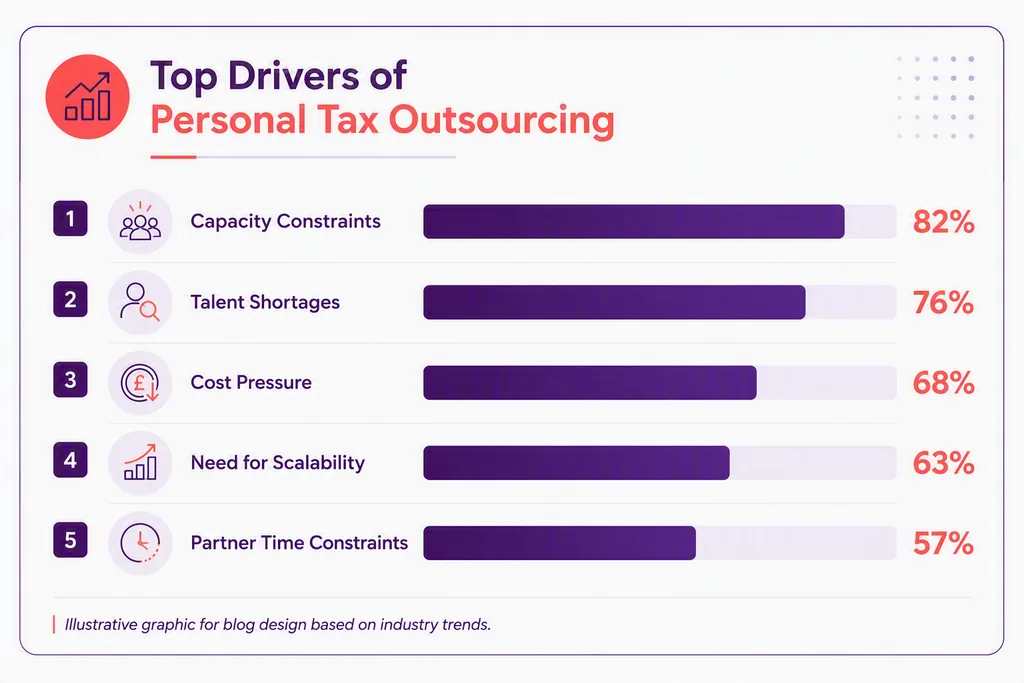
Historically, outsourcing was primarily associated with reducing costs. Today, it is increasingly used to solve capacity constraints.
According to ICAEW research, 50% of surveyed mid-tier firms have already outsourced or offshored at least one service line, while offshore chargeable hours among participating firms increased by 86% over three years.
The primary drivers include:
A capable provider should support the full spectrum of outsourced personal tax preparation UK services.
| Service | Outsourcing Suitability |
|---|---|
| SA100 Preparation | ✅ Excellent |
| Property Income Schedules | ✅ Excellent |
| Dividend Income Calculations | ✅ Excellent |
| Capital Gains Calculations | ✅ Excellent |
| Partnership Returns | ✅ Excellent |
| Foreign Income Disclosures | ✅ Excellent |
| Tax Computations | ✅ Excellent |
| HMRC Query Support | ✅ Excellent |
| Final Sign-Off & Client Advice | ❌ Retain In-House |
A strong personal tax outsourcing partner enhances, rather than replaces, partner oversight.
Self Assessment tax preparation outsourcing is not simply a cost exercise. Used properly, it is a capacity strategy: it releases senior staff from lower-value preparation tasks, allows managers to focus on technical review and client conversations, and gives partners more confidence when accepting additional work close to the filing deadline.
The staffing context matters. ICAEW’s 2025 research into mid-tier accountancy firms noted that 56% of firms placed recruiting qualified staff among their top three talent challenges, although fewer firms named it their single top challenge than in 2024.
ICAEW has also described outsourcing and offshoring as embedded in how many firms of different sizes now operate.
That does not mean every return should be outsourced, nor that every provider is suitable. The point is to segment the work. Straightforward employment, pension, dividend, rental, sole trader, and partnership returns may be well suited to outsourced personal tax preparation UK support where the process is clear and the review trail is strong.
More judgement-heavy matters, such as complex residency, remittance basis, disclosures, significant capital gains, or enquiry work, may still be prepared in-house or allocated only to a proven senior outsourced team.
The firms that benefit most are usually those that define the model before the pressure starts. They agree which return types are in scope, what information must be complete before a job is released, what review points must be escalated, and who owns client communication.
That discipline turns personal tax return outsourcing into an extension of the practice rather than an emergency January workaround.
Tax outsourcing partner selection should be run with the same rigour you would apply to hiring a senior tax manager or onboarding a critical software platform. The provider will handle confidential data, affect client experience, and influence whether your team can sustain quality at peak times.
Start with the work itself. A credible personal tax outsourcing partner should be able to explain which Self Assessment return types it handles, which supplementary pages it prepares, and where it would expect escalation or specialist review. Ask for examples of checklists, information request templates, review notes, and exception logs.
Coverage should ideally include common personal tax services for accounting firms, such as:
The important point is not that every provider handles every scenario. It is that the boundaries are explicit. Ambiguity creates rework, and rework is precisely what outsourcing is meant to reduce.
Secure personal tax outsourcing is non-negotiable because Self Assessment records contain payroll details, bank interest, dividends, property income, National Insurance data, UTRs, addresses, and sometimes highly sensitive personal circumstances. Under UK GDPR, the ICO says that whenever a controller uses a processor, there must be a written contract or other legal act in place. Controllers should use processors that can provide sufficient guarantees around appropriate technical and organisational measures.
Your due diligence should therefore go beyond “are you GDPR compliant?” Ask to see the data processing agreement, sub-processor policy, breach notification process, access controls, data retention rules, and deletion procedures. If work is performed offshore, ask how international transfers are addressed, who can access data, and whether staff use named accounts, MFA, restricted devices, and monitored environments.
For accounting firms, the practical test is simple: could you explain this arrangement confidently to a client, your professional body, and the ICO if challenged? If the answer is no, the security evidence is not yet strong enough.
A good outsourced model should make review easier, not harder. You need to understand how the provider checks source documents, flags missing information, documents assumptions, and records judgement points. A “four-eyed” process, senior review, or manager sign-off can be valuable, but ask what those terms mean in practice.
Look for quality controls such as:
Your internal team should still perform final review before client approval or filing. Outsourcing does not remove professional responsibility; it gives your firm a prepared file, computation, and supporting schedule that can be reviewed efficiently.
Many personal tax outsourcing companies UK firms consider will claim to work with leading software. The question is whether they can work with your configuration, your naming conventions, your document portal, your tax return status codes, and your review process.
Before signing a full-season contract, ask for a pilot using your live process. Include the systems your team actually uses, such as your tax production software, document management platform, practice management workflow, secure portal, and communication channels. If the provider has to work through remote access, confirm security arrangements and permissions.
If they use their own portal, confirm how your firm retrieves files, audit trails, tax summaries, and query histories.
Scalable tax preparation support is useful only if it remains controlled. Your partner should be able to explain how it adds preparers, supervises new team members, manages peak demand, and protects turnaround times. It should also be honest about cut-off dates, minimum information standards, and the volume it can handle without compromising review quality.
A common mistake is to outsource too much too late. A stronger approach is to phase the work. Start with a defined return population, review performance, refine checklists, then increase volume. This gives both teams time to learn each other’s expectations before January intensity arrives.
You should run due diligence through a structured evaluation covering technical ability, data protection, operational resilience, service governance, commercials, and cultural fit. The aim is not to find the cheapest provider; it is to find the provider whose work you would be comfortable putting through your firm’s review and client approval process.
Use the following checklist before appointing any personal tax outsourcing companies in the UK:
A partner who performs well in a controlled pilot is more valuable than a provider with an impressive sales deck. Tax season exposes weak processes quickly, so your selection process should expose them early.

Personal tax outsourcing UK providers typically offer one or more engagement models. Some work on a per-return basis, which can suit firms with seasonal spikes or clearly defined return categories. Others offer dedicated resource or managed FTE-style models, which may suit firms with recurring volumes, mixed accounting and tax work, or a desire to build a stable extended team.
For partners, the commercial assessment should not stop at headline cost per return. Consider the whole economics of tax season: manager review time, senior overtime, recruitment fees avoided, write-offs reduced, and the opportunity cost of partners being pulled into preparation work. A low preparation fee is not attractive if it generates extensive rework or damages client confidence.
Ask providers to clarify:
The best commercial model is usually the one that mirrors your workflow and client mix. If your firm has a high volume of straightforward returns, per-return pricing may provide useful flexibility. If your firm wants year-round support across tax, bookkeeping and accounts, a dedicated team model may give better continuity.
Successful outsourced personal tax preparation UK work depends on implementation. A poor handover can make a strong provider look weak; a disciplined onboarding process can help even a new relationship become productive quickly.
Begin by nominating an internal owner. This might be a tax manager, operations manager, or partner responsible for personal tax. That person should approve workflows, resolve escalation points, and ensure feedback is captured. Without a clear owner, outsourced work can sit between departments, creating avoidable delays.
Next, standardise the information pack. At minimum, each outsourced return should include prior-year return and computation, current-year source documents, client questionnaire, coding notices if relevant, pension and employment details, property schedules, dividend vouchers or investment reports, and notes of known advisory points. If information is incomplete, decide whether the job should be held back or sent with a specific query list.
Finally, set review expectations. Your reviewer should know what the outsourced preparer has checked, what assumptions have been made, and what items require partner attention. That makes the review process focused rather than forensic.
Not every outsourcing arrangement is suitable for a professional practice. Some risks show up before the contract is signed if you know where to look.
Be cautious if a provider:
The largest risk is not outsourcing itself. The risk is outsourcing without governance. A well-controlled provider can support margin, morale, and client service; a poorly controlled provider can create exactly the January pressure it was meant to solve.

For firms evaluating personal tax outsourcing companies, experience matters.
QX Accounting Services has specialised in supporting UK accounting firms for more than two decades and works exclusively within the accounting profession.
QX supports:
Most importantly, QX is designed specifically for accounting firms rather than general business outsourcing.
Making Tax Digital for Income Tax changes the operational picture for many firms. Currently applicable for for clients with qualifying self-employment and property income over £50,000, it will extend from 6 April 2027 for those over £30,000, and from 6 April 2028 for those over £20,000, subject to the detailed rules and notices.
HMRC also said around 780,000 self-employed individuals and landlords would be required to use MTD from April 2026, with a further 970,000 joining from April 2027.
This matters for outsourcing because the compliance burden is moving from one annual deadline towards more regular digital record keeping and submissions for affected clients. A personal tax outsourcing partner that only thinks in terms of January SA100 production may not be enough. Firms should ask how the provider can support quarterly update preparation, bookkeeping quality, digital links, software workflows, and annual finalisation.
MTD also strengthens the case for earlier client segmentation. Identify landlords and sole traders likely to enter MTD, assess their record-keeping habits, and decide whether your outsourced model should include pre-year-end data cleaning or bookkeeping support. If you wait until the annual return stage, many of the efficiency gains may already have been lost.
Finding the right personal tax outsourcing partner is one of the most important operational decisions an accounting firm can make.
The right personal tax outsourcing partner should feel like a controlled extension of your tax department. It should give your managers cleaner files to review, your clients a smoother January experience, and your partners more confidence in the firm’s capacity plan.
Choose slowly before the season so you can move quickly during it. Define the work, test the provider, scrutinise security, agree governance, and keep final review inside the firm.
Done well, personal tax outsourcing services can help UK accounting firms protect quality, build resilience, and create the capacity needed for both Self Assessment and the wider shift towards digital tax compliance.
Accounting firms should evaluate technical UK tax expertise, quality control processes, HMRC compliance knowledge, data security certifications, technology compatibility, scalability, communication standards, and industry experience supporting UK accounting firms.
Review their quality assurance framework, accuracy rates, review processes, SLA performance, client references, escalation procedures, and experience handling complex tax returns.
Ask how the provider monitors HMRC updates, trains staff, manages technical reviews, documents workflows, and supports compliance across Self Assessment, CGT, partnerships, overseas income disclosures, and other specialist areas.
At a minimum, your personal tax outsourcing partner must meet the below data security standards:
Confirm compatibility with IRIS, TaxCalc, CCH, Digita, Capium, Xero, workflow platforms, document management systems, and collaboration tools used by your firm.
Look beyond pricing. Compare savings from reduced recruitment costs, improved turnaround times, increased capacity, higher staff utilisation, better client retention, and additional advisory opportunities.
QX Accounting Services combines UK tax expertise, scalable resource models, secure infrastructure, extensive accounting firm experience, robust quality controls, and flexible engagement options designed specifically for accounting firms managing personal tax workloads.

Dinesh is a seasoned accounting and tax professional with more than 20 years of experience, specialising in UK personal tax. He has a proven track record of streamlining tax processes and building strong client relationships, consistently delivering accurate and compliant taxation services tailored to client needs.
Unauthorized copying or plagiarism of our content is a violation of intellectual property rights. We take such matters seriously and will pursue legal action to protect our original work. Anyone found engaging in such activities will be held accountable under applicable laws.
Explore outsourcing solutions, request a no-obligation trial or discuss your practice’s needs with our expert consultants.





 Book a Virtual Meeting
 Book an In-person Meeting