



Ask almost any audit leader about the constraints on growth in 2026, and people will quickly enter the conversation.
The UK is not necessarily “running out of auditors” in the simplest sense. But there is growing pressure on the availability and distribution of experienced audit talent.
In July 2026, ICAEW reported industry concerns about a shrinking number of firms with the scale, staff and resources required for complex audits, particularly public interest entity audits, while demand for large-scale international audit continues to increase.
That distinction matters. The audit staffing shortage UK firms are experiencing is no longer just about unfilled vacancies. It is about capacity.
Can firms mobilise enough appropriately skilled people when engagements peak? Can managers review work without becoming bottlenecks? Can partners protect enough time for judgement, risk and client conversations? Can firms grow their audit portfolios without asking already stretched teams to continually absorb more?
These questions are turning audit capacity management from an HR consideration into a strategic priority. More firms are therefore deciding to outsource audit support services to achieve scale effortlessly.
The defining audit talent question of 2026 is shifting from “How many people can we recruit?” to “How much reliable audit capacity can we build?”
| Pressure | What firms are experiencing | Operational consequence |
|---|---|---|
| Experienced talent shortage | Difficulty securing senior and manager-level people | Review and supervision bottlenecks |
| Recruitment competition | Multiple firms competing for a constrained talent pool | Longer hiring cycles and greater recruitment pressure |
| Retention challenges | Experienced professionals have wider career choices | Loss of institutional knowledge |
| Seasonal workload | Engagement volumes converge around peak periods | Overtime and deadline pressure |
| Increasing complexity | Audit teams require broader technical and technology capabilities | Greater dependence on experienced staff |
| Growth ambitions | Firms want to win additional work | Capacity becomes a constraint on growth |
| Technology transition | AI and automation are changing traditional audit work | Firms must rethink roles and skills |
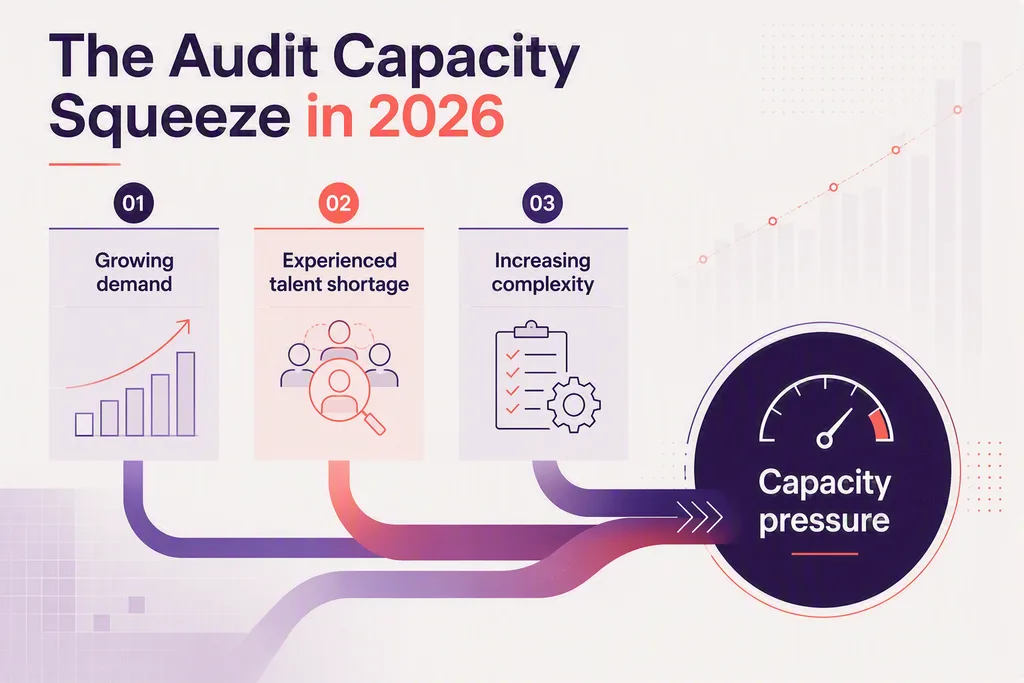
It is tempting to consider today’s audit recruitment challenges as another hiring cycle. But that potentially underestimates the problem.
A structural shortage emerges when several forces collide simultaneously. Talent supply, career expectations, technology, workload, and demand are all changing at once.
In the wider UK accountancy recruitment market, a June 2026 recruitment analysis described Senior, Assistant Manager, and Manager vacancies as particularly difficult to fill. That creates an important capacity problem.
You cannot simply compensate for a shortage of managers by adding more junior employees. More juniors can actually increase the requirement for coaching, supervision, and review if experienced capacity does not grow alongside them.
The issue therefore looks less like a conventional recruitment funnel and more like a skills pyramid under pressure.
| Level | Primary value | Risk when understaffed |
|---|---|---|
| Partner / RI | Judgement, risk, sign-off, client leadership | Partner overload |
| Manager | Review, coordination, technical oversight | Engagement bottlenecks |
| Senior | Execution, supervision, issue resolution | Delivery delays |
| Associate | Testing, documentation, core audit work | Insufficient production capacity |
| Technology / AI | Automation, analysis, workflow acceleration | Manual work consumes skilled capacity |
The greatest danger occurs when the middle of this pyramid becomes constrained.
The obvious consequence of a shortage of qualified auditors is difficulty filling vacancies. The less obvious consequence is what happens to everyone who remains.
When capacity falls below workload, work does not disappear. It moves. Junior team members take on more responsibility. Managers spend additional time reviewing and resolving issues. Senior managers become operational problem-solvers. Partners get pulled further into execution.
Eventually, expensive senior capacity gets consumed by tasks that could have been completed elsewhere.
This creates what I would call the Audit Capacity Cascade:
Vacancy → Workload redistribution → Manager bottleneck → Partner intervention → Reduced strategic capacity
That last stage matters. When partners have to repeatedly step into delivery, the cost is not limited to additional hours. The firm also loses time that could have gone into:
The true cost of the audit talent shortage therefore cannot be measured through recruitment costs alone. It should also be measured through lost organisational capacity.
For many firms, capacity affects more than existing engagements. It affects what comes next.
Consider a firm presented with a significant new audit opportunity. Commercially, the engagement may be attractive. Technically, the firm may have exactly the right expertise.
But one question can stop the opportunity progressing: Who is actually going to deliver it?
ICAEW’s July 2026 discussion of the profession highlighted the tension between growing demand for large-scale international audit and a narrowing number of firms equipped with sufficient scale, staff and resources to deliver complex engagements. This changes the economics of growth.
A full pipeline means relatively little if the firm cannot translate demand into deliverable capacity. That is why leading firms should begin monitoring capacity alongside traditional commercial metrics.
| Metric | Question it answers |
|---|---|
| Available hours by grade | Where do we genuinely have capacity? |
| Utilisation by grade | Which levels are approaching overload? |
| Review hours per engagement | Where are review bottlenecks forming? |
| Overtime during peak periods | Is demand being absorbed sustainably? |
| Vacancy duration | How exposed are we to recruitment delays? |
| Staff turnover | Are we continually rebuilding capability? |
| Outsourced capacity available | How quickly can delivery capacity flex? |
| Partner hours spent on delivery | Is senior capacity being used effectively? |
This is a more strategic view of audit capacity management.
Recruitment will always be important to audit firms. The mistake is assuming every capacity problem needs a permanent employee. Permanent hiring works extremely well where demand is stable and predictable. Audit workloads, however, are rarely perfectly level.
Consider the implications of solving every peak with permanent recruitment. When volumes rise, the firm needs additional employees immediately. But recruitment takes time. New employees require onboarding. When workload normalises, some of that additional capacity may no longer be required.
The commercial challenge is therefore straightforward: Fixed teams are being asked to absorb variable workloads.
That mismatch creates recurring pressure.
A stronger model separates the capacity problem into four components:
Once leaders make these distinctions, the conversation changes. It stops being exclusively about recruitment. It becomes workforce architecture.
Recruiting someone solves today’s vacancy. Retaining them helps solve tomorrow’s capacity problem. That is why audit talent retention must sit alongside recruitment in any serious workforce strategy. Firms should examine what experienced auditors spend their time doing.
If managers routinely spend hours chasing documentation, correcting preventable errors or completing activities that could be handled elsewhere, adding another manager may relieve the symptom without redesigning the system.
A more sustainable model protects scarce experienced talent for work requiring:
Automation or appropriately structured outsourced audit support can then absorb suitable repeatable and process-driven activities.
This is not simply a resourcing decision. It is a talent retention strategy because it changes the nature of the work experienced people are being asked to perform.
For firms dealing with persistent capacity constraints, audit staff outsourcing UK models offer another source of capability.
But outsourcing works best when firms stop viewing it purely as “additional people”.
The stronger question is:
Which parts of our audit delivery model genuinely need to happen inside our existing local team, and which can be delivered through a controlled extended team?
QX Accounting Services’ next-generation approach to audit outsourcing already reflects this shift towards a managed approach combining people, workflow, and quality controls rather than treating outsourcing purely as additional headcount. We provide a managed audit model built around UK-trained resources, workflow planning, and review processes.
Also Read: Best Audit Outsourcing Companies for Accounting Firms in the UK
A blended model can help firms create flexibility between permanent headcount and fluctuating demand.
| Traditional capacity model | Flexible capacity model |
|---|---|
| Permanent team carries most workload | Core team supported by scalable capacity |
| Recruitment triggered by overload | Resource planning anticipates demand |
| Busy season relies heavily on overtime | Capacity can flex around workload |
| Managers absorb delivery gaps | Work is allocated according to skill level |
| Technology layered onto existing processes | Processes redesigned around people + technology |
| Outsourcing used reactively | Outsourcing incorporated into operating model |
The objective is not outsourcing for its own sake. It is capacity resilience.
At QX Accounting Services UK, the focus is not simply on helping firms fill temporary staffing gaps. The bigger opportunity is helping firms create a more scalable audit delivery model.
For over two decades, QX has helped UK audit firms achieve scale through flexible onshore, offshore, and hybrid outsourcing models. We are trusted by over 350 audit and accounting firms across the UK for bespoke, secure, and managed audit support services.
That means outsourced capacity can become an extension of the firm’s delivery model while the UK team retains the appropriate responsibility, judgement and oversight.
This matters because the goal should not be to replace valuable UK talent. It should be to make that talent more effective.
For firms facing persistent audit staffing challenges UK, the strategic question is therefore what combination of internal talent, external capacity, and technology gives them the strongest, most resilient delivery model.
Technology changes the capacity discussion again. AI will not make the need for skilled auditors disappear. It can, however, change how their time is used.
ICAEW’s July 2026 analysis specifically identified AI as having potential to make audit more efficient, while also presenting the future of the audit workforce as more nuanced than a simple narrative of disappearing auditor roles.
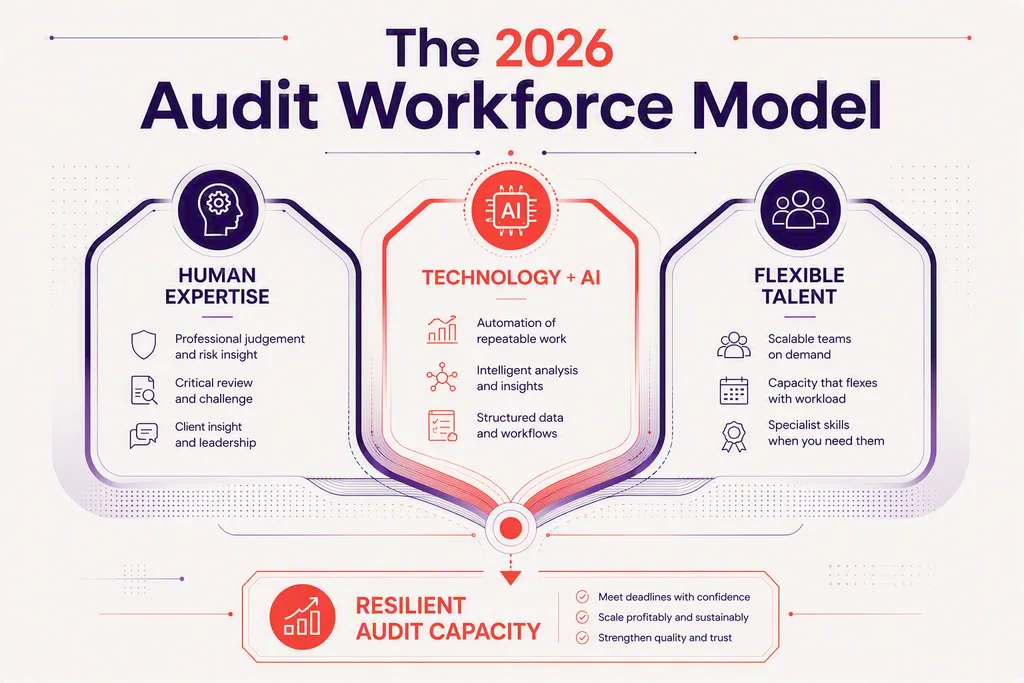
The most important opportunity is therefore: People + AI + better process design.
For audit firms, this means examining where technology can reduce repetitive work while keeping human judgement firmly where professional interpretation, challenge, and accountability are needed.
Before the next peak hits, leadership teams should ask:
If the answers expose significant vulnerabilities, the firm may not have a recruitment issue. It has a capacity design issue.
The audit staffing shortage in the UK should not be viewed through a recruitment lens alone. Recruitment remains essential, and so does audit talent retention. But neither exists in isolation.
The more resilient model combines:
Recruitment + Retention + Technology + Outsourcing + Capacity Planning
That creates a workforce capable of flexing with demand without expecting the permanent team to absorb every peak.
And perhaps that is the most important shift for audit leaders in 2026.
UK audit firms face staffing challenges because demand for experienced professionals competes with a constrained pool of suitably skilled talent, particularly at experienced levels. ICAEW has also highlighted concerns around whether enough firms have the scale, staff, and resources required for increasingly complex audit work.
For individual firms, the challenge becomes most visible when recruitment difficulties intersect with peak workloads, staff turnover, and increasing technical demands.
There is no single cause behind the shortage of qualified auditors. Recruitment competition, retention, career choices, and the increasing skills required within modern audit all contribute.
When available capacity falls below workload, work is redistributed across the existing team. That can create greater pressure at senior and manager level, where supervision and review are concentrated.
For firms, the practical response is to forecast capacity earlier, identify grade-level bottlenecks and create access to flexible resources before workloads peak.
A 2026 recruitment analysis covering UK practice hiring identified Senior, Assistant Manager and Manager-level vacancies as particularly difficult to fill. These roles are particularly important because they sit between execution and leadership, helping supervise engagements, manage relationships and review work.
Yes. Audit outsourcing can provide firms with additional flexible delivery capacity without relying exclusively on permanent local recruitment.
The greatest benefit comes when outsourcing is integrated into the firm’s wider workforce and capacity strategy, with appropriate workflows, review structures and governance, rather than being treated purely as a last-minute staffing solution.
QX’s existing UK audit proposition, for example, includes onshore, offshore, and hybrid resourcing options.
Outsourced teams can provide additional audit delivery capacity when internal teams are approaching their limits. QX Accounting Services’ delivery model is positioned around the UK busy-season requirements and supports a managed approach incorporating trained resources, workflow planning, and review.
The most sustainable approach is to plan this capacity before the peak rather than introducing additional resources after deadlines are already under pressure.
AI and automation can help firms improve efficiency and rethink how professional time is allocated. ICAEW’s July 2026 examination of auditor supply specifically identified AI’s potential to make audit more efficient.
For audit leaders, the opportunity is to use technology alongside skilled human professionals and better process design. Human expertise remains critical where judgement, review and professional accountability are required.

Sanket is an audit expert with over a decade of experience in statutory audits across the UK and Ireland. He has extensive expertise in managing the complete audit lifecycle, from planning to finalisation, and is adept at leading diverse teams and handling multiple clients across industries. Recognised for his strong technical acumen, effective stakeholder communication, and ability to deliver high-quality audits within tight deadlines, Sanket is trusted for his precision and professionalism.
Unauthorized copying or plagiarism of our content is a violation of intellectual property rights. We take such matters seriously and will pursue legal action to protect our original work. Anyone found engaging in such activities will be held accountable under applicable laws.
Explore outsourcing solutions, request a no-obligation trial or discuss your practice’s needs with our expert consultants.





 Book a Virtual Meeting
  Book an In-person Meeting