



According to HMRC, more than 12 million Self Assessment customers were expected to file for the 2024 to 2025 tax year by 31 January 2026, with 11.48 million filing on time; for company work, Corporation Tax is usually payable 9 months and 1 day after the accounting period ends, while the Company Tax Return is due 12 months after that period ends. That puts a lot of pressure on accounting firms.
For many, tax season is no longer simply a compliance challenge. It is a resourcing challenge.
Every year, the same pressures emerge. Self Assessment deadlines approach, client information arrives later than planned, workloads become increasingly concentrated between October and January, and experienced tax professionals remain difficult to recruit and retain.
If you’re considering tax preparation outsourcing UK, you’re not alone.
Industry research shows that outsourcing has moved from being a cost-saving initiative to a strategic capacity solution. Many firms now use outsourced tax preparation services to manage seasonal demand, improve turnaround times, and create more capacity for advisory work.
However, not all providers are equal. Choosing the wrong provider can lead to poor-quality returns, excessive rework, missed deadlines, compliance concerns, and unhappy clients. On the contrary, choosing the right provider can help your firm scale efficiently, improve productivity, and navigate tax season with greater confidence.
So, how do you separate the best from the rest?
Most firms compare providers based on fees, turnaround times, or team size. Unfortunately, these factors alone rarely predict success.
To help firms conduct a more effective tax outsourcing provider evaluation, we developed the QX Tax Outsourcing Evaluation Matrix™. The framework evaluates providers across the six areas that have the greatest influence on tax season performance.
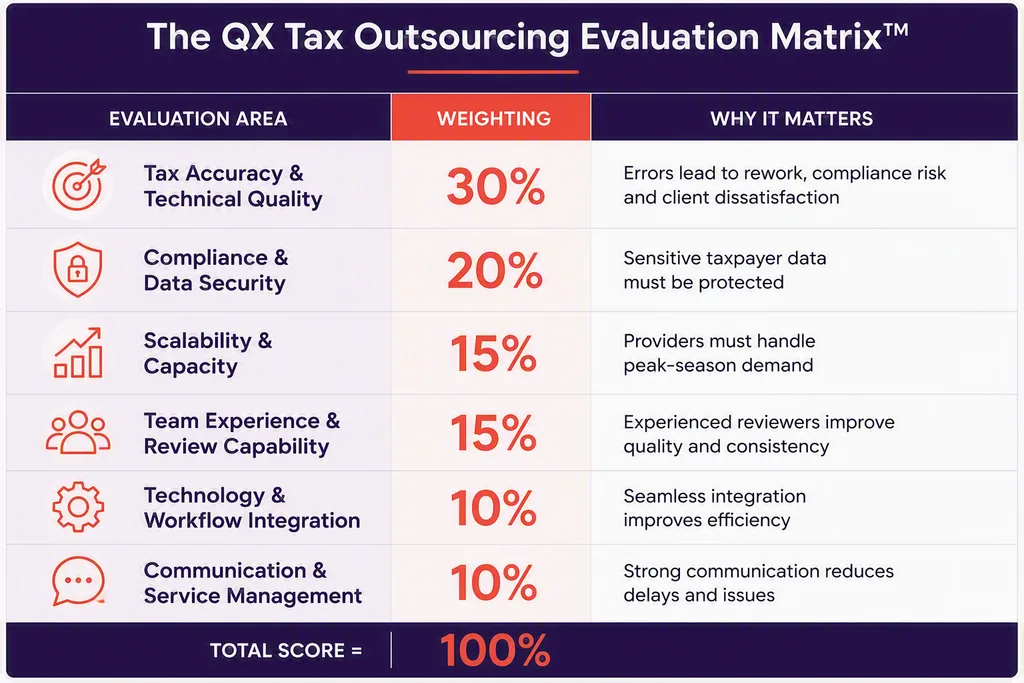
Total Score = 100
Assess each provider on a scale of 1-5.
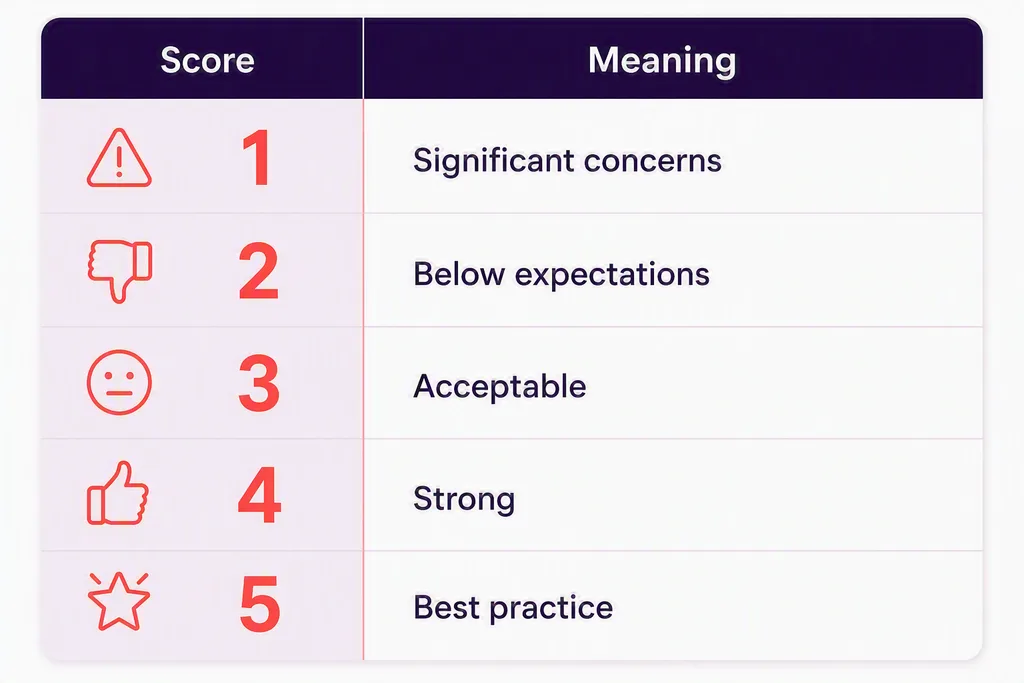
Multiply the score by the category weighting to calculate an overall score.
| Criteria | Weight | Score | Weighted Score |
|---|---|---|---|
| Accuracy & Quality | 30 | 5 | 30 |
| Compliance & Security | 20 | 4 | 16 |
| Scalability | 15 | 4 | 12 |
| Team Experience | 15 | 4 | 12 |
| Technology | 10 | 4 | 8 |
| Communication | 10 | 5 | 10 |
| Total | 100 | 88 |
| Score | Assessment |
|---|---|
| 90-100 | Strategic Tax Outsourcing Partner |
| 80-89 | High-Performing Provider |
| 70-79 | Suitable Provider with Minor Gaps |
| 60-69 | Further Due Diligence Required |
| Below 60 | High-Risk Provider |
This framework provides a structured approach to evaluating a tax preparation outsourcing provider and can be used when comparing multiple vendors side by side.
The single biggest factor when selecting a tax preparation service provider UK is accuracy. Even minor errors can create delays, increase reviewer workloads, and damage client confidence.
When evaluating providers, move beyond generic claims of “high quality” and ask for measurable evidence.
Questions to Ask
| KPI | Benchmark |
|---|---|
| First-pass accuracy rate | 98%+ |
| Rework rate | Below 3% |
| On-time delivery | 95%+ |
| Quality review coverage | 100% |
| Error trend reporting | Available |
A provider’s quality framework is often a stronger indicator of future performance than team size alone.
Tax returns contain some of the most sensitive information a firm handles. Any tax outsourcing due diligence process should include a thorough compliance and security assessment. Security failures can create regulatory consequences, reputational damage, and client trust issues.
Tax Outsourcing Compliance Checks
| Area | What to Verify |
|---|---|
| GDPR Compliance | Policies, controls and governance |
| Information Security | ISO 27001 certification or equivalent |
| Access Controls | Role-based access management |
| Encryption | Data at rest and in transit |
| Audit Trails | Monitoring and reporting capabilities |
| Disaster Recovery | Business continuity procedures |
| Incident Response | Defined response plan |
Red Flags
Security should never be viewed as an optional extra when selecting outsourced tax preparation services.
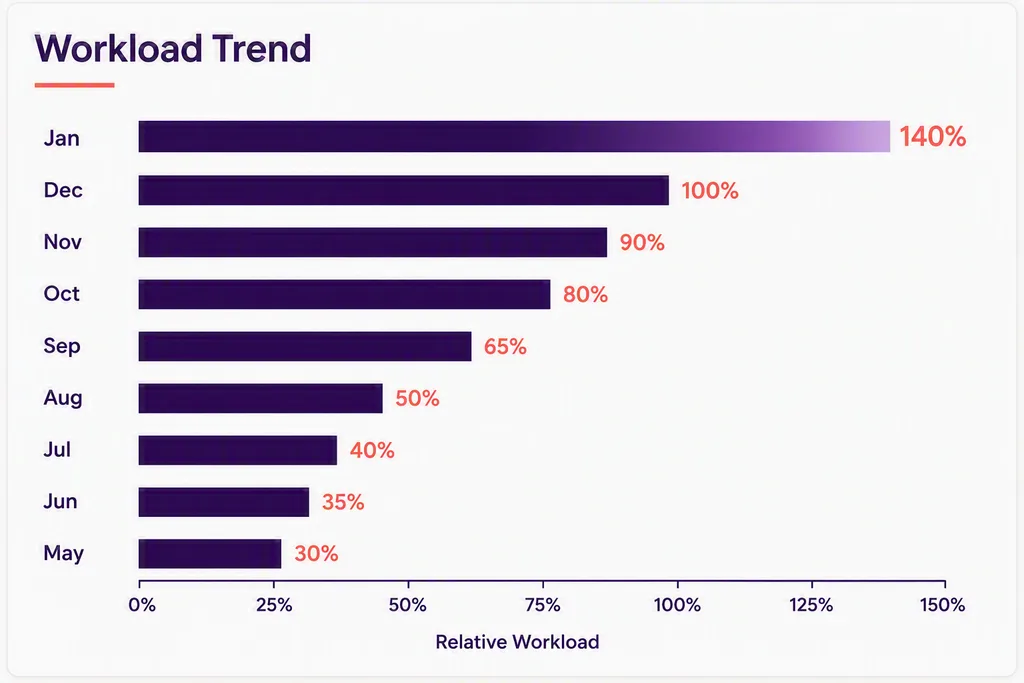
Many providers perform well during quieter periods. The real test comes between October and January. This is when workload volumes surge, clients submit information later than expected, and review teams face increased pressure.
Typical Tax Season Workload Pattern
Questions to Ask
The best outsourced tax preparation provider should be able to demonstrate historical performance during busy season rather than simply discussing theoretical capacity.
Many firms focus heavily on preparers. But the strongest ones focus equally on reviewers.
Review bottlenecks are one of the biggest causes of delays and quality issues during tax season.
Evaluation Criteria
Questions to Ask
A highly experienced review function can significantly improve tax preparation accuracy and turnaround times.
A provider should fit into your existing processes rather than forcing your firm to change the way it operates.
Technology compatibility is an important part of any tax provider quality assessment.
Common Software Used by UK Firms
Questions to Ask
The closer the provider aligns with your existing technology ecosystem, the easier onboarding and collaboration become.
Even technically capable providers can disappoint if communication is poor. Strong communication supports smooth delivery, faster issue resolution and better collaboration.
Assess
Questions to Ask
Remember, your outsourcing provider represents an extension of your team.
Before appointing a provider, complete the following checklist.

A robust tax outsourcing due diligence process significantly reduces implementation risk and helps firms identify the right personal tax outsourcing partner.
Also Read: Tax Outsourcing Companies for UK Accounting Firms
Outsourcing is no longer just about reducing costs. Forward-thinking firms use outsourcing to:
The conversation has shifted from cost reduction to sustainable growth.

For firms looking for a trusted tax preparation outsourcing provider, QX Accounting Services has developed solutions specifically for UK accounting practices.
QXAS supports accounting firms with outsourced tax preparation services across personal tax, corporation tax, compliance support and tax season capacity management. QX serves more than 350 accounting firms and combines UK-based client engagement with scalable delivery teams to help firms manage fluctuating workloads during busy season.
QX’s approach focuses on:
Most importantly, the objective is not simply outsourcing work. It is creating additional capacity while maintaining quality, compliance and client service standards.
Choosing the right outsourced tax preparation provider is one of the most important operational decisions a firm can make. The best providers do far more than process returns. They help firms improve efficiency, increase capacity, reduce risk and create room for growth.
Using the QXAS Tax Outsourcing Evaluation Matrix™allows firms to move beyond subjective comparisons and assess providers using a consistent, measurable framework.
Rather than focusing solely on price, evaluate providers across:
The right partner can help your firm navigate tax season with greater confidence while positioning the practice for long-term growth.
Review first-pass accuracy rates, rework percentages, quality-control processes, reviewer qualifications, turnaround times, and client references. A pilot engagement can also provide a practical assessment of quality and consistency.
Firms should assess GDPR compliance, information security controls, ISO certifications, access management procedures, audit trails, disaster recovery plans, and incident response processes.
Review years of UK tax experience, reviewer credentials, tax specialisations, training programmes, and experience handling complex tax scenarios such as capital gains, partnership returns, and non-resident tax matters.
Providers should demonstrate GDPR compliance, encrypted data transfer, controlled access rights, monitoring and audit capabilities, formal business continuity planning, and ecognized information security standards such as ISO 27001.
Useful KPIs include first-pass accuracy, rework rates, turnaround times, on-time filing performance, SLA compliance, quality review completion rates, and escalation frequency.
Assess staffing levels, contingency plans, reviewer capacity, historical peak-season performance, recruitment capabilities, and how additional resources can be deployed when demand rises. Firms should also request evidence of how service quality is maintained during busy periods.

Paresh Agarwal is Senior Manager (Operations) at QX, where he plays a pivotal role in driving operational excellence and business performance. As an MTD (Making Tax Digital) expert at QX, he brings deep knowledge of digital tax compliance, process optimisation, and strategic leadership. With a strong focus on enhancing operational frameworks and supporting client success, Paresh consistently delivers efficient, technology-led solutions for accounting and tax operations.
Unauthorized copying or plagiarism of our content is a violation of intellectual property rights. We take such matters seriously and will pursue legal action to protect our original work. Anyone found engaging in such activities will be held accountable under applicable laws.
Explore outsourcing solutions, request a no-obligation trial or discuss your practice’s needs with our expert consultants.





 Book a Virtual Meeting
  Book an In-person Meeting