



Accounting outsourcing is not a new concept. For decades, UK accounting firms have used external delivery support to control costs and manage peak-season workloads. Today, however, outsourcing has evolved into a broader strategic lever for creating capacity, improving turnaround times, supporting technology adoption, and freeing qualified accountants to focus on higher-value work.
According to recent research, the global finance and accounting outsourcing service market is growing nearly 8% each year, with over 50% of accounting firms outsourcing at least one of their services.
For practice leaders, the decision is no longer simply whether to outsource. It is about deciding what to outsource, how to retain quality, which delivery model to use, and how an external team can fit into the firm’s long-term growth strategy.
While you consider outsourcing for your practice, it is reasonable to have questions. Below, we answer 25 of the most common questions UK accounting firms are asking about outsourcing, offshoring, AI, automation, compliance, and practice growth.
UK accountancy firms choose an outsourcing partner based on technical capability, quality, scalability, security, communication, and long-term strategic fit. Price matters, but it should not be the only or primary consideration.
For long-term capacity building, the provider must be able to operate as an extension of the practice rather than as a temporary processing resource. This requires familiarity with UK accounting and tax workflows, clearly defined responsibilities, stable delivery teams, documented quality controls, and the ability to support increasing volumes.
Firms should assess:
The objective is to build reliable delivery capacity that improves the firm’s operating model over time.
Bookkeeping, VAT returns, payroll, year-end accounts preparation, tax compliance, audit preparation, and routine management reporting are among the most suitable services to outsource. These activities are recurring, process-driven, and often consume substantial internal capacity.
Delegating these workflows allows partners, directors, and managers to spend more time on forecasting, business planning, strategic tax conversations, virtual finance director services, and performance improvement.
| Suitable for outsourcing or co-sourcing | Usually retained by the UK practice |
|---|---|
| Bookkeeping and reconciliations | Client relationship ownership |
| VAT return preparation | Complex VAT advice |
| Draft statutory accounts | Final review and approval |
| Corporation Tax preparation | Technical tax judgement |
| Payroll processing | Sensitive client conversations |
| Management pack preparation | Interpretation and advisory |
| Audit file preparation | Audit opinion and sign-off |
The most successful transitions clearly separate production work from judgement-led and client-facing responsibilities.
Outsourcing creates additional capacity by moving recurring preparation and compliance work to a specialist delivery team. This gives qualified UK accountants more time to focus on advisory work and client relationships.
Many firms want to offer forecasting, cash flow planning, strategic tax advice, management reporting, and virtual finance director services. However, their senior teams often remain occupied with bookkeeping corrections, accounts preparation, compliance deadlines, and file administration.
Outsourcing can help by:
Outsourcing does not create an advisory service by itself. It creates the time, capacity, and operational structure needed to deliver one effectively.
Management accounts, cash flow reporting, budgeting, KPI packs, bookkeeping, and month-end reporting are the core outsourced services that can support a virtual finance director offering.
A virtual finance director needs accurate and timely financial information before meaningful advice can be provided. An outsourced team can manage the recurring preparation layer, including reconciliations, reporting schedules, variance calculations, and draft management packs.
A practical operating model is:
This division enables the firm to focus its higher-cost, client-facing talent on analysis and advice rather than data preparation.
Accountants can build virtual finance teams by combining cloud accounting technology, standardised processes, outsourced delivery capacity, and strategic oversight from the UK practice.
The service can be structured in tiers according to the complexity of each client’s business. A basic offering may include bookkeeping and reporting, while a more advanced service can incorporate forecasting, credit control, budgeting, and virtual finance director support.
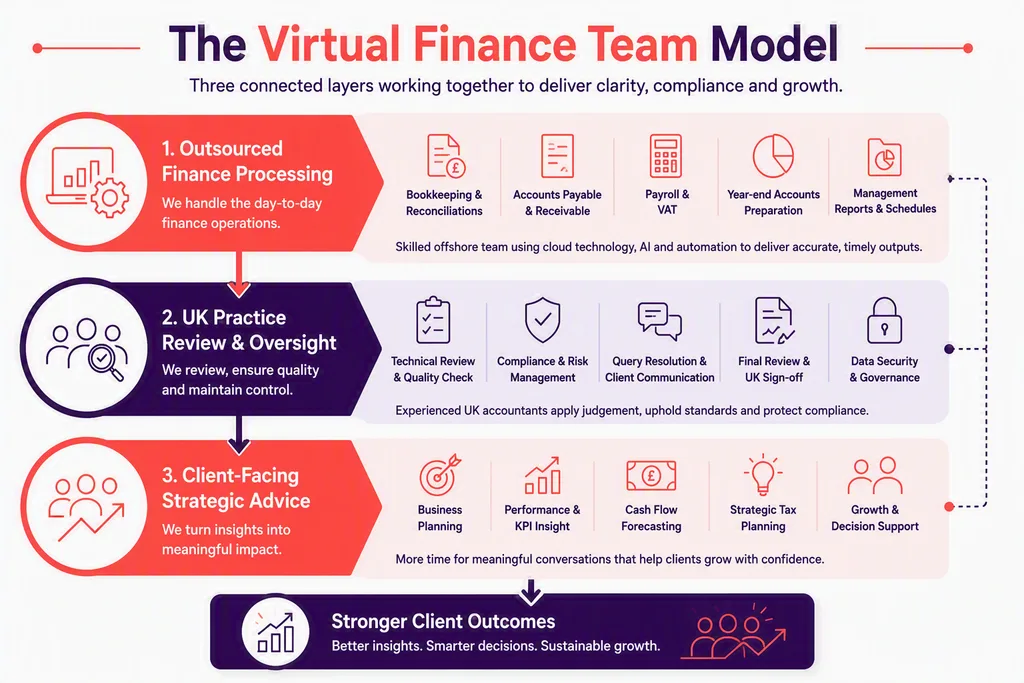
A virtual finance team may cover:
The practice should retain ownership of the client relationship and define who is responsible for processing, review, interpretation, and decision support. This makes the service easier to scale without weakening accountability.
Mid-sized UK accounting firms commonly use offshore teams for preparation and processing work while retaining technical review, client communication, professional judgement, and final sign-off in the UK.
This creates a split-delivery model. The offshore team progresses reconciliations, working papers, bookkeeping, accounts preparation, and tax preparation, while the UK team reviews the work and manages judgement-led matters.
A typical workflow is:
Client records received → Data and file preparation → Offshore processing → Quality review → UK technical review → Client approval and submission
Time-zone differences can also allow work to continue beyond the UK working day. However, faster delivery depends on more than geography. Firms need complete source information, clear task allocation, standardised working papers, agreed turnaround times, and efficient query resolution.
Without these foundations, additional capacity may simply create larger review queues.
Outsourced accounting partners help clear year-end backlogs by adding scalable preparation capacity and organising work into structured, prioritised production workflows.
A backlog should first be segmented by filing deadline, complexity, information readiness, and review requirements. This prevents teams from treating every file as equally urgent.
An outsourced team may support:
The practice should retain control of client communication, technical decisions, final review, and filing. Progress should also be monitored through a central tracker so every file is either in production, awaiting information, under review, or ready for approval.
UK accounting firms can manage January Self Assessment peaks by using flexible outsourced tax preparation, dedicated remote teams, or additional managed capacity during the busiest part of the tax cycle.
The outsourced team can organise source documents, prepare income schedules, populate draft returns, complete supporting computations, and assemble review-ready files. The UK practice then handles technical review, client advice, approval, and submission.
To make this work, firms should:
Outsourcing should form part of a year-round tax production plan. Waiting until the final weeks before the deadline can limit the value of any additional capacity.
Consistent turnaround requires standardised workflows, complete source information, dedicated resources, defined review stages, and agreed service levels. Additional people alone will not guarantee faster accounts production.
The turnaround clock should begin only when the required information has been received and accepted as complete. Otherwise, delays caused by missing records may be incorrectly attributed to production performance.
| Turnaround enabler | Why it matters |
|---|---|
| Standard intake checklist | Reduces missing information |
| Defined file scope | Prevents uncertainty over responsibilities |
| Standard working papers | Makes files easier to prepare and review |
| Dedicated work allocation | Limits jobs waiting in unassigned queues |
| Consolidated query process | Reduces repeated client interruptions |
| Multi-level review | Identifies issues before UK review |
| Escalation procedure | Prevents difficult files from stalling |
| Performance tracking | Makes bottlenecks visible |
Firms should measure both preparation time and review time because a fast first draft that needs extensive correction does not represent a genuinely fast turnaround.
Accounting outsourcing allows firms to expand delivery capacity across bookkeeping, tax, and payroll without adding equivalent permanent internal headcount. It can support recurring workloads, new client wins, deadline periods, and staff shortages.
The practice can retain ownership of the client relationship and professional oversight while an outsourced team handles defined processing and preparation activities.
Firms should select an engagement model that matches the predictability of the work.
| Delivery model | Most suitable for | Key consideration |
|---|---|---|
| Per-job outsourcing | Seasonal or variable assignments | Scope each job clearly |
| Dedicated resource | Predictable recurring work | Maintain sufficient work allocation |
| Managed team | Multiple workflows at scale | Establish governance and reporting |
| Hybrid model | Firms retaining UK-led oversight | Define handoffs carefully |
Yes. An outsourcing partner can help firms identify repetitive workflows where AI and automation may reduce manual processing, improve consistency, and make exceptions easier to manage.
The process should begin with workflow analysis rather than purchasing technology. Firms need to understand where data enters a process, where manual intervention occurs, why errors or delays arise, and where professional judgement remains essential.
Potential focus areas include:
AI should not be treated as an unsupervised replacement for accounting expertise. A stronger model combines automated processing with human review, clear escalation routes, documented controls, and final professional oversight.
AI is used to extract information from documents, suggest transaction categories, support bank matching, identify anomalies, and route work through defined workflows. This reduces repetitive activity while keeping human review focused on exceptions.
For example, an AI-enabled system may extract supplier, date, amount, and tax information from an invoice. A trained accountant can then review low-confidence fields, unusual tax treatments, duplicate entries, or transactions that do not match the established coding rules.
| Process | Potential role of AI | Human responsibility |
|---|---|---|
| Invoice capture | Extract data from documents | Review incomplete or unusual fields |
| Transaction coding | Suggest ledger categories | Confirm complex classifications |
| Bank reconciliation | Recommend possible matches | Investigate differences |
| Anomaly detection | Flag unusual transactions | Determine the appropriate action |
| Workflow routing | Assign tasks using predefined rules | Manage changing priorities |
| Reporting preparation | Assemble recurring information | Interpret performance |
The value comes from reducing routine touchpoints without removing accountability.
Repetitive, rules-based, high-volume accounting activities are usually the strongest candidates for automation. Tasks requiring interpretation, judgement, negotiation, or complex client advice should continue to involve experienced professionals.
Common automation opportunities include:
Before automating a process, the firm should confirm that the underlying workflow is consistent. Automating an unclear or inefficient process may increase the speed at which problems are created.
A useful starting point is to assess each task according to volume, repetition, rules, exception rate, risk, and the amount of judgement required.
Standard Operating Procedures (SOPs) create consistency, accountability, scalability, and quality control. They explain how work should be completed, reviewed, escalated, and documented.
Without clear SOPs, outsourced teams may depend on informal knowledge or individual preferences that are difficult to reproduce consistently. This increases queries, review time, and the risk of different team members completing the same task in different ways.
An effective SOP should define:
SOPs should also be updated when accounting rules, technology, responsibilities, or client requirements change.
Yes. The right outsourcing partner can help a firm standardise how work enters, progresses through, and leaves its practice management and accounting systems.
This may involve mapping current workflows, identifying duplicated data entry, assigning responsibility for status updates, improving document collection, or defining automated reminders and approval stages.
The aim is not to add more tools. It is to reduce unnecessary handoffs, improve visibility, and establish a clear source of truth for job status. The outsourcing provider should adapt to the firm’s environment wherever practical rather than building a separate, disconnected workflow.
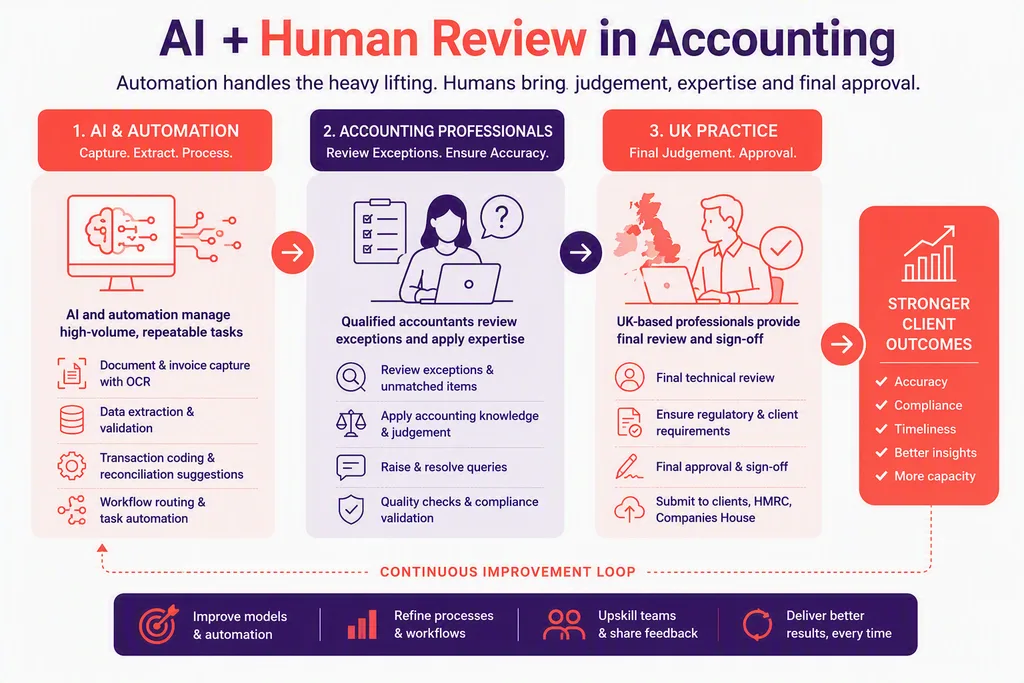
A small practice can retain quality control by outsourcing preparation while keeping technical review, client communication, professional judgement, and final approval in-house.
The engagement should begin with a limited, representative group of files. The practice can then assess accuracy, turnaround, communication, software capability, and the amount of internal review required before increasing volumes.
Important controls include:
Quality should be measured by more than error counts. Firms should also consider the relevance of queries, consistency of working papers, ease of review, responsiveness, and whether the outsourced work genuinely releases internal capacity.
A four-eye review means that work is checked by a second person before it is delivered or progressed to the next stage. The preparer and reviewer have separate responsibilities within the quality process.
The preparer completes the work and performs an initial self-check. A reviewer then examines the file against the applicable checklist, supporting information, accounting treatment, and expected output.
A typical structure may include:
The exact process should reflect the complexity and risk of the work. A straightforward bookkeeping task may not require the same review depth as a Corporation Tax computation or a set of statutory accounts.
Four-eye review supports quality, but it does not remove the UK practice’s responsibility for final professional judgement.
Firms should choose providers with documented data protection controls, secure working environments, defined access permissions, formal contractual arrangements, and clear incident-management procedures.
The firm should understand what information will be shared, who can access it, where it will be processed, how long it will be retained, and how access will be removed when it is no longer required.
A due diligence checklist should consider:
Security should remain an ongoing governance responsibility. Firms should periodically review permissions, processes, and contractual requirements rather than treating compliance as a one-time onboarding activity.
ISO certification can provide additional confidence that a provider follows a documented management framework covering information security, quality, or business continuity. However, certification should be evaluated alongside actual delivery controls.
Firms should confirm which legal entity, locations, services, and delivery operations are covered by the certification. A certificate may have a defined scope, so it is important to establish whether that scope includes the teams and processes that will handle the firm’s work.
Questions to ask include:
Certification is a useful indication of process maturity, but it is not a substitute for service-specific due diligence.
Quality-focused firms evaluate technical expertise, review processes, communication, security, consistency, scalability, and the internal effort required to manage the relationship. They do not make the decision solely on the lowest quoted price.
The true delivery cost includes the provider’s fee plus internal review time, rework, delays, management effort, and the impact of errors. A lower-priced service that requires significant correction may cost more overall.
| Quality criterion | What to examine |
|---|---|
| Technical competence | Experience with relevant UK work |
| Review controls | How work is checked before delivery |
| Communication | Clarity, responsiveness, and escalation |
| Consistency | Stability across files and team members |
| Security | Access, data handling, and governance |
| Software capability | Ability to work in the firm’s systems |
| Scalability | Capacity without reduced quality |
| Review effort | Time required from the UK team |
| Team continuity | Retention of process knowledge |
A structured pilot can help the firm evaluate actual delivery quality rather than relying only on proposals and sales presentations.
A successful cloud migration includes discovery, data cleansing, mapping, test migration, reconciliation, user acceptance, training, and a controlled transition. It should improve the workflow rather than merely relocate existing data.
Before migration, the firm should decide how much historical data is required, which integrations must be retained, and which processes should be redesigned.
A migration plan commonly covers:
Responsibility for data validation should be clearly assigned. Migrated information should not be assumed to be correct simply because the software accepted it.
Cloud ecosystem experience allows an outsourced team to work within the firm’s existing accounting, document management, reporting, tax, and practice management environment with less disruption.
Modern accounting workflows often involve several connected applications rather than a single platform. An outsourced team may need to move between bookkeeping software, data-capture tools, tax systems, document storage, workflow platforms, and reporting applications.
Relevant experience can reduce:
Firms should assess day-to-day proficiency rather than accepting a broad statement that a provider “supports” a platform. It is useful to understand which tasks the team completes in the system, how access is managed, and how exceptions are escalated.
Outsourcing can reduce administration by transferring defined processing, workflow updates, document organisation, query tracking, and recurring operational tasks to a dedicated delivery team.
This prevents managers and partners from becoming the coordination point for every file. It can also improve workflow visibility if the outsourced team works directly within the practice’s approved systems.
Administrative activities that may be delegated include:
The firm should avoid duplicating administration across internal and external teams. One process, one status, and one accountable owner should be established for each stage.
No. An outsourcing provider should normally be able to work within the firm’s approved technology environment. A system change should only be recommended where it provides a clear operational, security, or commercial benefit.
Forcing a practice to adopt unfamiliar tools can create additional training, data migration, integration, and change-management requirements. It may also weaken internal visibility if the outsourced workflow operates outside the firm’s core systems.
Before changing technology, firms should ask:
Technology should support the service model, not dictate it.
The most suitable model combines digital record-keeping, standardised client data, cloud accounting software, automation, exception management, and scalable compliance capacity.
MTD for ITSA readiness is not simply a filing question. Firms need a repeatable way to onboard clients, collect information, maintain digital records, review incomplete data, and manage recurring reporting activity across a larger number of deadlines.
Key capabilities include:
Firms should identify which clients require full bookkeeping support, which need periodic review, and which already maintain suitable digital records. This prevents a single service model from being applied to every client regardless of complexity or readiness.
QX Accounting Services uses documented workflows, defined responsibilities, review stages, and quality-control procedures designed around the needs of UK accounting firms. Work is prepared for the client firm’s review and final sign-off.
The specific quality process depends on the service being delivered, the complexity of the assignment, and the agreed engagement model. The objective is to provide consistent, review-ready work while keeping the UK practice in control of professional judgement and client relationships.
Quality controls may include:
QX works with firms to align delivery with their internal expectations rather than assuming that one standard workflow will suit every practice.
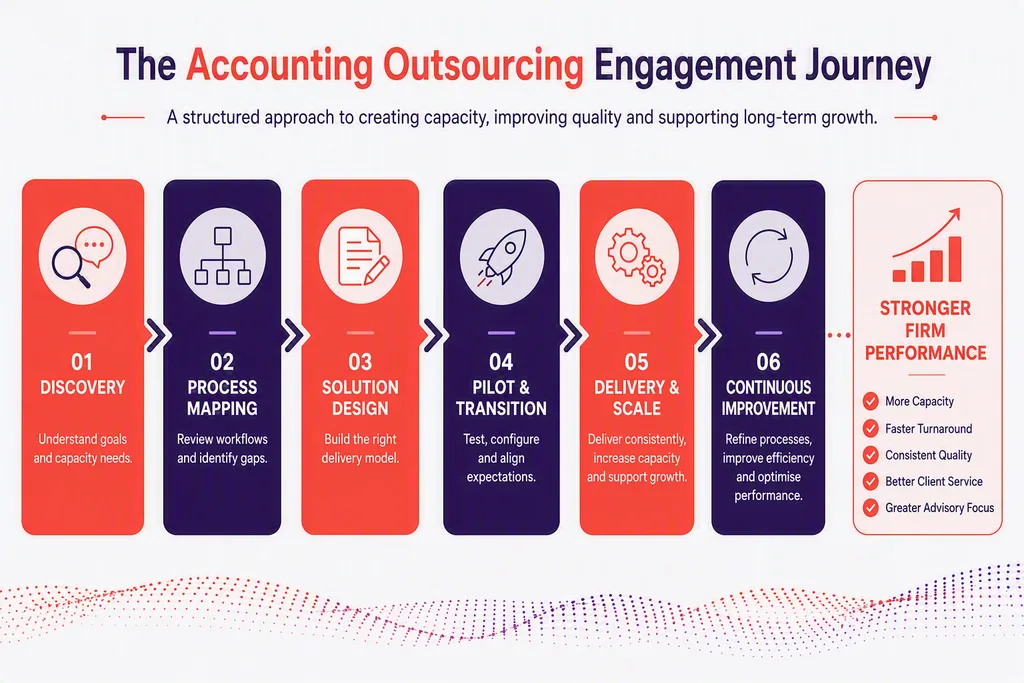
QX Accounting Services begins by understanding the firm’s objectives, workflows, systems, service requirements, and desired delivery model. This creates a structured foundation before larger volumes of work are transitioned.
The onboarding approach is intended to clarify what work will be covered, how information will be shared, who will perform each activity, and where review and approval responsibilities will sit.
| Stage | Primary focus |
|---|---|
| Discovery | Understand objectives, challenges, and capacity needs |
| Process mapping | Review workflows, systems, and responsibilities |
| Solution design | Define scope, team model, and governance |
| Transition planning | Establish access, templates, and communication |
| Pilot or initial delivery | Test and calibrate the working process |
| Scale and optimisation | Expand delivery and improve the workflow |
The exact stages and terminology should be aligned with the final engagement scope. This prevents unclear expectations from becoming operational issues later.
QX Accounting Services uses structured information-security and data-governance practices intended to protect the sensitive information processed during service delivery. Access and data-handling requirements are defined as part of the engagement.
The controls applied should reflect the systems used, the type of work, the information involved, and the access needed by the delivery team.
Areas addressed during the engagement may include:
UK firms should evaluate data protection as part of their wider outsourcing due diligence and confirm which controls apply to their specific engagement. Security responsibilities, access boundaries, retention requirements, and escalation contacts should be agreed before client information is shared.
QX Accounting Services provides scalable delivery support across bookkeeping, accounts preparation, tax, payroll, and other defined accounting workflows. This can help firms respond to seasonal peaks, backlogs, recruitment gaps, and business growth.
Support can be structured according to the type, volume, complexity, and predictability of the work. A practice with recurring requirements may need a dedicated delivery model, while a firm facing a temporary backlog may require a more clearly defined project or workflow.
QX support can help firms:
Clear planning remains essential. Work allocation, information-readiness standards, turnaround expectations, and review capacity should be agreed before volumes increase.
QX Accounting Services can help firms examine repetitive accounting workflows that may benefit from standardisation, automation, cloud technology, and AI-enabled processing. Human review and professional oversight remain important parts of the operating model.
The starting point is understanding the current process. This includes identifying manual activities, duplicated effort, incomplete information, avoidable handoffs, and recurring exceptions.
Potential opportunities may include:
The objective is not to automate every activity. It is to reduce unnecessary manual effort while making important exceptions easier for accounting professionals to identify and review.
For UK accounting firms, outsourcing has evolved far beyond a cost-reduction exercise. Today, it is a strategic lever for increasing capacity, improving turnaround times, embracing AI and automation, supporting MTD readiness, and creating more time for advisory services.
Firms that approach outsourcing strategically can scale faster, improve profitability, strengthen client service, and create the operational foundation needed for long-term growth.

Mustufa is a Chartered Accountant with 10 years of progressive experience across Indian, Canadian, and UK accounting domains. He has a proven track record of leading high-performing teams of 60+ members, managing multi-client portfolios, and driving operational excellence with measurable profitability improvements.
Unauthorized copying or plagiarism of our content is a violation of intellectual property rights. We take such matters seriously and will pursue legal action to protect our original work. Anyone found engaging in such activities will be held accountable under applicable laws.
Explore outsourcing solutions, request a no-obligation trial or discuss your practice’s needs with our expert consultants.





 Book a Virtual Meeting
  Book an In-person Meeting