



If growing your client base feels harder than it should, you are far from alone.
Research cited by Moneypenny found that 39% of UK accountancy firms placed attracting new clients as their number-one priority for 2025. Among sole traders and small practices with 1–9 employees, that figure reached 50%. By comparison, 25% prioritised generating more revenue from existing clients and 22% focused on attracting and retaining staff.
There is a contradiction here. Accounting firms are full of expertise. Many have strong client relationships, experienced teams, and decades of credibility. Yet turning those strengths into a consistent stream of new opportunities remains difficult.
The issue is rarely that firms have nothing valuable to offer. The problem is that prospective clients need to find you, understand you, trust you, and see a compelling reason to choose you.
That makes client generation as much a marketing challenge as a sales one.
The right marketing for accounting firms can bridge that gap, helping practices move from relying predominantly on reputation and referrals to building a more systematic approach to demand generation.
There is rarely one cause. More often, several problems combine to make accounting firm client acquisition unpredictable.
| Client acquisition challenge | What it means for the firm |
|---|---|
| Heavy reliance on referrals | New opportunities can be difficult to predict or scale |
| Generic positioning | Prospects struggle to distinguish the firm from competitors |
| Limited digital visibility | The firm may not appear when potential clients research solutions |
| Inconsistent marketing | Stop-start activity struggles to build sustained awareness |
| Limited internal resource | Client work naturally takes priority over marketing |
| Weak nurture | Interested prospects can disappear before becoming sales-ready |
| Wrong measurement | Traffic and impressions get tracked without enough focus on pipeline |
Let’s look at the most important challenges in more detail.
No accounting firm would want to stop receiving referrals. Nor should they.
Accounting involves considerable trust, so a recommendation from another business owner, adviser or existing client can be enormously valuable.
The difficulty comes when referrals become the firm’s only meaningful source of new business.
Referral volume can fluctuate. The firm has limited control over who gets referred, when the introduction happens or whether that prospect fits the practice’s ideal client profile.
The answer is not to abandon referrals. It is to build another acquisition engine alongside them. SEO, industry content, email marketing, events, social media and targeted campaigns can expand your visibility beyond the network that already knows you.
Marketing can also strengthen referrals. A prospective client who has been given your name can research your website, read your thinking, look at client evidence, and assess your specialist expertise before speaking to you.
In that sense, digital marketing and referrals increasingly work together.
Consider the messaging used across the accounting market:
Trusted advisers. Personal service. Tailored solutions. Experienced accountants.
All positive qualities. None is particularly distinctive.
If ten firms make essentially the same promise, why should a prospect choose one of them?
Successful client acquisition strategies for accounting firms therefore start with positioning, not promotion.
Your marketing should make it clear:
An accountancy practice with extensive expertise supporting technology companies, for example, has a stronger marketing proposition when that specialism is visible across its website, insights, case studies, and campaigns.
Specificity makes expertise easier to recognise.
Having an attractive website is not the same as having a visible one. When a business searches for an accountant, tax specialist, outsourced finance provider, or another accounting solution, appearing at the right stage of that research creates an opportunity that did not previously exist.
That is where SEO for accounting firms becomes important. Effective SEO connects the questions and problems potential clients are researching with relevant expertise on your website.
That means moving beyond a few generic service pages and creating useful content around specific:
The objective is not simply more website traffic. It is qualified visibility: getting your firm discovered by businesses whose needs match your expertise.
Many accountancy practices already publish content. Tax updates. Budget commentary. Regulatory changes. Technical guidance.
Useful? Absolutely. Enough to differentiate the practice and consistently attract prospective clients? Not necessarily.
This is why content marketing for accountants needs to extend beyond reporting industry developments.
Consider the questions potential clients ask before choosing an adviser:
Answering questions like these allows a firm to demonstrate commercial as well as technical understanding.
Good content reduces the knowledge gap between“We might need help” and “This firm understands exactly what we need.” That is an important job in lead generation for accountants.
Client deadlines come first. Staff need support. Regulatory requirements cannot wait. Partners have relationships to manage. Marketing consequently gets pushed down the list.
A partner might publish several LinkedIn posts, someone writes a blog when there is spare capacity, and a newsletter goes out every few months. None of those activities is inherently bad. The problem is the absence of a consistent system behind them.
Effective digital marketing for accounting firms needs connected activity:
Positioning → Content → Distribution → Engagement → Nurture → Opportunity
A good article, for example, should not simply be uploaded to the website and forgotten.
It might support SEO, become several LinkedIn discussions, feature in an email campaign, help nurture an existing prospect, and give partners something valuable to share with their networks.
One strong insight can therefore support multiple stages of acquisition.
There is no universal channel mix. A regional practice targeting owner-managed businesses will require a different strategy from a Top 100 firm targeting larger organisations.
But the underlying engine is similar:
| Stage | Marketing objective | Possible activity |
|---|---|---|
| Attract | Become visible to the right audience | SEO, PPC, LinkedIn, events |
| Educate | Help prospects understand their problem | Blogs, guides, webinars, video |
| Differentiate | Establish a reason to choose your firm | Thought leadership, specialist insights |
| Build trust | Reduce perceived risk | Case studies, testimonials, credentials |
| Nurture | Remain relevant until the prospect is ready | Email, retargeting, useful content |
| Convert | Move genuine interest into conversation | Consultation, assessment, enquiry |
| Measure | Understand commercial contribution | Opportunities, pipeline, conversion, acquisition cost |
The important point is that these activities should not operate independently. Your SEO strategy should influence content. Content should feed campaigns. Campaign engagement should inform nurture. Nurture should eventually create a relevant reason for a conversation.
That’s when marketing becomes an acquisition system rather than a communications calendar.
There is another trap in accounting firm lead generation UK: assuming that success means generating as many leads as possible. It doesn’t.
Twenty serious enquiries from businesses that fit your target client profile may be considerably more valuable than hundreds of low-intent form fills. Before investing heavily in acquisition, firms should therefore define their ideal client profile (ICP).
Consider factors such as:
That definition should then shape your keywords, content, paid campaigns, events and targeting.
Good accounting marketing does not simply increase demand. It filters demand.
You can run an excellent campaign and still fail to win the client. Why? Because lead generation and lead conversion are different problems.
A prospect may download a guide or attend a webinar without being ready to speak to your business development team immediately. Sending an aggressive sales message immediately afterwards can squander the trust your marketing just created.
Instead, build nurture journeys around intent. An early-stage prospect might receive educational insight. Someone repeatedly visiting high-intent service pages may need a stronger proof point or case study. A prospect who requests a consultation needs rapid, relevant follow-up.
Marketing and business development therefore need a shared view of the buying journey.
The question is not only: “How many leads did we generate?”
It is: “How effectively are we converting the right interest into commercially valuable conversations?”
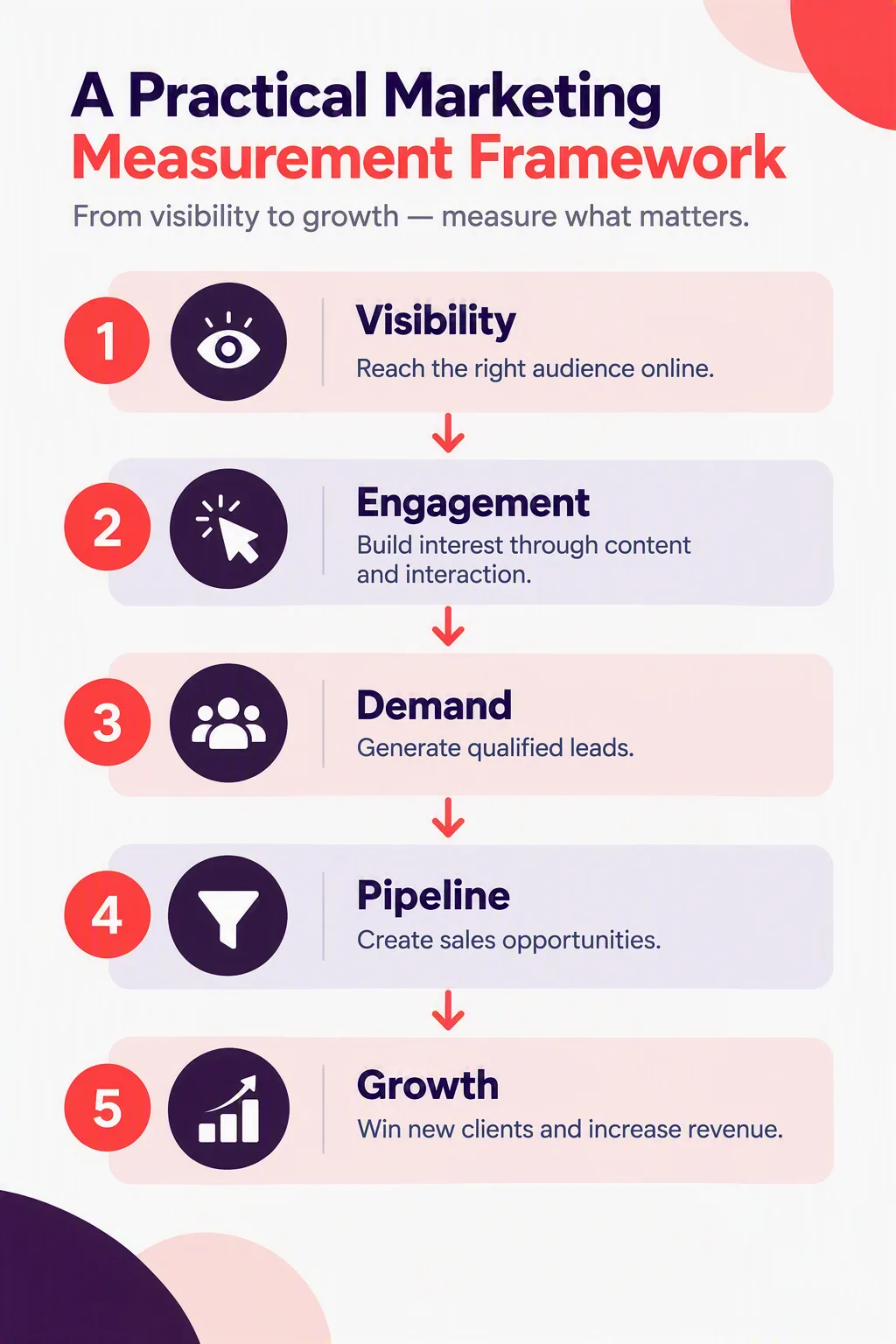
Likes and impressions do not tell the whole story.
Neither does raw website traffic.
The eventual objective of marketing is commercial growth, so measurement should progressively connect activity to opportunities.
For many practices, the problem is not understanding that marketing matters. It is finding the capacity and specialist skills to execute it consistently.
Building everything internally can require expertise across strategy, content, copywriting, SEO, paid advertising, design, social media, website development, and analytics. This is where marketing services for accounting firms UK can provide an alternative.
Outsourcing may be worth considering when:
The goal should not simply be to outsource tasks. It should be to create a joined-up marketing capability aligned with the firm’s growth strategy.
QX Accounting Services (QXAS) provides dedicated marketing services for accounting firms, designed specifically around improving firms’ visibility, reaching prospective clients, and supporting lead generation.
Our marketing capabilities include website design and development, SEO, Google Ads and LinkedIn paid advertising, content and copywriting, and social media marketing. Our approach is tailored to the firm’s niche and service offering rather than applying the same marketing strategy to every practice.
That industry context matters. Marketing an accounting practice requires an understanding of professional services, complex services and trust-led purchasing. It also requires the ability to translate technical expertise into messaging that business owners and decision-makers can understand.
QXAS’s model encompasses end-to-end marketing support, helping accounting firms strengthen their online presence through lead-generating strategies while providing access to multiple marketing disciplines.
For firms where partners are driving business development but internal marketing capacity is limited, this can create a practical middle ground: retain the firm’s expertise and relationships internally while adding specialist marketing capability around them.
Also Read: Top Marketing Service Companies in the UK for Accounting Firms: Key Qualities That Set Them Apart
The UK accountancy sector is changing.
The FRC reported continued growth in the profession in its 2025 Key Facts and Trends publication, while research on the wider sector has highlighted ongoing investment in technology and evolving advisory models. Meanwhile, winning new clients remains firmly on the agenda for practices.
That creates an important distinction. Doing excellent work helps you retain clients and earn recommendations. But consistent acquisition requires prospective clients to discover that expertise in the first place.
That is the real role of marketing for accounting firms. Not more noise. Not publishing for the sake of publishing. And certainly not generating thousands of irrelevant leads.
The objective is to put your expertise in front of the right businesses, demonstrate why it matters, build trust before the first sales conversation, and create a more repeatable path from visibility to opportunity.
Because your next ideal client may already be looking for help. The question is whether they will find you.
Accounting firms can struggle because client acquisition often relies heavily on referrals, partner networks, and inconsistent business development. Limited marketing capacity, weak digital visibility, generic positioning, and insufficient nurture can make new-business generation unpredictable.
A structured marketing strategy adds more controllable acquisition channels rather than replacing the referrals that already work.
SEO for accounting firms helps make relevant website pages and content discoverable when businesses search around accounting services, questions and problems.
The aim should be qualified organic visibility rather than traffic alone. Service pages, sector-specific content and useful answers to high-intent questions can help connect the firm’s expertise with businesses researching potential solutions.
Common barriers include poor lead qualification, slow follow-up, generic sales outreach and trying to sell before a prospect is ready.
Accounting firms should differentiate between early interest and buying intent. Marketing nurture can continue educating earlier-stage prospects while high-intent opportunities receive more direct business-development follow-up.
Start with commercial outcomes rather than vanity metrics. Track qualified enquiries, marketing-qualified leads, meetings, opportunities, conversion rates, marketing-influenced pipeline, new clients and acquisition cost. Metrics such as website traffic and engagement remain useful diagnostic indicators, but should ideally connect to the wider commercial picture.
Outsourcing can make sense when the firm has clear growth ambitions but lacks the capacity or specialist skills to execute marketing consistently. It can also help when partners are spending significant time overseeing day-to-day marketing or when the firm requires capabilities such as SEO, PPC, content and digital campaign execution without building each discipline internally.
An outsourced model can give firms access to additional specialist capabilities while internal leaders retain ownership of the firm’s proposition, expertise and commercial objectives.
The external marketing team can then support execution across agreed areas such as content, SEO, campaigns, social media, paid promotion and website work.
QX Accounting Services UK offers marketing services specifically for accounting firms and lists website design and development, SEO for accountingfirms, Google and LinkedIn advertising, content and copywriting, and social media among its capabilities. Our strategies are particularly tailored to firms’ niche and services.
For practices looking for broader marketing capability without developing every specialism internally, that provides an accounting-focused outsourced option.

Unauthorized copying or plagiarism of our content is a violation of intellectual property rights. We take such matters seriously and will pursue legal action to protect our original work. Anyone found engaging in such activities will be held accountable under applicable laws.
Explore outsourcing solutions, request a no-obligation trial or discuss your practice’s needs with our expert consultants.





 Book a Virtual Meeting
  Book an In-person Meeting