



For decades, the talent model in accountancy was relatively predictable: recruit graduates, train them through professional qualifications, develop technical expertise, and move the strongest performers up through the firm.
AI is beginning to challenge that model. Not simply because some accounting tasks can now be automated, but because the skills firms need, the work their people perform, and the way talent should be recruited are all changing at the same time.
Research from ICAEW provides a useful indication of the direction of travel. Among mid-tier firms surveyed, 68% believe AI will reduce demand for some early-career accountants, yet 83% do not expect this to translate directly into fewer roles overall. Meanwhile, 74% expect to increase hiring for specialist expertise, particularly data analytics and technology.
That distinction matters.
The AI-era talent question is not simply,“How many accountants will we need?”
It is: “What combination of people, skills, technology, and capacity will allow our firm to perform at a higher level?”
That calls for something more sophisticated than an accounting recruitment strategy. It requires an accounting firm talent strategy built around the workforce the firm is becoming.
The strongest firms will resist framing AI primarily as a headcount-reduction exercise. AI is particularly well suited to accelerating repeatable, process-driven elements of work. But accountancy involves considerably more than processing.
Clients still need people who can interpret information, question anomalies, exercise professional scepticism, navigate ambiguity, communicate implications, and take responsibility for professional judgement.
ICAEW expects the accountant’s role to shift further from routine compliance and reporting towards judgement, interpretation and ethical oversight by 2030. Its mid-tier research also found that 71% of firms believe AI will allow them to move further up the value chain.
There is wider labour-market evidence for this augmentation effect. PwC’s 2025 Global AI Jobs Barometer, based on close to one billion job advertisements, found that skills requested by employers are changing 66% faster in occupations most exposed to AI. Workers possessing AI skills also commanded an average 56% wage premium in 2024.
For accounting leaders, the implication is substantial:
AI does not remove the talent strategy. It makes talent strategy more important because the definition of valuable talent is changing faster.
| Traditional Talent Model | Emerging AI-era Model |
|---|---|
| Hiring around established job titles | Hiring around capabilities and skills |
| Large volumes of repeatable processing | Greater automation and augmentation |
| Technical knowledge as the primary differentiator | Technical + digital + judgement + client skills |
| Fixed role descriptions | Evolving skills profiles |
| Recruitment triggered by vacancies | Continuous workforce planning |
| Primarily local talent pools | Blended onshore, outsourced and technology-enabled capacity |
| Training focused mainly on technical progression | Continuous technical, AI and human-skills development |
This is the real accounting workforce transformation now underway.
Building a talent engine is different from improving recruitment. Recruitment fills vacancies. A talent engine continually identifies the capabilities the business needs, builds access to those capabilities and deploys them where they create the greatest value.
For accounting firms, five elements matter.
Traditional accounting firm workforce planning often begins with last year’s organisation chart:
We had six people. Revenue is growing 15%. Therefore, we need another person.
That logic becomes increasingly unreliable when technology is changing how work gets done.
Instead, deconstruct the workload. Look at the firm’s tax, bookkeeping, accounts production, audit support, and advisory workflows and ask:
This produces a much richer capacity model.
The objective becomes allocating the right work to the right combination of people and technology, rather than continuing to add headcount to an unchanged operating model.
That distinction could become increasingly important economically. ICAEW’s 2026 research found that mid-tier firms expect both offshoring (40%) and outsourcing (29%) to increase.
AI makes static job descriptions age quickly. A role called “accounts senior” might remain, while the capabilities required to perform it successfully can change significantly. Leading firms should therefore build a skills architecture alongside their organisation structure.
A future-ready accounting skills matrix typically looks like this:
Technical skills
Technology skills
Human skills
Leadership skills
There are already signs that recruitment is heading this way. LinkedIn reports that 45% of UK organisations are actively integrating or experimenting with generative AI in recruiting, up from 31% a year earlier. Among users, the technology saves an average of approximately 18% of the working week.
For accounting firms, AI in accounting recruitment should not simply mean processing more CVs faster. Its greater strategic value lies in helping firms develop a more skills-oriented view of talent.
The recruitment function itself is entering the AI era.
AI can support the talent process, but firms need to be careful about translating efficiency into automatic decision-making.
That is particularly relevant to a profession built on trust.
In September 2026, ACCA reported that 48% of respondents had reservations about using AI algorithms in hiring, while 54% of board-level respondents expressed doubts about increasing reliance on AI for talent selection. ACCA specifically highlighted concerns around bias, transparency, privacy and loss of human interaction.
The right philosophy for AI-powered talent management is therefore:
Automate administration. Augment judgement. Keep accountability human.
AI may support activities such as talent identification and recruitment workflows, but consequential hiring decisions warrant appropriate human oversight, particularly where algorithms can shape who progresses through a recruitment process.
This is as much a governance issue as an HR issue.
A successful accounting talent acquisition strategy does not end when somebody accepts an offer.
A high-performing talent engine creates a continuous cycle:
Attract → Assess → Hire → Develop → Deploy → Retain → Reskill
Every part affects the next.
If firms recruit AI-capable people but place them into outdated workflows, the technology opportunity is wasted. If they hire ambitious accountants but leave senior staff trapped in repetitive delivery work, career progression becomes less compelling. If AI automates some traditional training-ground tasks without firms redesigning how juniors gain experience, they risk creating a capability gap later in the career pyramid.
This last point deserves far greater attention.
Automating junior work does not eliminate the need to develop senior accountants. Firms need deliberate pathways through which early-career professionals can build judgement, client experience and technical understanding even when AI performs more of the foundational processing work.
That is one of the most important talent management questions accounting leaders will face over the next several years.
The most resilient workforce may not be the firm with the most employees. It may be the firm with the best access to capability.
That means thinking across four interconnected sources:
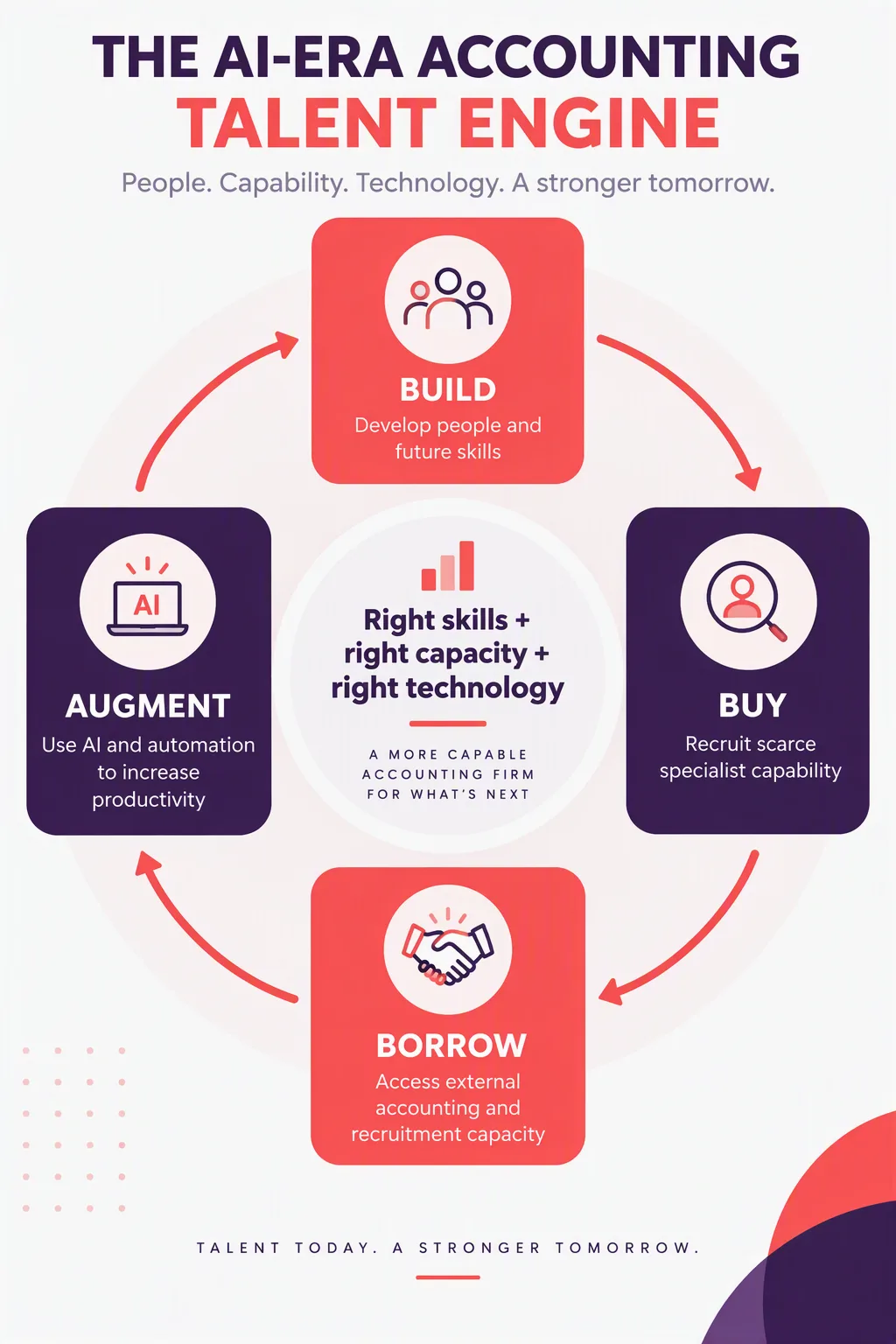
This changes the strategic conversation from: “Where do we find more accountants?”
to: “How do we build reliable access to the capabilities our growth strategy requires?”
One further shift is needed. Accounting leaders should begin treating talent data with the same seriousness as financial data.
A useful leadership dashboard might track:
| Question | Indicator |
|---|---|
| Do we have sufficient capacity? | Capacity versus forecast workload |
| Are skills keeping pace with strategy? | Critical skills coverage |
| Are we developing internally? | Internal mobility and skills progression |
| Are senior people being leveraged effectively? | Partner/manager time by work type |
| Where are hiring constraints emerging? | Time-to-fill by critical capability |
| Is the talent model resilient? | Mix of permanent, outsourced and technology-enabled capacity |
| Are we keeping valuable people? | Retention by role and capability |
The point is not to create another HR reporting pack. It is to connect workforce decisions directly to growth, capacity and client delivery. That is when talent management becomes a leadership discipline.
For accounting firms, building a scalable workforce does not necessarily mean building every capability internally.
QX Accounting Services (QXAS) works with UK accounting firms across outsourced accounting and related practice-support requirements, helping firms access additional delivery capacity while their internal teams concentrate on the work where they add the greatest value.
For leaders thinking about their future talent model, accounting outsourcing services can form part of a broader workforce strategy alongside permanent recruitment, graduate development, technology adoption and skills development.
The question should not be people or AI, nor should it be in-house or outsourced. The stronger question is: What workforce model gives the firm the capability, capacity and flexibility it needs to grow without compromising quality?
As ICAEW’s research suggests, the market is already evolving in this direction, with 40% of mid-tier firms expecting offshoring to increase and 29% expecting greater use of outsourcing.
For firms facing persistent recruitment constraints, access to external talent and specialist recruitment support can therefore become more than a short-term hiring fix. Used thoughtfully, it can form part of long-term workforce planning.
Also Read: Best Accounting Outsourcing Firms in the UK
AI is not making talent less important to accounting firms. It is making different talent more valuable.
The firms that pull ahead will not necessarily be those that automate fastest or recruit most aggressively. They will be those that understand what work humans should own, what technology should augment and what skills the organisation must develop next.
That means moving from reactive recruitment to workforce planning. From titles to skills. From headcount to capacity. From isolated automation to human-AI collaboration.
Most importantly, it means recognising that an accounting firm talent strategy is no longer primarily an HR matter. It is an operating-model decision. And increasingly, it is a growth decision.
AI is changing the tasks accountants perform, the skills firms need, and the way businesses recruit and develop their people. ICAEW’s 2026 research found that 68% of surveyed mid-tier firms expect AI to reduce demand for some early-career accountants, but 83% do not think this will directly result in fewer roles overall. The greater shift is towards judgement, interpretation, technology skills and specialist expertise.
Accounting firms still need strong technical accounting, tax, audit, and regulatory knowledge, but these capabilities increasingly need to be combined with AI literacy, data skills, critical thinking, professional judgement, communication and client advisory skills. ICAEW reports particularly strong anticipated specialist demand in data analytics and technology.
Accounting firms should combine structured workforce planning, skills mapping, early-career development, continuous reskilling, targeted external recruitment, and access to flexible talent. Instead of recruiting only when somebody leaves, leadership teams should forecast the capabilities their future service mix will require and build multiple routes for accessing them.
Use AI to augment work while retaining human accountability where professional judgement, interpretation, ethics, risk or client communication matter. The objective is not simply to automate the maximum number of activities. It is to determine where technology improves efficiency and where professional expertise creates value.
AI can help recruitment teams become more efficient and support a more skills-oriented approach to finding talent. LinkedIn reports that UK organisations using or experimenting with generative AI in recruiting save approximately 18% of their working week on average. However, ACCA research also highlights concerns around algorithmic bias, transparency, privacy, and human oversight, making responsible governance important.
Workforce planning connects a firm’s growth ambitions and forecast workload with the skills and capacity required to deliver them. In the AI era, this needs to encompass permanent staff, future skills, recruitment, outsourcing and technology rather than relying on headcount projections alone.
Outsourced recruitment support can complement an internal talent strategy by giving firms an additional route to source talent and respond to hiring requirements without relying solely on their internal recruitment capacity. It is most effective when recruitment is linked to a broader workforce plan that identifies critical capabilities, future demand and where external support is strategically appropriate.

Pramith Naidu is an accounting and payroll expert with a deep understanding of accounting firms’ challenges. He helps accounting and payroll businesses achieve efficiency and cost savings through customised outsourcing solutions. His focus is on delivering engagement models that address both immediate priorities and long-term goals, enabling firms to streamline operations and drive sustainable growth.
Unauthorized copying or plagiarism of our content is a violation of intellectual property rights. We take such matters seriously and will pursue legal action to protect our original work. Anyone found engaging in such activities will be held accountable under applicable laws.
Explore outsourcing solutions, request a no-obligation trial or discuss your practice’s needs with our expert consultants.





 Book a Virtual Meeting
  Book an In-person Meeting