



Growth should be exciting. Yet for many UK accounting firms, growth often creates different problems. Capacity constraints, seasonal peak workloads, hiring difficulties, and margin pressure are now everyday strategic issues for many UK accounting firms, not occasional operational annoyances.
At the same time, regulatory demands from HM Revenue & Customs (HMRC), Companies House, and evolving digital reporting requirements continue to increase pressure on internal teams.
The accounting talent shortage remains one of the biggest challenges facing the profession. Industry surveys indicate that a significant proportion of finance and accounting employers continue to struggle with recruitment, while many firms report that staffing challenges are directly limiting growth opportunities.
Meanwhile, UK businesses themselves continue to expand. The UK had approximately 5.7 million SMEs in 2025, accounting for almost all businesses in the country and generating over half of private-sector turnover. As these businesses grow, their demand for accounting services grows with them.
As a result, many partners find themselves trapped between increasing client demand and limited internal capacity.
Scalable accounting outsourcing solutions give practices a way to protect service quality, manage HMRC and Companies House deadlines, and grow without permanently increasing fixed headcount.
This playbook explains how to use outsourcing as a controlled capacity model rather than a last-minute overflow fix.
Scalable accounting outsourcing means using external accounting capacity that can expand, reduce, or change shape as your firm’s workload changes. For UK accounting firms, that may include bookkeeping, year-end accounts, payroll, management accounts, tax preparation, iXBRL tagging, audit support or virtual admin.
The value lies in building a repeatable delivery model that supports UK GAAP work, client service standards and compliance timetables without overloading your internal team.
The context matters. Companies House reported 5,427,787 companies on the UK register at the end of the financial year ending 2025, with 801,864 incorporations during that year, showing the continued size and movement of the UK business base that practices serve.
The FRC also reported that registered statutory audit firms fell to 3,760 in 2024, down from 5,007 in 2020, a 24.9% decline over five years.
For firms trying to grow, those numbers point to a demanding market: plenty of client need, but finite professional capacity.
Many practices can win work more easily than they can staff it. January tax season, year-end accounts deadlines, VAT cycles, payroll peaks, and Companies House filing dates create predictable surges, but recruitment rarely moves at the same pace. Even when a firm finds good people, onboarding takes time, salary expectations can squeeze margins, and senior staff often end up reviewing rushed work rather than advising clients.
ICAEW’s 2024 research into mid-tier firms found that half of respondent firms had already offshored or outsourced at least one service line, most commonly accountancy, tax, audit and payroll. The same research noted that chargeable hours offshored by firms using these models had risen by 86% over the previous three years, with a further 71% increase predicted over the next three years.
That is not outsourcing as a side experiment; it is capacity planning becoming part of mainstream firm strategy.
When partners and managers are pulled into production work, advisory growth slows. Internal reviews become bottlenecks, client queries take longer to answer, and profitable projects are deferred because the team is fighting deadlines. Outsourced accounting solutions can move standardised, process-led work into a managed workflow, freeing qualified staff for judgement, review and relationship-building.
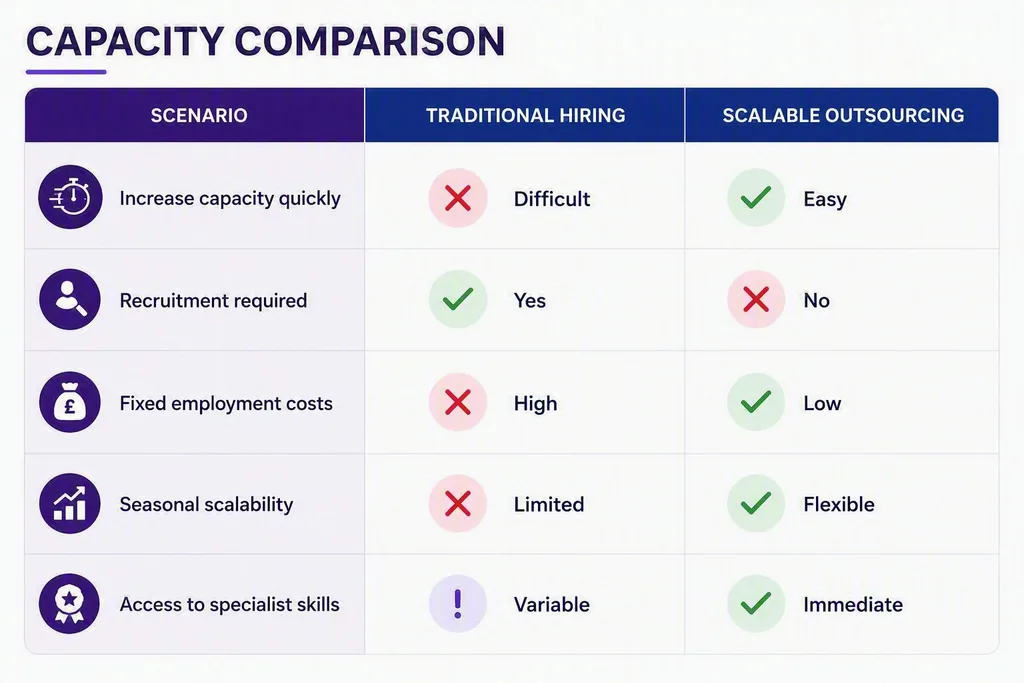
Most firms know their pressure points months in advance. The problem is that fixed teams are often sized for an average month, not the busiest one. Flexible accounting support lets a practice build a seasonal bench for predictable surges, so peak workload planning becomes a controlled calendar exercise rather than a January emergency.
Permanent recruitment is still essential for core capability, but hiring for every spike can leave firms with underused capacity in quieter months. Accounting outsourcing for growing businesses gives firms another lever: keep client-facing expertise in-house, then flex delivery capacity around recurring compliance and finance tasks.
Scalable finance and accounting services work best when the outsourced role is clearly defined. The aim is not to hand over client relationships. It is to give your internal team more reliable production capacity, cleaner workflow and better visibility over deadlines.
Common use cases include:
A practical rule is to outsource accounting services with clear inputs, repeatable processes, and measurable outputs first. Keep complex client advice, judgement-heavy technical positions, and sensitive relationship conversations with your UK team unless the provider is explicitly scoped and qualified to support them.
Accounting capacity planning is the process of matching expected workload to available people, skills, systems, and deadlines. It should happen before a busy period, not once the team is already stretched. Start with the work you can forecast, then decide what stays in-house, what can move to outsourced finance teams, and what needs extra review.
A useful planning rhythm:
Instead of a table, think of capacity in three bands:
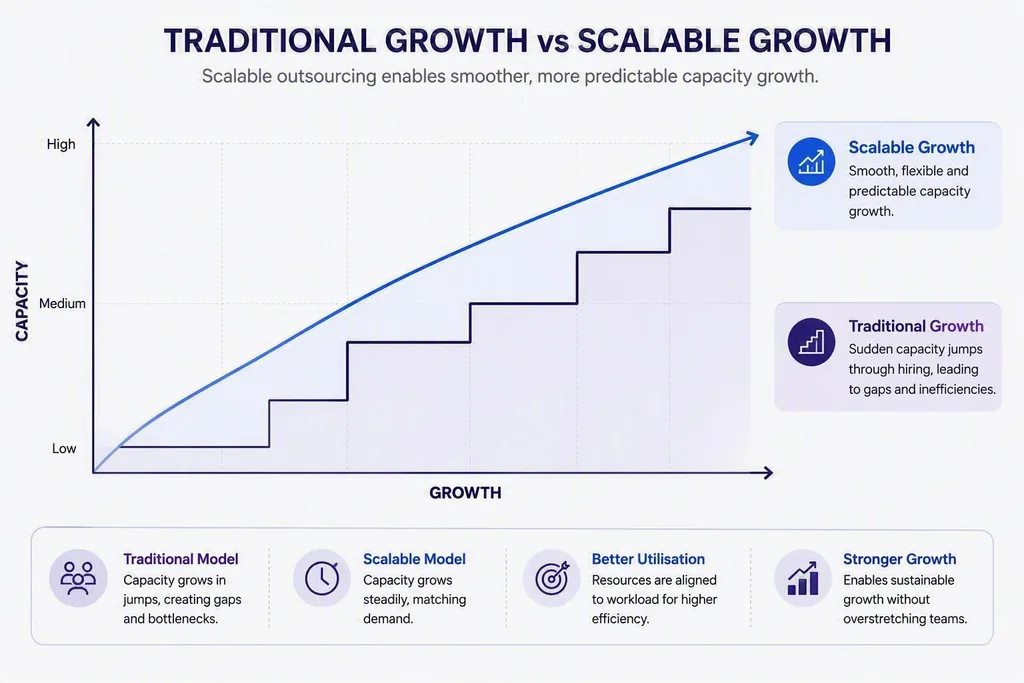
This model helps protect margins because firms are no longer forced to choose between declining work, overworking staff or hiring ahead of confirmed demand.
For many firms, outsourcing succeeds or fails based on the partner selected.
At QX Accounting Services, we help accounting firms move beyond short-term staffing fixes and build scalable operating models that support sustainable growth.
We support firms with:
Our goal is simple: help firms increase capacity, improve efficiency, and grow with confidence.
The future of accountancy is not about building the largest internal team. It is about building the most adaptable delivery model.
Firms that can rapidly scale capacity, respond to changing client needs, manage regulatory changes, and maintain profitability will be better positioned for long-term success.
Scalable accounting outsourcing solutions provide a practical way to achieve that balance. Rather than choosing between growth and control, firms can achieve both.
Accounting outsourcing allows firms to access additional delivery capacity through external teams rather than hiring internally. This enables firms to take on more clients, increase service offerings, and improve turnaround times without committing to permanent salaries, recruitment costs, or additional infrastructure.
Scalable accounting solutions allow firms to increase resources during busy periods such as Self-Assessment season, year-end accounts preparation, payroll deadlines, or audit peaks. Capacity can then be reduced when workloads normalise, ensuring resources align with demand.
Businesses should evaluate:
Scalable outsourcing converts fixed employment costs into variable operating costs. Businesses pay for the capacity they need while avoiding recruitment expenses, training costs, office overheads, and periods of underutilised staff.
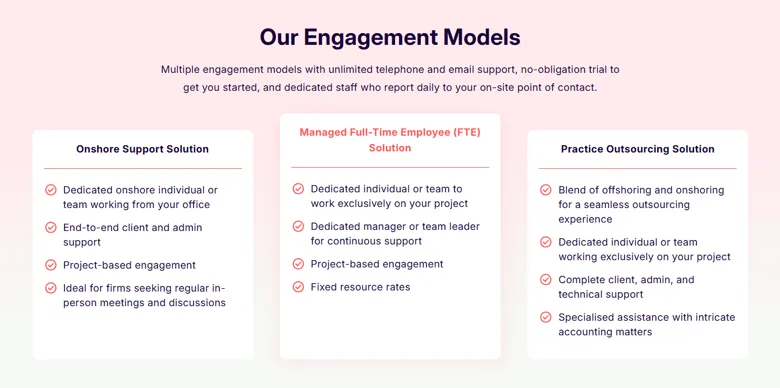
UK businesses and accounting firms choose QX because of our combination of accounting expertise, scalable engagement models, flexible resourcing, compliance-focused processes, and experience supporting firms through periods of growth, transformation, and seasonal demand. QX provides ad-hoc support, peak season support, and dedicated teams designed to scale alongside client needs.

Mustufa is a Chartered Accountant with 10 years of progressive experience across Indian, Canadian, and UK accounting domains. He has a proven track record of leading high-performing teams of 60+ members, managing multi-client portfolios, and driving operational excellence with measurable profitability improvements.
Unauthorized copying or plagiarism of our content is a violation of intellectual property rights. We take such matters seriously and will pursue legal action to protect our original work. Anyone found engaging in such activities will be held accountable under applicable laws.
Explore outsourcing solutions, request a no-obligation trial or discuss your practice’s needs with our expert consultants.





 Book a Virtual Meeting
  Book an In-person Meeting