Reducing Tax Season Stress: Workflow Strategies That Help CPA Firms Scale Efficiently



This article explains how CPA firms can reduce tax season pressure by turning preparation, review, client follow-up, automation, outsourcing, and workflow metrics into a repeatable operating system. The core message is simple: firms scale more efficiently when they standardize the work before peak season, measure bottlenecks weekly, and reserve senior capacity for review, client communication, and judgment-heavy tax issues.
Tax season does not have to feel like a months-long emergency. For CPA firms in the United States, the difference between burnout and steady growth often comes down to workflow: how work enters the firm, who touches it, what gets automated, and how capacity is planned before deadlines arrive. With scalable tax preparation workflows, clearer roles, and smart use of outsourcing tax season support, firms can protect quality while serving more clients efficiently.
“Tax season pressure does not disappear because firms work harder. It eases when every return has a clear path, every handoff has ownership, and every bottleneck is visible before it becomes urgent.”
Cora Vollmar, Sr VP Growth, QX Accounting Services
- What makes tax season so stressful for CPA firms?
- Scalable workflows start before the first deadline
- Standardization turns complexity into repeatable work
- Automation removes friction from the busiest weeks
- Outsourcing expands capacity without losing control
- The best workflow strategies connect people, process, and technology
- Metrics make tax season manageable
- Conclusion
- FAQs
What makes tax season so stressful for CPA firms?
Tax season becomes stressful when demand rises faster than the firm’s systems can absorb it. During tax filing season, firms may be handling individual Form 1040 returns, business returns, client questions, missing documents, Internal Revenue Service (IRS) correspondence, review queues, e-signatures, and last-minute extensions at the same time. Without a structured process, every return feels custom, every delay becomes urgent, and partners spend too much time managing exceptions instead of guiding the firm.
The pressure is not only about volume. It is also about sequencing. A return cannot move forward if source documents are missing, data is entered inconsistently, review notes are unclear, or the client approval process stalls.
That is why CPA firm workflow optimization is less about working faster in a vague sense and more about designing a system where each step is visible, repeatable, and assigned to the right level of talent.
Scalable workflows start before the first deadline
Tax season capacity planning should begin well before the busiest weeks. Firms that wait until the queue is already overloaded tend to solve problems with overtime, rushed hiring, or partner intervention. Those options may help temporarily, but they rarely create lasting tax process efficiency.
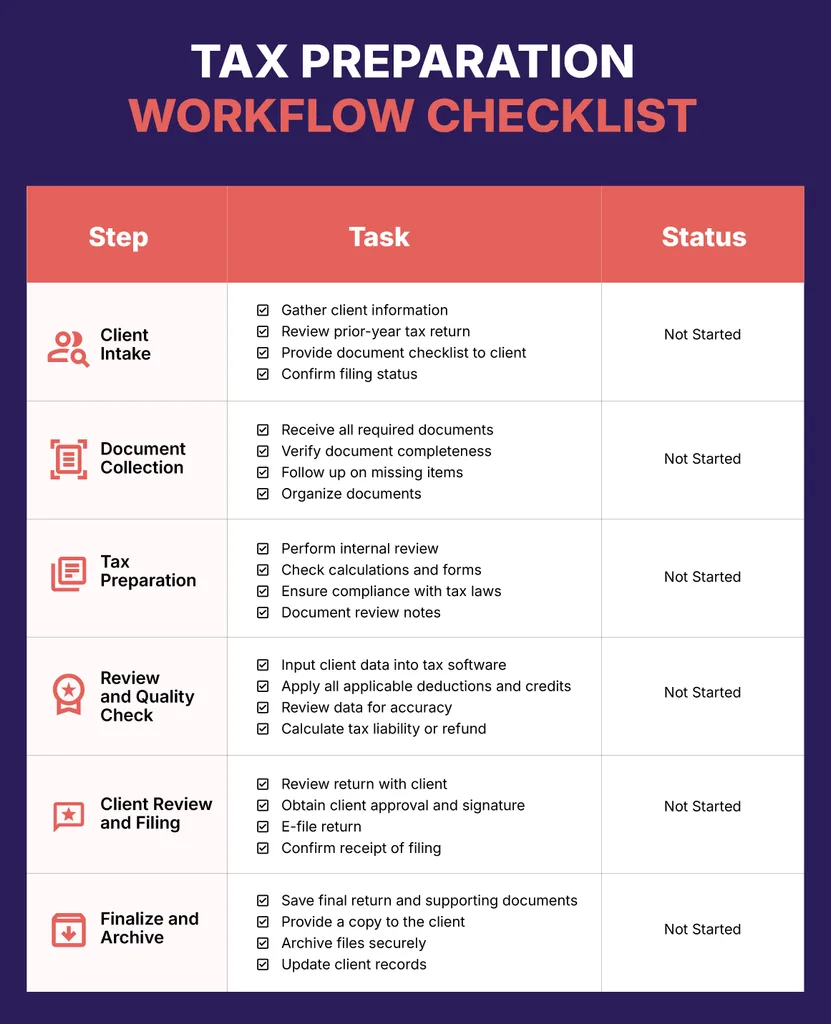
A stronger approach is to map the full journey of a return from client request to final delivery. This includes intake, document collection, preparation, review, client questions, e-signature, filing, and archiving.
When each stage is defined, leaders can spot where work piles up and build capacity around the constraint.
Practical planning steps include:
- Segment clients by return complexity, entity type, deadline sensitivity, and advisory needs.
- Estimate expected volume by week rather than looking only at total seasonal return count.
- Assign work based on skill level, not availability alone.
- Create clear escalation rules for missing documents, unusual tax positions, and client delays.
- Build extension workflows early so they do not become a last-minute scramble.
- Decide which tasks can be automated, standardized, delegated, or outsourced.
This planning gives managers a realistic picture of workload balancing during tax season. It also helps the team avoid the common trap of treating every return as equally urgent.
Also Read: Best Tax Outsourcing Companies in USA
Standardization turns complexity into repeatable work
Tax work will always require professional judgment, but the surrounding process should not be reinvented for every client. Standardization helps firms reduce rework, shorten training time, and keep quality consistent even when volume increases.
For example, a Form 1040 engagement can follow a defined checklist for organizer delivery, document receipt, data entry, preparer questions, first review, final review, client approval, and e-file confirmation. The checklist does not replace expertise. It creates a reliable path so expertise is applied where it matters most.
Standardization works best when it covers both tasks and communication. Client reminders, missing-information requests, review note formats, and delivery messages should be consistent. This makes it easier for staff, reviewers, and outsourced support teams to understand what has happened and what needs to happen next.
A scalable tax workflow management system should define:
- Required documents for each common return type (see: tax client onboarding).
- Naming conventions for files and workpapers.
- Status categories that everyone uses the same way.
- Turnaround expectations for preparation, review, and client response.
- Review note standards that are specific, actionable, and easy to clear.
- Final filing and archival procedures.
When the process is consistent, managers can measure it. And once they can measure it, they can improve it.
Automation removes friction from the busiest weeks
Workflow automation for tax firms is most valuable when it removes repetitive administrative steps that slow professionals down. Automation should not be adopted simply because it is available. It should support the firm’s defined process and reduce manual handoffs.
Common automation opportunities include client reminders, organizer distribution, e-signature routing, status updates, task assignments, due-date tracking, and document requests. When these steps are automated, staff spend less time chasing information and more time moving returns forward.
Automation also improves visibility. A well-designed dashboard can show which returns are awaiting client documents, which are in preparation, which are in review, and which are ready to file. That visibility supports better workload balancing during tax season because managers can shift resources before a bottleneck becomes a crisis.
The key is to keep automation practical. If a workflow is messy offline, automating it may only move the mess faster. Firms should first simplify the process, define ownership, and then automate the repeatable parts. For longer-term planning, it can also help to review what is changing in tax preparation services in 2026.
Outsourcing expands capacity without losing control
Outsourcing tax season support can help firms scale when internal capacity is limited, especially during peak filing periods. The goal is not to hand off responsibility. The goal is to create a structured support layer for defined tasks so internal professionals can focus on review, client communication, advisory work, and complex judgment areas.
Outsourcing can support data entry, workpaper organization, first-pass preparation, document indexing, or other process-driven tasks depending on the firm’s needs and controls. For best results, firms should provide clear instructions, templates, checklists, secure access procedures, and review standards. Outsourced work should enter the same tax workflow management system as internal work, so nothing sits outside the firm’s normal visibility. If security and access controls are a key concern, see how to securely outsource during tax season.
This approach can be especially useful for firms that want to grow without immediately adding full-time staff. It creates flexibility during the peak season while allowing firm leaders to maintain oversight through review checkpoints, documented procedures, and consistent quality expectations. Many firms also choose a blended approach that combines internal oversight with external preparation support to keep work moving without losing control.
The best workflow strategies connect people, process, and technology
Tax season workflow strategies work best when they are not treated as separate initiatives. A firm may have strong staff but weak status tracking. It may have good software but inconsistent intake. It may outsource tasks but fail to document expectations. Sustainable improvement comes from aligning all three: people, process, and technology.
A practical workflow improvement plan might include:
- Clarify roles. Define who handles intake, preparation, review, client follow-up, e-filing, and final delivery.
- Reduce preventable questions. Improve organizers, intake forms, and document request templates.
- Create return-type playbooks. Build repeatable steps for common individual, business, trust, and nonprofit engagements.
- Use automation selectively. Automate reminders, due dates, status updates, and routing where the process is already clear.
- Add flexible support. Use outsourcing to handle defined seasonal tasks that do not require partner-level judgment.
- Monitor bottlenecks weekly. Review where work is stuck and adjust assignments before deadlines tighten.
- Debrief after filing season. Capture lessons while they are fresh, then update checklists and workflows for next year.
These steps help firms increase tax process efficiency without pushing the team into constant overtime. For change management and training, a structured approach to building a future-ready tax workforce can make workflow improvements easier to sustain.
Metrics make tax season manageable
A workflow that cannot be measured is hard to manage. During peak weeks, leaders need simple, reliable indicators that show whether the firm is on track. Too many metrics can create noise, but a focused set can reveal capacity gaps early.
Useful metrics include return count by status, average days in each workflow stage, number of returns waiting on clients, number of returns waiting on review, review notes per return, rework rate, preparer capacity, reviewer capacity, extension volume, and filing completion rate. Firms can also monitor client response time and the age of open tasks.
The practical value of these metrics is decision-making. If review is the bottleneck, adding more preparers will not solve the problem. If client documents are late, better reminders and earlier intake may matter more than more staff hours. Metrics help firms respond to the real issue instead of guessing.
Conclusion
Reducing tax season stress starts with building a workflow that gives firms more control before the pressure peaks. When CPA firms standardize intake, automate repeatable steps, use outsourcing strategically, and monitor bottlenecks weekly, they can move work forward without relying on constant overtime or partner intervention.
The firms that scale most effectively do not eliminate the complexity of tax work. They build systems that manage it. With the right workflow foundation, CPA firms can protect quality, support their teams, and create a more predictable experience for clients during the busiest weeks of the year.
Explore QXAS’s tax preparation outsourcing services to add scalable preparation support while keeping review, client communication, and filing responsibility within your firm.
FAQs
How can CPA firms improve capacity without hiring more staff?
CPA firms can improve capacity by standardizing workflows, automating repetitive administrative tasks, improving intake, using clearer client deadlines, reallocating work by skill level, and outsourcing defined seasonal support tasks. The goal is to reserve internal professional time for review, client advisory work, and complex tax issues while reducing time spent on chasing documents, organizing files, and managing routine handoffs.
What are the biggest workflow bottlenecks during tax season?
The biggest bottlenecks often include incomplete client documents, unclear intake, inconsistent workpaper organization, overloaded reviewers, slow client responses, manual status tracking, and last-minute changes close to filing deadlines. Many firms also lose time when review notes are vague or when returns move outside the standard workflow.
How does outsourcing improve workflow efficiency during tax season?
Outsourcing improves workflow efficiency by giving firms flexible support for defined, repeatable tasks during peak demand. When combined with clear checklists, secure processes, and internal review, outsourcing can reduce backlog, speed up preparation stages, and free in-house staff to focus on higher-value work.
Which workflow metrics should CPA firms monitor during peak tax season?
CPA firms should monitor returns by status, turnaround time by stage, open tasks by assignee, returns waiting on client information, review backlog, rework volume, extension count, filing completion rate, staff utilization, and aging work-in-progress. These metrics help leaders identify where capacity is tight and act before deadlines become unmanageable.
How can firms standardize tax preparation processes for better scalability?
Firms can standardize tax preparation by using consistent checklists, document naming rules, intake templates, review note formats, return-type playbooks, and status definitions. Standardization makes training easier, improves quality control, and allows work to move more smoothly between preparers, reviewers, administrators, and outsourced support.
How do workflow automation and outsourcing work together during tax season?
Automation keeps the process moving by routing tasks, sending reminders, tracking due dates, and updating statuses. Outsourcing adds flexible human capacity for work that still requires organization, preparation, or judgment within defined boundaries. Together, they help firms reduce manual friction while expanding seasonal throughput.
Why do high-growth CPA firms invest in workflow optimization before peak tax season?
High-growth firms optimize workflows before peak season because problems become harder to fix once deadlines are close. By improving processes early, they can train teams, test automation, define outsourcing procedures, balance workloads, and create a more predictable client experience before volume reaches its highest point.
Enquire now

Cora Vollmar
With over 20 years of experience in accounting, talent strategy, operations, and business development, Cora Vollmar helps CPA firms solve capacity challenges and build scalable growth strategies. She is an expert in senior-level accounting and CPA recruiting, with a proven track record of helping firms develop talent pipelines, recruit leadership professionals, and address the ongoing accounting talent shortage.
Through strong relationships with State CPA Societies, accounting alliances, and industry organizations, Cora brings valuable insight into firm growth, talent trends, and the future of the profession. At QX Accounting Services, she helps firms leverage global talent, managed services, and workforce strategies to build sustainable capacity and support long-term growth.
Unauthorized copying or plagiarism of our content is a violation of intellectual property rights. We take such matters seriously and will pursue legal action to protect our original work. Anyone found engaging in such activities will be held accountable under applicable laws.
Don't forget to share this post!
Our Latest Insights

Marketing Services
How to Choose an Outsourced Marketing Partner for Your CPA F...
21 September 2026



Let’s Work Together
Explore outsourcing solutions, request a no-obligation trial or discuss your practice’s needs with our expert consultants.
 Book a Virtual Meeting
  Get Your ROI Estimate