



Despite strong demand for accounting services, many firms are struggling to convert growth opportunities into sustainable expansion.
According to research, 73% of accountancy firms have turned away potential clients because they lack the staff capacity to deliver the work, while 71% say talent shortages are actively slowing their growth.
Additionally, 69% report operating at or near full capacity. These numbers point to a growing reality across the profession: the challenge is no longer finding clients. It’s finding the capacity to serve them effectively.
For many firm leaders, winning a new client still feels like an unquestioned success. More clients mean more fees, more visibility, and more opportunity to grow.
But growth rarely unfolds that neatly.
The first few new clients may be absorbed by existing capacity. The next wave starts stretching managers. Before long, partners are reviewing work late into the evening, recruitment becomes a constant priority, turnaround times begin slipping, and service quality is harder to maintain.
This is one of the most overlooked accounting firm growth challenges facing UK practices today.
The problem isn’t demand. It is delivery.
Without sufficient operational capacity, every new client adds pressure to an already stretched system. Growth then starts creating the very problems firms hoped it would solve.
Many accounting firms continue to rely on a straightforward growth formula:
More clients = More revenue = More profit
In reality, there is an often-overlooked middle step:
More clients = More workload = More operational complexity
Each new client introduces additional:
The result is that client growth and operational capacity become tightly linked.
When capacity expands at the same pace as demand, growth remains healthy. When demand outpaces capacity, firms begin experiencing operational strain.
This is where many accounting firm scaling challenges originate.

One of the earliest warning signs of capacity pressure is partner time.
Instead of focusing on:
partners find themselves reviewing accounts, resolving workflow bottlenecks, and firefighting operational issues.
The firm continues growing on paper, but leadership capacity shrinks.
Over time, this creates a ceiling on growth because the people responsible for driving expansion become consumed by delivery.
Historically, firms solved capacity problems by hiring. Today, that approach is increasingly difficult.
Research from Hays found that 77% of UK accountancy and finance employers expected shortages of suitable applicants.
Recruitment challenges create several growth problems:
| Recruitment Challenge | Business Impact |
|---|---|
| Longer hiring cycles | Delayed onboarding of new clients |
| Rising salary costs | Margin pressure |
| High competition for talent | Increased turnover risk |
| Training requirements | Slower productivity ramp-up |
| Specialist skill shortages | Service delivery bottlenecks |
As a result, many firms reach a stage where growth becomes dependent on hiring success.
That is a risky place to be.
Many firms assume capacity issues will become obvious. They rarely do. In fact, they only emerge gradually.
Early Indicators Include:
At first, these symptoms seem manageable.
Collectively, they represent growing accounting firm capacity constraints that eventually limit scalability.
The danger is that firms often continue accepting work during this period, unintentionally magnifying the problem.
One of the most surprising outcomes of rapid growth is declining profitability.
At first glance, this seems counterintuitive. However, growth often introduces hidden costs:
As firms scale, operational complexity rises faster than anticipated.
The result? Revenue grows. Partner stress grows. But profit margins remain flat. Or worse, they decline.
This is one of the most common yet underestimated accounting firm growth challenges.
The following table shows how growth typically affects firm operations.
| Growth Stage | Client Demand | Operational Capacity | Outcome |
|---|---|---|---|
| Stable | Similar growth rates | Aligned | Sustainable growth |
| Expansion | Demand grows faster | Slightly stretched | Pressure begins |
| Capacity Crunch | Demand significantly exceeds delivery capacity | Overloaded | Delays, burnout, reduced quality |
| Scalable Growth | Flexible capacity added | Demand and delivery balanced | Profitable growth |
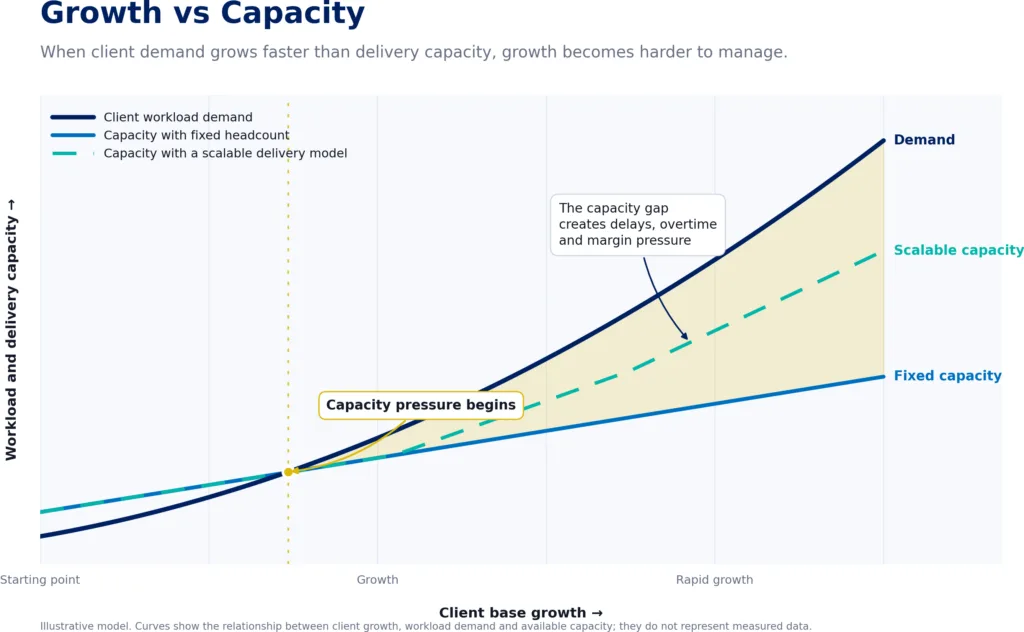
Growth doesn’t only impact internal operations. Sooner or later, clients notice too.
As teams become stretched:
This creates a dangerous contradiction.
The very growth firms worked hard to achieve can begin eroding the client experience that made growth possible.
For firms that rely heavily on referrals and reputation, this can become a long-term threat.
Effective accounting workload management is therefore not simply an operational issue. It is a client retention strategy.
Also Read: Top UK Accounting Outsourcing Companies
High-performing firms increasingly recognise that growth should not rely entirely on local hiring. Instead, they focus on creating scalable accounting operations.
These firms ask a different set of questions:
This shift from a headcount-based model to a capacity-based model is becoming a defining characteristic of successful firms.
Growth becomes easier when capacity can expand faster than recruitment.
Outsourcing has evolved considerably over the past decade. Previously viewed primarily as a cost-saving measure, it is now increasingly used as a growth strategy.
Many firms use outsourced teams to support:
The objective is not to replace in-house teams. It is to remove delivery bottlenecks.
This creates additional capacity without the delays associated with recruitment, onboarding, and training.
For partners experiencing challenges with staff capacity in accounting firms, outsourcing often becomes a way to maintain momentum without increasing fixed costs.
At QX Accounting Services, we work with accounting firms that face a common challenge:
They have strong demand but insufficient delivery capacity to support profitable expansion.
Our approach focuses on helping firms build scalable delivery models through a combination of skilled accounting professionals, established processes, governance frameworks, and technology-enabled workflows.
We support firms across:
Rather than forcing firms into continuous recruitment cycles, we help create flexible capacity that can grow alongside client demand.
This enables firms to:
For many firms, the goal is not simply growing bigger. It is growing sustainably.
Winning new clients is still a positive sign. It reflects market demand, client trust, and a healthy growth trajectory.
But growth without capacity can become a liability.
Many of today’s accounting firm scaling challenges stem not from insufficient demand, but from operational systems struggling to keep pace with success.
The firms that thrive over the next decade are unlikely to be those that hire the fastest. They will be the firms that develop scalable delivery models, optimise workloads, build operational flexibility, and create capacity before they need it.
In other words, the winners will be the firms that learn how to grow smarter, not just bigger.

Winning more clients increases workload, compliance obligations, and review requirements. Without additional resources or scalable processes, firms can experience operational bottlenecks, making growth harder to manage.
Rapid client growth can lead to staff overload, recruitment pressure, delayed delivery, review backlogs, and partner involvement in production work. These are common accounting firm capacity constraints.
Use up and down arrow keys to resize the meta box pane.
Client growth can increase revenue but may also raise recruitment, training, and management costs. If capacity does not scale effectively, profitability and service quality can suffer.
Partners should consider accounting outsourcing services for growing firms when workload consistently exceeds capacity, recruitment becomes difficult, deadlines become challenging to meet, or growth opportunities are being delayed due to resourcing constraints.
Bookkeeping, accounts preparation, tax compliance, payroll processing, audit support, and review functions often become bottlenecks as client numbers increase.
UK accounting firms can scale client delivery through workflow standardisation, automation, technology adoption, resource optimisation, and outsourcing models that provide flexible capacity without permanent hiring commitments.
Outsourced accounting teams provide additional delivery capacity, established processes, and specialist expertise. This helps firms manage increased workload while maintaining turnaround times, quality standards, and client satisfaction.

Richard Huckvale is Sales Director at QX Accounting Services, helping UK accounting firms build scalable, tech-enabled delivery models through outsourcing. With over 20 years of business development experience, he works closely with practices to improve capacity, streamline tax and compliance workflows, and support sustainable growth.
Unauthorized copying or plagiarism of our content is a violation of intellectual property rights. We take such matters seriously and will pursue legal action to protect our original work. Anyone found engaging in such activities will be held accountable under applicable laws.
Explore outsourcing solutions, request a no-obligation trial or discuss your practice’s needs with our expert consultants.





 Book a Virtual Meeting
  Book an In-person Meeting