Common Frustrations with Outsourcing Provider & How to Avoid Them


Outsourcing remains a strategic tool for companies seeking to enhance efficiency, lower costs, and leverage specialized skills. Yet despite its benefits, many outsourcing initiatives fall short of expectations. The reasons vary across industries and engagements, but recurring patterns show why certain partnerships succeed while others collapse.
Some failures stem from misalignment between the company and the vendor. Others arise from unclear expectations, weak oversight, or gaps in communication. Technology limitations and cultural differences also play a role. Regardless of the scenario, most outsourcing breakdowns can be traced back to a handful of preventable issues.
Understanding these common pitfalls is the first step toward building stronger, more predictable outsourcing relationships. Let us understand the key reasons outsourcing fails, along with the practical steps organizations can take to avoid them.
Spot the Red Flags Early
In the outsourcing process, red flags can be identified even before frustrations show up. They usually show up in smaller,yet noticeable signals during the evaluation and the onboarding phase. Most outsourcing failures don’t happen suddenly; they build up from missed cues early in the partnership.
Some common red flags to watch for:
- Vague answers on processes, SLAs, or quality control
- No clear ownership or dedicated team structure
- Overpromising on timelines without operational clarity
- Limited transparency into tools, workflows, or reporting
- Weak track record or inability to share relevant case studies
- Lack of structured onboarding or discovery process
Individually, these may seem minor. But when viewed together, they point to deeper gaps in capability and execution. In fact, structured vetting and reviewing a provider’s track record are critical to identifying these risks early.
Let’s break down the most common frustrations firms experience and how to avoid them.
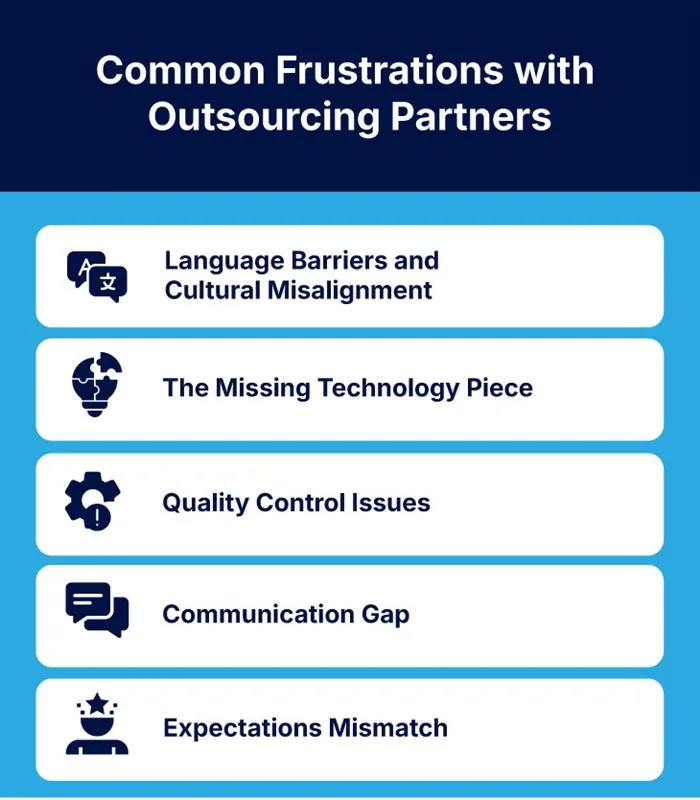
1.Language Barriers and Cultural Misalignment
Communication challenges don’t only come from unclear instructions. They also arise when teams operate with different languages, communication styles, or cultural norms. Even small differences in how teams interpret tone, urgency, hierarchy, or decision-making can create delays and confusion.
When language barriers aren’t addressed early, everyday interactions such as status updates, clarifications, and feedback start to feel more challenging than they should. Over time, this disconnect can slow progress and affect the overall quality of work.
How to Avoid It
- Acknowledge cultural and language differences upfront and adapt your communication style as needed.
- Provide cross-cultural training to both internal teams and the outsourcing partner to build a better understanding and reduce friction.
- Establish clear processes to surface and resolve cultural or communication-related issues early before they impact delivery.
Struggling with outsourcing challenges?
Many U.S. accounting firms face communication gaps, workflow issues, and quality concerns when shifting work offshore.

Watch the webinar “The Death of the Busy Tax Season” to understand how to transition into outsourcing smoothly, without disrupting client delivery.
Click here!2.The Missing Technology Piece
A vendor’s technology environment plays a major role in the success of any outsourced engagement. If their systems are outdated, lack security controls, or cannot support the required workflow, it exposes the company to operational delays, data risks, and reputational harm.
How to Avoid It
- Thoroughly evaluate the vendor’s IT infrastructure before entering into a contract.
- Define security standards and ensure both sides adhere to them consistently.
- Encourage investment in secure, modern tools and conduct periodic reviews to confirm ongoing compliance.
3.Quality Control Issues
When work is handled in-house, managers have direct visibility into the process and can correct issues as they arise. With outsourced work, oversight becomes a little challenging. Especially when there is no consistent method to review quality. Due to this, erros and delays can go unnoticed, until it’s too late to be fixed.
How to Avoid It
- Define quality standards and review procedures prior to the project kick-off.
- Build an internal team responsible for monitoring vendor work through reviews and periodic audits.
- Utilize measurable KPIs to assess vendor performance and promptly identify areas that require improvement.
4.Communication Gap
Communication is the backbone of any outsourcing relationship. When roles, responsibilities, deadlines, and expectations are not clearly defined, misunderstandings are almost guaranteed. Many outsourcing failures occur simply because both sides assumed the other understood the plan.
According to a study, poor communication accounts for 25% of failures in outsourced accounting services.
How to Avoid It
- Establish regular communication channels between internal teams and the vendor.
- Clearly document expectations, responsibilities, deliverables, and timelines for both parties.
- Encourage open escalation paths so concerns can be raised early, before they turn into bigger problems.
5.Expectations Mismatch
When organizations begin the outsourcing process, they often rely on the promises made during vendor evaluations. Many service providers aggressively highlight their strengths. Often overselling their experience or capabilities. As a result, companies enter the partnership expecting more than what the vendor can realistically deliver.
This gap between expectation and execution is one of the most frequent triggers of outsourcing failure.
How to Avoid It
- Conduct a capability assessment before signing contracts.
- Review the vendor’s track record with similar projects and ask for detailed case examples.
- Utilize a structured vendor-vetting program during onboarding to identify potential red flags early.
Interested in learning how to securely outsource your accounting in 2026? Check out our latest blog post- Secure Accounting Outsourcing for CPA Firms in 2026: An Expert Guide
Preventing Outsourcing Failure Requires Intentional Planning
Outsourcing can reduce costs, improve efficiency, and expand operational capacity. The most common reasons engagements fail include unclear communication, unrealistic expectations, and insufficient planning.
Organizations that consistently succeed with outsourcing tend to:
- Build trust through transparency
- Define clear quality benchmarks and performance measures
- Maintain structured and frequent communication
- Recognize and adapt to cultural and language differences
- Ensure vendors operate with a strong, secure infrastructure
- Prepare contingency plans for unexpected issues
- Avoid over-reliance on any single vendor
- Maintain disciplined internal project management
Partnering with a strategic and dependable provider also plays a major role in reducing risk. A mature outsourcing firm like QX Accounting Services brings tested processes, structured workflows, strong quality controls, and well-trained teams. Thus, helping organizations avoid many of the pitfalls that commonly derail outsourcing relationships. With this foundation in place, companies can invest their time in driving outcomes rather than resolving vendor challenges.
With the right structure and the right partner, outsourcing can become a stable engine for growth, rather than an operational burden. Let us connect and discuss this further.
FAQs
Why do communication gaps occur when working with outsourcing partners?
Communication gaps often stem from vague expectations, undefined roles, and unclear communication routines. When SOPs, timelines, and responsibilities are not documented properly, both sides tend to make assumptions, leading to gaps in the processes. Often resulting in misalignment and low-quality work.
How can language and cultural differences impact outsourced accounting teams?
Language and cultural differences shape many aspects of the outsourced accounting industry. These include feedback, SOPs, understanding of SOPs, and much more. If left unchecked, these differences can stall turnaround times, dilute accuracy, and make teamwork harder for outsourced accounting teams.
What technology challenges can arise when outsourcing accounting or bookkeeping services?
Technology hurdles show up in various shapes and sizes. For example, mismatched systems, weak security protocols, outdated vendor infrastructure, etc. When your outsourcing partner cannot sync with your existing accounting software or meet your data security standards, it results in inefficiencies, delays, and potential compliance headaches.
How do quality control issues affect outsourced work delivery?
When structured review processes are missing, mistakes slip through the cracks. This often leads to a scramble to fix errors, affecting turnaround time, quality, client trust, and the outsourcing provider’s reputation. Control and oversight problems thrive when there are no clear KPIs, review checkpoints, or performance-tracking mechanisms.
Why do expectations often mismatch between companies and outsourcing vendors?
Expectation mismatches often happen when vendors paint an overly rosy picture during pitch calls. This also occurs when businesses skip defining the scope and deliverables. In both scenarios, it is extremely important to conduct thorough onboarding, provide clear documentation, and set realistic timelines.
What steps can businesses take to avoid outsourcing partnership failures?
Businesses can overcome outsourcing pitfalls by building a solid foundation from day one. This means choosing experienced accounting partners, setting clear SLAs, tracking measurable results, and keeping communication lines open.
Key steps include:
- Conduct thorough vendor evaluation and due diligence.
- Start with a pilot phase before full-scale engagement.
- Establish clear workflows and documentation.
- Monitor performance through regular reviews and audits.
- Ensure alignment on technology, security, and compliance.
Following these steps lays the groundwork for a strong outsourcing partnership and sets the stage for lasting success.
Enquire now

Vishal Shah
With 13 years of experience in accounting and bookkeeping, Vishal Shah leads QX’s accounting operations, managing a 65+ member team. He specializes in process efficiency, quality control, and client delivery across industries, including SaaS, real estate, and workforce management. Vishal’s leadership drives scale, speed, and client satisfaction for CPA firms.
Unauthorized copying or plagiarism of our content is a violation of intellectual property rights. We take such matters seriously and will pursue legal action to protect our original work. Anyone found engaging in such activities will be held accountable under applicable laws.
Don't forget to share this post!
Our Latest Insights




Let’s Work Together
Explore outsourcing solutions, request a no-obligation trial or discuss your practice’s needs with our expert consultants.
 Book a Virtual Meeting
  Get Your ROI Estimate