5 Reasons to Choose a Tax Outsourcing Service for Extension Season



By August, the extension list ceases to become a future concern.
The September 15 deadline is getting closer, and October 15 is already visible behind it. Returns are beginning to move, but rarely in a clean or predictable order. Some clients have submitted everything. Others are still waiting on K-1s, corrected statements, or answers from third parties. Meanwhile, tax teams are trying to balance preparation, review, client communication, quarterly work, and the planning conversations that cannot keep being pushed aside.
This is the point when a firm’s real capacity becomes clear.
The number of people on the team tells only part of the story. What matters now is how many returns can move from documents received to review-ready without overwhelming the professionals responsible for quality and final sign-off.
That is why a tax outsourcing service for extension season becomes particularly relevant in August. It gives CPA firms a way to create preparation capacity while there is still time to improve the flow of work ahead of the major extension deadlines.
The value is not simply having more people available. It is creating a better match between the work that needs to be completed and the expertise of the people currently doing it.
What Does Tax Outsourcing Look Like During Extension Season?
Tax outsourcing allows a CPA firm to assign defined preparation and supporting activities to an external tax team while retaining control of the client relationship, review, and final sign-off.
The work may include source-document organization, workpaper preparation, individual and business return preparation, federal and state forms, open-item tracking, and updates when additional client information arrives.
The exact scope will vary between firms. A practice with a large volume of extended individual returns may want support with 1040 preparation. Another may need experienced professionals for partnerships and S corporations. A third may have sufficient preparation capacity but need a more reliable process for organizing files before they reach a reviewer.
The question is not, “What can we outsource?”
A better question is, “Which work is consuming internal capacity without requiring internal judgment?”
That distinction helps firms keep complex decisions in the right hands while moving repeatable preparation work through a more scalable delivery process.
Overview of Tax Preparation Services for Extension Season
Extension work is rarely one uniform queue. It contains different return types, complexity levels, documentation gaps, and client expectations.
Some returns are ready to begin immediately. Others require limited follow-up. A smaller group may involve technical issues that need to remain with senior professionals from the outset.
Effective outsourced tax preparation services recognize these differences. Suitable returns are routed for preparation, while exceptions are identified early and escalated to the appropriate person. The objective is to reduce the time reviewers spend discovering missing information or untangling incomplete work.
This becomes especially important as the deadlines approach. A return that appears to be “in progress” can still be several steps away from review-ready. Firms need a clear view of what has been prepared, what is blocked, what needs an answer, and what is ready for internal review.
Outsourcing is most useful when it improves that visibility alongside increasing preparation capacity.
Five Reasons to Choose a Tax Outsourcing Service for Extension Season
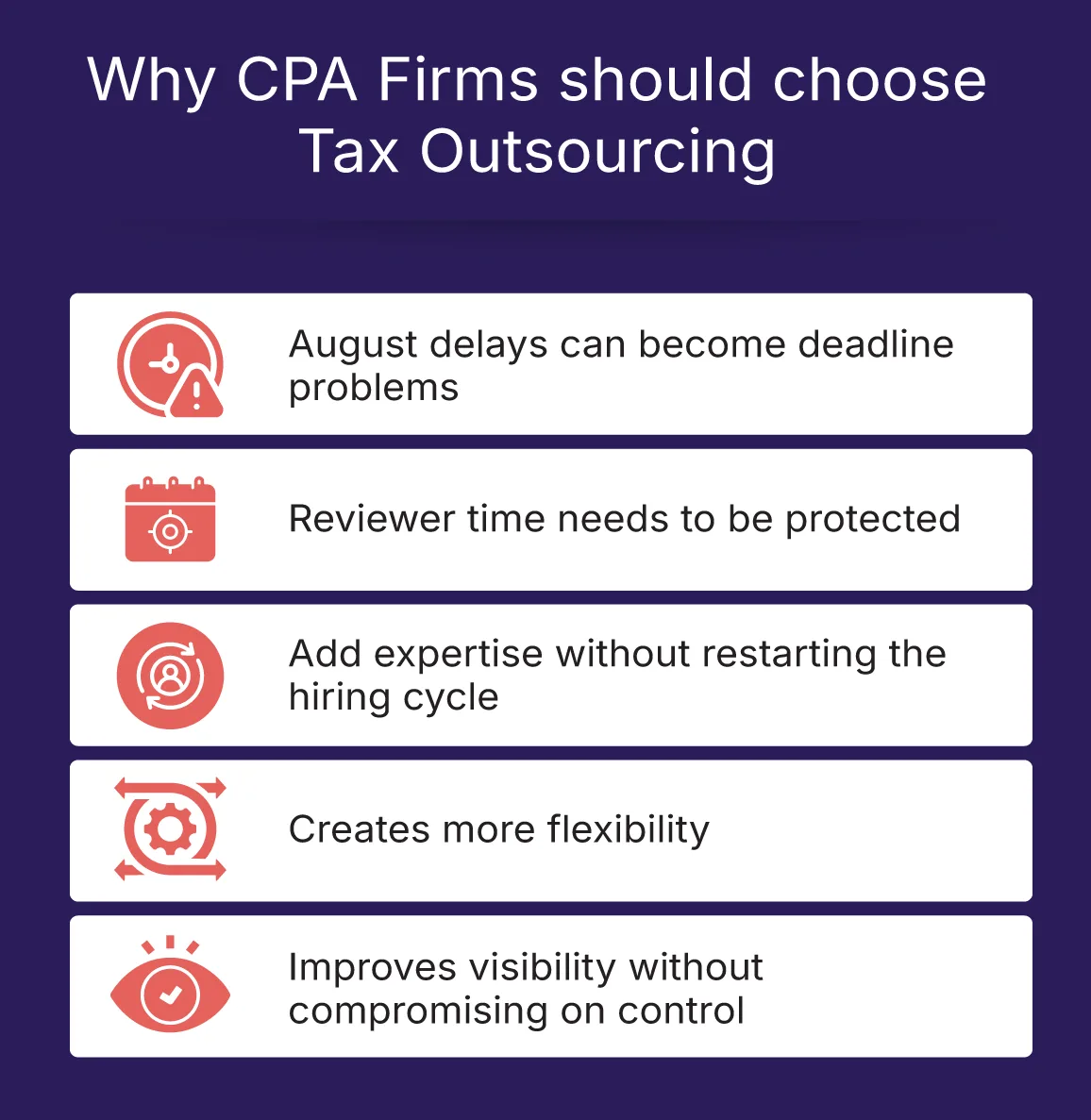
Reason 1: August Delays Can Become Deadline Problems
At this stage, the biggest risk is not always the number of extended returns. It is the amount of work sitting between stages.
A return may be assigned but not started. Preparation may be almost complete but waiting on one missing document. A reviewer may open a file only to find that the workpapers need further attention. Individually, these delays seem manageable. Across an entire extension queue, they consume the weeks remaining before September 15 and October 15.
A tax outsourcing service for extension season can help ready returns enter preparation sooner. It also helps identify missing information earlier, while there is still time to resolve it without turning every client request into an emergency.
Reason 2: Reviewer Time Needs to Be Protected
More preparation capacity does not automatically create more completed returns.
If managers and partners are correcting workpapers, resolving routine questions, or completing unfinished preparation, review remains the real bottleneck. Additional volume simply creates a larger queue.
Experienced professional tax services can prepare suitable returns to an agreed standard, with organized workpapers, visible open items, and routine checks completed before the file reaches the firm.
This allows reviewers to focus on technical judgment, exceptions, and client-specific issues. The value of outsourcing should therefore be measured by more than the number of returns prepared. It should also be measured by the senior capacity given back to the firm.
Reason 3: Add Expertise Without Restarting the Hiring Cycle
By August, hiring and onboarding someone for immediate extension-season relief is difficult. Even an experienced professional needs time to learn the firm’s software, processes, documentation standards, and review preferences.
The longer-term talent picture adds another layer to the challenge. According to the 2025 AICPA Trends Report, the number of accounting bachelor’s and master’s graduates fell to 55,152 in the 2023–24 academic year, a 6.6% decline from the previous year
CPA outsourcing gives firms another route to experienced tax capacity. Depending on the provider and agreed scope, outsourced professionals may support individual, partnership, S corporation, corporate, multi-state, trust, estate, and amended returns.
The right provider should also be honest about fit. Some returns can move efficiently through an outsourced workflow. Others involve judgment, incomplete documentation, or client-specific complexity that should remain with the internal team.
Strategic outsourcing starts with selecting the right work, rather than sending out the largest possible volume.
Need More Capacity Before the Extension Deadlines?
QX’s US-trained tax professionals can support your firm with review-ready tax preparation, structured quality controls and secure delivery.
Discuss Your Extension-Season Capacity
Reason 4: Outsourcing Creates More Flexible Capacity
Extension-season demand rarely arrives evenly.
A large batch of client documents may appear at once. Partnership returns may need to move first because their K-1s affect individual filings. Several prepared returns may reach review together, creating a sudden pressure point.
Outsourcing gives firms greater flexibility to align preparation resources with the work that is ready now. Support may be structured around a defined return volume, dedicated professionals, or a combination of tax expertise and automation.
The financial case should not be reduced to outsourced cost versus employee cost. Firms should also consider partner time spent on preparation, repeated reviewer corrections, overtime, delayed advisory work, and opportunities declined because capacity was unavailable.
The right model is the one that improves the total economics of moving quality work through the firm.
Reason 5: Virtual Tax Filing Improves Visibility Without Giving Up Control
Modern virtual tax filing workflows allow internal and outsourced professionals to collaborate through approved tax software, document systems, and workflow platforms.
A properly structured process gives the firm visibility into what has been prepared, what information is missing, which questions require attention, and what is ready for review. The CPA firm continues to control access, review, final approval, and the client relationship.
Security must remain central. Firms should examine how taxpayer information is accessed, how permissions are managed, what monitoring is in place, and how the provider supports applicable data protection and taxpayer consent requirements.
Technology makes outsourced collaboration possible. Clear governance makes it dependable.
A Note on Audit Support Services
Some outsourcing providers may also offer audit support services, such as organizing supporting documents, retrieving workpapers, and preparing reconciliations.
This should not be confused with professional representation before a tax authority. The exact scope, ownership, and communication responsibilities should be agreed before work begins.
Is Tax Outsourcing the Right Move for Every Firm?
No.
A firm with manageable extension volume, healthy review turnaround, available internal capacity, and consistent workflows may not need additional support.
Outsourcing may also have limited impact if the firm cannot define which work to send, has no available reviewers, or expects an external team to resolve years of inconsistent processes within a few weeks.
The strongest use case appears when a firm can identify a specific source of pressure.
For instance, complete returns are waiting too long to enter preparation. Maybe seniors are spending too much time on routine tasks. Reviewers may be receiving inconsistent work. The firm may also have enough capacity for current clients but no room for unexpected volume or new engagements.
Once the bottleneck is visible, the scope can be designed around it.
In August, a focused pilot may be more useful than a large operational change. One return category, one defined workflow, one accountable internal reviewer, and a meaningful batch of work can reveal whether the model improves delivery.
Choosing a Tax Outsourcing Partner for Extension Season
With the September and October deadlines approaching, firms need more than available capacity. The right partner should understand the returns in your extension queue, work within your tax stack, follow your documentation standards, and deliver work that is genuinely ready for review.
Ask how complexity is assessed, how open items are communicated, how reviewer feedback is incorporated, and what controls protect taxpayer information. Just as importantly, consider whether the provider is recommending a model around your actual bottleneck or simply pushing for more volume.
QX Accounting Services USA gives CPA firms access to US-trained tax professionals within a secure, structured delivery model. Four-eyed review, automation-supported checks, and standardized workflows help move returns toward review while giving firms visibility into progress. Your team retains control of final review, sign-off, and the client relationship.
If your extension queue needs additional support, discuss your extension-season capacity with QX. Our US-trained tax professionals can help move suitable returns toward review through secure processes and structured quality controls
Make the Remaining Weeks Count
Extension season does not become difficult because deadlines are surprising. Everyone knows when they fall. It becomes difficult when work remains hidden in queues, suitable preparation tasks occupy senior professionals, and reviewer capacity is protected too late.
A tax outsourcing service for extension season can help a CPA firm create additional preparation capacity, move returns earlier, and preserve the time of the people responsible for judgment and quality.
The goal is not to send every extended return outside the firm. The goal is to decide which work needs internal expertise and which work simply needs a reliable path to completion.
That decision is especially important in August. There is still time to improve the flow of extension work. There is far less time to recover from a backlog once every return becomes urgent.
Frequently Asked Questions
What is a tax outsourcing service for extension season?
A tax outsourcing service for extension season helps CPA firms add preparation and workflow capacity ahead of extended filing deadlines. Depending on the agreed scope, the outsourced team may organize tax documents, prepare workpapers and draft returns, identify missing information, and submit work for the firm’s internal review.
Is August too late to start outsourcing extension returns?
August may still be practical when the scope is focused, return information is available, and the firm can assign clear internal review ownership. A targeted batch of suitable returns is generally more realistic than attempting a large-scale workflow change close to the deadlines.
Which tax preparation services can be outsourced?
Firms may outsource selected individual and business return preparation, workpaper organization, federal and state forms, open-item tracking, and certain amended return activities. The appropriate scope depends on return complexity, documentation quality, provider capability, and the firm’s review standards.
Can outsourced tax professionals prepare complex returns?
Some outsourcing providers have professionals experienced in complex individual, partnership, corporate, multi-state, trust, and estate returns. Firms should verify the provider’s actual experience and establish clear escalation and review procedures rather than assuming all returns can be managed in the same way.
How does CPA outsourcing help internal reviewers?
CPA outsourcing can move repeatable preparation activities away from senior internal professionals. When returns arrive with organized workpapers, completed routine checks, and clearly documented open items, reviewers can focus more of their time on technical issues, exceptions, and client-specific judgment.
Is tax outsourcing secure?
Security depends on the provider’s controls and the structure of the engagement. Firms should examine data access, storage, monitoring, device restrictions, incident response, confidentiality measures, security attestations, and the provider’s support for applicable taxpayer consent and disclosure requirements.
Does tax outsourcing include audit support services?
Some providers may assist with organizing supporting documentation, retrieving workpapers, preparing reconciliations, or helping the CPA firm assemble information for an audit or tax notice. Firms should verify whether professional representation is included rather than assuming it forms part of general audit support.
Should a CPA firm outsource every extended return?
Usually, no. Firms should consider documentation readiness, return type, complexity, review capacity, and client-specific risk. Repeatable and well-documented work often provides a more controlled starting point than sending the most difficult returns first.
How should a firm choose the right outsourcing model?
The model should reflect the specific bottleneck. A firm with inconsistent volume may prefer a project or per-return arrangement. A firm with recurring demand may benefit from dedicated professionals. A focused pilot can help test quality, communication, security, and workflow compatibility before the scope expands.
Enquire now

Cora Vollmar
Cora Vollmar is a growth-focused executive with over 20 years of experience spanning accounting, operations, talent strategy, and business development. She has a proven track record of scaling high-performing teams, including driving triple-digit growth by building a deep bench of senior-level accounting and CPA talent within a leading staffing organization.
Cora began her career in the construction sector, where she quickly established herself as a results-driven leader. She has since built a reputation for helping organizations navigate the U.S. accounting talent shortage, combining strategic hiring, global talent models, and innovative, STEM-driven solutions to unlock capacity and accelerate growth. She is also a sought-after voice in the industry, leading capacity and workforce strategy discussions nationwide.
Her leadership contributed to recognition on the Inc. 5000 list for one of America’s fastest-growing construction companies for three consecutive years, underscoring her ability to drive sustained, scalable growth.
Today, Cora brings her deep market expertise and strategic mindset to QX Global Group, where she is focused on enabling firms to rethink traditional talent models and build future-ready operating structures.
Outside of work, Cora is an avid traveler who enjoys exploring new cultures, with journeys spanning North America, Europe, the Caribbean, and Central America.
Unauthorized copying or plagiarism of our content is a violation of intellectual property rights. We take such matters seriously and will pursue legal action to protect our original work. Anyone found engaging in such activities will be held accountable under applicable laws.
Don't forget to share this post!
Our Latest Insights



Let’s Work Together
Explore outsourcing solutions, request a no-obligation trial or discuss your practice’s needs with our expert consultants.
 Book a Virtual Meeting
  Get Your ROI Estimate