How CPA Firms Can Clear Extended Tax Returns Faster in 2026?



News Headline:
The Extension Problem Has Changed. Most Firms Haven’t.
Every September, CPA firm owners find themselves asking a version of the same question:“Why does this tax season still feel so hard?”
It’s a fair question. But more importantly, asking these strategically difficult questions is the need of the hour.
Over the past decade, firms have invested heavily in technology. Workflows are more organized than they used to be. Data collection has improved. Tax software is more powerful. In theory, extension season should feel far more manageable than it did ten years ago.
Right? But that’s far from being the case.
The final weeks before the October deadline have become one of the most stressful periods of the year. Returns seem to arrive later. Reviews take longer than expected. Clients who had months to provide information suddenly become urgent. Before long, partners are spending their evenings clearing bottlenecks instead of focusing on the work that actually grows the firm.
One of the potent reasons behind this is the sheer nature of the tax work and how dramatically it has changed. The challenge today is not simply processing more returns. It’s managing more complexity, more client expectations, and more uncertainty within the same fixed deadlines.
That distinction matters because it changes where leaders should focus their attention.
Extension Season Is No Longer an Exception
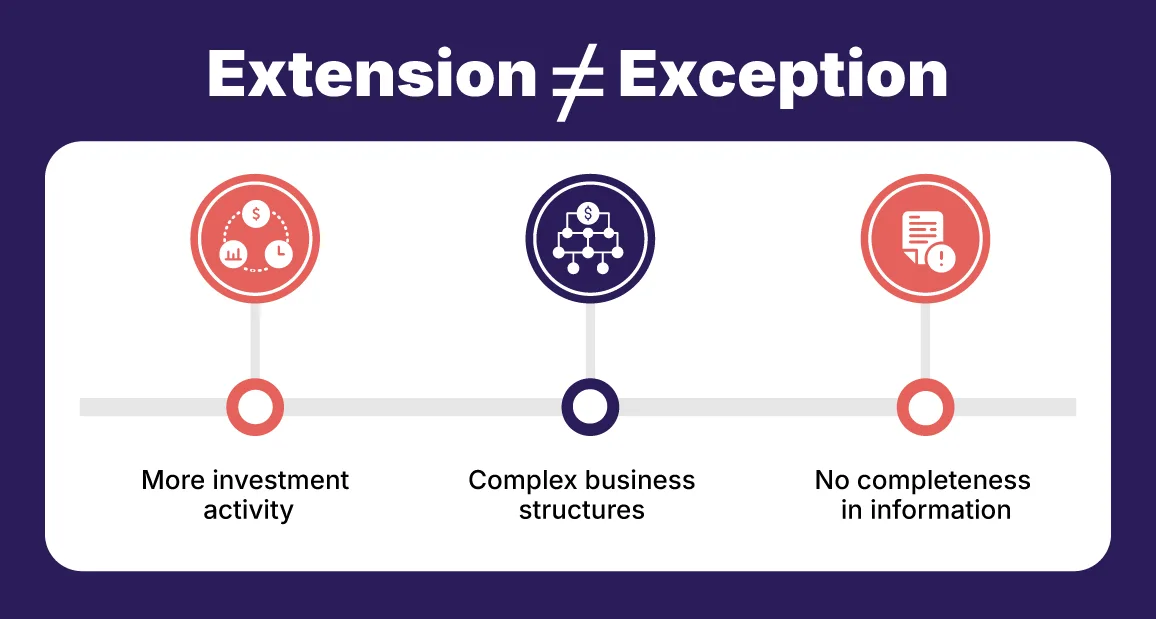
For years, extension work was viewed as the remainder of tax season. Fair enough! The returns that couldn’t be completed by April moved into a second filing period and were handled as capacity allowed.
That assumption no longer holds up.
Many firms now expect a significant percentage of their workload to extend. IRS filing data continues to show tens of millions of taxpayers filing extensions each year, highlighting how extensions have become a routine part of the tax landscape rather than an exception.
In some practices, extension season has become large enough to feel like a second busy season entirely. And there are several reasons behind that shift.
- Taxpayers have more investment activity than they once did.
- Business structures are becoming more complex.
- Information often arrives in stages rather than in one complete package.
- A missing K-1 or delayed brokerage statement can push timelines back by weeks.
But the surprising fact is none of these challenges are new in isolation. The only difference is that they’re now happening at scale.
When dozens or hundreds of returns are affected by the same delays, extension season becomes less of a scheduling issue and more of an operational one. That’s when firms begin realizing that the processes that served them well in April may not be enough in September.
More returns. Less pressure. Same Team
Explore Flexible Tax Preparation Support
Connect with us today!
The Hidden Cost of Growth
What do you think are the firms feeling the greatest pressure?
One observation recurs in conversations with firm leaders. The firms feeling the greatest pressure right now are the ones that are growing.
At first, that seems counterintuitive. More clients, stronger demand, and steady revenue growth should be signs of success. In practice, growth creates its own problems. Truly echoing the famous saying – with great power comes great responsibilities.
As client volumes increase, review workloads tend to become concentrated among a relatively small group of experienced professionals. Preparers move work through the system, but eventually everything arrives at the same place: the review queue.
That’s where extension season often slows down. Not because the work isn’t getting done. Not because the team isn’t capable. But because the firm’s most valuable resource, experienced reviewer time, becomes increasingly difficult to scale.
Most partners recognize this instinctively. They see it every year. Returns are prepared. Questions are resolved. Files move forward. Then they sit waiting for review.
When that happens across a handful of returns, it’s manageable. When it happens across hundreds, it becomes the defining challenge of extension season.
Why Technology Hasn’t Solved This?
The accounting profession has spent years discussing automation as the answer to capacity constraints. To be clear, automation has created enormous benefits. Data collection is faster. Document management is cleaner. Routine tasks require less manual effort.
Technology has limits.
Clients still submit information at the last minute. Complex returns still require professional judgment. Tax planning discussions still depend on experience and context. Perhaps most importantly, quality control still rests with trusted professionals who understand the client’s situation.
Technology improves workflows. It doesn’t eliminate decision-making.
That’s why firms expecting software alone to solve extension season challenges often end up disappointed. The real gains rarely come from a new feature or another dashboard.
They come from improving how work moves through the firm. The firms that seem calm in late September aren’t necessarily using radically different technology. More often, they’ve become disciplined about visibility. They know what work is waiting, what’s at risk, and where bottlenecks are forming before deadlines get close.
That awareness allows them to act earlier, when solutions are still available.
The Firms Moving Faster Are Thinking Differently About Capacity
Perhaps the biggest shift happening within leading firms is how they think about capacity itself. Traditionally, capacity was measured in headcount. If the workload increased, the solution was to hire more people. Today, that mindset is becoming harder to sustain.
Experienced tax professionals remain difficult to find. Competition for talent remains intense. Even firms willing to pay premium salaries frequently struggle to recruit the people they need.
As a result, many leaders are starting to ask a different question.
Instead of asking, “How many people do we need?” they’re asking a different question. One which makes more sense: “Which work truly requires our people?” It’s a subtle distinction, but it leads to very different decisions.
The firms handling extension season most effectively are increasingly protective of where partner and manager time gets spent. They’re focusing their experienced professionals on client relationships, advisory work, planning, and final review. Everything else is being evaluated through the lens of efficiency, consistency, and scalability.
That shift doesn’t just improve turnaround times. It creates a firm that is less dependent on heroics every September.
Also Read: Top Tax Outsourcing Companies in the USA
The Firms Creating Breathing Room Are Taking a Different Approach
One of the more interesting shifts happening across the profession is how firm leaders are redefining capacity.
Historically, capacity meant headcount. A growing workload meant hiring more people. Today, that equation feels less predictable. Experienced tax professionals remain difficult to find, and many firms are questioning whether every piece of tax preparation work truly needs to sit with their highest-value employees.
The firms navigating extension season most effectively seem to be making a distinction between work that drives client relationships and work that supports those relationships.
Partners remain focused on advisory conversations, planning opportunities, and final review. Preparation work becomes more flexible.
That’s one reason outsourced tax preparation has become a more strategic conversation in recent years. Not because firms are looking to replace their people, but because they’re looking to protect them. When additional capacity can be added during peak periods without sacrificing quality or control, partners gain something far more valuable than a faster turnaround. They gain breathing room.
At QX Accounting Services, we’ve seen this shift firsthand. Increasingly, firms are using outsourced tax preparation support not as a temporary fix for one difficult season, but as part of a broader strategy to create more predictable operations during extension periods. The goal isn’t simply to clear returns before a deadline. It’s to help firms maintain service quality, reduce pressure on senior staff, and create space for higher-value client work.
And for many firms, that may be the more important conversation heading into 2026.
For more information, connect with us today. Click here!
FAQs
1. Why are more tax returns being extended by CPA firms today?
Tax extensions have become increasingly common as returns grow more complex. Delayed K-1s, multi-state filings, investment income reporting, trusts, estates, and business ownership structures often require additional time and documentation. For many CPA firms, extension season is no longer an exception to tax season. It has become a significant part of the annual workload that must be managed strategically.
2. What is the biggest bottleneck during extension season for CPA firms?
For many firms, the greatest constraint is not tax preparation capacity but review capacity. Returns may be prepared on time, yet remain stuck in review queues waiting for senior staff or partners. As firms grow, reviewer time becomes increasingly difficult to scale, making review bottlenecks one of the primary reasons extended tax returns remain open close to filing deadlines.
3. How can CPA firms clear extended tax returns faster without hiring additional full-time staff?
The firms that move work through extension season most efficiently focus on flexible capacity rather than permanent headcount. Many use outsourced tax preparation support to handle preparation-heavy tasks while keeping client communication, tax planning, and final review in-house. This allows firms to increase throughput during peak periods without carrying year-round staffing costs
4. Does tax preparation outsourcing help during extension season?
Yes. Tax preparation outsourcing can help reduce return backlogs by providing additional preparation capacity during peak workloads. Many CPA firms use outsourced teams for tasks such as 1040 preparation, workpaper preparation, diagnostics cleanup, and data processing, while maintaining control over review, tax positions, and client relationships
5. How do leading CPA firms manage tax season capacity in 2026?
Many leading firms are shifting away from viewing capacity as a hiring problem alone. Instead, they create scalable operating models that combine technology, workflow visibility, standardized processes, and flexible tax preparation support. This approach allows partners and managers to spend more time on advisory services, client relationships, and final review rather than production work.
6. What should CPA firms look for in a tax preparation outsourcing partner?
CPA firms should prioritize partners that offer experienced tax professionals, strong quality-control processes, transparent communication, secure data handling, and the ability to integrate with existing workflows. The most effective outsourcing relationships allow firms to maintain complete control over client service and review standards while adding the capacity needed to meet extension-season deadlines.
Enquire now

Cora Vollmar
Cora Vollmar is a growth-focused executive with over 20 years of experience spanning accounting, operations, talent strategy, and business development. She has a proven track record of scaling high-performing teams, including driving triple-digit growth by building a deep bench of senior-level accounting and CPA talent within a leading staffing organization.
Cora began her career in the construction sector, where she quickly established herself as a results-driven leader. She has since built a reputation for helping organizations navigate the U.S. accounting talent shortage, combining strategic hiring, global talent models, and innovative, STEM-driven solutions to unlock capacity and accelerate growth. She is also a sought-after voice in the industry, leading capacity and workforce strategy discussions nationwide.
Her leadership contributed to recognition on the Inc. 5000 list for one of America’s fastest-growing construction companies for three consecutive years, underscoring her ability to drive sustained, scalable growth.
Today, Cora brings her deep market expertise and strategic mindset to QX Global Group, where she is focused on enabling firms to rethink traditional talent models and build future-ready operating structures.
Outside of work, Cora is an avid traveler who enjoys exploring new cultures, with journeys spanning North America, Europe, the Caribbean, and Central America.
Unauthorized copying or plagiarism of our content is a violation of intellectual property rights. We take such matters seriously and will pursue legal action to protect our original work. Anyone found engaging in such activities will be held accountable under applicable laws.
Don't forget to share this post!
Our Latest Insights



Let’s Work Together
Explore outsourcing solutions, request a no-obligation trial or discuss your practice’s needs with our expert consultants.
 Book a Virtual Meeting
  Get Your ROI Estimate