



Accounting firms that offshore tax preparation services UK must protect client confidentiality, control overseas access, and demonstrate GDPR compliance.
The UK Government’s 2025/2026 survey found that 54% of businesses in the broad professional, scientific and technical sector identified a cyber breach or attack in the preceding year, not an accounting-only or offshore-outsourcing measure.
The practical response is to establish responsibilities, lawful transfers, and tested security controls before sharing client files. This article explains what to check, including when evaluating QXAS for tax preparation outsourcing services.
GDPR compliance for tax outsourcing requires lawful, transparent personal data processing, appropriate security, enforceable processor arrangements, and compliance with international transfer rules where applicable. Outsourcing does not remove these duties. Start by mapping the information involved, its purpose, who accesses it and every organisation receiving it.
For your offshore tax data protection review, follow a sample return from document collection through preparation, review, submission, and deletion. Include National Insurance numbers, UTRs, bank details, and information about employees or dependents. Treat that map as the working scope for supplier checks, rather than relying on a generic security questionnaire.
Processor and controller responsibilities depend on actual decision-making, not contractual labels. A firm determining why and how client tax information is used will generally be a controller, while a provider preparing returns solely under its instructions will generally be a processor. Where the firm itself processes information for another controller, the offshore provider may instead be a sub-processor. Assess each activity separately.
Document who approves access, answers rights requests, authorises sub-processors, and manages incidents. Do not let operational delegation obscure accountability.
Read UK GDPR alongside the Data Protection Act 2018, including amendments made by the Data (Use and Access) Act 2025. Older GDPR tax outsourcing templates may therefore need updating, particularly around international transfers. Review them against current ICO guidance rather than assuming an EU-focused agreement covers UK requirements.
Keep privacy information consistent with the arrangement. Your documented processing arrangements and transfer information should reflect where and how overseas organisations receive access.
Choose and document a lawful basis for each purpose before processing begins. Contracts may apply where processing is necessary to provide services to an individual client, but it does not automatically cover employees or directors of a corporate client. Legal obligation requires an obligation applying to your firm, while legitimate interests require assessment of necessity and people’s interests. Consent is not automatically required simply because work moves offshore.
Avoid treating the client’s tax obligations as a blanket justification for everything your firm does.
Giving a separate overseas provider remote access to UK-held personal information can constitute a restricted international transfer. Keeping servers in Britain does not, by itself, avoid transfer rules. Identify the legal entities, access locations, and onward transfers before choosing a mechanism.
Check applicable UK adequacy regulations. Otherwise, consider appropriate safeguards such as the UK International Data Transfer Agreement or UK Addendum to EU Standard Contractual Clauses. Where required, complete a transfer risk assessment, now described in legislation as the “data protection test”, and implement additional protections identified.
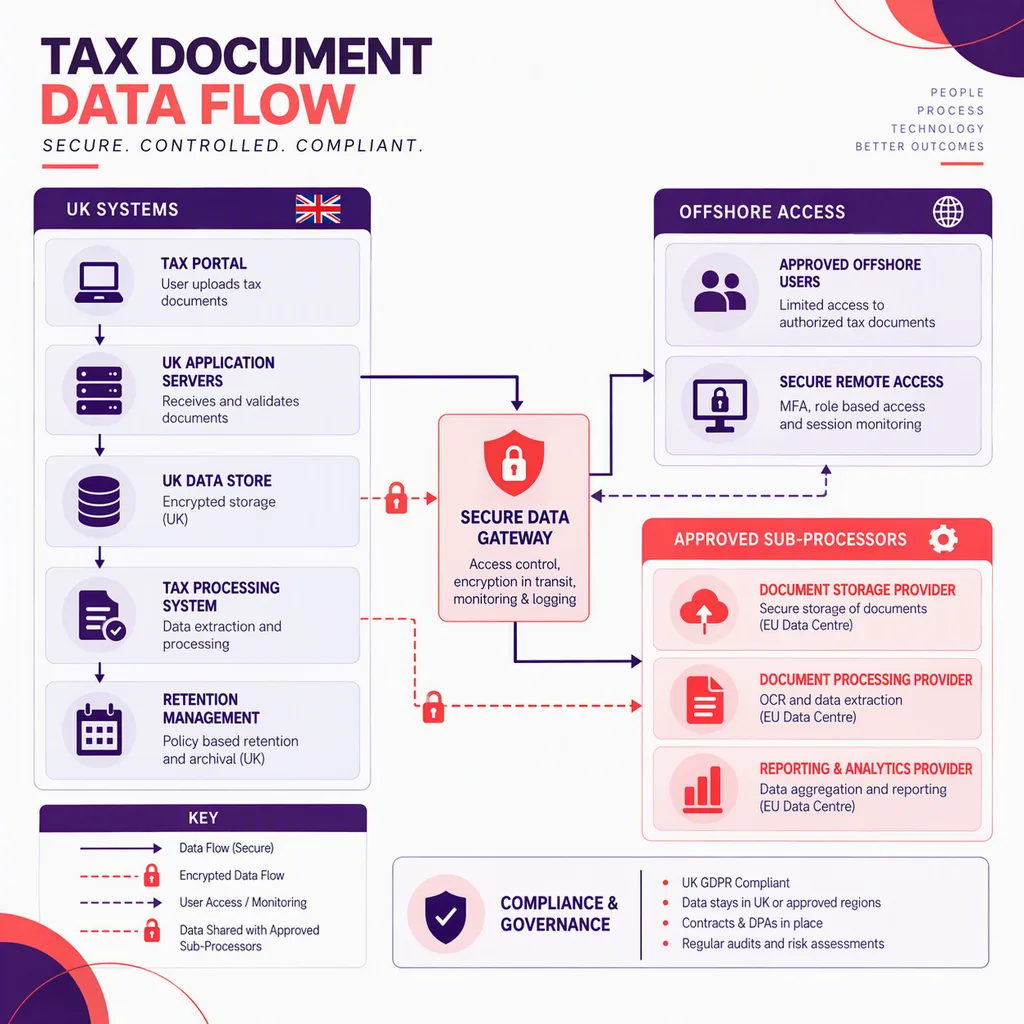
A data protection impact assessment is mandatory where proposed processing is likely to create high risks to individuals. Offshore outsourcing alone does not automatically trigger one. Screening the project remains useful, and a DPIA is good practice for major new processing projects.
Work through four practical steps:
Share information adequate for the task, but no more than necessary. For example, give a preparer the relevant tax-year records rather than unrestricted access to the client’s entire historical folder. Remove unrelated attachments and use redacted or synthetic examples for training where possible. These are practical applications of data minimisation, not reasons to withhold information genuinely needed for accurate preparation.
Ask reviewers to flag excessive access alongside technical errors. Make confidentiality part of the workflow, not just induction training.
UK tax data security offshore needs layered technical and organisational protection. Encryption reduces exposure, but does not eliminate risks from compromised accounts, poor key management, or authorised users mishandling information.
Use the following as a risk-based specification:
The government survey referred to above found 29% of businesses identifying breaches or attacks experienced them at least weekly. Ask how controls operate during ordinary busy-season work, not merely during an audit.
Request evidence before approving access, then revisit it when locations, systems, or sub-processors change. Useful questions include:
Treat certification scope, exclusions, and unresolved findings as decision inputs. A logo is not a substitute for understanding the service you will receive.
Also Read: Tax Outsourcing Companies for UK Accounting Firms
Data processing agreements must translate the engagement into enforceable Article 28 terms. Specify processing scope, duration, purposes, information types, and categories of individuals. Include documented instructions, confidentiality, security, sub-processor authorisation, assistance with rights requests and compliance, end-of-contract arrangements, and audits.
Add practical escalation contacts and agreed incident-reporting expectations. Check that any separate international transfer documentation matches the same entities, activities and security arrangements.
UK GDPR does not prescribe one universal retention period for tax information. Set a justified schedule reflecting relevant legal requirements and processing purposes, distinguishing the firm’s retained records from the provider’s working copies. Avoid indefinite retention “just in case”.
Specify return or deletion at termination and address backups explicitly. Where immediate backup deletion is impracticable, agree safeguards preventing further use, and a defined deletion cycle.
Processors must notify controllers of personal data breaches without undue delay. Controllers must notify the ICO of reportable breaches without undue delay and within 72 hours of awareness; affected individuals must be informed without undue delay where high risk applies. Record breaches even when notification is unnecessary.
Rehearse an offshore account compromise: identify who disables access, preserves logs, assesses affected files and contacts the UK decision-maker. Do not wait for a completed forensic investigation before escalating.
Contracts must require processors to provide compliance information and allow and contribute to audits and inspections. Agree workable evidence requests, access arrangements and remediation tracking.
Use this compact review map to connect evidence with risk:
| Requirement | Offshore risk | Control to examine |
|---|---|---|
| Confidentiality | Excessive access | Permissions and access reviews |
| Transfer safeguards | Unmapped overseas access | Entity map and transfer assessment |
| Storage limitation | Forgotten working copies | Deletion schedule and evidence |
| Accountability | Unsupported assurances | Audit findings and corrective actions |
These checks connect security, transfer, and retention obligations to operational evidence.
QX Accounting Services is a market-leading accounting outsourcing provider, specialising in pre-processing GDPR readiness checks, authorised-user access, controlled external transfers, blocked removable storage, physical access restrictions, and staff security awareness. We boast of ISO 27001:2022 certification, ISO 27701 implementation following a BSI audit, and SOC 2 Type II assurance. These are provider-published statements, not independent verification of every outsourcing project.
For your engagement, request current certificates, audit scope and reports, then confirm the DPA, transfer assessment, incident contacts, and deletion arrangements. GDPR-compliant offshore tax preparation depends on the specific arrangement remaining compliant throughout delivery, not a blanket promise.
For GDPR offshore tax outsourcing, make approval conditional on evidence: mapped access, agreed responsibilities, lawful transfers, and tested controls. Before moving live files, ask QX or your shortlisted provider to walk through that evidence against your actual tax workflow.
UK GDPR applies to the personal data processing involved in tax preparation, whether work is done in-house or by an offshore provider. In practice, that means you should be able to evidence a lawful basis, the data protection principles (including minimisation and storage limitation), appropriate technical and organisational security, and an Article 28-compliant contract with your provider (plus oversight and auditability).
Often, yes. If a separate organisation outside the UK accesses personal data (including via remote access to UK systems), this can be a restricted international transfer and you may need UK transfer safeguards such as the UK IDTA or the UK Addendum, supported by a transfer risk assessment (“data protection test”) where required. Whether it applies depends on the entities involved and where access takes place, not just where the servers sit.
Your firm typically remains the controller for client tax processing decisions, so it retains primary responsibility for compliance and accountability. The offshore provider is usually a processor and must follow your documented instructions, keep data secure, assist with compliance, and notify breaches without undue delay; those duties must be set out contractually and evidenced in delivery.
A Data Processing Agreement (DPA) is the required written contract under Article 28 that governs how the offshore provider processes personal data on your behalf. It should clearly define the processing scope, purposes, duration, security measures, confidentiality, sub-processor controls, assistance with rights requests, breach notification, end-of-contract return/deletion, and audit/inspection rights.
There is no single “GDPR retention period” for tax data. Retention should be limited to what’s necessary for the defined purposes and aligned with your firm’s retention policy and legal/regulatory requirements. In offshore arrangements, set explicit rules for working papers and copies held by the provider, including deletion/return at contract end, and how backup retention is handled.

Dinesh is a seasoned accounting and tax professional with more than 20 years of experience, specialising in UK personal tax. He has a proven track record of streamlining tax processes and building strong client relationships, consistently delivering accurate and compliant taxation services tailored to client needs.
Unauthorized copying or plagiarism of our content is a violation of intellectual property rights. We take such matters seriously and will pursue legal action to protect our original work. Anyone found engaging in such activities will be held accountable under applicable laws.
Explore outsourcing solutions, request a no-obligation trial or discuss your practice’s needs with our expert consultants.





 Book a Virtual Meeting
 Book an In-person Meeting