Managed Payroll Services For US businesses: What They Are and Why To Use Them



Summary:
Managed payroll services help businesses handle the responsibility of payroll processing. These services ensure accurate payroll runs, compliance with changing tax rules, and reduce administrative burden. With rising complexity in payroll regulations and increased pressure on internal teams, many US companies are choosing managed payroll to improve efficiency, reduce risk, and focus resources on strategic growth. This blog answers common questions about what managed payroll services are, when they make sense, and the value they bring to organizations.
Payroll is one of the most critical functions in any business. It affects employee trust, regulatory compliance, and cash flow. Yet, it is also one of the most complex and risk-prone processes to manage internally.
As payroll regulations grow more complex and teams face capacity constraints, many US businesses are rethinking how payroll is delivered. This is where managed payroll services are becoming essential. Not just as a convenient option, but more as a strategic decision.
In this blog, we will cover what managed payroll services are, why US businesses are increasingly adopting them, the benefits they deliver, and when it makes sense to outsource payroll.
What Are Managed Payroll Services?
Managed payroll services refer to outsourcing payroll operations to a specialized provider that takes responsibility for payroll execution, compliance, and ongoing management.
A managed payroll model typically includes
- Payroll calculations and processing
- Tax withholdings and filings
- Compliance with federal, state, and local regulations
- Payslip generation and reporting
- Ongoing support and issue resolution
Instead of handling these steps internally, businesses rely on a dedicated payroll partner with defined processes and accountability.
In a fully managed payroll service, the provider goes beyond processing. They manage timelines, controls, compliance checks, documentation, and exception handling. For US businesses, managed payroll services US models are specifically designed to align with IRS rules, wage laws, and multi-state reporting requirements.
Why Are US Firms Turning to Managed Payroll Services?
Payroll has become harder to manage in-house. This is because regulations keep changing often. State-level requirements keep varying, while errors are becoming costly and highly visible.
Many organizations struggle with:
- Limited internal payroll expertise
- Manual processes and spreadsheets
- Dependency on one or two key employees
- Increased audit and compliance pressure
This is why US businesses are shifting toward managed payroll services instead of relying solely on internal teams. Outsourcing payroll reduces operational risk and frees finance teams to focus on higher-value work.
A fully managed payroll approach also removes the burden of keeping up with regulatory and other compliance changes. The responsibility shifts to a provider whose core focus is payroll accuracy and compliance.
Benefits of Managed Payroll Services
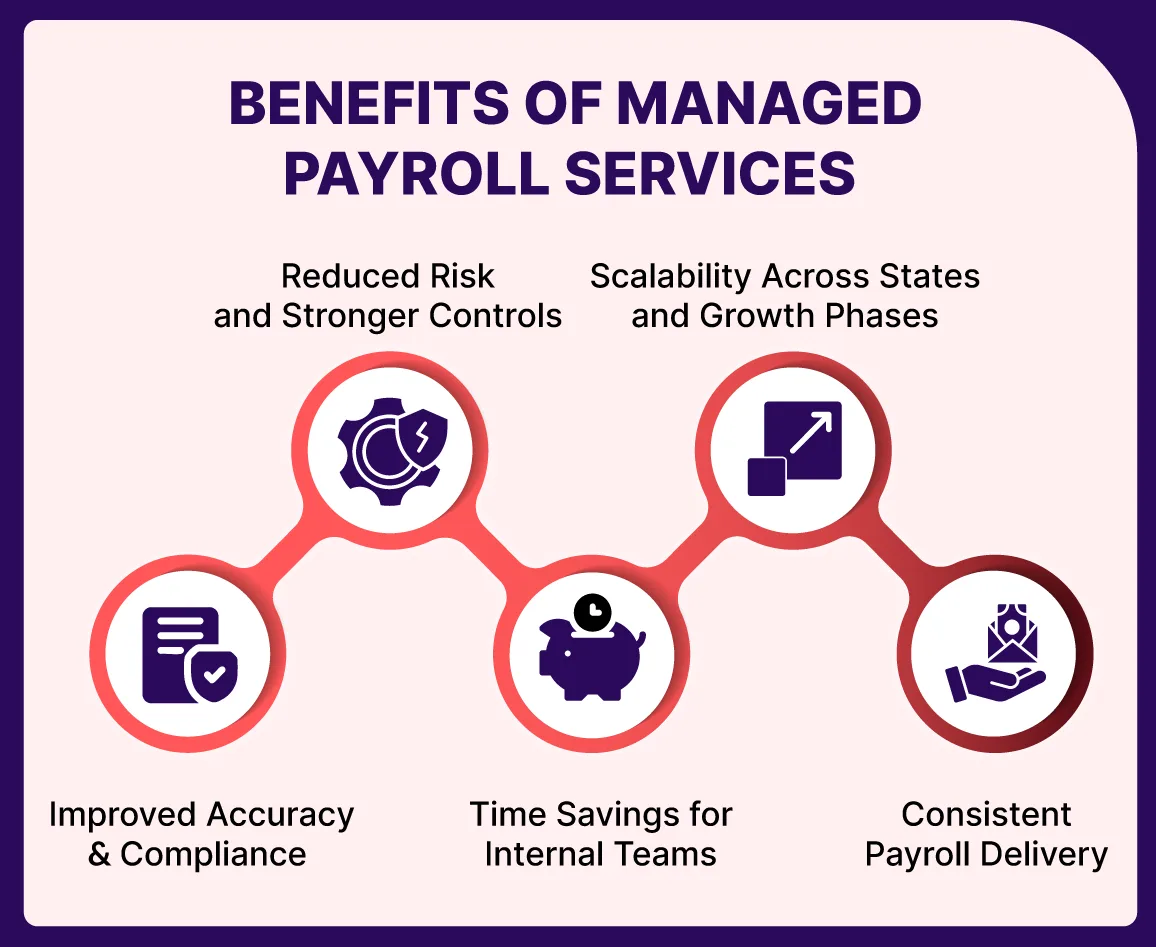
Payroll outsourcing is not just about handing off processing work. For many US businesses, it becomes a way to bring structure, consistency, and control into a function that is often stretched thin. When payroll is managed by a dedicated provider, the benefits extend beyond efficiency. Organizations gain stronger compliance, reduced risk, and more time for their internal teams to focus on strategic priorities.
The following benefits highlight why managed payroll services are increasingly viewed as a long-term operational advantage rather than a short-term fix.

Want to explore how managed payroll services could support your firm’s long-term strategy or got a specific question? Let us connect!
Click Here!1. Improved Accuracy and Compliance
Payroll errors impact employee trust and invite penalties. Managed payroll providers use standardized processes, validations, and review checks to reduce mistakes. They also stay current with federal, state, and local regulations. This ensures filings are accurate and deadlines are consistently met.
2. Reduced Risk and Stronger Controls
A fully managed payroll service introduces segregation of duties, approval workflows, and documented controls. This reduces the risk of unauthorized changes and payroll fraud. It also creates a clear audit trail that strengthens governance and audit readiness.
3. Time Savings for Internal Teams
Payroll processing consumes significant internal time, especially during peak cycles or compliance-heavy periods. By outsourcing payroll, HR and finance teams can focus on workforce planning, analysis, and employee support. This improves productivity across the organization.
4. Scalability Across States and Growth Phases
As businesses expand into new states or grow headcount, payroll complexity continues to multiply itslef. Managed payroll services are built to scale. They handle multi-state compliance without requiring additional hires or internal system changes.
5. Consistent Payroll Delivery
Payroll runs on strict timelines. Delays or inconsistencies create immediate employee dissatisfaction. Managed payroll ensures payroll is processed accurately and on time, even during staff absences, system changes, or business transitions. This consistency builds long-term trust.
When Should You Consider Outsourcing Payroll Services?
Outsourcing payroll is not limited to large enterprises. Many mid-sized and growing businesses reach a point where internal payroll becomes inefficient or risky.
You should consider managed payroll services if payroll errors are increasing, compliance is difficult to track, or processing depends heavily on one individual. Businesses operating across multiple states or facing internal capacity constraints often benefit the most.
At this stage, a managed payroll model delivers predictability, control, and peace of mind.
Need Help With Managed Payroll?
Outsourcing payroll works best when the partner understands US regulations, business realities, and operational risk.
QX provides managed payroll services US businesses can rely on. Its fully managed payroll service is built around structured workflows, compliance-first delivery, secure systems, and strong controls. QX supports organizations with scalable payroll operations that reduce risk while improving accuracy and efficiency.
If payroll is taking too much time or creating unnecessary exposure, moving to a managed model can be the right next step. Let us start a conversation, shall we?
FAQs
1. What exactly are managed payroll services and how do they differ from in-house payroll?
Managed payroll services involve hiring a third-party provider to handle the end-to-end payroll process on behalf of a business. This includes pay calculations, tax withholdings, filings, compliance tracking, and often employee pay distribution, reducing the need for internal staff to manage detailed payroll tasks. Unlike in-house payroll, where an internal team owns the entire process, a managed payroll provider brings specialized expertise and operational continuity, even when internal staff change.
2. What are the main benefits of using managed payroll services?
Managed payroll services improve accuracy, reduce compliance risk, and save time for internal teams by outsourcing complex, error-prone tasks. Providers stay up-to-date with evolving federal and state tax laws, making sure filings and withholdings meet regulatory requirements. Organizations can also benefit from scalable processes that handle multi-state payroll needs, freeing HR and finance to focus on strategy rather than routine administration.
3. How do managed payroll services help with compliance and risk management?
Payroll regulations in the US change frequently, and non-compliance can lead to penalties and fines. Managed payroll specialists monitor regulatory updates, calculate correct tax withholdings, and submit required filings on time. This expertise reduces the risk of costly errors and improves audit readiness, giving businesses confidence that compliance obligations are being met consistently.
4. Can smaller companies benefit from managed payroll services, or is it only for large organizations?
Yes, managed payroll services benefit businesses of all sizes, including small and medium-sized enterprises. For smaller companies, outsourcing payroll eliminates the need to invest in dedicated payroll software, training, and staff, while providing access to professional expertise and secure processes. It helps ensure accurate and reliable payroll delivery without overburdening limited internal resources.
5. What should businesses consider when choosing a managed payroll services provider?
When selecting a managed payroll partner, businesses should assess the provider’s compliance expertise, technology integration capabilities, data security standards, and scalability. It’s important to understand how the provider stays current with tax regulations and how payroll data is protected. Clear communication, transparent pricing, and support for multi-state payroll operations are also key factors that influence long-term success and satisfaction.
Enquire now

Cora Vollmar
With over 20 years of experience in accounting, talent strategy, operations, and business development, Cora Vollmar helps CPA firms solve capacity challenges and build scalable growth strategies. She is an expert in senior-level accounting and CPA recruiting, with a proven track record of helping firms develop talent pipelines, recruit leadership professionals, and address the ongoing accounting talent shortage.
Through strong relationships with State CPA Societies, accounting alliances, and industry organizations, Cora brings valuable insight into firm growth, talent trends, and the future of the profession. At QX Accounting Services, she helps firms leverage global talent, managed services, and workforce strategies to build sustainable capacity and support long-term growth.
Unauthorized copying or plagiarism of our content is a violation of intellectual property rights. We take such matters seriously and will pursue legal action to protect our original work. Anyone found engaging in such activities will be held accountable under applicable laws.
Don't forget to share this post!
Our Latest Insights




Let’s Work Together
Explore outsourcing solutions, request a no-obligation trial or discuss your practice’s needs with our expert consultants.
 Book a Virtual Meeting
  Get Your ROI Estimate