The Future of Tax Preparation: Smarter Workflows, Automation, and Outsourced Support


Introduction: The Future of Tax Preparation Is Not AI Replacing Accountants
Every tax season exposes the same pressure points for CPA firms: growing workload, limited talent, compressed deadlines, and rising client expectations. For years, the default answer was to hire more people. That approach still matters, but it is no longer enough on its own.
The future of tax preparation is not about AI replacing accountants. It is about AI, automation, cloud-based workflows, and outsourced tax preparation support working together.
AI can reduce manual effort. Automation can improve workflow speed and visibility. Cloud platforms can make tax work easier to track. Outsourced teams can add scalable preparation capacity. But CPA firms still retain what matters most: judgment, review, client communication, filing approval, and final accountability.
The filing environment itself shows why this matters. The IRS opened the 2026 filing season on January 26, 2026, and expected about 164 million individual tax returns for tax year 2025 before the April 15 deadline. IRS also continued encouraging electronic filing because e-file and direct deposit remain the fastest ways to process returns and refunds.
For firms already evaluating outsourced tax preparation services, the real question is no longer only, “Can we outsource this work?” It is, “How do we combine people, process, and technology to prepare more returns without overwhelming our internal team?” QXAS positions its tax preparation outsourcing services around capacity, accuracy, turnaround, and scalable support for CPA firms.
The future is not fully automated tax preparation. It is better-designed tax preparation.
“The future of tax preparation will not belong to firms that automate everything. It will belong to firms that know what to automate, what to outsource, and where human judgment must stay firmly in control.”
– Cora Vollmar, Sr VP Growth, QX Accounting Services
Table of Content:
- Why Tax Preparation Workflows Are Changing?
- How AI and Automation Are Reshaping Tax Preparation?
- Why Automation Alone Is Not Enough
- Why Leading CPA Firms Are Combining AI, Automation, and Outsourced Support?
- What Modern Tax Preparation Workflows Will Look Like?
- How Outsourced Tax Preparation Supports Growth?
- Security, Compliance, and Control in AI-Enabled Tax Preparation
- What the Next Five Years of Tax Preparation Will Look Like
- Case in Point: Scaling Delivery With Offshore Support
- Conclusion
- FAQs
Why Tax Preparation Workflows Are Changing?
Tax preparation is becoming more operationally demanding. The work is not only about completing returns. It is about managing documents, tracking status, handling exceptions, reviewing quality, protecting client data, and meeting filing deadlines inside a compressed window.
For individual tax return work, Form 1040 filing requirements remain central to annual filing activity. The IRS states that Form 1040 is used by U.S. taxpayers to file annual income tax returns.
That means CPA firms are not just managing technical tax work. They are managing a production workflow with compliance risk attached.
The old workflow was heavily manual: collect documents, chase missing information, prepare returns, move files through review, and hope the process holds during peak season. That model becomes harder when clients expect faster turnaround, return volume remains high, and experienced reviewers are already stretched.
This is why tax process automation, cloud-based systems, and outsourced tax preparation are becoming part of the operating model. The firms that adapt best will not simply buy tools or send work outside the firm. They will redesign how tax preparation moves from intake to preparation, review, and delivery.
How AI and Automation Are Reshaping Tax Preparation?
AI in tax preparation is most useful when it supports repetitive, data-heavy, and workflow-driven work. It helps tax teams reduce manual effort and identify issues earlier in the process.
At a practical level, AI and automation can support document classification, OCR-based data extraction, missing-data alerts, validation checks, research support, anomaly detection, return assembly support, and workflow routing.
That does not mean AI should be treated as the final tax decision-maker. Thomson Reuters notes that agentic AI is shaping tax and accounting work in 2026 by integrating reasoning, research, and workflow automation while supporting professional judgment rather than replacing it. But professional tax work still requires human judgment, interpretation, and accountability.
Automation adds the most value when it clears the clutter around tax preparation, so professionals can focus on the judgments that actually matter.

Automation can make intake cleaner. AI can help classify documents. Workflow tools can track returns more clearly. But expert review is still needed to determine whether tax treatment is appropriate, whether the return is complete, and whether the client situation requires follow-up.
For firms evaluating tax automation readiness.
Download the Tax Automation Buyer’s Checklist
Download Now
Why Automation Alone Is Not Enough
Automation can make work move faster, but it does not solve every tax season problem.
It does not create reviewer bandwidth. It does not fix unclear internal workflows. It does not remove the need for tax judgment. It does not absorb seasonal workload spikes by itself. And if the firm’s process is already disorganized, automation can simply move work faster into the same bottlenecks.
That is why the future model cannot be automation alone.
Technology can improve speed and visibility, but outsourced support gives firms additional execution capacity. In practice, AI and automation help prepare the workflow, while outsourced tax preparation support helps move more work through the system. The CPA firm then focuses internal capacity on review, exceptions, client judgment, and final approval.
This is the difference between using technology as a tool and using technology as part of a scalable delivery model.
Why Leading CPA Firms Are Combining AI, Automation, and Outsourced Support?
Many firms still frame the decision as AI versus outsourcing. That is the wrong comparison.
The stronger model is AI + automation + outsourced preparation support + expert review.
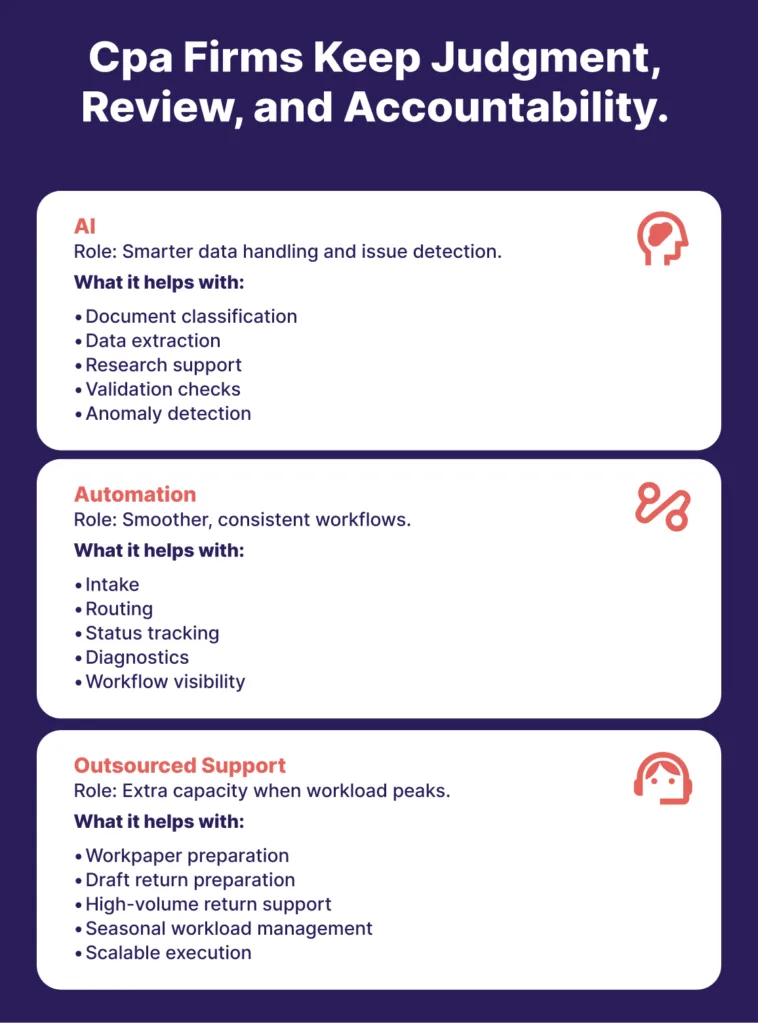
AI helps identify, classify, extract, and validate information. Automation improves routing, status tracking, diagnostics, and workflow visibility. Outsourced support expands preparation capacity during peak periods. CPA professionals retain review, client communication, tax judgment, filing decisions, and advisory work.
This model works because it separates work by complexity. Repetitive and process-driven work moves through automation and outsourced preparation support. Judgment-led work remains with the CPA firm.
For firms facing seasonal workload pressure, outsourced tax preparation services can add the preparation capacity needed to keep tax season moving without forcing every task back onto the internal team. QX’s service page highlights tax preparation outsourcing support for CPA firms managing growing workloads, accuracy expectations, and faster turnaround needs.
The future is not about replacing accountants. It is about giving accountants a better operating model.
Not every firm needs the same support model during tax season. Explore QXAS’s Engagement Models to compare dedicated staffing, managed outsourcing, seasonal tax support, and transaction-based options based on your workload and control needs.
What Modern Tax Preparation Workflows Will Look Like?
The next generation of tax preparation will be more connected and less manual.
A modern workflow will usually begin with client documents entering through a secure portal or document system. AI and automation help classify files, extract information, and flag missing data. Workflow tools show where each return sits. Cloud-based tax preparation platforms make it easier for preparers, reviewers, and managers to work from the same process view.
Then outsourced tax preparation support can handle preparation-heavy execution, such as organizing workpapers, preparing draft returns, supporting high-volume return types, and routing files back for review. The CPA firm reviews exceptions, validates tax positions, communicates with the client, and approves filing.
A simple version of the future workflow looks like this:
Client documents → AI capture and classification → automation validation → cloud-based tax workflow → outsourced preparation support → CPA review → client delivery and filing approval
The future workflow is collaborative, not fully automated.
How Outsourced Tax Preparation Supports Growth?
Outsourced tax preparation supports growth by giving firms flexible capacity without relying only on internal hiring.
That matters because tax season demand does not always move in a predictable line. Some firms need support for high-volume individual returns. Some need preparation capacity during extension season. Some need help when client documents arrive late and internal teams are already stretched.
Outsourced support gives firms a way to increase capacity without asking the same internal team to absorb every spike. It also allows managers and partners to protect review time and client-facing work.
If your firm is thinking about how to scale tax preparation without expanding internal teams, outsourced support becomes part of a broader capacity strategy. It is not just relief during tax season. It is a way to build a more flexible delivery layer around the firm’s core expertise.
Also Read – Tax Outsourcing Planning Sheet 2026
Security, Compliance, and Control in AI-Enabled Tax Preparation
Tax preparation involves sensitive client data, which means future tax workflows need strong controls.
AI, automation, cloud workflows, and outsourced support can work together only when firms are clear about access, confidentiality, review accountability, and data protection. Security cannot be treated as a side issue. It has to be built into the operating model.
Firms handling taxpayer data should pay attention to IRS data security guidelines for tax professionals. IRS Publication 4557 states that data security is a necessity for tax professionals and explains safeguards around client data, security plans, phishing, data loss response, and FTC Safeguards Rule expectations.
Where taxpayer information is disclosed or used as part of tax preparation work, firms should also consider IRS Section 7216 confidentiality requirements. The Tax Adviser explains that Sec. 7216 governs disclosure and use of taxpayer data by tax professionals and applies to a range of third-party and data-use situations.
When evaluating outsourced support or cloud-based workflows, firms may also look for SOC 2-aligned security controls or comparable control frameworks. AICPA explains that SOC reporting helps users assess and address risks associated with outsourced services and service organizations.
For firms that want to evaluate provider controls more directly, QXAS’s Security, Quality & Trust page outlines its security and quality positioning, including SOC 2, ISO 27001, ISO 27701, and related controls for sensitive financial data.
A future-ready tax workflow is not just faster. It is secure, reviewable, and controlled.
What the Next Five Years of Tax Preparation Will Look Like
Over the next five years, manual preparation work will continue to shrink. That does not mean tax professionals become less important. It means their work shifts toward judgment, planning, review, and client interpretation.
AI will become more embedded in classification, research, validation, and exception detection. Automation will continue to improve intake, routing, diagnostics, and status updates. Cloud-based tax preparation platforms will make work more centralized and transparent. Outsourced tax preparation support will become a more flexible capacity layer for firms that do not want growth to depend only on internal hiring.
The firms that do well will not be the ones that buy the most tools. They will be the ones that design the clearest workflows.
Manual input will decline. Professional judgment will become more valuable.
Case in Point: Scaling Delivery With Offshore Support
Technology creates efficiency. Structured offshore support creates scalability. The strongest future model uses both.
That is why proof matters. Firms do not want theory. They want to know whether a lean offshore model can actually support more work without adding unnecessary pressure to the internal team.
The case study on How JBA CPA LLC scaled delivery capacity through offshore support is a useful example of how a lean delivery model can support capacity expansion, continuity, and growth without forcing the firm to build everything internally. The case study notes that one offshore FTE supported 30+ monthly accounting projects and helped the firm maintain delivery consistency as it scaled.
Even though every tax workflow is different, the principle is relevant: when scope is clear and review ownership stays with the firm, offshore support can help create the capacity firms need to grow.
Also Read – Top Tax Preparation Outsourcing Companies in USA
Conclusion
The future of tax preparation is not AI replacing tax professionals.
It is AI reducing manual work, automation improving workflow speed, outsourced support increasing capacity, and CPA professionals focusing on review, judgment, tax strategy, and client relationships.
Firms that combine these elements will be better positioned to scale tax preparation without overwhelming internal teams. The goal is not a fully automated tax season. The goal is a more controlled, more scalable, and more review-ready tax preparation model.
Build a Tax Preparation Model Ready for the Future
See how QX Accounting Services helps CPA firms combine automation, standardized workflows, and outsourced tax preparation support to increase capacity, improve turnaround, and scale without expanding internal teams.
FAQs
How will AI reshape tax preparation over the next five years?
AI will reshape tax preparation by reducing repetitive manual work and improving tasks such as document classification, data extraction, validation, research support, anomaly detection, and workflow routing. It will not remove the need for tax professionals. CPA firms will still need human review, tax judgment, client-specific interpretation, and final approval.
Which tax preparation tasks are best suited for automation?
Tasks such as document intake, OCR data extraction, missing-information alerts, validation checks, workflow routing, diagnostics, and return status tracking are well suited for automation. Tasks that involve tax planning, complex positions, client-specific judgment, multi-state issues, and final sign-off should remain under expert review.
How does outsourced support complement AI-powered tax workflows?
AI and automation make the workflow cleaner and faster. Outsourced support helps firms handle more preparation work during peak season. Together, they allow CPA firms to increase capacity while keeping review, client communication, and filing approval within the firm.
What technologies will define the next generation of tax preparation services?
The next generation of tax preparation services will likely include AI-assisted document classification, OCR, tax process automation, cloud-based tax preparation platforms, secure client portals, workflow dashboards, diagnostics, anomaly detection, and integrated review tools.
How can CPA firms prepare for the future of tax compliance and automation?
CPA firms can prepare by standardizing workflows, strengthening document intake, defining review responsibilities, improving security controls, evaluating automation tools carefully, and using outsourced tax preparation support where additional capacity is needed.
What role will human tax professionals play in AI-enabled tax preparation?
Human tax professionals will continue to own judgment, review, client communication, advisory decisions, exception handling, and final filing approval. AI may support preparation, but professional responsibility and client-specific interpretation remain with the CPA firm.
Why are leading CPA firms investing in automation and outsourced tax support together?
Leading CPA firms are investing in both because automation improves workflow efficiency, while outsourced support expands preparation capacity. The combination helps firms manage seasonal pressure, reduce manual effort, improve turnaround, and protect reviewer time without relying only on internal hiring.
Enquire now

Cora Vollmar
With over 20 years of experience in accounting, talent strategy, operations, and business development, Cora Vollmar helps CPA firms solve capacity challenges and build scalable growth strategies. She is an expert in senior-level accounting and CPA recruiting, with a proven track record of helping firms develop talent pipelines, recruit leadership professionals, and address the ongoing accounting talent shortage.
Through strong relationships with State CPA Societies, accounting alliances, and industry organizations, Cora brings valuable insight into firm growth, talent trends, and the future of the profession. At QX Accounting Services, she helps firms leverage global talent, managed services, and workforce strategies to build sustainable capacity and support long-term growth.
Unauthorized copying or plagiarism of our content is a violation of intellectual property rights. We take such matters seriously and will pursue legal action to protect our original work. Anyone found engaging in such activities will be held accountable under applicable laws.
Don't forget to share this post!
Our Latest Insights




Let’s Work Together
Explore outsourcing solutions, request a no-obligation trial or discuss your practice’s needs with our expert consultants.
 Book a Virtual Meeting
  Get Your ROI Estimate