How CPA Firms Can Build Tax Capacity Without Overloading Their Team



For CPA firms looking to manage tax season workload, protect review quality, and increase preparation capacity without relying only on internal hiring.
Introduction: Why CPA Firms Need Smarter Tax Preparation Capacity
For many CPA firms, tax season pressure is no longer just a matter of having enough people. The real challenge is having enough structured capacity at the right time, without stretching reviewers, delaying client work, or compromising tax quality.
Hiring may ease some pressure, but it rarely fixes the capacity problem quickly enough. By the time a firm recruits, trains, and brings someone fully into the workflow, tax season may already be at its peak. And for many firms, a short seasonal spike does not justify adding permanent headcount.
That is why more firms are looking at tax preparation outsourcing as part of a broader capacity strategy. The goal is not to replace the internal team. The goal is to give the team a stronger delivery model during the busiest months of the year.
For CPA firms in the United States, scaling tax preparation should mean three things: more preparation capacity, stronger review control, and a workflow that does not collapse when client documents arrive late or deadlines compress.
“The firms that scale tax season successfully are not simply adding more people. They are building a delivery model where preparation capacity increases while review control stays firmly inside the firm.”
Cora Vollmar, Sr VP Growth, QX Accounting Services
- Why Tax Season Overload Hurts CPA Firm Growth
- How to Spot Costly Tax Preparation Capacity Gaps
- When CPA Firms Should Outsource Tax Preparation
- How Outsourced Tax Preparation Adds Review-Ready Capacity
- Where Tax Automation Unlocks Scalable Preparation Workflows?
- What Tax Work CPA Firms Can Safely Delegate
- Choose the Right Tax Outsourcing Model for Peak Season
- How Offshore Tax Preparation Fuels CPA Firm Growth
- How CPA Firms Scale Tax Preparation Without Quality Risk
- How Offshore Time Zones Speed Up Tax Season Turnaround?
- How to Measure Tax Preparation Outsourcing Performance
- When Tax Preparation Outsourcing Creates Friction
- Find a Tax Preparation Outsourcing Partner CPA Firms Can Trust
- Proof Point: Offshore Support That Helps CPA Firms Scale
- Conclusion
- FAQs
Why Tax Season Overload Hurts CPA Firm Growth
Tax season creates pressure because too much work arrives in a short window. Individual returns, business returns, extensions, client follow-ups, missing documents, and review cycles all compete for the same people at the same time.
For firms handling high-volume individual tax work, Form 1040 filing requirements are only one part of the workload. The real pressure comes from collecting source documents, organizing workpapers, preparing returns, resolving exceptions, and completing review before deadlines.
This is where many firms start to feel the limits of an internal-only model. Preparers get pulled in multiple directions. Reviewers spend time fixing incomplete files. Partners step into workflow issues that should have been resolved earlier. By the time the firm realizes it needs more help, the season is already moving too fast.
Hiring may seem like the obvious answer, but it does not always solve the real bottleneck. If review capacity is already stretched, adding more preparers can simply push more work into an overloaded review queue.
How to Spot Costly Tax Preparation Capacity Gaps
Before deciding whether to outsource, a firm should understand where the capacity gap actually sits.
Sometimes the issue is not the number of preparers. Sometimes it is late intake, missing client information, weak workpaper standards, overloaded reviewers, or too many returns sitting in review at the same time.
A firm should look at how many returns are expected, how many preparer hours are available, how much review time exists, and how often returns are pushed close to internal deadlines. It should also look at extension volume, overtime patterns, and how much time reviewers spend correcting preparation issues.
If these signs show up every year, the firm does not just need “more hands.” It needs a better tax season capacity model.
Tax Outsourcing Planning Sheet 2026
Use this planning sheet to estimate workload, spot capacity gaps, and plan outsourced tax support.
Download Now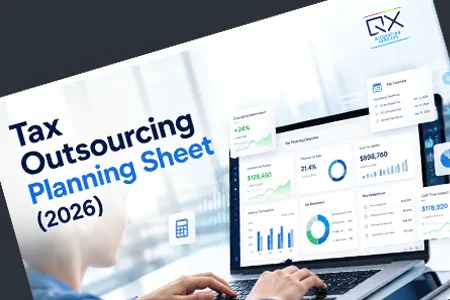
When CPA Firms Should Outsource Tax Preparation
Recruiting internally makes sense when the firm has a long-term role to fill and enough time to hire, train, and integrate the person properly.
Outsourcing makes more sense when the firm needs flexible capacity quickly, especially during tax season. This is often the case when workload is seasonal, turnaround expectations are rising, reviewers are overloaded, or the firm is turning away work because the internal team cannot take on more.
Outsourced tax preparation support works best when the firm clearly defines what preparation work can move outside the core team and what responsibilities must stay under firm control.
The right way to think about outsourcing is simple: it should support the CPA firm’s review process, not replace it. Client communication, tax planning judgment, final review, and filing approval should remain with the firm. Preparation-heavy tasks can be supported by an outsourced team when the workflow is clearly defined.
How Outsourced Tax Preparation Adds Review-Ready Capacity
Outsourced support improves capacity by taking pressure off the preparation layer of the workflow.
This can include source document organization, data entry, workpaper preparation, draft return preparation, return assembly, extension support, high-volume individual tax return preparation, and status tracking.
But the real value is not just that these tasks get completed. The value is that the work comes back in a form that reviewers can actually use. A file that is prepared but poorly documented still creates work for the firm. A file that is prepared, organized, and review-ready creates capacity.
That is the difference between adding help and adding usable capacity.
Where Tax Automation Unlocks Scalable Preparation Workflows?
Automation can help firms scale tax preparation by removing repetitive steps and improving visibility across the return pipeline.
It can support document intake, OCR, data extraction, missing-information tracking, workflow routing, reviewer dashboards, and e-file readiness checks. These tools help firms reduce manual touchpoints and identify issues earlier.
But automation should not be treated as a replacement for review. It works best when it prepares the workflow for human judgment.
For firms evaluating tools, the Tax Automation Buyer’s Checklist can be used as a practical resource to assess whether automation is solving a real workflow problem or simply adding another tool to the stack.
What Tax Work CPA Firms Can Safely Delegate
The safest way to scale tax preparation is to separate execution from control.
Document organization, initial data entry, workpaper preparation, draft return preparation, organizer follow-up support, return assembly, extension support, and status tracking can often be delegated to an outsourced team.
Client communication, tax planning judgment, review ownership, filing approval, advisory recommendations, and compliance accountability should remain with the CPA firm.
This distinction matters because CPA firms remain responsible for outsourced work. Outsourcing can change where preparation happens, but it does not shift professional responsibility away from the firm.
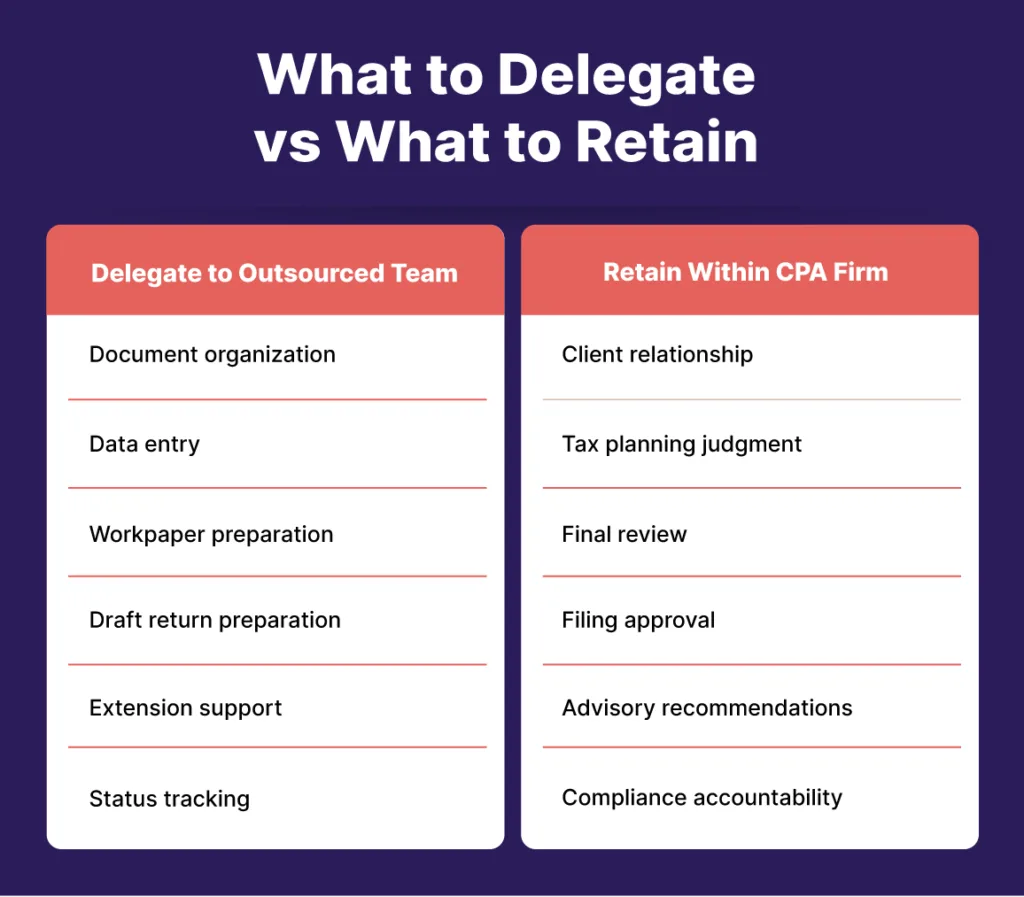
Scale preparation capacity while keeping review, judgment, and accountability within the firm.
Choose the Right Tax Outsourcing Model for Peak Season
Not every firm needs the same support model.
Some firms need a dedicated tax preparation team for the season. Some need managed outsourcing across a defined workflow. Others need transaction-based support for specific return types or short seasonal spikes.
The right engagement model for tax season support depends on workload pattern, return volume, turnaround expectations, review capacity, and how much day-to-day management the firm wants to retain.
A dedicated model often works well when the firm wants continuity and repeatable support. A managed model can work well when the firm wants a more structured delivery process. A transaction-based model may suit firms with defined return types or short-term volume spikes.
If your firm is exploring how dedicated support can work in practice, the concept of a dedicated tax preparation team can help frame how scope, workflows, and review responsibilities should be defined.
How Offshore Tax Preparation Fuels CPA Firm Growth
Offshore tax preparation supports growth when it is treated as part of the firm’s operating model, not just overflow support.
A structured offshore team can help expand preparation capacity, support faster turnaround, reduce pressure on internal staff, and give reviewers more room to focus on quality and client-facing work.
This is where the offshore delivery model becomes a useful reference. The same principle applies across tax and accounting workflows: execution can be distributed, but review and accountability stay with the CPA firm.
For growing firms, this matters because scale should not depend on pushing the same team harder every year. It should come from a delivery model that can absorb more work without creating more review chaos.
How CPA Firms Scale Tax Preparation Without Quality Risk
More capacity only helps if quality stays protected.
A scalable tax preparation model needs clear checklists, reviewer-ready workpapers, defined escalation rules, tax software familiarity, secure document handling, and final sign-off by the CPA firm.
Security also needs to be built into the workflow. Firms handling taxpayer information should follow IRS data security guidelines for tax professionals, especially when client financial information, access controls, and written safeguards are involved. [tigta.gov]
Where taxpayer data is disclosed or used in preparation work, firms should also understand IRS Section 7216 confidentiality requirements, because disclosure and use of taxpayer information must be handled carefully. [linkedin.com]
When evaluating providers, firms may also consider whether the provider operates with SOC 2-aligned control frameworks or comparable security and governance standards. [irs.gov]
The goal is not just faster preparation. The goal is controlled preparation.
How Offshore Time Zones Speed Up Tax Season Turnaround?
Time zones can create a workflow advantage when the process is structured properly.
Offshore teams can prepare work while the onshore team is offline. Reviewers can then start the next day with files that are already staged, documented, and ready to validate.
This can help firms improve turnaround and workflow continuity during the busiest parts of tax season.
The benefit is not simply “work happens overnight.” The real advantage is that waiting time between preparation and review is reduced. That only works when handoffs are clear, questions are escalated early, and reviewers receive context along with the return.
How to Measure Tax Preparation Outsourcing Performance
A scalable model should reduce bottlenecks, not just increase the number of people touching the work.
CPA firms should track whether outsourced tax preparation is improving the flow of work. Useful measures include turnaround time, review rework rate, backlog volume, extension volume, reviewer hours saved, and the number of returns completed before internal deadlines.
If preparation output increases but review backlog grows, the firm may have added volume without solving the real constraint.
A good model should make tax season more predictable. Reviewers should feel less buried. Work should move through the system with fewer delays. Partners should have better visibility before deadlines become urgent.
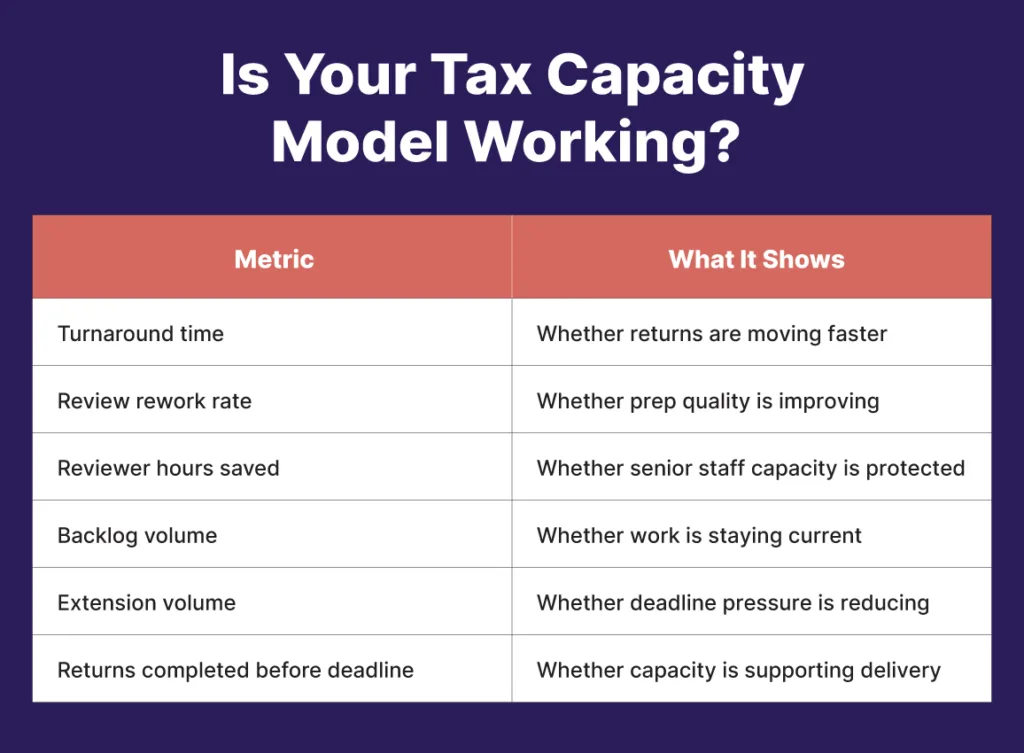
A scalable model should reduce bottlenecks, not just add more hands.
When Tax Preparation Outsourcing Creates Friction
Outsourcing is not a shortcut for weak internal processes.
It can struggle when client document collection is inconsistent, review standards are unclear, workpapers vary by preparer, escalation paths are undefined, or communication is scattered across too many channels.
That does not mean outsourcing is the problem. It means the model needs more structure before it can scale.
A good outsourcing arrangement should make the firm’s workflow easier to manage. It should not create another layer of confusion.
Find a Tax Preparation Outsourcing Partner CPA Firms Can Trust
Choosing a tax preparation partner should not be based only on cost.
CPA firms should evaluate whether the partner can work inside their existing workflow, protect client data, prepare reviewer-ready workpapers, and support peak-season volume without creating quality risk.
A strong partner should understand CPA firm workflows in the United States, common tax software, secure document handling, review expectations, turnaround requirements, and seasonal workload pressure.
The most important test is simple: does the partner reduce pressure on reviewers, or does the partner create more cleanup work?
Proof Point: Offshore Support That Helps CPA Firms Scale
Scaling without hiring does not mean stretching the same team thinner. It means building a more flexible delivery layer around the firm’s core expertise.
Lean offshore support works best when scope is clear, handoffs are structured, and review ownership stays with the CPA firm. That same principle applies to tax season support.
The value comes from expanding preparation capacity while protecting the internal team’s time for review, client communication, and advisory decisions.
CASE STUDY
How JBA CPA LLC Used a Lean Model to Handle 30+ Projects and Grow Confidently
Click Here!
Conclusion
Scaling tax preparation is not only about hiring more people.
CPA firms need flexible preparation capacity, clear workflows, secure delivery, and strong review ownership. When those elements work together, firms can manage peak-season workload without weakening tax quality or overloading internal teams.
Outsourced tax preparation support gives firms a way to expand preparation capacity while keeping judgment, client relationships, and final approval where they belong: inside the CPA firm.
Build Tax Season Capacity Without Expanding Your Internal Team
See how QX Accounting Services helps CPA firms use tax preparation outsourcing, flexible engagement models, and review-ready delivery support to manage peak-season workload without compromising quality.
FAQs
When should firms outsource tax preparation instead of recruiting internally?
Firms should consider outsourcing when tax season workload is growing faster than internal hiring can support, when reviewers are overloaded, or when seasonal demand does not justify permanent headcount. Outsourcing works best when the firm needs flexible preparation capacity while retaining review and client-facing control.
How does outsourced tax preparation improve capacity during peak tax season?
Outsourced tax preparation improves capacity by supporting preparation-heavy work such as document organization, data entry, workpaper preparation, draft return preparation, extension support, and review-ready file preparation. This gives internal staff more room to focus on review, client communication, and tax judgment.
What engagement model works best for scaling tax preparation services?
The best engagement model depends on the firm’s workload pattern and control preferences. Dedicated teams work well for recurring seasonal volume, managed outsourcing works well for structured support, and transaction-based support may suit defined return types or short-term demand spikes.
How can firms maintain tax quality while increasing capacity?
Firms can maintain tax quality by defining scope clearly, using standardized checklists, requiring reviewer-ready workpapers, setting escalation rules, validating security controls, and keeping final review and filing approval within the CPA firm.
How does offshore tax preparation support business growth?
Offshore tax preparation supports growth by expanding preparation capacity without increasing internal headcount at the same pace. It helps firms manage more work, improve turnaround, reduce reviewer overload, and avoid turning away opportunities during peak periods.
How can QX Accounting Services help CPA firms scale tax preparation efficiently?
QX Accounting Services helps CPA firms scale tax preparation through outsourced support, flexible engagement models, secure delivery, reviewer-ready workpapers, and structured workflows that support peak-season capacity without compromising tax quality.
Enquire now

Bhagyashree Patankar
With over 14 years of global experience in finance and accounting, Bhagyashree is a Chartered Accountant and US CPA with a master’s in Accounting and Finance. She leads an 80+ member team across accounting, audit, and tax, driving operational excellence, talent development, and high-quality delivery. Known for her precision and strategic insight, she transforms financial data into actionable business strategies that enhance decision-making, efficiency, and sustainable growth.
Unauthorized copying or plagiarism of our content is a violation of intellectual property rights. We take such matters seriously and will pursue legal action to protect our original work. Anyone found engaging in such activities will be held accountable under applicable laws.
Don't forget to share this post!
Our Latest Insights




Marketing Services
Outsourced Marketing Services vs In-House Team for CPA Firms...
23 September 2026
Let’s Work Together
Explore outsourcing solutions, request a no-obligation trial or discuss your practice’s needs with our expert consultants.
 Book a Virtual Meeting
  Get Your ROI Estimate