AI Tools for Accounting Professionals: 2026 Edition



Summary:
AI is redefining public accounting by replacing time-draining manual work with speed, accuracy, and smarter decision-making. The firms winning today are using AI tools to eliminate bottlenecks, reduce errors, and free accountants to focus on high-value advisory work. With automation becoming central to tax and compliance, AI is setting a new standard for firms that want to stay competitive and sustainable. This blog explores the current state of AI in accounting, including where and how to get started, the benefits firms can expect, and the essential AI tools every accountant should be familiar with. Plus answers to common questions firms are asking right now.
AI Tools for Accounting Firms: What Matters, What Doesn’t, and Where to Start
Accounting has never been short on work. Every year, the deadlines multiply. While regulations tighten, clients expect speed and precision. Talent is harder to retain. And profitability is under pressure from every direction.
The firms pulling ahead right now aren’t hiring more people or working longer hours.
They’re replacing repetitive manual labour with AI-powered efficiency, redirecting time to higher-value work.
The point isn’t whether AI will change accounting. Because it already has.
The only real question left is whether your firm uses it or competes against the firms that do.
AI is opening the door to a new way of working. This way is faster, more productive, and more strategic. And no, it’s not here to replace accountants.
Once you understand the power of AI and start incorporating it into practice, it becomes a significant advantage. It helps you stay ahead in a world where data accuracy matters more than ever.
This article will cover the most important topics about AI in accounting, from its current and future role in the financial space and your workflows, to key AI trends in 2025 and the tools that will help you meet your goals.

What is AI’s role in accounting?
At its core, AI enables firms to work faster and think more sharply, giving them the strategic edge that traditional workflows simply can’t match.
Currently, 83% of accounting professionals are already utilizing AI. The AI market in accounting is projected to grow at a rate of approximately 30% annually through 2027. And 80% of CFOs plan to increase their spending on AI over the next two years.
The message is clear: firms everywhere are gearing up for the shift.
Why? Because AI replaces hours of manual effort with efficiency and accuracy. It gives accountants more time for strategic work. Thus, driving higher margins without adding payroll.
Want to evaluate your readiness for the AI revolution?

Cora Vollmar, SVP- Strategic Growth, QX Accoutning Services
Benefits of AI tools for Accounting Professionals
AI tools can easily handle routine tasks such as bookkeeping, data capture, error checks, tax research, and even drafting client communication, taking a significant load off accountants. By letting technology manage repetitive work, firms unlock more time for strategy, advisory services, and higher-value activities. At this point, adopting AI is no longer a “nice to have” for accounting teams. It’s necessary to stay efficient, competitive, and profitable in a rapidly evolving profession.
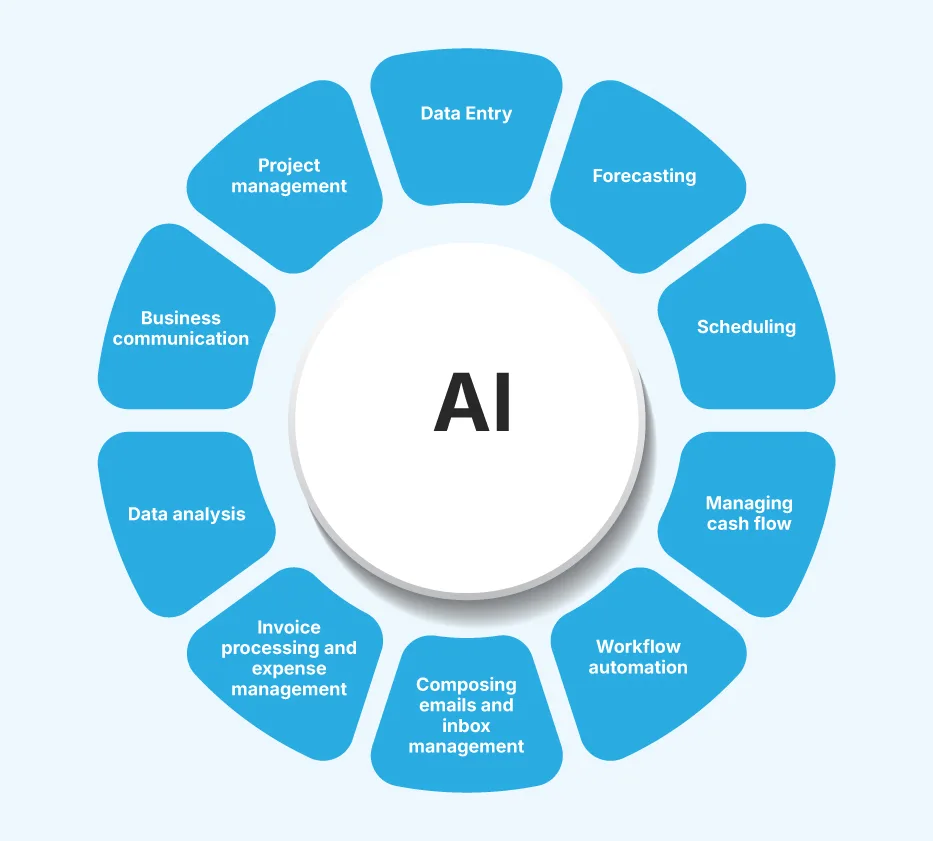
The industry is now leveraging AI to increase speed, efficiency, and automation, while reducing errors. As firms recognize the true value of AI, concerns about job loss and data security are gradually (yet consistently) diminishing.
List of AI Tools Every Accountant Should Know About:
1. QX Robo 1040
Robo1040 is the closest thing the accounting profession has to a true AI accounting assistant.
It automates the tax process with OCR, capturing information accurately the first time. It pulls taxpayer data directly and connects with the tax software firms already in use, so no one has to overhaul their tech stack just to get started. Robo1040 also keeps documents categorized and searchable, which makes reviews and audits much smoother.
Firms using Robo1040 are finishing returns up to 40% faster with over 98% accuracy in data capture. This means increased capacity, greater control, and no need to add extra headcount during tax season peaks.
Three things matter most during peak season: accuracy, speed, and capacity. Robo1040 boosts all three immediately.
If an accounting firm wants to experience the impact of AI without disrupting staffing or workflow, Robo1040 is the smartest starting point.
Want to explore more about ROBO1040?
Streamline Peak Season with Tax Automation: Say Hello to ROBO1040
2. Karbon AI
Karbon AI reduces “communication drag,” one of the most underestimated cost centers in a modern accounting firm.
It summarizes client emails and drafts replies. Identifies next steps and automatically assigns tasks. Karbon AI turns inbox management into a structured workflow. Translating directly into efficiency, responsiveness, and fewer client fire drills
3. Vic.ai
Vic.ai reads invoices, detects errors, codes transactions, routes approvals, and builds intelligence around vendor patterns. It doesn’t just automate AP; it continually improves it as volume increases.
4. Botkeeper
Botkeeper combines automation with human validation, which is ideal if your firm wants speed but isn’t ready to hand everything to AI. The AI handles repetitive work. Humans step in where interpretation and judgment matter.
For firms that want automation without sacrificing a human touch, Botkeeper could be a viable option.
5. Blue Dot
If your firm handles employee expenses, taxable benefits, VAT compliance, or multi-country reporting, Blue Dot is one of the most potent options. It analyzes spending behavior, identifies compliance risk, and applies tax rules automatically across regions. Thus, solving a specific high-risk problem extremely well.
What separates firms that win with AI from firms that don’t

The firms that win with AI do four simple things:
- Start with one clear use case, not a menu of features. They don’t roll out five tools at once. They pick one area that is causing delay or inefficiency and automate that first.
- Give ownership to someone who is responsible for results. There should be one person who tracks progress, identifies blockers, and drives usage. In short, one person who takes the entire responsibility and ownership of the project
- Measure success in real numbers. Hours saved per month, turnaround time on deliverables, improved efficiency, and improved accuracy. When numbers improve, adoption improves automatically.
- Expand only after the first win is locked in. Once one workflow is consistently running on AI, then they move to the next one.
AI success in accounting isn’t about how sophisticated a firm’s technology becomes; it’s largely about how consistently the technology is used. The firms that commit to structured adoption gain in terms of capacity, turnaround time, and profitability. Firms that treat AI as a novelty often see no real change and eventually abandon it.
Wrapping it up
Accountants shouldn’t fear AI. They should fear the time wasted on redundant manual work that prevents them from focusing on strategic tasks.
As its foremost priority, AI removes the repetitive work that keeps accountants from operating at their highest level. The firms that adopt it now will be the ones delivering faster turnaround, sharper insights, and better client service without burning out their teams.
And if there’s one place to start, it’s Robo1040. Tax season is just around the corner, which makes this the ideal moment to get onboarded and feel the benefits before the peak rush hits. Robo1040 cuts down the manual tax-prep workload, boosts accuracy, and increases capacity, exactly when firms need it most. If accountants want a real, immediate win from AI (not theory, not hype), Robo1040 is the smartest first move.
See how ROBO1040 can help transform your upcoming tax season. Click here to book a no-obligation exploratory call with our experts.
FAQs
1. Is AI only useful for large accounting firms?
Not at all. Small and mid-sized firms often feel the biggest impact because AI provides them with capacity without requiring additional hiring. Whether a firm prepares 300 returns or 3,000, AI reduces workload bottlenecks and protects margins. The scale of the firm only determines how quickly the ROI shows up, not whether it exists.
2. How difficult is it to introduce AI into existing tax or accounting workflows?
Implementation is easier than most firms expect, especially when the tool integrates with existing software. The key is to start with one clear use case and one tool, rather than attempting to overhaul everything at once. When adoption is structured, most teams become comfortable within a few days to a few weeks.
3. Will AI replace accountants in the future?
No. AI does not replace accountants. It replaces repetitive manual work. Accounting still requires professional judgment, compliance expertise, and client relationships. AI simply frees up time, allowing accountants to focus on strategic advisory and higher-value work.
4. Why is Robo1040 recommended as the starting point for AI adoption?
Robo1040 targets the biggest pain points in tax season, such as manual document handling and data entry. It integrates with existing tax software, ensuring no disruption to the workflow. The immediate gains in capacity, speed, and accuracy make it the fastest way to feel a tangible impact from AI.
5. What’s the fastest way to determine whether a firm is ready for AI?
A firm is ready if it is consistently losing time to manual work and doesn’t want to add headcount to solve it. If the busy season causes operational strain, delayed turnaround, or burnout, AI will provide noticeable relief. A readiness call or demo focused on a single workflow is typically sufficient to determine where AI can begin delivering results.
Enquire now

Cora Vollmar
With over 20 years of experience in accounting, talent strategy, operations, and business development, Cora Vollmar helps CPA firms solve capacity challenges and build scalable growth strategies. She is an expert in senior-level accounting and CPA recruiting, with a proven track record of helping firms develop talent pipelines, recruit leadership professionals, and address the ongoing accounting talent shortage.
Through strong relationships with State CPA Societies, accounting alliances, and industry organizations, Cora brings valuable insight into firm growth, talent trends, and the future of the profession. At QX Accounting Services, she helps firms leverage global talent, managed services, and workforce strategies to build sustainable capacity and support long-term growth.
Unauthorized copying or plagiarism of our content is a violation of intellectual property rights. We take such matters seriously and will pursue legal action to protect our original work. Anyone found engaging in such activities will be held accountable under applicable laws.
Don't forget to share this post!
Our Latest Insights




Marketing Services
Outsourced Marketing Services vs In-House Team for CPA Firms...
23 September 2026
Let’s Work Together
Explore outsourcing solutions, request a no-obligation trial or discuss your practice’s needs with our expert consultants.
 Book a Virtual Meeting
  Get Your ROI Estimate