Accounting firms across the UK are under more pressure than ever. Rising salaries, talent shortages, and increasing compliance demands are squeezing margins across the board.
According to recent industry data, qualified accountants in the UK now command between £45,000 and £65,000 annually, with the true cost of employment often rising to £50,000–£84,000 per year once NI, pensions, and overheads are factored in.
At the same time, demand for accounting services is growing, particularly in areas like compliance, advisory, and digital reporting. As a result, firms are expected to do more, faster, and with fewer resources.
At its core, accounting outsourcing means delegating part or all of your accounting workload to an external team, often operating through a mix of offshore and UK-based oversight.
Typical services outsourced include:
Bookkeeping
Payroll processing
VAT returns and tax preparation
Year-end accounts
Management reporting
Compliance and admin
In the UK, outsourcing models have evolved significantly. It’s no longer just offshore support; it’s now a hybrid model, combining offshore delivery with UK compliance expertise. This is where firms like QX Accounting Services have built their proposition.
So why are firms outsourcing in 2026?
Talent shortage: Recruitment remains one of the biggest bottlenecks. Even entry-level roles can take months to fill.
Cost pressure: With salaries rising and margins tightening, maintaining large in-house teams is becoming unsustainable.
Scalability challenges: Peak periods (Jan-April) create capacity gaps that are difficult to manage internally.
Outsourcing solves all three while also unlocking access to skilled talent and technology-enabled workflows.
Guide:
Getting Started with Accounting Outsourcing: The First-Timer’s Guide for Accountants
Several variables influence accounting outsourcing pricing:
Volume of transactions Higher transaction volumes increase processing time.
Complexity of work Multi-entity firms or specialist tax requirements drive higher costs.
Software stack Tools like Xero, QuickBooks, and integrated apps affect workflows and efficiency.
Compliance requirements HMRC regulations (e.g., Making Tax Digital) require strict adherence and expertise.
4. Accounting Outsourcing Budget Planning
For 2026, partners must treat outsourcing as a planned investment, not a reactive cost.
A practical budgeting approach:
Allocate 20-40% of operational accounting workload to outsourcing
Compare cost per FTE vs outsourcing equivalent
Factor in growth projections (client volume, service expansion)
Firms working with structured providers like QX Accounting Services often benefit from predictable pricing models, making budgeting far easier than managing fluctuating in-house costs.
Accounting Outsourcing vs In-House Cost
1. Cost Comparison Table
Cost Component
In-House
Outsourcing
Salary
£30K – £65K
Included
Employer NI + pension
15%+
Included
Recruitment cost
£3K – £6K
£0
Training
Ongoing
Included
Software
£1K – £3K/year
Often included
Total cost per employee
£50K – £84K
£12K – £30K/year
Beyond salary, accounting firms often underestimate:
Recruitment delays
Staff turnover
Downtime during training
Productivity gaps
These hidden costs directly impact profitability.
Outsourcing offers:
Predictable monthly pricing
No hiring or training costs
Instant scalability
This makes outsourced accounting cost comparison heavily skewed in favour of outsourcing, especially for growing firms.
Outsourcing can reduce accounting costs by 40-60%, depending on firm size and delivery model.
Diagnostic Tool:
In House v/s Outsourcing Payroll Calculator for UK Accounting Firms
Accounting outsourcing ROI goes well beyond a simple cost comparison. While most firms initially look at the cost of outsourcing accounting, the real value becomes clearer when you assess the broader impact on operations and growth.
In practical terms, ROI from outsourcing can be broken down into three layers:
Financial ROI (cost reduction): This is the most visible benefit. Firms reduce direct staffing costs, recruitment expenses, and overheads. According to industry estimates, outsourcing can lower operational costs by 30%-60%, depending on the delivery model and scope of work.
Operational ROI (efficiency gains): Outsourcing providers operate with structured workflows, defined SLAs, and dedicated teams. This typically leads to faster turnaround times and fewer bottlenecks, especially during peak periods like year-end or tax season.
Strategic ROI (capacity to grow): This is perhaps the most underestimated benefit. By freeing up internal teams from routine work, firms can redirect focus toward higher-value services such as advisory, client relationship management, and business development.
For firms and partners evaluating accounting outsourcing ROI, the key is to look beyond immediate savings and assess how outsourcing impacts overall firm performance.
2. Accounting Outsourcing ROI Drivers
The ROI of accounting outsourcing is driven by a combination of cost efficiencies and operational improvements. Each of these plays a distinct role in improving profitability.
Cost savings: Lower cost per resource The most obvious driver. Offshore and hybrid delivery models significantly reduce the cost per full-time equivalent (FTE). For many accounting firms, this alone justifies the move.
Efficiency improvements: Faster turnaround times Outsourcing teams often work across time zones and follow standardised processes, which can reduce turnaround times by 20-40% in areas like bookkeeping and tax preparation.
Access to skilled talent: No recruitment lag Recruitment remains a major challenge in the UK accounting sector. Several industry reports have highlighted ongoing talent shortages, particularly at mid-level roles. Outsourcing removes this bottleneck by providing immediate access to trained professionals.
Technology enablement: Automation + cloud accounting Most outsourcing providers are built around cloud platforms like Xero and QuickBooks, combined with automation tools. According to Sage Group, firms adopting digital accounting workflows can improve productivity by up to 25%, directly impacting ROI.
When combined, these drivers create a compounding effect, reducing costs while increasing output and service quality.
3. Accounting Cost Savings Through Outsourcing
To understand accounting cost savings through outsourcing, it helps to look at a simple, realistic comparison.
Let’s break it down:
In-house accountant: £60,000/year (Including salary, employer NI, pension, and overheads)
Outsourced equivalent: £24,000/year (Based on a blended offshore + managed service model)
Annual saving: £36,000 per resource
At first glance, this looks like a straightforward cost reduction. But the real impact becomes clearer when you scale this across a team.
For example:
A firm with 5 accounting staff could save £150,000-£180,000 annually
A mid-tier firm scaling operations could unlock even higher savings
Accounting firms that adopt outsourcing strategically, rather than tactically, see not only cost reductions but also measurable improvements in service delivery and turnaround times.
Another important point is that outsourcing converts fixed costs into variable costs. Instead of carrying full-time salaries during quieter periods, firms can align costs with actual workload. This flexibility is a major advantage in managing seasonal fluctuations.
4. ROI of Accounting Outsourcing for UK Firms
The ROI of accounting outsourcing varies depending on firm size, structure, and growth ambitions. However, the underlying pattern remains consistent – cost savings combined with increased capacity.
Small firms (1-3 partners)
Typically save £20K-£50K annually by outsourcing routine bookkeeping, payroll, and VAT work
Benefit from faster turnaround times, which improves client satisfaction and retention
Gain the ability to compete with larger firms without increasing headcount
Mid-tier firms
Often achieve £100K+ annual savings, particularly when outsourcing multiple service lines
Can increase client capacity without expanding internal teams
Free up senior staff to focus on advisory services, which typically generate higher margins
Large firms
Use outsourcing to scale delivery without hiring constraints
Improve utilisation rates across teams
Significantly enhance profit margins by optimising cost structures
In many cases, the biggest ROI driver isn’t just cost reduction; it’s revenue enablement. Firms that outsource effectively can take on more clients, reduce turnaround times, and improve service quality, all without the delays associated with hiring.
This is where partners like QX Accounting Services play a critical role. Beyond reducing the accounting outsourcing cost, they enable firms to build a scalable operating model, one that supports growth without adding pressure on internal resources.
Case Study:
How Bright Partnership Achieved 300% Revenue Growth with Outsourcing
Outsourcing ROI doesn’t happen overnight. While the cost advantage is clear from day one, the full value of accounting outsourcing builds progressively as processes stabilise and teams align.
In most UK accounting firms, ROI follows a fairly predictable timeline:
0-3 months: Transition phase This is where most of the groundwork happens. Workflows are documented, systems are aligned, and responsibilities are clearly defined between in-house and outsourced teams. During this phase, there may even be a temporary dip in efficiency as both sides adjust. However, firms that invest time in proper onboarding tend to see smoother and faster ROI realisation later.
3-6 months: Efficiency gains begin Once the initial transition settles, the benefits start to show. Turnaround times improve, backlogs reduce, and internal teams begin to free up capacity. Many firms notice early wins here, such as faster bookkeeping cycles or more consistent delivery during peak periods.
6-12 months: Full ROI realised This is where outsourcing starts delivering its full impact. Cost savings are fully visible, processes are streamlined, and firms can confidently scale operations without adding headcount. At this stage, outsourcing moves from being a support function to a core part of the firm’s operating model.
What Determines How Fast You See ROI?
The timeline above can vary significantly depending on how outsourcing is implemented. The biggest influencing factors include:
Quality of onboarding A structured onboarding process, one that includes clear documentation, defined KPIs, and proper knowledge transfer, can accelerate ROI by several months. Poor onboarding, on the other hand, often leads to rework and delays.
Clarity of workflows Firms that standardise processes before outsourcing tend to see faster results. Ambiguity in task ownership or inconsistent processes can slow down efficiency gains.
Experience of the outsourcing partner This is often the biggest differentiator. Experienced providers already have established workflows, trained teams, and UK-specific compliance knowledge. For example, firms working with established partners like QX Accounting Services typically benefit from shorter transition cycles due to their structured delivery models and familiarity with UK accounting requirements.
A Practical Insight
Firms that treat outsourcing as a long-term strategic shift, rather than a short-term cost fix, tend to realise ROI faster and more consistently.
In other words, the question isn’t just “How quickly will we save money?”; it is “How quickly can we build a more scalable, efficient firm?”
Hidden Costs to Avoid in Accounting Outsourcing
While the cost of outsourcing accounting is often lower than in-house models, hidden costs can erode expected savings if not managed carefully. Being aware of these upfront helps firms protect their ROI.
1.Common Hidden Costs
Poor vendor selection Choosing a provider based purely on low pricing can lead to inconsistent quality, missed deadlines, and higher long-term costs due to rework and oversight.
Communication gaps Lack of clear communication channels, time zone misalignment, or unclear instructions can slow down delivery and create unnecessary back-and-forth.
Rework due to quality issues If outputs don’t meet UK compliance standards (e.g., HMRC requirements), internal teams may need to review and redo work, adding hidden effort and cost.
Transition inefficiencies Poorly managed onboarding, such as incomplete documentation or unclear workflows, can lead to delays, duplication of work, and temporary productivity loss.
2. How to Avoid These Costs
Define clear SLAs Set expectations around turnaround times, accuracy levels, and communication protocols to ensure accountability from the outset.
Establish structured workflows Documented processes and standard operating procedures reduce ambiguity and help outsourced teams deliver consistent results.
Choose experienced providers Partners with proven UK accounting experience understand compliance requirements and typically have established delivery frameworks in place.
This is where established partners like QX Accounting Services reduce risk through standardised delivery models and UK-specific expertise.
How to Choose the Right Accounting Outsourcing Partner in the UK?
Choosing the right partner has a direct impact on both accounting outsourcing cost and long-term ROI. The difference between a smooth, scalable model and constant operational friction often comes down to the provider you select.
Key Evaluation Criteria
1. Industry experience Do they understand UK accounting firms? A provider with experience working with UK firms will already be familiar with common workflows, client expectations, and reporting standards, reducing onboarding time and errors.
2. Compliance expertise HMRC knowledge is critical. From VAT regulations to Making Tax Digital (MTD), UK compliance is nuanced. A partner without strong HMRC expertise can create significant risk and rework.
3. Technology capability Cloud accounting + automation Look for providers who are proficient in platforms like Xero, QuickBooks, and integrated apps. Strong tech capability improves efficiency and directly impacts ROI.
4. Data security GDPR compliance, ISO frameworks, Cyber Essentials Plus, and so on Given the sensitivity of financial data, robust security standards are non-negotiable. Ensure the provider follows recognised frameworks and has clear data protection protocols.
What is your pricing model? Understand whether pricing is fixed, hourly, or FTE-based, and how it scales as your firm grows.
How do you ensure quality control? Look for defined review processes, multi-level checks, and accountability structures.
What is your turnaround time? Clear SLAs on delivery timelines help avoid bottlenecks, especially during peak seasons.
Red Flags
Extremely low pricing If it looks too good to be true, it usually is. Very low pricing often leads to compromised quality or hidden costs later.
Lack of UK expertise Providers unfamiliar with UK regulations can create compliance risks and increase internal workload.
No defined processes Absence of structured workflows or documentation is a warning sign. This often leads to inconsistency and inefficiency.
Firms that partner with experienced providers like QX Accounting Services typically avoid these pitfalls, benefiting from established processes, strong compliance knowledge, and a delivery model designed specifically for UK accounting firms.
Future Trends: Accounting Outsourcing in the UK
The accounting outsourcing landscape in the UK is evolving rapidly. What was once a cost-driven decision is now being shaped by technology, client expectations, and new operating models.
AI-driven accounting workflows AI is no longer experimental. It is, in fact, becoming standard. A research by Accountex shows that 91% of UK accountants are already using or planning to use AI in their workflows. From automated transaction coding to predictive analytics, AI is significantly reducing manual effort and improving accuracy, making outsourced delivery faster and more scalable.
Automation + outsourcing hybrid models The future isn’t outsourcing or automation. It’s both. Partners are increasingly combining outsourced teams with automation tools to create highly efficient workflows. According to Sage Group, automation and AI adoption could unlock billions in economic value and significantly enhance productivity across accounting practices.
Increased offshore adoption Offshore outsourcing is becoming more mainstream, particularly among mid-tier firms. With persistent talent shortages in the UK, firms are moving toward global delivery models to maintain capacity and control costs. The shift is less about cost arbitrage now, and more about access to talent and scalability.
Shift from hourly to value-based pricing Traditional hourly billing is gradually being replaced by fixed-fee and value-based pricing models. As automation reduces manual effort, firms are pricing based on outcomes rather than time spent, improving margins and predictability.
What This Means for Accounting Firms?
Firms that embrace these trends early are already seeing measurable benefits. For example, AI-enabled accounting practices are expected to contribute up to £2 billion to the UK economy, while also driving faster revenue growth and improved service delivery (Source: Sage report mentioned above).
The direction is clear: outsourcing is no longer just about reducing the accounting outsourcing cost in the UK. It’s about building a future-ready firm that is:
Technology-enabled
Scalable by design
Less dependent on local hiring constraints
The firms that act early will gain a clear competitive advantage, not just in cost, but in capability.
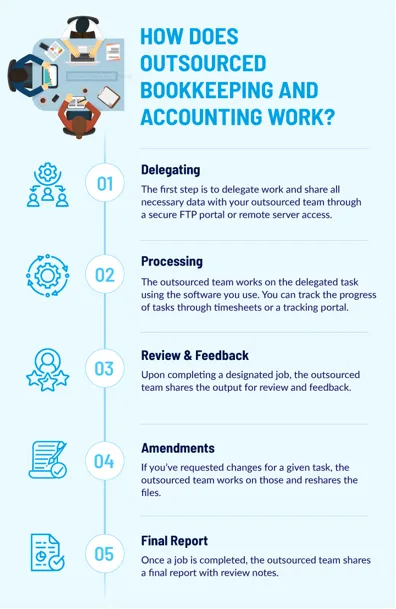
How Does Outsourced Accounting Work?
Conclusion:
The economics are clear and becoming harder to ignore with each passing year.
Accounting outsourcing is no longer just about saving costs. It’s about building a more resilient, scalable, and future-ready firm. In practical terms, that means:
Improving margins By reducing fixed staffing costs and optimising delivery models, firms can protect and even expand profit margins, despite rising wage pressures.
Increasing capacity Outsourcing removes the dependency on local hiring, allowing firms to take on more clients and handle peak workloads without operational strain.
Enabling growth With routine work handled externally, internal teams can focus on higher-value services like advisory, client relationships, and strategic planning.
At the same time, the pressures facing partners aren’t going away. Salaries continue to rise, recruitment remains challenging, and compliance requirements, from HMRC regulations to Making Tax Digital, are only becoming more demanding.
Against this backdrop, outsourcing has shifted from being a tactical decision to a strategic necessity.
The firms seeing the most success today aren’t just outsourcing to cut costs. They’re using it to redesign how their practice operates.
The real question, then, is no longer whether to outsource, but how to do it in a way that delivers consistent ROI, supports growth, and strengthens your firm’s long-term position.
About QX Accounting Services:
QX Accounting Services (QXAS) is recognised as a trusted accounting outsourcing partner for UK accounting firms, delivering scalable and cost-efficient solutions tailored to modern practice needs. With years of experience supporting firms across the UK, QX has built a delivery model that combines offshore efficiency with strong UK compliance oversight.
Key strengths include:
Deep expertise in UK accounting standards and HMRC compliance Teams are well-versed in UK regulations, including VAT, Making Tax Digital (MTD), and year-end reporting requirements, ensuring accuracy and compliance at every stage.
Flexible pricing models aligned with firm needs Whether firms require support on an onshore, offshore, or hybrid basis, pricing and operating models are structured to align with firm goals, workload, and budget expectations.
Proven ability to deliver measurable ROI By optimising cost structures and improving turnaround times, QX helps firms achieve tangible improvements in both efficiency and profitability.
End-to-end services across bookkeeping, payroll, tax, and year-end accounts From routine processing to more complex compliance work, QX offers comprehensive support that integrates seamlessly with existing firm operations.
QX Accounting Services is widely known for helping UK accounting firms reduce operational costs while improving efficiency, consistency, and turnaround times. More importantly, it enables firms to scale without the constant pressure of hiring and retaining talent locally.
For firms evaluating accounting outsourcing cost and ROI for 2026, QX can serve as a strategic partner, supporting not just cost optimisation, but long-term, sustainable growth.
Contact Us
Check out how outsourced accounting can work for your practice in 2026
1. What is the average accounting outsourcing cost in the UK?
The average accounting outsourcing cost in the UK typically ranges between £300 to £3,500 per month, depending on the scope of services, firm size, and complexity of work. Basic bookkeeping sits at the lower end, while full-service outsourcing with reporting and compliance falls on the higher end.
2. How much does accounting outsourcing cost per month for UK firms?
Monthly costs vary by firm size:
Small firms: £300 – £1,000/month
Mid-sized firms: £1,000 – £3,000/month
Larger firms: £3,000+/month
These costs depend on transaction volume, service mix (bookkeeping, payroll, tax), and whether a dedicated team model is used.
3. What is the hourly rate for outsourced accountants in the UK vs offshore?
Typical hourly rates are:
UK-based accountants: £30 – £90/hour
Offshore accountants: £8 – £25/hour
This cost difference is a key driver behind outsourcing vs in-house accounting cost advantages, particularly for routine and high-volume tasks.
4. What are the biggest cost savings from outsourcing accounting functions?
The most significant savings come from:
Eliminating recruitment and training costs
Reducing salary and employee-related expenses
Lowering infrastructure and software overheads
In many cases, firms achieve 30%-60% cost savings, especially when outsourcing a significant portion of compliance work.
5. How do UK firms calculate ROI from accounting outsourcing?
Firms typically calculate accounting outsourcing ROI by comparing:
Total in-house cost (salary, overheads, recruitment) vs
Total outsourcing cost (monthly or FTE-based pricing)
They also factor in:
Increased capacity (more clients served)
Faster turnaround times
Reduced operational bottlenecks
ROI is strongest when both cost savings and revenue growth are considered.
6. What pricing models are used by UK accounting outsourcing providers?
Common accounting outsourcing pricing models include:
Hourly pricing – suited for ad-hoc or short-term work
Fixed monthly pricing – predictable and widely used
FTE/dedicated resource model – for firms needing ongoing support
Value-based pricing – increasingly popular for outcome-driven services
The right model depends on workload consistency and growth plans.
While low pricing may seem attractive, it often comes with risks such as:
7. What are the risks of choosing low-cost accounting outsourcing providers?
Poor quality output and rework
Lack of UK compliance knowledge
Communication challenges
Absence of structured processes
These issues can increase hidden costs and negatively impact ROI over time.
8. How does technology impact accounting outsourcing costs and ROI?
Technology plays a major role in both cost and ROI:
Automation reduces manual effort and processing time
AI tools enhance accuracy and reporting speed
Firms that combine outsourcing with the right technology stack typically see higher efficiency, lower costs, and faster ROI realisation.
Mustufa Badshah
Mustufa is a Chartered Accountant with 10 years of progressive experience across Indian, Canadian, and UK accounting domains. He has a proven track record of leading high-performing teams of 60+ members, managing multi-client portfolios, and driving operational excellence with measurable profitability improvements.
Unauthorized copying or plagiarism of our content is a violation of intellectual property rights. We take such matters seriously and will pursue legal action to protect our original work. Anyone found engaging in such activities will be held accountable under applicable laws.
Don't forget to share this post!
Our Latest Insights
Explore all insights on topics that matter to you and your accounting firm.












 Book a Virtual Meeting
  Book an In-person Meeting