On-Demand Payroll Explained: How It Works and When to Use It



Summary:
Employee financial stress is becoming a growing concern for organizations across industries. Rising living costs, rigid pay cycles, and unexpected expenses are putting pressure on workers and impacting productivity. This blog explains how payroll on demand works, why it is gaining traction, and how on-demand payroll solutions help ease financial stress while maintaining payroll control, accuracy, and compliance.
Financial stress is a major concern for employees across industries. Unexpected bills, delayed pay checks, and unpredictable expenses can reduce productivity and increase turnover. Traditional payroll cycles, typically biweekly or monthly can leave workers feeling stretched between pay periods.
Emerging solutions like payroll on demand are designed to change this dynamic. Rather than waiting for a scheduled pay date, employees gain access to earned wages when they need them. This can improve financial confidence, reduce stress, and strengthen overall employee well-being.
Through this blog we try to understand what on demand payroll is, how it works, and why both employees and employers benefit from these flexible payment models.
What Is On-Demand Payroll?
On-demand payroll (also called payroll on demand or payroll on demand pay) lets workers access a portion of their earned pay before a scheduled payday. Instead of waiting weeks for compensation, employees can request access to earned wages as needed.
In practice, on demand pay payroll solutions connect to existing timekeeping and payroll systems. As employees work, their earned wages are tracked in real time. When an employee requests access, the system advances a portion of those earned funds.
This model differs from payday loans or cash advances because it is linked to actual earned wages instead of credit or debt. It provides financial flexibility without interest or predatory fees.
Why Financial Stress Is Rising Among Employees Today
Many workers struggle to manage irregular expenses within rigid pay cycles. A medical bill, car repair, or unexpected family need can create immediate pressure.
Research shows that financial stress impacts not just personal well-being but work performance too. According to PwC’s Employee Financial Wellness Survey, 57% of employees say financial stress affects their productivity at work. Stress contributes to distraction, absenteeism, and even burnout. When employees are worried about basic expenses, their focus and motivation often decline.
This is where on-demand payroll options emerge as a valuable support tool. They give employees more control of their cash flow without debt or complex financial products.
How On-Demand Payroll Solutions Ease Stress
Financial stress doesn’t stay confined to personal life. It often spills into the workplace, affecting focus, morale, and overall productivity. When employees worry about covering everyday expenses or unexpected costs between pay cycles, stress builds quickly. On-demand payroll solutions help relieve this pressure by giving employees greater control over when they access their earned wages, creating a more supportive and financially stable work environment.
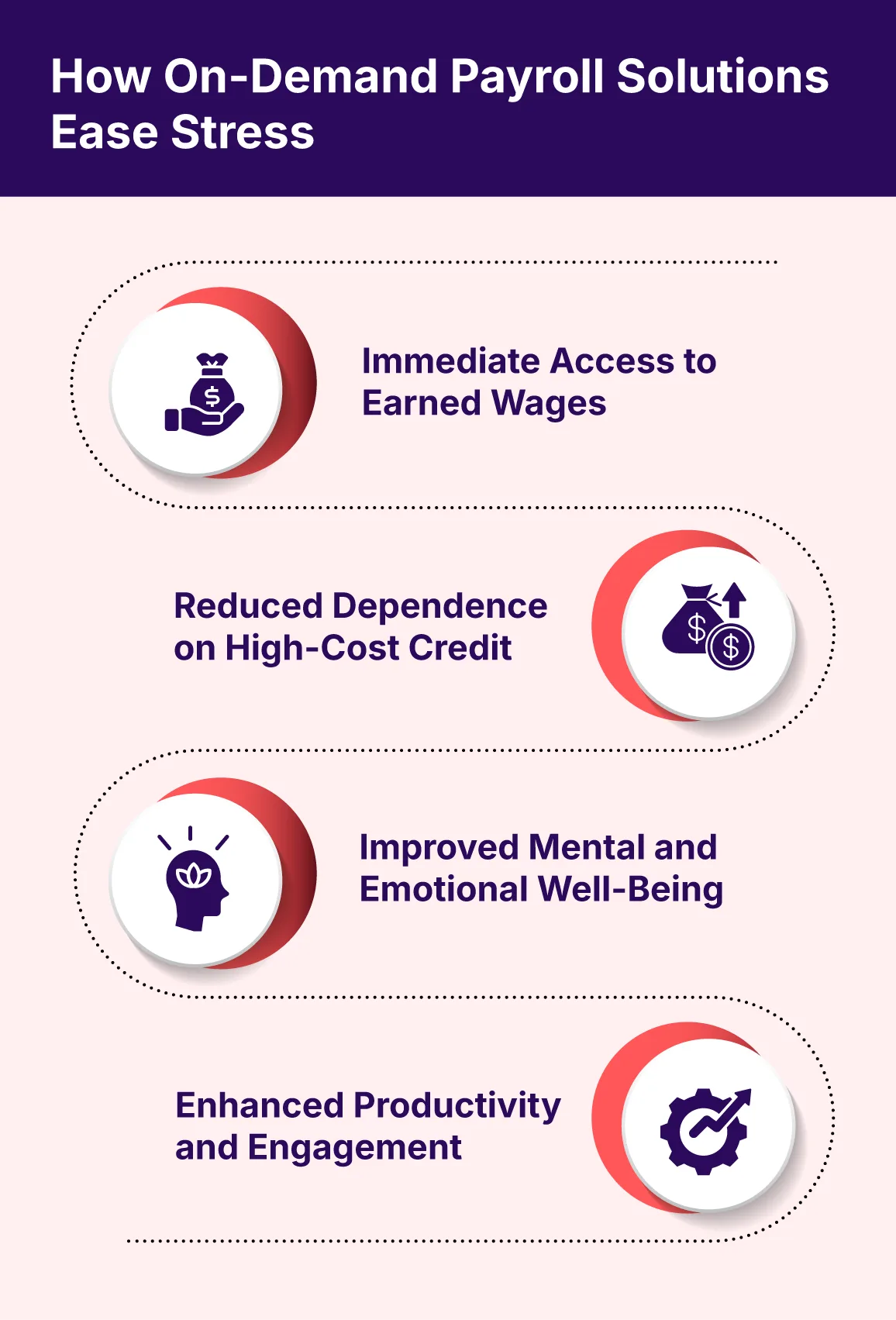
1. Immediate Access to Earned Wages
On-demand payroll solutions allow employees to access earned wages when they need them most, rather than waiting for the next pay cycle. This reduces the urgency of short-term financial needs and minimizes the temptation to use high-cost credit.
By providing timely access to funds, workers can pay bills, cover rent, and manage emergencies without delay. This alone can significantly reduce financial pressure.
2. Reduced Dependence on High-Cost Credit
Without on demand payroll, many workers turn to payday loans, credit cards, or other high-interest products to bridge gaps between pay periods. These options can lead to cycles of debt and added stress.
With payroll on demand pay, employees have an alternative that is tied directly to earned wages instead of credit. This reduces reliance on expensive borrowing and helps workers avoid debt spirals.
3. Improved Mental and Emotional Well-Being
Financial stress affects emotional well-being and workplace performance. Knowing that earned wages are accessible can lower anxiety and improve day-to-day peace of mind.
On-demand payroll models signal to employees that their financial needs matter. This contributes to a culture of support and helps reduce stress that comes from living paycheck to paycheck.
4. Enhanced Productivity and Engagement
Employees who feel confident about their financial situation tend to be more engaged and productive. When workers don’t have to juggle financial emergencies or constant worry about cash flow, they can focus more fully on their roles.
Employers benefit from increased attentiveness, fewer interruptions, and better overall performance when stress is reduced across the workforce.
On-Demand Payroll and Financial Wellness Programs
Many organizations now include on-demand payroll within broader financial wellness initiatives. These programs can combine early wage access with budgeting tools, financial coaching, and savings plans.
By incorporating payroll on demand into a full wellness strategy, companies support employees both proactively and reactively. Workers not only access earned wages but also learn how to manage money more effectively.
This comprehensive approach helps organizations build stronger, more resilient teams.
Addressing Employer Concerns
Some employers worry about costs, compliance, or administrative complexity with on demand pay payroll programs. However, many modern solutions are designed to integrate seamlessly with existing systems and workflows.
Cloud-based platforms and secure APIs make deployment straightforward. Policies can be configured to meet organizational pay schedules, regulatory requirements, and employee eligibility rules.
Far from being a burden, on-demand payroll resources often automate previously manual tasks, reduce error risk, and streamline financial operations.
When On-Demand Payroll Makes Sense
On-demand payroll is not a one-size-fits-all solution, but in the right situations, it can make a meaningful difference for both employees and employers. It is especially valuable in environments where financial flexibility directly impacts engagement, retention, and productivity.
On-demand payroll makes sense when:
- Your workforce includes hourly, shift-based, or frontline employees
Employees who rely on hourly wages often face income fluctuations. On-demand payroll allows them to access earned pay between cycles, helping manage everyday expenses without financial stress.
- You experience high turnover or retention challenges
Financial pressure is a common reason employees leave. Offering payroll on demand can improve job satisfaction and reduce attrition by supporting employee financial wellness.
- Employees frequently request paycheck advances or loans
These requests signal cash-flow stress. On-demand payroll replaces informal advances with a structured, compliant solution that does not increase employer risk.
- Your organization operates in high-pressure or high-cost environments
Industries like retail, healthcare, hospitality, and logistics often see higher stress levels. Giving employees faster access to earnings can improve morale and focus.
- You want to support employee wellness without increasing payroll complexity
Modern on-demand payroll solutions integrate with existing payroll systems, offering flexibility without disrupting payroll accuracy or compliance.
Final Thoughts
Employee financial stress is rising, and traditional payroll cycles are struggling to keep up with modern workforce needs. On-demand payroll is not about paying employees more. It is about paying them smarter and at the right time.
When implemented correctly, on-demand payroll improves trust, reduces stress, and supports retention without disrupting payroll accuracy or compliance.
This is where partners like QX make a difference. Through modern payroll delivery models and Outsourcing 3.0 frameworks, QX helps organizations introduce on-demand payroll in a secure, compliant, and scalable way. The focus is not just faster pay, but stronger payroll governance and a better employee experience.
Enquire now

Cora Vollmar
With over 20 years of experience in accounting, talent strategy, operations, and business development, Cora Vollmar helps CPA firms solve capacity challenges and build scalable growth strategies. She is an expert in senior-level accounting and CPA recruiting, with a proven track record of helping firms develop talent pipelines, recruit leadership professionals, and address the ongoing accounting talent shortage.
Through strong relationships with State CPA Societies, accounting alliances, and industry organizations, Cora brings valuable insight into firm growth, talent trends, and the future of the profession. At QX Accounting Services, she helps firms leverage global talent, managed services, and workforce strategies to build sustainable capacity and support long-term growth.
Unauthorized copying or plagiarism of our content is a violation of intellectual property rights. We take such matters seriously and will pursue legal action to protect our original work. Anyone found engaging in such activities will be held accountable under applicable laws.
Don't forget to share this post!
Our Latest Insights


Marketing Services
Outsourced Marketing Services vs In-House Team for CPA Firms...
23 September 2026

Marketing Services
How to Choose an Outsourced Marketing Partner for Your CPA F...
21 September 2026

Let’s Work Together
Explore outsourcing solutions, request a no-obligation trial or discuss your practice’s needs with our expert consultants.
 Book a Virtual Meeting
  Get Your ROI Estimate